
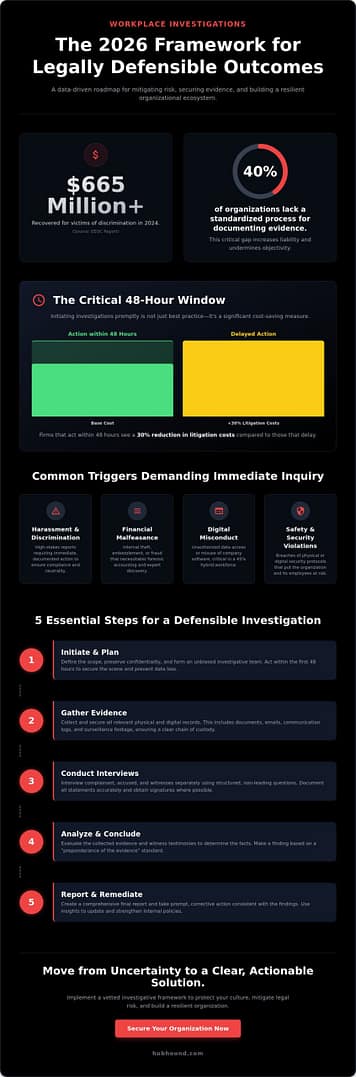
A 2024 report from the Equal Employment Opportunity Commission (EEOC) revealed that the agency recovered over $665 million for victims of discrimination, yet 40% of organizations still lack a standardized process for documenting evidence. You already know that a single mishandled claim can dismantle years of culture building and trigger devastating legal battles. It’s a reality where internal bias and fragmented evidence gathering are the primary hurdles for HR teams aiming for true objectivity. Without a standardized, vetted approach, workplace investigations often become a source of liability rather than a tool for resolution.
This 2026 guide provides a comprehensive framework to optimize your internal protocols and ensure every outcome is legally defensible. We’ve curated the most effective strategies to help you mitigate risk and maintain a secure organizational ecosystem. You’ll discover a step-by-step roadmap for handling complex misconduct, gathering hard evidence, and restoring a sense of integrity across your entire workforce. This is the expert filter you need to move from uncertainty to a clear, actionable solution.
Key Takeaways
- Adopt a data-driven approach to corporate inquiries to move beyond basic interviews and meet 2026 standards for organizational integrity.
- Combine physical surveillance with digital forensics to capture a complete, 360-degree view of alleged misconduct and policy violations.
- Evaluate the cost-benefit of internal teams versus external firms to ensure your workplace investigations remain objective and legally defensible.
- Implement a structured five-step framework for evidence collection to secure physical and digital records before they are altered or lost.
- Use vetted investigative findings to optimize internal policies and build a resilient organizational ecosystem through proactive monitoring.
What Are Workplace Investigations? Defining the Scope of Corporate Inquiry
A workplace investigation is a formal, objective process designed to determine the facts regarding alleged misconduct or policy violations within an organization. By 2026, these inquiries have evolved from simple witness interviews into complex, data-driven forensic operations. Modern teams now leverage AI-assisted sentiment analysis and digital communication logs to build an accurate factual timeline. Standardizing workplace investigations is non-negotiable for risk management. Without a repeatable framework, organizations face inconsistent outcomes and increased liability. A properly conducted investigation acts as a vital tool for legal defense and a catalyst for long-term cultural health.
The transition to digital-first environments means investigators must be as comfortable with metadata as they are with face-to-face questioning. Efficiency is the priority. You can’t afford to let a complaint sit idle while evidence disappears or employee morale plateaus. Establishing a vetted process ensures that every inquiry follows a curated path toward resolution, regardless of the department or seniority level involved.
The Legal and Ethical Mandate for Investigation
Federal regulatory bodies expect a prompt and thorough response to all credible complaints. Failing to act can lead to severe punitive damages. In a 2024 industry study, firms that initiated investigations within 48 hours of a report saw a 30% reduction in litigation costs compared to those that delayed. Balancing employee privacy with the need for transparency requires a highly specific protocol. You must protect sensitive data while ensuring the complainant feels heard and the accused receives due process. This balance is essential for maintaining the integrity of the HubSpot ecosystem or any high-growth business environment where trust is a primary currency.
Common Triggers: When an Inquiry Becomes Mandatory
Certain scenarios demand immediate intervention to protect the organization’s integrity. Harassment and discrimination remain the highest-stakes categories. These require objective oversight to ensure neutrality and compliance with national labor standards. Internal issues such as embezzlement or corporate crime often involve complex financial gaps that necessitate forensic accounting and expert discovery.
Emerging threats in 2026 also include remote work misconduct and digital security breaches. With 45% of the national workforce operating in hybrid models, monitoring digital footprints is now a standard part of the investigative scope. Common triggers include:
- Harassment and Discrimination: High-stakes reports requiring immediate, documented action.
- Financial Malfeasance: Internal theft, embezzlement, or procurement fraud.
- Digital Misconduct: Unauthorized access to proprietary data or misuse of company software integrations.
- Safety Violations: Breaches of physical or digital security protocols that put the organization at risk.
Identifying these triggers early allows leadership to pivot from a reactive stance to a proactive one. It’s about tracking down the facts with the precision of a specialist. When you treat workplace investigations as a standardized business process, you remove the ambiguity that often leads to choice paralysis during a crisis.
The Anatomy of a Professional Investigation: A Multi-Disciplinary Approach
Effective workplace investigations in 2026 require a 360-degree view of the facts. You can’t rely on a single data stream to protect organizational integrity. Modern investigators integrate physical surveillance with advanced digital forensics to verify claims and build a complete picture. This multi-layered strategy ensures that no detail is missed, providing a foundation for informed decision-making.
Standard HR skills often fall short during high-stakes inquiries. Specialized investigative training is vital for conducting witness interviews that hold up under scrutiny. These professionals use cognitive interviewing techniques to extract accurate details without leading the witness. When key witnesses or former employees are difficult to reach, skip tracing becomes a critical tool. It allows investigators to locate individuals who hold essential information, ensuring the record remains complete and unbiased. In cases where a subject has become entirely unreachable, the same methodologies used to locate missing adults through advanced investigative strategies can be adapted to track down critical witnesses in corporate inquiries.
Every finding must be case-ready from the start. This means all evidence should be admissible in civil or criminal proceedings if the situation escalates. When dealing with allegations of unlawful harassment, following strict chain-of-custody protocols is non-negotiable. According to 2024 industry benchmarks, 72% of successfully defended employment lawsuits relied on documented, multi-disciplinary evidence gathered within the first 14 days of an incident. This speed and precision prevent small issues from becoming systemic failures.
Surveillance and Field Operations in Corporate Settings
Discreet surveillance is often necessary when physical misconduct or inventory theft is suspected. It provides objective clarity in disputes that would otherwise remain a matter of conflicting personal accounts. High-quality video evidence can resolve a case instantly, saving months of litigation. Investigators must maintain strict ethical standards and follow federal privacy laws during off-site operations. This ensures that any footage captured remains a legal asset rather than a liability. Understanding the full range of advanced surveillance techniques used by professional investigators in 2026 can help you evaluate whether your current approach meets the standard for court-ready evidence. You can find vetted investigative partners who specialize in these sensitive operations through curated directories.
Digital Forensics and Information Gathering
Digital footprints have become the “smoking gun” of 2026 investigations, providing an unalterable timeline of events. Investigators now recover deleted communications and track unauthorized data access through sophisticated metadata analysis. Corporate due diligence helps identify hidden conflicts of interest that might compromise your company. By leveraging these digital tools, investigators can uncover patterns of behavior that are invisible to the naked eye. This proactive approach turns fragmented data into a clear, actionable narrative that protects the brand.
Internal vs. External Investigations: Overcoming the Bias Objection
Internal HR teams often fall into the “Conflict of Interest” trap without realizing it. Even the most seasoned HR professional carries subconscious leanings toward long-term colleagues or the company’s bottom line. This perceived bias destroys the credibility of workplace investigations before they even conclude. When an internal team handles a high-stakes complaint, the results are frequently viewed as a “rubber stamp” for management, leading to 60% higher rates of retaliation claims according to industry data from 2024.
The cost-benefit analysis favors the external approach for complex cases. While a professional firm requires an upfront fee, the price of a botched internal probe is far higher. A 2023 Hiscox report found that the average cost for an employment claim reaching defense is $160,000; this doesn’t include the settlement or the damage to brand equity. Third-party neutrality provides a “firewall” for the C-suite and the Board of Directors. It demonstrates that leadership prioritizes integrity over optics.
The most common objection is “We know our people best.” While true, familiarity is the enemy of objectivity. Professional investigators don’t need to know your culture; they need to know the facts. They provide an objective truth that internal teams, bound by office politics and reporting structures, simply can’t reach.
The Perils of Investigative Bias
Confirmation bias leads investigators to seek evidence that supports their initial hunch while ignoring exculpatory data. This flaw creates massive legal exposure during discovery. An external investigator serves as a neutral fact-finder whose testimony holds more weight in court. Using best practices for a compliant investigation ensures that the process survives judicial scrutiny. External intake also protects whistleblowers. Employees provide more honest testimony to a third party because they don’t fear seeing the interviewer in the breakroom the next day.
Strategic Use of External Investigative Partners
Identify the triggers for outside help early. You should hire a workplace investigations lawyer when allegations carry significant litigation risk, when internal conflicts of interest are unavoidable, or when attorney-client privilege is essential to protecting your findings from discovery. Engaging a specialized corporate investigation firm adds an additional layer of expert-level oversight that standard HR protocols often cannot provide, particularly when deep-seated misconduct or financial fraud is suspected. Before engaging any outside partner, reviewing a comprehensive company investigator checklist for 2026 can help you verify credentials, understand fee structures, and align your selection criteria with the DOJ’s latest corporate enforcement standards. workplace investigation services
5 Essential Steps for a Legally Defensible Workplace Investigation
Executing workplace investigations requires a precise, repeatable framework to withstand legal challenges. In 2026, the standard for “defensible” has shifted toward extreme transparency and digital integrity. Follow these five steps to protect your organization’s reputation and legal standing.
- Preparation and Planning: Define the scope immediately. A 2024 industry report found that 38% of investigations suffer from “scope creep,” which unnecessarily delays resolution. Select an investigative team that lacks direct reporting ties to the parties involved to ensure neutrality.
- Evidence Collection: Secure digital and physical records within 24 hours of the initial complaint. This includes Slack archives, CRM activity logs, and email metadata. Use forensic imaging for hardware to maintain a chain of custody that holds up under judicial review.
- The Interview Process: Focus on gathering facts rather than confessions. Reliable statements come from a controlled environment where the investigator remains objective and non-confrontational.
- Analysis and Reporting: Synthesize the data without bias. Compare witness statements against the digital trail to identify discrepancies and confirm timelines.
- Remediation and Follow-up: Take decisive action based on the evidence. Whether it’s targeted training or termination, document the logic behind the decision. Schedule check-ins for the following six months to ensure no retaliation occurs.
Mastering the Investigative Interview
Mastering the interview is a critical phase of workplace investigations. Structured interviews yield 25% more reliable evidence than unstructured conversations because they provide a consistent baseline for comparison. Use de-escalation techniques like the “OARS” model (Open-ended questions, Affirmations, Reflections, and Summaries) to lower tension during difficult witness statements. Always prioritize contemporaneous notes over memory. Recorded statements, when legally permitted, provide an indisputable record of tone and phrasing that written summaries often miss.
Drafting the Final Investigative Report
Report integrity depends on sticking to the facts. Avoid “opinion creep” by removing adjectives that characterize a witness’s intent or personality. Use standardized reporting formats to ensure your findings survive the scrutiny of opposing counsel during discovery. A 2026 investigative summary must include a clear statement of the allegation, a verified timeline of events, a list of evidence reviewed, and a definitive finding based on the preponderance of evidence standard. This level of detail transforms a simple memo into a robust legal shield. Applying a structured HR investigation checklist during this phase ensures your final report meets the professional-grade standards required for legally defensible outcomes in 2026.
Don’t leave your organizational integrity to chance. Find vetted experts to help you navigate complex internal audits and compliance requirements.
Optimizing Corporate Resilience with Vetted Investigative Expertise
Effective workplace investigations provide more than just a resolution to a single conflict. They serve as a roadmap for structural optimization. When a case concludes, the data gathered should immediately inform your internal policy updates. If an inquiry uncovers a recurring issue with expense reporting, the response must include more than just a reprimand. It requires a total overhaul of your financial software permissions and mandatory training for all department heads. This proactive loop ensures that mistakes aren’t repeated.
Modern resilience depends on continuous monitoring. A 2024 ACFE report indicates that organizations lose roughly 5% of their annual revenue to internal fraud. Proactive background screening isn’t a one-time event during onboarding. It’s a recurring safeguard. This “always-on” approach identifies potential risks before they escalate into legal liabilities. Partnering with a dedicated corporate investigation firm ensures you have the specialized expertise needed to detect these invisible threats before they compromise your organizational integrity. It’s the most effective way to maintain a clean corporate ecosystem and protect your long-term growth.
Transparency is the foundation of an investigation-ready culture. Employees need to know exactly how to report misconduct and what to expect during the process. Clear, anonymous reporting channels reduce the time it takes to detect issues by 50% according to industry benchmarks. HubHound simplifies this by acting as an expert filter. We help you find the niche investigative expertise required to handle sensitive corporate matters with precision and discretion. Our curated network removes the guesswork from selecting a partner.
The Future of Corporate Due Diligence
Integrating results from workplace investigations into your risk management strategy transforms a liability into a learning opportunity. Vetted insights allow you to protect organizational assets by identifying systemic vulnerabilities. Proactive screening serves as your first line of defense against workplace toxicity. By leveraging data-driven insights, you ensure that your corporate due diligence stays ahead of emerging threats and protects your brand’s integrity. A structured company investigator checklist can help your team standardize the vetting process and apply the DOJ’s latest corporate enforcement guidelines to every engagement.
Next Steps: Securing Your Organization
Building a relationship with a pre-vetted investigative partner is a strategic necessity. Having this list ready ensures you can act immediately when a red flag appears. You can conduct a confidential consultation to assess risks without alerting internal subjects. This level of preparedness protects your reputation and your bottom line. Contact HubHound to discuss your specific investigative needs and find the right experts for your team today.
Future-Proofing Your Corporate Integrity for 2026
Maintaining a secure and compliant corporate environment requires more than reactive policies. Successful workplace investigations in 2026 rely on a multi-disciplinary framework that removes internal bias and prioritizes data-driven transparency. By implementing the five essential steps for a legally defensible inquiry, your organization can mitigate risk and protect its reputation against complex modern challenges. Professional oversight isn’t just a safety net; it’s a strategic asset for long-term resilience.
HubHound simplifies the discovery process by connecting you with specialized experts who have already undergone rigorous screening. You’ll gain access to licensed investigators with over 30 years of industry experience. These professionals utilize vetted and verified investigative techniques to deliver comprehensive court-ready evidence reporting. Don’t leave your organizational integrity to chance when you can leverage curated expertise designed for the modern enterprise. We’ve done the heavy lifting so you can make an informed decision in minutes.
Building a culture of accountability starts with the right partners today.
Frequently Asked Questions
How long does a typical workplace investigation take to complete?
Most workplace investigations conclude within 30 to 45 days. Complex cases involving multi-departmental data or forensic digital analysis can extend to 90 days. Efficient teams prioritize a 14 day turnaround for initial fact-finding to mitigate disruption and legal risk. Speed helps preserve evidence and maintains organizational stability during the discovery process.
Can an employee refuse to participate in a workplace investigation?
Employees generally don’t have a legal right to refuse participation in an internal investigation. Most company policies classify a refusal to cooperate as insubordination, which is grounds for immediate disciplinary action or termination. You should check collective bargaining agreements for specific union protections that might apply to interview protocols during the fact-finding stage.
Is it better to use a lawyer or a private investigator for workplace issues?
Select a lawyer for investigations involving high litigation risk to protect findings under attorney-client privilege. Hire a private investigator for factual surveillance or background verification tasks. A 2023 industry survey showed 62% of firms prefer specialized legal counsel for sensitive harassment claims to ensure objective reporting and compliance with national labor standards. Understanding when to engage a workplace investigations lawyer versus a private investigator can be the difference between protected findings and costly legal exposure.
What happens if a workplace investigation is found to be biased?
A biased investigation leads to severe legal liability, including wrongful termination lawsuits and EEOC penalties that often exceed $300,000 per claim. Biased results invalidate any resulting disciplinary actions and destroy employee trust. Courts look for a good faith effort, so a lack of neutrality usually results in summary judgments against the employer.
How do we maintain confidentiality during a high-profile investigation?
Maintain confidentiality by implementing need-to-know access protocols and using encrypted document sharing platforms. Limit the core investigative team to 3 or 4 key decision-makers to prevent information leaks. Require all interviewees to sign non-disclosure acknowledgments, reminding them that breaches lead to immediate disciplinary measures according to your vetted internal policies.
What is the cost of hiring an external workplace investigation firm?
External firms typically charge between $250 and $600 per hour depending on the investigator’s seniority. Fixed-fee projects for standard harassment claims often range from $5,000 to $15,000 based on 2024 industry averages. These costs reflect the value of hiring a vetted expert to ensure the final report stands up to rigorous legal scrutiny.
Can we use surveillance to investigate an employee for misconduct?
You can use surveillance if you have a legitimate business reason and the employee has a low expectation of privacy. Monitoring in common areas like breakrooms or parking lots is generally permitted, but private spaces like restrooms are strictly prohibited. Your employee handbook must clearly outline monitoring policies to avoid privacy tort claims or legal challenges. Reviewing the latest professional surveillance techniques and legal boundaries for 2026 can help ensure your monitoring practices remain compliant and produce admissible evidence.
What are the first steps an HR manager should take when a complaint is filed?
Document the complaint immediately and secure all relevant digital evidence to prevent data loss. Issue a formal notice of investigation to involved parties within 48 hours of the initial filing. HR managers should assess the need for interim measures, such as paid administrative leave, to separate parties and prevent retaliation during the workplace investigations process. In situations where a key witness or former employee has become unreachable, understanding how to find missing adults using professional investigative strategies can provide HR teams with actionable techniques for locating individuals critical to the fact-finding process. Consulting a comprehensive HR investigation checklist at the outset of a complaint ensures that intake procedures, evidence preservation, and interview protocols all align with 2026 compliance standards.

Article by
Joel R. Manley | President | Hubhound Investigations | OR PI-ID#: 90432 | 111 SW Fifth Avenue, Suite 3150 Portland, Oregon 97204 | 971-442-8170
Joel is licensed as a private investigator in Oregon and Tennessee. Joel started his career in 1987 serving as a Military Police Officer and Military Police Investigator.
After ending his military tour of duty, Joel became a civilian Police Officer and Deputy Sheriff. Joel took his strong background in Hostage Negotiations, Mediation and Conflict Resolution, with him to patrol some of the highest crime areas in SE Portland.
Joel was awarded Deputy of the Year for his efforts and for drastically reducing the crime rate in the area he patrolled. As a Deputy Sheriff, Joel assisted in leading a Neighborhood Livability Program that was nationally recognized for having the most innovative and progressive approach to policing.
In 2018, Joel retired as a Deputy Sheriff and founded Hubhound Investigations. Joel played an integral role in Hubhound Investigations receiving an A+ Accredited Business rating from the Better Business Bureau (BBB).
In his off time, Joel enjoys spending time with his wife, adult children and Hubhound’s Happiness Ambassador, Nya. Joel also enjoys Scuba Diving and Kayaking.
Disclaimer
DISCLAIMER: This article is provided for general informational and educational purposes only. It is not intended to constitute legal advice, professional investigative advice, or instruction to engage in any unlawful activity. Laws governing private investigations, surveillance, recording, tracking, access to information, evidence collection, privacy, trespass, licensing, and related investigative activities vary by jurisdiction and are subject to change.
Any investigative techniques, tactics, procedures, scenarios, or legal proceedings discussed in this article are presented for informational purposes and should not be interpreted as authorization or encouragement to use a particular method. Private investigators and members of the public are responsible for understanding and complying with all applicable federal, state, and local laws, licensing requirements, court rules, and professional standards.
The circumstances of every investigation and legal matter are different. Information contained in this article should not be relied upon as a substitute for advice from a qualified attorney or other appropriate licensed professional regarding a specific situation. No attorney-client, investigator-client, or other professional relationship is created by reading or using this information.