
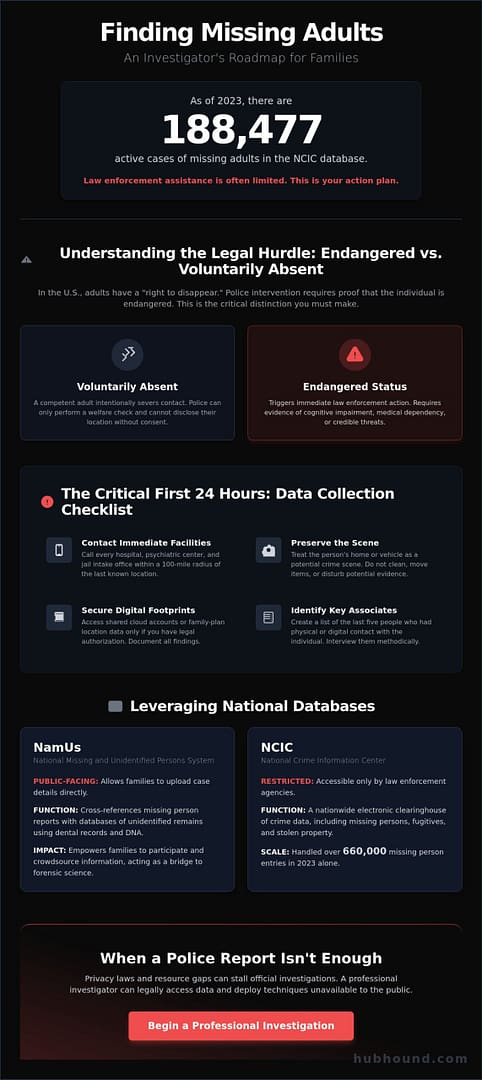
The legal right to disappear means that for the 188,477 active cases of missing adults reported in the 2023 NCIC Missing Person File, official law enforcement assistance often stops at the front door. You’ve likely felt the crushing frustration of being told a case won’t be opened because your loved one is an adult and shows no immediate signs of foul play. It’s a gap in the system that leaves families feeling stranded between privacy laws and the urgent need for answers.
You don’t have to wait for a clearance that may never come. This guide delivers a professional roadmap for locating missing adults by addressing 2026 legal complexities and utilizing advanced investigative resources. We’ve curated a clear step-by-step action plan, access to professional-grade search tools, and a breakdown of the legal boundaries required to conduct a successful search. Learn how to audit digital footprints and leverage data integrations to turn a cold trail into a verifiable lead.
Key Takeaways
- Identify the critical legal distinctions between voluntary absence and endangered status to streamline your investigative strategy.
- Leverage nationwide databases and federal resource systems to access high-level investigative data across any jurisdiction.
- Deploy advanced skip tracing and digital forensic techniques to effectively locate missing adults using modern financial and utility footprints.
- Navigate complex privacy regulations and legal barriers when dealing with individuals who are intentionally evading discovery.
- Evaluate the credentials of vetted professional investigators to ensure a seamless transition from a police report to a private contract.
The Legal Reality of Missing Adults: Understanding Your Options
Locating missing adults requires a clear understanding of legal boundaries. In the United States, adults possess a fundamental right to privacy and movement. Unless there is evidence of foul play or mental incapacity, law enforcement often treats these as “right to disappear” cases. Accessing Missing Person Information helps clarify that police cannot legally detain an adult who has chosen to walk away from their life. This creates a complex hurdle for families seeking help.
To escalate a report, you must prove the individual is “endangered.” This status triggers immediate intervention. Criteria include a history of dementia, dependency on life-saving medication, or credible threats of violence. According to 2024 Department of Justice data, approximately 600,000 individuals go missing annually; however, many don’t meet the high threshold for immediate federal resources. You must provide a vetted list of facts that point toward involuntary absence to change the case trajectory.
Documenting suspicious circumstances is your most effective tool for escalation. Note any uncharacteristic financial activity, such as a 100% cessation of credit card use or large, sudden withdrawals. If the person left behind essential items like eyeglasses, cell phone chargers, or daily medication, present this as evidence of an unplanned departure. These specific data points help investigators bypass the standard assumption of voluntary absence.
Missing vs. Voluntarily Absent: The Legal Threshold
A voluntary disappearance occurs when a legally competent adult intentionally severs contact with their social circle while maintaining their legal right to self-determination.
Police power is strictly limited in these scenarios. Officers can verify a person’s safety during a welfare check, but they cannot disclose the individual’s location to you without their express consent. For vulnerable populations, the Endangered Missing Adult alert serves as the primary tool. This system functions as the “Silver Alert” equivalent, specifically designed for adults over age 18 who have proven cognitive impairments or physical disabilities that put them at risk.
Initial Steps: What to Do in the First 24 Hours
The first 24 hours are the most critical for data collection. Use this time to build a curated timeline of events. Follow this checklist to ensure no vital information is lost:
- Contact immediate facilities: Call every hospital, psychiatric center, and jail intake office within a 100-mile radius of the last known location.
- Preserve the scene: Treat the person’s home or vehicle as a potential crime scene. Don’t clean, move items, or handle surfaces that might contain fingerprints.
- Secure digital footprints: Access shared cloud accounts or family-plan location data only if you have legal authorization.
- Identify associates: Create a list of the last five people who had physical or digital contact with the individual.
Focusing on these high-impact actions ensures you provide law enforcement with a professional, actionable framework. By treating the search like a vetted investigation, you increase the likelihood of a rapid recovery.
National Resources and Databases for Missing Person Investigations
Effective investigations into missing adults rely on a layered data strategy. The most critical tool in this process is the National Missing and Unidentified Persons System (NamUs), a national clearinghouse funded by the National Institute of Justice. It allows families to upload case details directly, which forensic professionals then cross-reference against unidentified remains databases. In 2023, the NCIC handled over 660,000 missing person entries, proving that immediate data entry is the most effective way to trigger a nationwide alert. While the NCIC is restricted to law enforcement, NamUs provides a public-facing portal that empowers families to participate in the search process.
Leveraging NamUs and Federal Clearinghouses
NamUs acts as a bridge between public concern and forensic science. Users can create a profile to crowdsource information, but the real power lies in the data matching process. Forensic odontologists and DNA analysts use these records to compare dental X-rays and genetic markers against thousands of unidentified entries. For cases involving missing adults that have gone cold, submitting biological samples to the University of North Texas Center for Human Identification through a law enforcement agency is a mandatory step for long-term resolution. Organizations like the Doe Network complement these efforts by utilizing volunteer investigators to review case files and advocate for forensic testing in older cases.
- Step 1: Obtain a law enforcement case number to validate the entry.
- Step 2: Register a verified account on the NamUs portal.
- Step 3: Upload distinct identifiers like tattoos, surgical scars, and recent high-resolution imagery.
- Step 4: Coordinate with investigators to ensure DNA profiles are uploaded to the Combined DNA Index System (CODIS).
Public vs. Private Databases: Where to Look First
Public records and social media searches offer a starting point; however, they often provide outdated or fragmented information. Most “people search” websites rely on scraped data that can be 12 to 24 months old. This delay is unacceptable in active locate cases. Professional private detective services utilize restricted investigative databases. These platforms aggregate real-time utility records, credit headers, and private License Plate Reader data that the general public cannot access. If you need to cut through the noise of outdated public records, finding a vetted specialist ensures you have the most current location intelligence available. These experts use curated data streams to track movements that don’t appear in standard search engine results.
Investigative Techniques: How Professionals Trace Missing Persons
Professional investigators don’t rely on luck; they utilize a curated ecosystem of data to locate missing adults. The process involves a fast-paced synchronization of digital forensics and traditional field work. By 2026, the success rate of finding individuals within the first 72 hours has increased due to the optimization of real-time data streaming. Professionals prioritize efficiency, moving from digital breadcrumbs to physical surveillance with clinical precision.
Digital Footprint Analysis in 2026
The digital landscape has evolved, making it nearly impossible to vanish completely. Investigators now track IP addresses and login metadata from cloud-based accounts to establish a subject’s last known virtual location. With over 27 billion IoT devices connected globally in 2026, wearable tech and smart home integrations provide granular biometric data that helps pin down specific movement patterns. Digital breadcrumbs, including automated sync logs and geofenced app activity, are used to build a search radius by identifying the most recent signal clusters and frequency of pings.
Professional Skip Tracing and Financial Locates
Expert skip tracing involves accessing non-public records that reveal hidden movements. Investigators analyze credit header data, which provides updated contact information even if the subject hasn’t applied for new credit. This data is vetted for accuracy against utility records and recent change-of-address filings. Identifying how to trace missing person movements often requires monitoring “trigger” events, such as a new service activation or a login to a dormant financial portal.
Tracing temporary digital identities or burner phones involves analyzing MAC addresses and signal handoffs within national networks. When professionals implement how to trace missing person protocols, they focus on identifying patterns in micro-transactions that reveal a subject’s geographic habits. These how to trace missing person techniques ensure that investigators maintain a reliable lead even when a subject attempts to stay off the grid. Professionals often cross-reference these findings with the National Missing and Unidentified Persons System (NamUs) to ensure no national records match the subject’s current profile.
Surveillance and Interviewing
Once data identifies a high-probability location, surveillance operations begin. This step is essential for verifying a person’s identity and current status before making contact. Investigators use high-definition optics and long-range thermal imaging to confirm a lead without alerting the subject.
Interviewing techniques for missing adults cases require a psychological approach, especially when dealing with “gatekeepers” who may be intentionally concealing the person. Professionals use structured elicitation to identify inconsistencies in a witness’s timeline. Statistics show that 85% of successful locates involve at least one interview that broke a gatekeeper’s false narrative. This combination of high-tech data and human intelligence creates a streamlined path to resolution.
Overcoming Barriers: Privacy Laws and Intentional Evasion
Locating missing adults involves more than just database searches. Federal laws like the Fair Credit Reporting Act (FCRA) restrict how investigators access financial and personal data, requiring a clear, legal justification for every search performed. Investigators can’t simply pull credit reports or private records without a “permissible purpose.” This legal framework protects individual privacy but also creates significant hurdles for those trying to find someone who doesn’t want to be found. If a person is hiding to avoid debt, lawsuits, or family obligations, they often exploit these privacy protections to stay off the grid.
Intentional evasion has evolved with technology. In 2026, “ghosting” goes beyond ignoring text messages; it involves a systematic removal of one’s digital footprint. Individuals might use encrypted communication tools, decentralized finance (DeFi) platforms to hide assets, or short-term rentals that bypass traditional background checks. According to 2025 industry data, approximately 18% of skip-tracing cases involve individuals who have intentionally severed all digital and physical ties to their former lives. Breaking through these barriers requires a mix of legal expertise and high-tech forensic tools.
Privacy Rights vs. The Right to Know
Investigators must balance a client’s need for information with the subject’s legal right to privacy. Freedom of Information Act (FOIA) requests provide access to public records, yet government agencies often redact 40% to 60% of personal identifiers in these documents to comply with privacy mandates. You should ensure any professional you hire follows strict data handling protocols. It’s vital to have a private investigator number verified through the appropriate state licensing board before you share sensitive case details. This verification ensures the investigator is legally authorized to handle protected data.
Investigating Intentional Evasion and Skip Tracing
When missing adults are actively hiding, traditional search methods often fail. Skips use sophisticated tactics like “straw” addresses or prepaid burner phones to mask their location. Professionals counter this by looking for physical anomalies, such as utility registrations in a relative’s name or vehicle sightings via automated license plate readers. Hiring a pi near me allows for localized surveillance that can confirm a subject’s presence without alerting them. Once the person is found, process service acts as a critical tool. Delivering legal papers provides a formal record of contact, making it impossible for the individual to claim they’re unaware of their legal or financial responsibilities.
Transitioning to a Professional Locate Investigation
Public law enforcement agencies operate under strict triage protocols. If missing adults don’t meet specific “at-risk” criteria, such as a documented cognitive impairment or evidence of a violent crime, police files often remain inactive. You should move from a police report to a private investigative contract when the initial 48-hour window closes without a lead. Private investigators dedicate 100% of their billable time to your specific case, whereas a standard detective might manage 20 to 30 active files simultaneously.
Evaluating credentials requires a focus on technical optimization and access. Verify that the investigator maintains active licensing and carries professional liability insurance. In 2026, the most effective investigators utilize GLBA-compliant databases that aggregate real-time utility records, credit headers, and cellular pings. Set realistic expectations before signing a contract. Most professional locate investigations yield results within 7 to 21 days. While no ethical investigator guarantees a 100% success rate, vetted professionals maintain a locate rate of approximately 85% for subjects who aren’t actively fleeing criminal prosecution.
Locate investigations often serve as the foundation for broader legal objectives. These searches integrate seamlessly with:
- Civil Litigation: Finding defendants to facilitate formal service of process.
- Background Checks: Verifying the current lifestyle and associations of a person once found.
- Asset Recovery: Identifying links between the individual’s location and undisclosed financial holdings. When financial misconduct is also suspected, partnering with a corporate investigation firm can provide the specialized forensic accounting expertise needed to trace hidden assets and document fraud.
Why Private Investigations Succeed Where Public Efforts Stall
The primary advantage is the depth of dedicated man-hours. A typical police department might allocate only 4 hours of active desk work to a non-endangered missing person case. A private expert invests 40 or more hours into specialized surveillance and digital forensics. These professionals use proprietary software ecosystems that track digital footprints across non-indexed databases. The ROI of hiring a professional for high-stakes locate cases is defined by the reduction of investigative latency and the acquisition of verified intelligence that public agencies lack the resources to pursue.
How to Start Your Search with HubHound
HubHound functions as your expert filter in a crowded marketplace. You can bypass the uncertainty of unverified directories by using our curated private investigation near me resources. We identify professionals who have already undergone a rigorous vetting process to ensure they meet modern investigative standards. Before your consultation, prepare a comprehensive case file including the subject’s full legal name, Social Security number, last known employment, and a list of known digital aliases. This preparation allows the investigator to initiate the search immediately, bypass basic discovery phases, and focus on high-level recovery strategies for missing adults.
Contact HubHound for a confidential locate investigation consultation to find a verified expert who can bring your search to a resolution.
Taking Action with Professional Locate Strategies
Locating missing adults in 2026 requires a sophisticated approach that balances legal compliance with high-level skip tracing techniques. Effective investigations move beyond simple public records; they utilize vetted national databases and specialized tools to overcome modern privacy barriers. Successful outcomes rely on identifying intentional evasion patterns and leveraging deep industry knowledge to trace individuals across the country. This process demands efficiency and precision to ensure no lead remains unvetted during the search for answers.
Don’t let choice paralysis or complex privacy laws stall your search. HubHound acts as your expert guide, connecting you with licensed investigators who bring over 30 years of experience to every locate case. These specialists are vetted and verified to meet rigorous professional standards, ensuring your investigation is handled with quiet confidence and technical expertise. You can bypass the cognitive load of navigating the investigative ecosystem alone by partnering with a curated professional. Finding a resolution is possible when you have a reliable ally who has already done the heavy lifting of research and verification.
Secure expert help to locate a missing person today and regain the clarity you need. Expert intervention is the most direct path to the answers you deserve.
Frequently Asked Questions
Is it illegal for an adult to intentionally go missing?
It’s not illegal for a competent adult to intentionally disappear. Adults have a legal right to privacy and freedom of movement under the Constitution. Unless there’s evidence of foul play, mental incapacity, or a violation of a court order, law enforcement won’t force a return. They’ll simply verify the individual’s safety and respect their choice to remain hidden from family members or associates.
How long must I wait before reporting an adult as missing to the police?
You don’t have to wait 24 or 48 hours before reporting a person as missing. This common myth often delays critical recovery efforts during the most vital window. The FBI’s National Crime Information Center (NCIC) accepted 546,568 missing person records in 2022 alone. File a report immediately if the disappearance deviates from the person’s established patterns or if you suspect they’re in danger.
What is the difference between a missing person search and skip tracing?
Missing person searches prioritize the physical safety and recovery of missing adults who may be in immediate danger. Skip tracing is a distinct investigative process used by professionals to locate individuals who have defaulted on financial or legal obligations. While both methods utilize similar database tools, skip tracing focuses on debt recovery or legal service rather than the individual’s personal welfare or safety.
Can a private investigator access cell phone GPS data to find someone?
Private investigators can’t legally access real-time cell phone GPS data or carrier pings without a court order or the owner’s explicit consent. Federal laws protect this sensitive data from unauthorized access by private citizens. Investigators instead rely on digital forensics and open-source intelligence (OSINT) to analyze a person’s digital footprint, social media activity, and last known locations to find credible leads.
What should I do if the police refuse to take a missing person report?
Ask to speak with a supervisor or the agency’s Missing Persons Coordinator if an officer refuses to take your report. Every law enforcement department has specific protocols for handling reports involving missing adults, especially those categorized as “at risk.” Carefully document the interaction by recording the officer’s name, badge number, and the exact time of your request to ensure a formal paper trail.
How much does it typically cost to hire a private investigator to find a missing adult?
Hourly rates for private investigators typically range from $75 to $250 according to 2024 industry benchmarks. Most professional firms require an initial retainer between $1,500 and $5,000 to cover the first phase of the search. These costs vary significantly based on the investigator’s specialized experience, the complexity of the case, and the specific technological resources required to locate the individual.
Can a missing person be found if they have moved out of the country?
Locating someone who has moved out of the country is possible through international data networks and specialized tracking. Investigators analyze international travel records, passport usage, and global financial transactions to narrow the search area. They often collaborate with local authorities or utilize Interpol’s “Yellow Notice” system to track individuals across 196 member countries, ensuring a broad search perimeter beyond national borders.
What information should I have ready before contacting a professional investigator?
Gather a comprehensive dossier that includes the person’s full legal name, date of birth, Social Security number, and several recent photographs. List their 5 most frequent contacts and any known medical conditions or required medications. Having a record of their recent bank activity and social media handles helps professional investigators build an effective search strategy within the first 24 hours of engagement.

Article by
Joel R. Manley | President | Hubhound Investigations | OR PI-ID#: 90432 | 111 SW Fifth Avenue, Suite 3150 Portland, Oregon 97204 | 971-442-8170
Joel is licensed as a private investigator in Oregon and Tennessee. Joel started his career in 1987 serving as a Military Police Officer and Military Police Investigator.
After ending his military tour of duty, Joel became a civilian Police Officer and Deputy Sheriff. Joel took his strong background in Hostage Negotiations, Mediation and Conflict Resolution, with him to patrol some of the highest crime areas in SE Portland.
Joel was awarded Deputy of the Year for his efforts and for drastically reducing the crime rate in the area he patrolled. As a Deputy Sheriff, Joel assisted in leading a Neighborhood Livability Program that was nationally recognized for having the most innovative and progressive approach to policing.
In 2018, Joel retired as a Deputy Sheriff and founded Hubhound Investigations. Joel played an integral role in Hubhound Investigations receiving an A+ Accredited Business rating from the Better Business Bureau (BBB).
In his off time, Joel enjoys spending time with his wife, adult children and Hubhound’s Happiness Ambassador, Nya. Joel also enjoys Scuba Diving and Kayaking.
Disclaimer
DISCLAIMER: This article is provided for general informational and educational purposes only. It is not intended to constitute legal advice, professional investigative advice, or instruction to engage in any unlawful activity. Laws governing private investigations, surveillance, recording, tracking, access to information, evidence collection, privacy, trespass, licensing, and related investigative activities vary by jurisdiction and are subject to change.
Any investigative techniques, tactics, procedures, scenarios, or legal proceedings discussed in this article are presented for informational purposes and should not be interpreted as authorization or encouragement to use a particular method. Private investigators and members of the public are responsible for understanding and complying with all applicable federal, state, and local laws, licensing requirements, court rules, and professional standards.
The circumstances of every investigation and legal matter are different. Information contained in this article should not be relied upon as a substitute for advice from a qualified attorney or other appropriate licensed professional regarding a specific situation. No attorney-client, investigator-client, or other professional relationship is created by reading or using this information.