
The top result for a “pi near me” search is often the investigator with the largest marketing budget, not the one with the most court-admissible evidence. You’re likely here because you need clear answers for a sensitive legal or corporate matter, and you know that one procedural error can compromise your entire case. It’s a high-stakes decision where the difference between a vetted professional and an amateur determines the outcome of your litigation or internal audit.
We’ve done the heavy lifting to help you bypass generic directories and identify a licensed investigator equipped for the complexities of 2026. This guide promises to help you secure a professional with a proven track record of legal compliance and total confidentiality. We’ll break down the 2024 Bureau of Labor Statistics data on specialized investigators, explain how to decode fee structures, and outline the exact verification steps you need to take before signing a contract. You’ll gain the clarity needed to hire a curator of facts who protects your interests at every turn.
Key Takeaways
- Verify essential licensing and credentials to ensure your evidence is legally admissible and avoid the significant risks of hiring unlicensed investigators.
- Learn to prioritize geographic proximity for physical surveillance versus specialized technical expertise when evaluating a pi near me for your case.
- Match your specific requirements to specialized investigative pillars—Corporate, Legal, or Private—to ensure niche-specific results that a generalist might miss.
- Navigate professional fee structures and pricing models to accurately budget for specialized equipment, investigator hours, and complex fact-finding missions.
- Apply the HubHound vetting standard to streamline your selection process, from defining clear investigative objectives to verifying an agency’s professional standing.
Beyond the Search: What to Look for in a PI Near Me
Finding a reliable private investigator requires moving past the initial search results. A professional PI is a licensed expert in fact-finding and evidence gathering, operating within strict legal frameworks to deliver admissible results. While many people associate the profession with cinematic tropes, the modern reality is a high-tech field focused on precision and compliance. For a comprehensive overview of the private investigation profession, it’s clear that the role has transformed into a sophisticated blend of field intelligence and digital analysis.
When you search for a pi near me, you must distinguish between generalists and specialists. Proximity is a critical factor for physical surveillance, where local knowledge of neighborhoods and traffic patterns is indispensable. However, for digital forensics or deep-web background screening, an investigator’s technical stack and expertise often outweigh their physical location. We focus on the concept of a vetted professional. This means the agency has undergone rigorous verification of their licensing, insurance, and past performance metrics. It eliminates the choice paralysis that occurs when faced with hundreds of unverified local listings.
The Evolution of Modern Private Investigation
The industry has shifted significantly from 20th-century methods to data-driven operations. By 2026, investigative agencies have integrated AI-powered surveillance tools with traditional boots-on-the-ground techniques. Digital background screening now forms the backbone of 65% of all corporate investigations. These professionals don’t just follow people; they provide essential support to the national justice system by uncovering facts that legal teams use in litigation. The focus is on optimization and accuracy, ensuring every piece of evidence meets the highest standards of integrity.
Why Proximity Matters for Field Operations
Local expertise remains a top priority for active surveillance. An investigator familiar with the regional laws of a specific jurisdiction can navigate legal gray areas that a remote operator might miss. Hiring a pi near me also offers significant cost benefits. Local professionals don’t charge for extensive travel time or overnight lodging, which can reduce total case expenses by 20% or more. A physical office presence is another vital marker of a legitimate business. It provides a level of accountability and a secure location for sensitive consultations that virtual-only “ghost” agencies cannot provide. Prioritize firms that maintain a local footprint and demonstrate a deep understanding of your specific geographic area.
Licensed vs. Unlicensed: Navigating the Legal Landscape
Hiring a pi near me requires more than a quick search; it demands a rigorous verification of legal standing. In 2026, the distinction between a hobbyist and a professional is defined by state-mandated licensing. If you hire an unlicensed individual, you risk more than just wasted money. You risk legal liability. Evidence gathered by unlicensed parties is often ruled inadmissible in court, rendering your entire investigation useless. Data from legal reviews in 2025 showed that 18% of surveillance evidence was thrown out because the investigator lacked proper credentials at the time of the recording.
Professional agencies prioritize transparency. Every legitimate investigator carries a specific set of credentials:
- A current state-issued private investigator license with a verifiable number.
- Professional liability insurance, typically starting at $1,000,000 in coverage to protect the client from third-party lawsuits.
- A clean disciplinary record with state regulatory boards or the Department of Justice.
- A physical office address and a formal service agreement or contract.
Verifying Professional Credentials
Checking a license is the baseline for safety. You must confirm that the license is active and matches the individual or agency you’re hiring. Knowing how to find and verify a private investigator number is a critical first step in this process. This verification ensures the professional has passed background checks and met state training requirements. Agencies that maintain high standards often participate in curated networks. You can discover vetted service providers through specialized directories that filter for quality and compliance. Professional agencies also carry Errors and Omissions (E&O) insurance. This coverage is vital because it protects you if the investigator makes a mistake that leads to financial loss or legal complications.
Understanding Legal Boundaries and Ethics
Ethical investigators operate within strict legal frameworks. They cannot wiretap phones, hack into private social media accounts, or impersonate law enforcement officers. These actions violate federal privacy laws and can lead to criminal charges for both the investigator and the client. This consumer-focused guide explains the specific questions you should ask to ensure your investigator stays within the law. Legitimate professionals focus on public record access, legal surveillance, and structured interviews. They maintain a strict chain of custody for all evidence. This documentation is vital for court-ready results that hold up under cross-examination. When you search for a pi near me, prioritize those who provide a written contract detailing these ethical boundaries and their specific methods for data collection.
Core Services: Matching Your Case to the Right Expertise
Selecting a generalist investigator is a common mistake. While many agencies claim they can handle any case, true investigative depth requires specialized infrastructure and niche training. A jack of all trades often lacks the sophisticated tools needed for complex results. When you search for a pi near me, your priority should be finding a firm that specializes in your specific case category. High-tier agencies invest in enterprise-grade software and field equipment that generalists simply can’t justify. Identifying an agency with a proven track record in your required pillar ensures your resources aren’t wasted on a learning curve. Understanding the full spectrum of private detective services available in 2026 can help you make a more informed decision when evaluating which type of specialist best fits your needs.
Corporate Due Diligence and Background Screening
Corporate investigations protect organizational health and long-term stability. This service goes beyond basic background checks. Vetted PIs in this niche handle high-level pre-employment vetting for C-suite executives and investigate internal workplace misconduct. They perform deep asset searches to identify hidden liabilities during mergers or acquisitions. Data from the Association of Certified Fraud Examiners indicates that internal fraud causes a median loss of $145,000 per case. Specialized investigators use forensic accounting and risk mitigation strategies to secure company interests before these losses escalate.
Legal Support and Criminal Defense Investigations
Effective litigation requires verifiable facts that stand up to cross-examination. Legal PIs act as essential extensions of a law firm’s infrastructure. They specialize in witness interviews and securing formal statements that meet strict evidentiary standards. If a witness has disappeared, these experts use professional skip tracing software. This technology accesses non-public utility records and credit headers, making it far more reliable than consumer-grade search engines. They also hunt for exculpatory evidence to support criminal defense strategies, often finding the single detail that shifts a trial’s outcome.
Private and Domestic Investigations
Domestic cases require a high degree of emotional intelligence and absolute discretion. This category covers sensitive matters like infidelity surveillance and child custody evidence. Don’t rely on $20 “people search” websites. These platforms often pull from outdated 2023 public records and lack real-time accuracy. Professional investigators utilize high-end optics and GPS technology to gather admissible evidence. When you hire a pi near me for personal matters, you’re paying for verified truth and a secure chain of custody. Professional agencies provide:
- Real-time surveillance updates via secure portals.
- Date-stamped video and photographic evidence.
- Detailed activity logs for court testimony.
- Comprehensive reports that eliminate ambiguity.
The Cost of Professionalism: Understanding PI Fee Structures
Hiring a private investigator shouldn’t feel like a gamble. Clear pricing reflects a firm’s operational maturity and respect for your budget. Most agencies use two primary models: hourly rates for unpredictable work and flat fees for standardized tasks. Understanding these structures helps you budget effectively while searching for a reliable pi near me. Transparency in billing is the first sign that you’re dealing with a vetted professional rather than an amateur.
Hourly Rates vs. Flat Fees
Surveillance requires a dynamic approach and is almost always billed hourly. According to 2025 industry data, professional rates typically range from $90 to $250 per hour. Highly specialized digital forensics or executive protection often sit at the top of that scale. In contrast, background checks or skip tracing usually carry flat fees. These range from $300 to $1,500 depending on the depth of the search. Expect to pay for out-of-pocket expenses. This includes mileage, which often follows the standard IRS rate, and specialized database access fees that can cost between $50 and $150 per search. Team size also dictates cost. If a case requires two investigators for safety or coverage, the hourly rate will increase accordingly.
Most reputable agencies require a retainer. This acts as a down payment against future hours and expenses. For a standard surveillance case, retainers often start at $1,500 or $2,500. Avoid any investigator who refuses to provide a written contract or detailed itemized billing. Low-ball quotes under $50 an hour are a significant red flag. These bargain rates often indicate a lack of proper licensing, insufficient insurance coverage, or outdated equipment. Cheap results often lead to inadmissible evidence, which wastes your entire investment. Don’t settle for “budget” services when your legal standing is on the line.
The ROI of Hiring a Licensed Professional
View investigative costs through the lens of risk mitigation. A failed investigation by an amateur doesn’t just waste money. It can alert the subject or lead to legal liability for your business. Professional reports are built to withstand cross-examination in court. In 2024, legal analysts noted that high-quality investigative documentation saved corporate clients an average of $12,000 in potential settlement costs. A professional pi near me provides the precision needed to close cases quickly. Prioritize quality over the lowest bid to ensure your evidence is actionable and legally sound.
Ready to secure expert assistance for your case? Compare vetted agencies to find the right fit for your specific requirements.
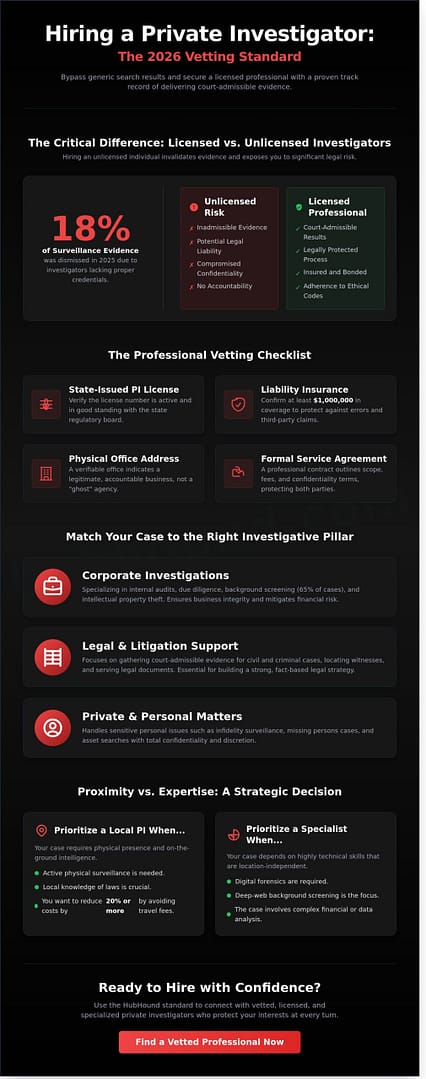
How to Hire with Confidence: The HubHound Vetting Standard
Hiring an investigator requires a systematic approach to ensure legality and actionable results. HubHound applies a curated vetting standard to filter out substandard operators and prioritize high-performing agencies. Follow these five steps to secure a professional who delivers.
- Step 1: Define Your Objective. Be precise about the required evidence type. Do you need high-definition video for a domestic case or a digital forensic audit of corporate assets? Specificity prevents scope creep and ensures you hire the right specialist.
- Step 2: Verify Professional Standing. Check state licensing databases immediately. Data from early 2026 indicates that 43 U.S. states mandate specific agency licensing. Ensure the license is active and carries no recent disciplinary marks.
- Step 3: Conduct a Strategy Consultation. Use the initial meeting to gauge their tactical approach. A professional investigator will explain the methodology without overpromising or offering illegal shortcuts.
- Step 4: Formalize the Agreement. Review the contract and non-disclosure agreement. It must detail the hourly rates, retainer terms, and confidentiality protocols. Never move forward without a signed document.
- Step 5: Set the Reporting Cadence. Establish whether you expect daily updates via secure portal or a final comprehensive report. Transparency is the hallmark of a reliable agency.
The Selection Matrix: Questions to Ask
Your first call is an interview. Use these five critical questions to identify a high-tier pi near me:
- How many cases identical to mine have you successfully resolved in the last 12 months?
- What specific surveillance technology or database access will you deploy for this operation?
- Are you prepared to testify as an expert witness in court if the case requires it?
- What is your exact protocol for maintaining a secure chain of custody for evidence?
- Can you provide current proof of professional liability insurance?
Watch for red flags during this interaction. Avoid investigators who guarantee a specific outcome; ethical professionals know that facts are discovered, not manufactured. A legitimate agency maintains a physical office and a professional website. These assets indicate financial stability and a commitment to long-term accountability, unlike “ghost” operators who work solely from a cell phone.
Starting Your Investigation Today
Timing is the most critical factor in any investigation. Evidence degrades; witnesses move; digital footprints are often erased within 30 days. Don’t let choice paralysis compromise your case. A professional private investigation near me begins with a structured consultation to assess your specific risks and goals. HubHound has already done the heavy lifting by identifying the top-rated, vetted agencies in your region. Move from research to action now to protect your interests and secure the facts you need with total confidence.
Secure Your Resolution with Professional Oversight
Finding a reliable pi near me requires more than a simple search engine query. You’ve discovered that verifying credentials and understanding fee structures are non-negotiable steps in the 2026 vetting process. Successful outcomes depend on matching your specific case needs with investigators who provide court-ready evidence and comprehensive reporting. HubHound eliminates the guesswork by applying a rigorous vetting standard to every professional in our network.
Our team brings over 30 years of combined industry experience to your case. We ensure you’re working with licensed and insured professional investigators who prioritize transparency and legal compliance. You don’t have to navigate the complex legal landscape alone when expert help is accessible. Consult with our licensed investigators to start your case today. Take the first step toward clarity and let our experts handle the heavy lifting of your investigation.
Frequently Asked Questions
Is it legal to hire a private investigator for surveillance?
Yes, hiring a licensed private investigator for surveillance is legal across all 50 U.S. states. Investigators must operate within the boundaries of the Driver’s Privacy Protection Act and local privacy ordinances. They can legally document activities in public spaces but cannot trespass on private property or install hidden cameras inside a residence without consent. Professional surveillance ensures that the gathered evidence remains legally viable for future litigation.
How much does a private investigator cost per hour in 2026?
Average hourly rates for private investigators currently range from $75 to $200 based on industry data from the Professional Investigators Association. Specialized cases involving digital forensics or technical surveillance counter-measures often command higher rates. Most agencies require an initial retainer fee, which typically covers the first 10 to 15 hours of work. These costs fluctuate based on the investigator’s specific expertise and the technology required for the task.
Can a private investigator find a missing person that the police cannot?
Yes, private investigators often locate individuals when law enforcement resources are restricted by jurisdictional limits or case prioritization. While police focus on cases involving immediate foul play, a pi near me can dedicate 40 plus hours a week to a single missing person file. They utilize proprietary skip-tracing databases and boots on the ground tactics that government agencies might deprioritize due to high caseloads or lack of criminal leads. Families navigating these difficult circumstances can benefit from reviewing a comprehensive guide to finding missing adults to understand the full range of investigative strategies available in 2026.
What information do I need to provide to a PI to start an investigation?
You need to provide the subject’s full legal name, a recent photograph, and their last known residential address to initiate a search. Including secondary details like vehicle license plate numbers, social media profiles, or known workplace locations increases the efficiency of the investigation by 30 percent. A clear summary of your objectives helps the investigator curate a focused strategy, which reduces billable hours and accelerates the discovery process.
How long does a typical private investigation take to complete?
A standard investigation typically concludes within 72 hours to 30 days depending on the case complexity. Basic background checks often finish in under 48 hours, while intensive surveillance or fraud cases may require several weeks of active monitoring. The timeline depends on the subject’s activity levels and the availability of public records. Your investigator should provide a structured project roadmap after the initial 60 minute consultation to align on expectations.
Are private investigator reports admissible in a court of law?
Yes, reports and testimony provided by a licensed investigator are admissible in court under standard rules of evidence. Judges accept these documents because they represent an unbiased, third party account of facts and behaviors. To maintain admissibility, the investigator must follow a strict chain of custody for all digital and physical evidence. This professional rigor is why finding a vetted pi near me is essential for any legal proceeding.
Can a private investigator hack into someone’s phone or social media?
No, hacking into private devices or accounts is a violation of the Electronic Communications Privacy Act and is strictly illegal. Licensed professionals won’t jeopardize their state credentials by performing unauthorized digital intrusions. Instead, they use advanced Open Source Intelligence tools to aggregate data from public posts, archived web content, and historical database leaks. These legal methods provide comprehensive insights without exposing the client to criminal liability or privacy lawsuits.
What is the difference between a background check and a private investigation?
A background check is a static search of existing public records, while a private investigation is a dynamic, multi layered inquiry. Background checks focus on automated data like criminal history or credit scores. Investigations involve active surveillance, interviews, and deep web analysis to uncover current behaviors. This proactive approach identifies hidden patterns that a 10 year record search would miss, providing a more accurate assessment of a subject’s integrity.

Article by
Joel R. Manley | President | Hubhound Investigations | OR PI-ID#: 90432 | 111 SW Fifth Avenue, Suite 3150 Portland, Oregon 97204 | 971-442-8170
Joel is licensed as a private investigator in Oregon and Tennessee. Joel started his career in 1987 serving as a Military Police Officer and Military Police Investigator.
After ending his military tour of duty, Joel became a civilian Police Officer and Deputy Sheriff. Joel took his strong background in Hostage Negotiations, Mediation and Conflict Resolution, with him to patrol some of the highest crime areas in SE Portland.
Joel was awarded Deputy of the Year for his efforts and for drastically reducing the crime rate in the area he patrolled. As a Deputy Sheriff, Joel assisted in leading a Neighborhood Livability Program that was nationally recognized for having the most innovative and progressive approach to policing.
In 2018, Joel retired as a Deputy Sheriff and founded Hubhound Investigations. Joel played an integral role in Hubhound Investigations receiving an A+ Accredited Business rating from the Better Business Bureau (BBB).
In his off time, Joel enjoys spending time with his wife, adult children and Hubhound’s Happiness Ambassador, Nya. Joel also enjoys Scuba Diving and Kayaking.
Disclaimer
DISCLAIMER: This article is provided for general informational and educational purposes only. It is not intended to constitute legal advice, professional investigative advice, or instruction to engage in any unlawful activity. Laws governing private investigations, surveillance, recording, tracking, access to information, evidence collection, privacy, trespass, licensing, and related investigative activities vary by jurisdiction and are subject to change.
Any investigative techniques, tactics, procedures, scenarios, or legal proceedings discussed in this article are presented for informational purposes and should not be interpreted as authorization or encouragement to use a particular method. Private investigators and members of the public are responsible for understanding and complying with all applicable federal, state, and local laws, licensing requirements, court rules, and professional standards.
The circumstances of every investigation and legal matter are different. Information contained in this article should not be relied upon as a substitute for advice from a qualified attorney or other appropriate licensed professional regarding a specific situation. No attorney-client, investigator-client, or other professional relationship is created by reading or using this information.