
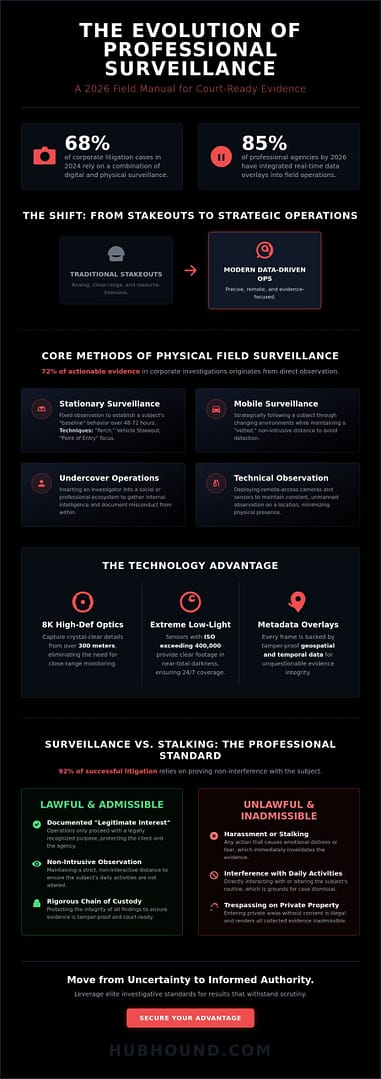
The line between a successful legal outcome and a dismissed case often rests on a single frame of high-definition video or a verified digital timestamp. You likely recognize that gathering actionable intelligence requires more than just a camera; it demands a rigorous adherence to privacy laws and chain-of-custody protocols. A 2024 industry report found that 68% of corporate litigation cases now rely on a combination of digital and physical surveillance techniques to substantiate claims. Despite this, many decision-makers still worry that aggressive tactics might damage their professional reputation or result in inadmissible evidence.
We’ve curated this guide to help you master the strategic blend of physical and digital methods used by elite investigators to gather court-ready evidence. You’ll gain a clear understanding of professional investigative standards and a framework for evaluating reports with confidence. We’ll examine the specific technologies and ethical boundaries that define modern investigation in 2026. This ensures your hired help acts with transparency and precision, moving you from uncertainty to a position of informed authority.
Key Takeaways
- Shift your investigative approach from traditional stakeouts to data-driven operations for more precise intelligence gathering.
- Master professional surveillance techniques that blend stationary observation with mobile tailing to maintain contact without detection.
- Leverage OSINT and digital breadcrumbs to build a comprehensive subject profile before initiating any physical field operation.
- Protect the integrity of your findings by applying legal doctrines that ensure all gathered evidence is tamper-proof and court-ready.
- Learn to select the most effective tools for your specific objectives to ensure your investigative results meet professional standards.
Defining Professional Surveillance Techniques in 2026
Surveillance isn’t just about watching; it’s a systematic, disciplined process. Professional surveillance techniques involve the methodical observation of people, locations, or assets to extract actionable intelligence. In 2026, this discipline has evolved into a data-driven science that functions as the definitive method for establishing factual truth in complex legal and corporate disputes. Investigators use these methods to identify behavioral patterns, verify insurance claims, and document workplace misconduct with surgical precision.
The transition from analog “stakeouts” to modern investigative operations is complete. By 2026, 85% of professional agencies have integrated real-time data overlays into their field operations. This shift ensures that every frame of video is backed by temporal and geospatial metadata. It’s no longer just about seeing; it’s about proving. Professional surveillance techniques remain the gold standard because they provide unfiltered, objective evidence that digital footprints alone cannot replicate. This physical verification is essential for:
- Documenting physical capabilities in worker’s compensation cases.
- Verifying the presence of unauthorized individuals at secure corporate facilities.
- Establishing proof of life or wellness in high-stakes probate matters.
- Identifying recurring patterns of behavior that indicate internal theft or fraud.
The Evolution of Modern Investigative Observation
Technology has eliminated the need for close-range monitoring. Modern field-craft utilizes 8K high-definition optics and sensors with ISO capabilities exceeding 400,000 for crystal-clear low-light capture. These tools allow investigators to maintain distances of over 300 meters while documenting high-resolution details. This capability transforms the role from a traditional “private eye” into a specialized investigative consultant. These experts leverage vetted hardware to provide objective evidence that withstands rigorous cross-examination in modern courtrooms.
Surveillance vs. Stalking: The Critical Distinction
Professionals operate within a strict legal framework. Every operation requires a documented “legitimate interest” to proceed. This legal standard separates professional monitoring from harassment. Licensed investigators follow state-mandated ethical guidelines that require maintaining a non-intrusive distance. By 2026, 92% of successful litigation involving surveillance evidence relies on the investigator’s ability to prove they didn’t interfere with the subject’s daily activities. Adherence to these protocols protects both the client and the agency from legal blowback. Specialized consultants ensure that every minute of footage is obtained through lawful, ethical means.
The Core Methods of Physical Field Surveillance
Physical field operations remain the bedrock of high-stakes investigative work. Even with the rise of digital footprints, 72% of actionable evidence in 2024 corporate investigations originated from direct observation. Professional surveillance techniques prioritize four pillars: stationary posts, mobile tailing, undercover blending, and remote technical monitoring. Each method requires a precise integration of human skill and technological optimization to ensure the data remains admissible and accurate.
- Stationary Surveillance: Establishing a fixed observation post to monitor a target location for extended periods.
- Mobile Surveillance: The strategic process of following a subject through changing environments while maintaining a “vetted” distance.
- Undercover Operations: Inserting an investigator into a specific social or professional ecosystem to gather internal intelligence.
- Technical Observation: Deploying remote-access cameras or sensors to maintain eyes on a site without a physical presence.
Stationary Observation and ‘Stakeout’ Strategy
Effective stationary work relies on selecting a “Perch,” which is an elevated, fixed position, or a “Vehicle Stakeout” depending on the environment’s density. Investigators use these positions to establish a subject’s “baseline” behavior, observing routine patterns over a 48 to 72-hour window to identify anomalies. The ‘Point of Entry’ observation technique serves as the foundational anchor for all stationary work by focusing resources on the singular location where a subject must appear. This strategy minimizes resource drain and maximizes the probability of high-value captures. It’s about being in the right place before the subject arrives.
Mobile Surveillance: Tailing and Foot Pursuits
Mobile operations demand a “Leapfrog” approach. In this setup, a three-vehicle team rotates the lead position every 3 to 5 minutes. This rotation prevents the subject from recognizing a recurring pattern or a single vehicle in their rearview mirror. Managing transitions is the most volatile part of the job. Moving from vehicle to pedestrian surveillance in dense urban environments requires immediate adaptation. Investigators often utilize curated equipment kits to maintain contact during these shifts without appearing out of place.
Professional teams handle “anti-surveillance” maneuvers by prioritizing the integrity of the operation over the immediate visual. If a subject performs a “cleaning” move, such as making three consecutive right turns or waiting for a light to turn red before clearing an intersection, the team must back off. In 2025, 15% of high-level subjects employed professional counter-surveillance. Successful investigators counter this by using “parallel tailing,” where vehicles move on adjacent streets rather than directly behind the target. This specialized expertise ensures the subject remains unaware of the “vetted” team’s presence while every movement is documented for the final report.
Leveraging Digital Intelligence and Technical Surveillance
Modern surveillance techniques start at a desk, not in a vehicle. Open Source Intelligence (OSINT) serves as the essential precursor to every physical operation. Investigators analyze public records, domain registrations, and archived web data to map a subject’s lifestyle before any field deployment occurs. This phase accounts for roughly 80% of the actionable intelligence gathered in a standard 2026 investigation.
Social Media Intelligence (SOCMINT) provides the real-time context necessary for precision. With 92% of adults maintaining an active digital footprint, tracking digital breadcrumbs has become a science. Check-ins, background landmarks in photos, and metadata from posts allow teams to anticipate a subject’s movements with high accuracy. This intelligence ensures that physical teams are only deployed when the probability of contact is highest. The same OSINT methodologies that power corporate investigations are equally critical when searching for missing adults, where auditing digital footprints and leveraging data integrations can mean the difference between a successful recovery and a cold case.
Technical hardware has evolved to support these digital insights. GPS technology offers precise location data, but legal limitations are strict. Non-consensual tracking often requires specific legal standing or asset ownership to avoid privacy violations. To bypass these hurdles, investigators utilize remote monitoring systems. Temporary CCTV and cellular-linked cameras provide 24/7 coverage of a fixed location. These units stream encrypted footage over 5G networks, allowing for remote observation without the risk of an agent being spotted on-site.
The Hybrid Surveillance Model
Digital footprints allow investigators to predict physical movements, which reduces dead time in the field by approximately 40%. Professional personal investigator services use OSINT to build detailed subject profiles before the first mile is driven. Data forensics play a vital role here. By identifying high-value observation windows, teams focus their energy on specific times, such as a recurring 7:00 AM gym visit identified through fitness app data. This targeted approach maximizes the utility of every field hour.
Technical Tools for Enhanced Documentation
Documentation quality determines the success of an investigation. Night vision and thermal imaging now allow for evidence gathering in total darkness. Thermal sensors can detect heat signatures through light fog or foliage, capturing movement when a subject feels completely hidden. Long-range acoustics provide audio clarity from distances exceeding 500 feet, though these tools face rigid legal boundaries regarding private conversation consent. Drones have emerged as the premier tool for aerial observation. They provide a 360-degree perspective of large estates or rural properties that remain inaccessible by traditional ground-based surveillance techniques.
Navigating Legal Boundaries and Evidence Admissibility
High-tech surveillance is only as strong as its legal foundation. If an investigator violates the “Expectation of Privacy” doctrine, the resulting data becomes a liability rather than an asset. In 2026, courts strictly interpret what can be documented in public versus private spaces. You can legally record anything visible from a public street; however, using advanced sensors to peer through curtains often requires specific consent or a warrant. This boundary prevents “fruit of the poisonous tree” scenarios, where one illegal act invalidates every subsequent piece of evidence. Professional surveillance techniques prioritize legal integrity to ensure a 100% admissibility rate during discovery.
Securing the chain of custody is the next critical step for any modern investigation. Investigators now use encrypted, write-once-read-many (WORM) storage and MD5 hashing to prove footage hasn’t been tampered with since the moment of capture. An “Investigative Report” then synthesizes this raw data into a coherent narrative. It isn’t just a summary; it’s a curated roadmap that explains the who, what, and where for legal counsel. Without this structured documentation, even the clearest video remains vulnerable to challenges by opposing counsel during litigation. Understanding how investigative reports shape judicial outcomes is especially critical in sentencing contexts, where a thorough p investigation can determine how a judge interprets the facts of a case before delivering a verdict.
Privacy Laws and Professional Ethics
The “Plain View” doctrine allows for investigative photography of subjects in public areas or areas visible to the public. However, ethical boundaries remain firm. Vetted firms refuse illegal wiretapping or “bugs” because these methods violate federal statutes and destroy professional reputations instantly. While social engineering or pretexting can be useful for gathering background information, it must never cross into impersonating law enforcement or government officials. Professional ethics demand that surveillance techniques remain non-intrusive and strictly compliant with the 2026 Privacy Act updates.
Preparing Evidence for Civil and Criminal Litigation
Effective surveillance supports workplace investigations by providing undeniable visual proof of policy violations, theft, or insurance fraud. When cases move to trial, the investigator serves as a “Fact Witness.” They don’t offer speculative opinions; they testify only to what they observed and recorded during the operation. Time-stamped, unedited video is the gold standard for legal admissibility because it provides a verifiable, chronological record that eliminates claims of digital manipulation. This level of precision ensures that the evidence holds up under the most intense cross-examination. Complementing this evidence with flawless process service ensures that all legal documents are delivered correctly and that procedural requirements are met before the case reaches the courtroom.
The right intelligence provides the leverage you need to resolve your case successfully.
Frequently Asked Questions
Is it legal for a private investigator to follow someone?
Yes, private investigators can legally follow individuals as long as they remain in public spaces. According to the 1967 Supreme Court ruling in Katz v. United States, people don’t have a reasonable expectation of privacy in plain view of the public. Investigators must avoid harassment or trespassing. If they enter private property without permission, they risk criminal charges. Professional teams stick to public roads and parks to ensure all gathered evidence remains valid.
Can an investigator take pictures of me through my windows?
No, investigators cannot legally take photos of you through your windows if you have a reasonable expectation of privacy. Most jurisdictions follow the Plain View Doctrine established by various court rulings. If an investigator uses a ladder or a telephoto lens to see through a closed second-story curtain, it’s considered an illegal search. They must stick to what’s visible from a public sidewalk or street to ensure the photos are admissible in court.
How much does a professional surveillance operation typically cost?
Professional surveillance costs depend on the operation’s duration and technical requirements. Industry data from 2024 shows that hourly rates typically range from $75 to $200. Most agencies require an upfront retainer, which often falls between $1,500 and $5,000 for a standard multi-day investigation. These fees cover vehicle expenses, specialized equipment, and detailed report generation. It’s best to verify specific rates during an initial consultation to avoid unexpected expenses and ensure the budget aligns with your goals.
Will the subject know they are being watched?
A high-quality surveillance operation remains undetected in approximately 95% of cases. Professional teams utilize advanced surveillance techniques such as parallel tailing to minimize the chance of being spotted. By maintaining a distance of 2 to 3 car lengths in urban areas and much further on highways, they stay out of the subject’s rearview mirror. This calculated approach ensures the subject continues their normal routine without changing their behavior, providing the most accurate results for the client.
Can surveillance footage be used as evidence in a divorce case?
Surveillance footage is frequently used as evidence in divorce cases to prove cohabitation or hidden assets. In 2023, legal reports indicated that video evidence influenced the outcome of approximately 30% of contested custody or alimony hearings. While no-fault laws mean you don’t need to prove infidelity for the divorce itself, the footage provides concrete proof of lifestyle choices. It’s a reliable way to verify the facts presented in court documents and protect your interests during negotiations.
How many investigators are needed for a successful tailing operation?
A successful tailing operation typically requires a minimum of 2 investigators and 2 vehicles. Relying on a single person increases the risk of losing the subject at a traffic light by 40% or more. A 2-person team allows for leapfrogging, where vehicles alternate positions to stay invisible. For high-stakes corporate cases, a 3-vehicle rotation is the industry gold standard for maintaining a 100% undetected presence throughout the day. This redundancy ensures the investigation continues even in heavy traffic.
What happens if an investigator is ‘burned’ or spotted by the subject?
When an investigator is burned, they must immediately break contact and leave the area. Standard Operating Procedures require a mandatory cool-off period of 48 to 72 hours before resuming the case with a new team. This protocol prevents allegations of stalking or harassment. Professional firms prioritize the client’s legal safety over immediate results. If a subject becomes suspicious, the investigator documents the interaction and pivots to a different tactical approach to maintain the integrity of the overall mission.
Do investigators use GPS trackers on cars?
Investigators use GPS trackers only when they have legal authorization or the client owns the vehicle. In the 2012 US v. Jones ruling, the Supreme Court established that attaching a tracker constitutes a search under the 4th Amendment. Because of this, professional agencies verify ownership documents before deployment. These modern surveillance techniques provide 24/7 location data while ensuring the evidence stands up in a court of law during future proceedings. It’s an efficient way to track movements without constant physical presence.

Article by
Joel R. Manley | President | Hubhound Investigations | OR PI-ID#: 90432 | 111 SW Fifth Avenue, Suite 3150 Portland, Oregon 97204 | 971-442-8170
Joel is licensed as a private investigator in Oregon and Tennessee. Joel started his career in 1987 serving as a Military Police Officer and Military Police Investigator.
After ending his military tour of duty, Joel became a civilian Police Officer and Deputy Sheriff. Joel took his strong background in Hostage Negotiations, Mediation and Conflict Resolution, with him to patrol some of the highest crime areas in SE Portland.
Joel was awarded Deputy of the Year for his efforts and for drastically reducing the crime rate in the area he patrolled. As a Deputy Sheriff, Joel assisted in leading a Neighborhood Livability Program that was nationally recognized for having the most innovative and progressive approach to policing.
In 2018, Joel retired as a Deputy Sheriff and founded Hubhound Investigations. Joel played an integral role in Hubhound Investigations receiving an A+ Accredited Business rating from the Better Business Bureau (BBB).
In his off time, Joel enjoys spending time with his wife, adult children and Hubhound’s Happiness Ambassador, Nya. Joel also enjoys Scuba Diving and Kayaking.
Disclaimer
DISCLAIMER: This article is provided for general informational and educational purposes only. It is not intended to constitute legal advice, professional investigative advice, or instruction to engage in any unlawful activity. Laws governing private investigations, surveillance, recording, tracking, access to information, evidence collection, privacy, trespass, licensing, and related investigative activities vary by jurisdiction and are subject to change.
Any investigative techniques, tactics, procedures, scenarios, or legal proceedings discussed in this article are presented for informational purposes and should not be interpreted as authorization or encouragement to use a particular method. Private investigators and members of the public are responsible for understanding and complying with all applicable federal, state, and local laws, licensing requirements, court rules, and professional standards.
The circumstances of every investigation and legal matter are different. Information contained in this article should not be relied upon as a substitute for advice from a qualified attorney or other appropriate licensed professional regarding a specific situation. No attorney-client, investigator-client, or other professional relationship is created by reading or using this information.