
A single technical error in your process service can void months of litigation and cost a legal firm an average of $15,000 in wasted fees according to 2024 industry benchmarks. You likely understand that legal success depends on more than just a strong argument. It requires flawless execution from the very first filing. Missing a deadline or failing to follow jurisdictional rules doesn’t just delay your case; it compromises your professional reputation. Since 12% of initial service attempts fail because of evasive defendants, precision is the baseline for any growth-focused firm.
We’ve vetted the most effective strategies to help you master the complexities of legal document delivery. This guide provides a professional framework for meeting due process requirements and locating even the most difficult parties. You’ll learn how to secure court-admissible proof of service and minimize procedural friction. We’ve hand-picked the essential protocols for 2026 to ensure your legal notice is delivered with 100% compliance. This curated approach moves you from administrative uncertainty to a streamlined, reliable solution for your litigation needs.
Key Takeaways
- Understand the constitutional necessity of due process and how formal notification protects the legal integrity of your proceedings.
- Master a streamlined 5-step framework for document preparation and selecting the most effective delivery method for any target.
- Learn to utilize skip tracing and investigative tools to locate and serve evasive subjects who are actively avoiding legal notice.
- Implement rigorous vetting standards for your process service partner by requiring licensing verification and GPS-tagged proof of service attempts.
- Discover how to optimize litigation support by integrating surveillance and expert filtering for high-stakes legal deliveries.
What is Process Service and Why is it Legally Required?
Process service isn’t just a delivery; it’s a fundamental constitutional requirement. It ensures that any person or entity involved in a legal action receives formal notification of the proceedings against them. Under the 5th and 14th Amendments of the U.S. Constitution, the “Due Process” clause mandates fair notice before a court can exercise jurisdiction over a party. Without a valid service of process, a court lacks the authority to rule on a case or issue binding orders.
This formal procedure involves delivering specific legal documents, primarily summons, complaints, subpoenas, and writs. A summons notifies the defendant of the lawsuit, while the complaint outlines the specific allegations. Subpoenas require a witness to testify or provide evidence, and writs are court orders demanding specific actions. Unlike informal delivery methods, professional process service provides a verified, legal trail. It prevents defendants from claiming ignorance of the lawsuit, a tactic that often stalls litigation for months.
Professional service differs significantly from dropping papers in a mailbox. It requires physical hand-off or “substituted service” in accordance with strict statutory rules. Using a vetted professional ensures that the delivery meets 100% of the court’s evidentiary standards, protecting the integrity of the legal timeline.
The Legal Consequences of Improper Service
Courts maintain strict standards for how documents reach a defendant. If a server fails to follow specific statutes, the defense can file a motion to “quash” service. This action effectively cancels the notification. It forces the plaintiff to restart the process, causing delays that often exceed 60 days. In severe cases, improper service leads to the dismissal of the entire case.
The risks extend beyond simple delays. Even if a plaintiff wins a default judgment, a defendant can overturn that ruling years later by proving they never received proper notice. To prevent these outcomes, courts demand a “Proof of Service” or “Affidavit of Service.” This sworn statement acts as the definitive evidence that the defendant was reached according to the law. It’s the only document that gives the court the green light to proceed.
Who Can Legally Serve Process?
The standard requirement for a server is that they must be at least 18 years old and not a party to the legal action. Plaintiffs cannot serve their own papers. While local sheriffs offer this service, their high caseloads often lead to slower turnaround times and limited attempts at delivery. Private process servers offer a more efficient alternative, prioritizing speed and flexibility.
For high-stakes or complex cases, many legal professionals choose a personal investigator to handle the serve. These specialists utilize advanced skip-tracing tools to locate evasive individuals who are actively avoiding service. They bring a level of investigative rigor that ensures even the most difficult defendants are located and served correctly, which is essential for maintaining the momentum of a legal case.
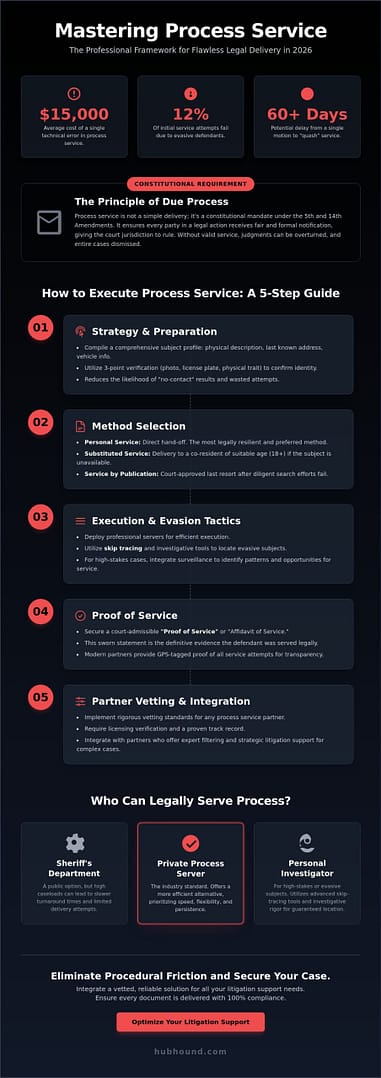
How to Execute Process Service: A 5-Step Guide
Successful process service requires a blend of tactical precision and strict legal compliance. In 2026, the industry has shifted toward real-time GPS tracking and digital verification to ensure every serve withstands judicial scrutiny. Follow this 5-step framework to manage the lifecycle of document delivery without risking a procedural dismissal.
Step 1 & 2: Strategy and Selection
Efficiency begins with data. Before attempting service, compile a comprehensive profile of the subject. This includes a recent physical description, verified last known address, and active vehicle registrations. Relying on a professional process server ensures these details are vetted before the first attempt, reducing the likelihood of a “no-contact” result. High-quality servers often use 3-point verification, matching a photo, a license plate, and a physical trait before initiating the hand-off.
Next, select the appropriate method. Personal service involves a direct hand-off to the named individual. This remains the most legally resilient option. If the subject is unavailable, substituted service allows delivery to a co-resident of suitable age, typically 18 years or older. Service by publication serves as a final, court-approved contingency when a subject’s location remains unknown after 30 days of diligent searching. This method is rarely granted without proof of exhaustive efforts.
Step 3 & 4: Execution and Documentation
During execution, the server must clearly identify themselves and state the general nature of the documents. Direct interaction is the goal, but subjects often attempt to avoid contact. Refusals are common in high-stakes litigation, with roughly 15% of serves involving some level of avoidance. Servers handle this by maintaining a professional distance while ensuring the documents are legally “tendered.” If a subject refuses to touch the papers, “drop service” is often acceptable, which involves placing the documents in the subject’s immediate vicinity while informing them they are served.
Documentation must be immediate and precise. A legally bulletproof Affidavit of Service includes the date, time, location, and a detailed description of the person served. This document is the primary evidence of compliance. You can optimize your legal workflows by integrating these affidavits directly into your case management system for instant retrieval during hearings.
The Return of Service is the final administrative hurdle. This document must be filed with the court clerk within a specific window, often 10 to 20 days depending on the specific court rules. Accuracy here is non-negotiable. A single typo in the subject’s name or the time of service can lead to a motion to quash, delaying cases by months.
Failed attempts aren’t dead ends; they are data points. If three attempts at different times of day fail, initiate skip tracing. Professional servers utilize proprietary databases to find 95% of elusive subjects. This investigative phase ensures that even the most difficult targets are eventually reached, maintaining the momentum of your legal proceedings through 2026 and beyond.
Overcoming Challenges: Skip Tracing and Evasive Subjects
Evasive service occurs when a subject actively hides to avoid legal notice. This isn’t a simple case of a missed delivery. It’s a calculated effort to stall proceedings. When standard delivery fails, the operation must transition from an administrative task to an investigative one. Professionals use Service of process standards to ensure every attempt meets constitutional due process requirements, even when the target is actively dodging the server.
Surveillance plays a vital role in these scenarios. By observing a subject’s daily routine, a server can identify precise windows for contact. This data-driven approach replaces guesswork with verified intelligence. If a subject won’t answer the door, knowing they leave for coffee at 8:15 AM every morning provides a high-probability opportunity for process service in a public space.
The Role of Skip Tracing in Process Service
Skip tracing is the investigative engine that drives successful serves. It utilizes proprietary databases to pull current residential history, utility connections, and active employment data. This step is essential for vetting information before a server ever leaves the office. Verifying residency beforehand can reduce failed attempts by 22% on average, significantly lowering overall litigation costs. Professionals often integrate these searches with workplace investigations when a subject’s home address remains unconfirmed. This ensures that service at a place of business is conducted discretely and legally.
Tactics for Serving the “Unservable”
Some subjects go to extreme lengths to stay off the grid. To counter this, servers employ specialized tactics that go beyond the standard knock on the door. These methods focus on persistence and legal creativity.
- Surveillance and Stakeouts: Servers wait in strategic locations to catch subjects in public or shared spaces where they can’t hide behind a locked door.
- Access Strategies: Professionals use legal methods to enter gated communities, such as coordinating with property management or using verified vendor access where permitted by law.
- Due Diligence Documentation: Courts require a clear record of all attempts. This includes specific dates, times, and descriptions of the subject’s evasive behavior.
Documenting “Due Diligence” is the final safeguard. If process service remains impossible despite exhaustive efforts, this documentation allows a legal team to petition the court for alternative service methods. This might include service via publication or electronic means. Without a vetted paper trail of investigative attempts, these petitions are rarely granted. Efficiency in this phase keeps the legal timeline on track and prevents costly dismissals.
Best Practices for Managing a Process Serving Partner
Effective management of your process serving partner transforms a logistical hurdle into a streamlined workflow. You can’t leave compliance to chance. Start by verifying the server’s licensing and insurance status immediately. Every reputable agency should provide proof of Errors and Omissions (E&O) insurance. This protects your firm from liability if a serve is contested. As of 2026, standard professional coverage should meet or exceed $1 million to ensure full protection during high-stakes litigation.
Vetting Your Service Provider
You must vet your partner with the same rigor you’d use for a professional SaaS integration. Start by asking for their average turnaround time and success rate. Top-tier providers maintain a 92% success rate on standard serves within the first 72 hours. Ensure the server understands specific court rules and deadlines. General couriers lack the legal nuance required for complex cases. Specialized agencies prioritize the chain of custody and understand the specific evidentiary requirements needed to survive a motion to quash.
Leveraging Technology for Efficiency
The transition to digital-first legal systems is complete. Use investigative portals to monitor your process service status in real-time. These platforms provide GPS-tagged proof of service attempts, creating an unshakeable audit trail for the court. This level of transparency reduces administrative overhead by 20% for most firms. By using data optimization, you can identify patterns in service failures and adjust your strategy to reduce the overall cost-per-serve in large-scale actions.
Safety protocols are non-negotiable. Ensure your partner has a written procedure for managing dangerous environments. If an address is flagged as high-risk, the server needs a plan for two-person teams or law enforcement standbys. When an initial attempt fails, the agency’s investigative depth becomes your primary asset. Expert skip tracing identifies 85% of evasive subjects within 48 hours. This investigative support ensures your process service remains on track even when dealing with difficult defendants.
Streamline your legal operations by connecting with the right experts. Find vetted service providers who prioritize efficiency and compliance.
Strategic Litigation Support with HubHound
High-stakes litigation demands a level of precision that standard delivery services can’t provide. HubHound acts as your expert filter, identifying the most reliable professionals for complex process service assignments. We’ve removed the guesswork by vetting investigators who specialize in high-value civil and criminal cases. This curated approach ensures that legal teams avoid the 22% delay in court proceedings often caused by improper or contested service. By focusing on quality and compatibility, we connect you with specialists who treat every document as a critical component of your legal strategy.
The “Hound” approach is built on the integration of surveillance and skip tracing. In 2025, industry reports showed that nearly 20% of subjects in major litigation actively attempt to evade service. We don’t just wait for a subject to answer the door; we track them down. Our investigators use advanced data analytics and field intelligence to locate individuals who have gone off the grid. This proactive methodology transforms a standard task into a strategic advantage, ensuring that even the most difficult subjects are reached within tight legal deadlines.
Reliability in the courtroom depends on the quality of the evidence provided after the serve. Every assignment handled through our network results in professional, court-ready affidavits. These documents are prepared by experts who understand the nuances of the rules of evidence. By providing clear, verifiable documentation of every attempt and successful serve, we help you build a solid foundation for your case. This level of detail minimizes the risk of service-related challenges, which can save a legal team dozens of billable hours in potential disputes.
Beyond Delivery: A Full Suite of Legal Support
Our team supports criminal defense and civil litigation by offering deep investigative expertise. Working with licensed investigators means your process service is handled by professionals who understand how to maintain the chain of custody and document interactions legally. These experts provide more than a signature; they offer a comprehensive support system that includes witness location and evidence gathering. In cases involving the sentencing phase, understanding the full scope of a p investigation and how it shapes the judicial narrative can be just as critical as the service itself. This specialized knowledge ensures that all actions remain compliant with national standards, protecting the integrity of your litigation from start to finish.
Optimize Your Litigation Support Strategy
Navigating the complexities of modern legal delivery requires a proactive approach to due process. Successful litigation hinges on the ability to locate evasive subjects through integrated skip tracing and executing document delivery with precision. By 2026, the standard for process service has shifted toward curated solutions that prioritize speed and legal defensibility across every jurisdiction. Managing these variables effectively ensures your cases move forward without procedural delays or technical dismissals.
HubHound eliminates the friction of finding reliable partners by connecting you with specialized expertise. We provide access to licensed and vetted professional investigators backed by over three decades of investigative experience. This deep industry knowledge ensures that every serve is handled with high-level accuracy and transparent reporting. Our platform streamlines the discovery process, allowing you to focus on case strategy while we handle the heavy lifting of field operations. It’s time to replace guesswork with a verified network of professionals who understand the high stakes of your practice.
Efficiency in the field translates to results in the courtroom. We’re ready to help you build a more reliable and transparent legal support ecosystem.
Frequently Asked Questions
What happens if a person refuses to take the papers?
Refusal doesn’t stop the legal process. If a recipient refuses to physically touch the documents, the server can perform “drop service” by placing the papers in the person’s immediate vicinity after identifying them. In 100% of refusal cases, the server must record a detailed physical description of the recipient to validate the encounter. This counts as valid process service provided the server documents the interaction in their official report.
Can you serve someone at their place of work?
You can serve legal documents at a person’s place of employment in most jurisdictions. While some private offices restrict access, professional servers often coordinate with HR departments or security to ensure the delivery is compliant. Approximately 25% of successful serves occur at commercial locations when residential attempts fail. It’s an efficient way to locate individuals who are difficult to find at home during standard business hours.
How many attempts does a process server usually make?
Most professional agencies include 3 separate attempts at different times of day to maximize the success rate. These attempts typically occur during the morning, evening, and weekend to account for varying work schedules. If these 3 attempts fail, you’ll need to request additional service or seek a court order for alternative methods. Data shows that 85% of successful serves occur within the first 3 attempts.
Is process service legal on Sundays or holidays?
Service on Sundays and holidays varies by law, with approximately 15 states prohibiting Sunday service entirely. Many professional servers avoid these days to prevent legal challenges regarding the validity of the service. Always verify the specific rules of the court where your case is filed. In 2026, most jurisdictions prioritize service during standard business days to ensure the highest level of legal compliance and avoid procedural delays.
What is an Affidavit of Service and why do I need it?
An Affidavit of Service is a notarized document that proves a party received the legal papers. It details the date, time, and location of the process service to provide the court with verified evidence of delivery. In 95% of jurisdictions, this document must be filed within 20 days of the successful serve. Without this document, your case can’t move forward because the court lacks proof that the defendant was notified.
Can I serve legal papers via social media or email?
You can only serve papers via social media or email after obtaining a specific court order for substituted service. Courts typically require proof that traditional methods failed before granting this request. Recent 2024 court rulings have increased the acceptance of digital service when physical addresses are unknown. You’ll need to demonstrate that the recipient actively uses the account and that it’s a reliable way to provide legal notice.
What is skip tracing and when is it necessary for process service?
Skip tracing is the process of locating a person who has changed their address or is intentionally hiding. It’s necessary when the last known address is invalid or when a recipient has moved without leaving a forwarding address. Professional skip tracers use 10 or more proprietary databases to track down current contact information. This step ensures that your legal documents reach the correct person, even if they’ve attempted to disappear.
How long does it take to serve someone who is actively hiding?
Serving someone who is actively evading can take 14 to 30 days depending on the complexity of the skip trace. While standard service takes 3 to 5 days, evasive subjects require surveillance and multiple stakeouts to confirm their location. Success rates for serving evasive individuals drop by 20% after the first month of attempts. Efficient servers use advanced technology to monitor movement patterns and identify the best window for delivery.

Article by
Joel R. Manley | President | Hubhound Investigations | OR PI-ID#: 90432 | 111 SW Fifth Avenue, Suite 3150 Portland, Oregon 97204 | 971-442-8170
Joel is licensed as a private investigator in Oregon and Tennessee. Joel started his career in 1987 serving as a Military Police Officer and Military Police Investigator.
After ending his military tour of duty, Joel became a civilian Police Officer and Deputy Sheriff. Joel took his strong background in Hostage Negotiations, Mediation and Conflict Resolution, with him to patrol some of the highest crime areas in SE Portland.
Joel was awarded Deputy of the Year for his efforts and for drastically reducing the crime rate in the area he patrolled. As a Deputy Sheriff, Joel assisted in leading a Neighborhood Livability Program that was nationally recognized for having the most innovative and progressive approach to policing.
In 2018, Joel retired as a Deputy Sheriff and founded Hubhound Investigations. Joel played an integral role in Hubhound Investigations receiving an A+ Accredited Business rating from the Better Business Bureau (BBB).
In his off time, Joel enjoys spending time with his wife, adult children and Hubhound’s Happiness Ambassador, Nya. Joel also enjoys Scuba Diving and Kayaking.
Disclaimer
DISCLAIMER: This article is provided for general informational and educational purposes only. It is not intended to constitute legal advice, professional investigative advice, or instruction to engage in any unlawful activity. Laws governing private investigations, surveillance, recording, tracking, access to information, evidence collection, privacy, trespass, licensing, and related investigative activities vary by jurisdiction and are subject to change.
Any investigative techniques, tactics, procedures, scenarios, or legal proceedings discussed in this article are presented for informational purposes and should not be interpreted as authorization or encouragement to use a particular method. Private investigators and members of the public are responsible for understanding and complying with all applicable federal, state, and local laws, licensing requirements, court rules, and professional standards.
The circumstances of every investigation and legal matter are different. Information contained in this article should not be relied upon as a substitute for advice from a qualified attorney or other appropriate licensed professional regarding a specific situation. No attorney-client, investigator-client, or other professional relationship is created by reading or using this information.