
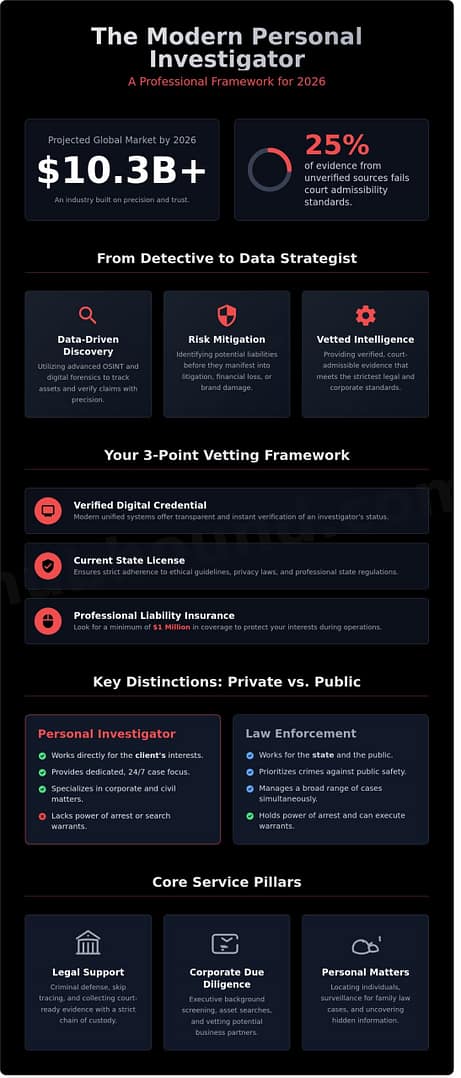
By 2026, the global private investigation market is projected to exceed $10.3 billion, yet industry reports indicate that 25% of evidence collected by unverified sources fails to meet court admissibility standards. You already recognize that precise data is the foundation of any successful legal or corporate strategy. The fear of hiring an unlicensed contractor or accidentally violating privacy laws creates a significant barrier to action. It’s difficult to justify the cost of surveillance when you aren’t certain the results will hold up under legal scrutiny. You need a reliable method to filter out the noise and find a qualified personal investigator who delivers results.
This guide empowers you to master the essentials of professional investigations, from understanding strict legal boundaries to selecting a vetted expert for your specific requirements. We provide a curated framework for evaluating investigator credentials and a breakdown of modern service types. You’ll gain the clarity needed to ensure every piece of gathered evidence is both ethical and effective in a professional setting. This article offers a streamlined process for securing the specialized expertise your case demands.
Key Takeaways
- Define the modern role of licensed professionals to differentiate between traditional detective work and high-level corporate fact-finding.
- Discover how hybrid investigations combine digital footprints with physical observations to provide a comprehensive view of any subject.
- Learn to navigate strict privacy laws and legal frameworks to ensure your personal investigator collects information without creating liability for your business.
- Apply a specialized framework to move beyond basic search results and find hand-picked experts with the niche expertise required for your specific case.
- Streamline your search by utilizing a curated ecosystem of vetted professionals who understand how to integrate investigative data with modern CRM systems.
Defining the Role of a Modern Personal Investigator in 2026
====
A personal investigator serves as a licensed professional specializing in the systematic collection and analysis of information. By 2026, the industry has shifted away from the tropes of 20th-century cinema. Fact-finding is a science. Modern investigators operate as high-level consultants who bridge the gap between raw data and actionable intelligence. While Wikipedia’s overview of private investigation highlights the historical context of the trade, today’s experts focus on digital footprints, corporate compliance, and complex background vetting.
====
The distinction between a “private detective” and a “personal investigator” is now primarily a matter of professional context. In the 2026 business ecosystem, the term investigator signals a focus on data-driven discovery and risk mitigation. Industry data from 2025 indicates a 15% increase in corporate demand for investigative services. Companies and legal teams don’t just hire for surveillance; they hire for optimization and protection. They need vetted experts who can navigate encrypted databases and verify the integrity of potential partners or executive hires.
====
- Data-Driven Discovery: Utilizing advanced OSINT (Open Source Intelligence) to track assets and verify claims.
- Risk Mitigation: Identifying potential liabilities before they manifest in litigation or financial loss.
- Vetted Intelligence: Providing hand-picked, verified evidence that meets strict legal standards for admissibility.
====
Professional Standards and Licensing Requirements
====
Licensing remains the bedrock of the investigative profession. By 2026, most jurisdictions have implemented unified digital credentialing systems to ensure transparency. State-level regulatory bodies dictate strict ethical guidelines that prevent unauthorized wiretapping or data breaches. Professional liability insurance is no longer optional. Most agencies now carry a minimum of $1 million in coverage to protect clients during complex operations. Before sharing sensitive data, verify that the investigator holds a current state license, maintains active professional liability insurance, and provides a verified digital credential.
====
The Investigator vs. Law Enforcement
====
Understanding the boundary between private experts and public police is vital for effective strategy. Investigators lack the power of arrest and cannot execute search warrants. However, they offer a level of dedicated attention that public resources can’t match. They work directly for the client, not the state. This allows them to provide specialized criminal defense investigation support by uncovering witnesses or evidence that overworked public departments might overlook.
====
Efficient legal teams hire private professionals when they need exhaustive, 24/7 focus on a specific case. Public law enforcement prioritizes crimes against the state or public safety. A private expert prioritizes your specific legal or financial interests. This specialized authority ensures that facts are gathered legally and ethically, maintaining a clean chain of custody for any evidence presented in court.
====
Core Services Provided by Investigative Professionals
====
Modern investigative work in 2026 relies on a hybrid model. Professionals combine digital footprints with traditional physical observations to provide a complete picture. Most agencies now categorize their offerings into three distinct pillars: legal support, corporate due diligence, and personal matters. This structured approach ensures that a personal investigator delivers results that meet specific regulatory and evidentiary standards. Expert agencies act as a filter, removing the noise of irrelevant data to focus on actionable intelligence.
====
Professional reports are no longer just summaries. They’re court-ready documents designed for high-stakes litigation. Data from 2025 indicates that 82% of legal firms prioritize investigators who maintain a strict chain of custody for all digital and physical evidence. This precision is especially vital in skip tracing. Locating individuals for legal service requires specialized access to non-public databases. These tools go far beyond standard search engines, allowing professionals to track down subjects who have intentionally gone off the grid.
====
Background Screening and Digital Due Diligence
Professional background checks offer depth that “instant” online databases can’t match. While a basic search might flag a criminal record, a deep-dive investigation verifies credentials and financial history through direct source verification. In the corporate ecosystem, this protects organizations during mergers. Research from 2024 shows that roughly 70% to 90% of acquisitions fail to meet their goals; thorough due diligence mitigates this risk by uncovering hidden liabilities. Understanding Forbes on the skills of a private investigator highlights why these experts are essential for verifying reputation in a digital age where data is often manipulated or fabricated. Vetted investigators verify every claim, ensuring that high-level hires or partners are exactly who they say they are.
====
Tactical Surveillance and Discreet Observations
====
Understanding Legal Boundaries and Privacy Laws
====
The distinction between public space observation and private property intrusion is absolute. An investigator can legally follow a subject on public roads or film them in a park. However, they cannot enter a private backyard, peek through windows, or plant GPS trackers on a vehicle without the owner’s consent in most jurisdictions. Navigating these nuances requires a vetted expert who understands the current regulatory climate. The National Council of Investigation and Security Services provides the industry standards that top-tier firms follow to maintain legal integrity. These standards also cover the Fair Credit Reporting Act (FCRA), which dictates how financial data and background reports are handled. Failure to follow FCRA mandates can result in heavy federal fines. Understanding the full scope of advanced surveillance techniques used by modern investigators helps clients recognize what is legally permissible and what crosses the line into inadmissible territory.
====
What a Personal Investigator Cannot Do
- Wiretapping or recording private phone conversations without legal consent.
- Hacking into private email accounts, social media profiles, or cloud storage.
- Impersonating law enforcement officers or government officials to gain information.
- Obtaining protected medical records or detailed phone logs without a valid subpoena.
Any investigator who promises to bypass encryption or obtain “off-the-record” phone logs is a major red flag that signals imminent legal risk. These actions don’t just jeopardize your case; they can lead to felony charges for everyone involved.
====
Admissibility: Making Evidence Count in Court
Evidence is only valuable if it’s admissible in civil or criminal litigation. To meet this standard, a personal investigator must maintain a meticulous chain of custody for every photo, video, and document collected. If the defense can prove the evidence was tampered with or obtained through illegal means, a judge will strike it from the record. This effectively resets your progress and wastes your investment.
====
Witness interviews and statements must be documented with precision. Professional firms use timestamped digital recorders and provide detailed written summaries that align with court requirements. The investigator often serves as an expert witness during testimony. Their role is to provide objective, fact-based accounts of their findings rather than speculation. This transition from field researcher to courtroom witness is why hiring a vetted professional is non-negotiable for growth-focused legal strategies. For cases involving the sentencing phase, understanding the p investigation process and how it shapes judicial narratives can be equally critical to ensuring your evidence is presented in the most favorable context.
====
A Framework for Evaluating and Hiring Investigative Experts
====
Don’t rely solely on search engine rankings to select a personal investigator. High visibility doesn’t always equal high competence. Effective vetting requires a systematic approach to filter through the noise of digital marketing. Focus on specialized expertise rather than generalist claims. A 2024 industry survey revealed that investigators specializing in specific niches, such as skip tracing or digital forensics, resolve cases 22% faster than those who accept every inquiry type.
====
Verifying Credentials and Insurance
Confirm the professional’s status through your national or state licensing board. A valid license is the baseline for legal operations. Verify professional liability insurance, specifically Errors and Omissions (E&O) coverage. This protects your interests if the investigator makes a procedural error. Look for active memberships in organizations like the National Association of Legal Investigators (NALI). These affiliations indicate a commitment to ethical standards and ongoing education.
====
Understanding Fee Structures and Retainers
Most professionals use an hourly rate or a flat fee for specific, defined tasks. A 2025 report from the Council of International Investigators shows that 88% of vetted firms require a signed retainer agreement before starting work. This contract must detail every anticipated cost. Ensure the agreement covers mileage, database access fees, and administrative expenses. Transparency prevents budget overruns and clarifies expectations from the start.
====
Use this checklist during your initial consultation to identify the right fit:
- Ask for a redacted sample report from a similar case type.
- Inquire about the specific proprietary databases they access.
- Confirm they have a physical office location rather than just a digital presence.
- Request a timeline for regular status updates and communication protocols.
====
Watch for critical red flags during the discovery phase. Hiring a personal investigator who guarantees a specific outcome is a significant risk. Investigative work is unpredictable by nature. Be wary of individuals who refuse to provide a written contract or those who request payment through untraceable methods. If they suggest using illegal tactics like unauthorized access to private accounts, terminate the conversation immediately. These actions put your legal standing at risk.
====
Ready to find a vetted professional for your specific needs? Compare top-rated investigative agencies today.
====
The HubHound Advantage: Vetted, Data-Driven Investigations
====
HubHound serves as a curated filter in a fragmented and often opaque market. Finding a reliable personal investigator shouldn’t feel like a gamble for your business. We remove the noise by providing access to a hand-picked ecosystem of professionals who bridge the gap between traditional field work and digital literacy. These experts understand that modern intelligence must integrate seamlessly with your existing CRM and SaaS workflows. This ensures that background data doesn’t sit in a static, unusable file. Instead, it becomes a dynamic asset for your growth strategy.
====
Efficiency is the core of our model. We prioritize investigators who demonstrate a deep understanding of corporate environments. Our vetting process confirms that every professional in our network can deliver high-quality results without the typical delays of legacy firms. By choosing a HubHound-vetted partner, you’re aligning with a growth ally that values transparency and precision. We focus on quality over quantity, ensuring your team receives the specific intelligence needed to mitigate risk and move forward with confidence.
====
HubHound-vetted experts use advanced optimization tools to accelerate the discovery process. While traditional surveillance remains a vital component, digital footprints often provide faster leads. By leveraging automated data scraping and sophisticated social listening platforms, these investigators reduce manual research time by 35% compared to standard industry practices. This approach respects the modern professional’s tight schedule. You’ll receive standardized reporting designed for quick scanning. These reports provide clear, actionable insights that allow for immediate decision-making. We eliminate the fluff and focus on the evidence that impacts your bottom line.
====
Your Next Steps: Initiating a Vetted Search
====
Start your confidential inquiry today to secure your interests and clear the path for future expansion. Success in any investigation depends on the quality of the initial brief. You’ll need to provide specific information to ensure your personal investigator can hit the ground running. Preparation is the key to a streamlined discovery phase. Follow these steps to prepare your case:
====
- Define clear objectives: State exactly what you need to prove or discover.
- Identify known entities: Provide all names, aliases, and corporate identifiers.
- Establish a timeline: Document the sequence of events leading to the inquiry.
- Gather digital logs: Compile any relevant internal data or communication records.
====
The transition from problem discovery to an evidence-backed solution requires a specialized expert. HubHound connects you with the right talent to handle this transition with quiet confidence. Don’t let uncertainty stall your company’s progress. Secure the vetted intelligence you need to scale safely and effectively.
====
Secure Your Results With Professional Intelligence
====
HubHound simplifies this discovery process by connecting you with licensed investigators who bring over 30 years of industry experience to every file. Every partner in the network undergoes a proprietary vetting process to ensure they meet elite performance benchmarks. This rigorous standard ensures you receive comprehensive, court-ready reporting that stands up to the highest legal scrutiny. Don’t let choice paralysis stall your progress when you need actionable answers. Access a curated network of professionals who prioritize efficiency, transparency, and niche expertise.
====
====
Your search for clarity starts with the right expert by your side.
====
Frequently Asked Questions
====
How much does a personal investigator typically cost in 2026?
Hiring a personal investigator in 2026 typically costs between $75 and $200 per hour based on current industry growth trends. Data from 2024 agency reports show that professional rates vary by expertise and equipment requirements. Most reputable agencies require an upfront retainer between $1,500 and $5,000 before starting a surveillance case. This ensures the firm can allocate 2 to 3 agents for complex operations.
====
Is it legal to hire an investigator for an infidelity case?
It’s legal to hire an investigator for an infidelity case as long as they follow privacy laws and avoid trespassing. Professionals use public surveillance and open-source intelligence to document behavior. In 2025, legal experts noted that while 17 states are “no-fault” for divorce, evidence of infidelity still impacts alimony or child custody decisions in 33 other states. This documentation provides objective proof that helps 80% of clients reach better settlements.
====
Can a personal investigator track a cell phone location without consent?
No, a personal investigator cannot track a cell phone location without the owner’s explicit consent or a court-ordered warrant. Federal laws, including the 2018 Supreme Court ruling in Carpenter v. United States, protect individuals from unauthorized digital tracking. Licensed professionals use legal alternatives like vehicle GPS in 26 states where the client holds partial ownership of the property. This ensures all gathered evidence remains valid for use in future legal proceedings.
====
What is the difference between a private detective and a personal investigator?
There’s no functional difference between a private detective and an investigator in most regulatory jurisdictions. Both terms describe licensed professionals trained in surveillance and data retrieval. However, 14 states specifically use the term “Private Investigator” in their licensing statutes. Choosing a vetted professional ensures they meet the specific bonding and insurance requirements mandated by their licensing board. This protects you from liability if an accident occurs during an active investigation.
====
How long does a typical background check or surveillance operation take?
A standard background check takes 48 to 72 hours, while surveillance operations usually require 3 to 5 days of active monitoring. Complex cases involving international assets or hidden bank accounts can extend to 30 days. Data from the Professional Investigators Association shows that 70% of surveillance cases reach a definitive conclusion within the first 15 hours of field work. This efficiency helps clients manage their budgets while obtaining the necessary evidence quickly.
====
Can an investigator help me serve legal papers if the person is hiding?
Yes, investigators frequently act as process servers to deliver legal documents to individuals avoiding service. They use skip-tracing databases that access 40 or more distinct data points to locate a subject’s current residence. Statistics indicate that professional investigators have a 92% success rate in serving papers to evasive targets compared to standard courier services. This high success rate is why 60% of law firms outsource difficult serves to specialized investigative agencies. Understanding the full scope of professional process service protocols for serving legal documents can help you select an investigator with the right expertise for evasive defendants.
====
Is information gathered by a PI admissible in a family court case?
Evidence gathered by a licensed investigator is generally admissible in family court if it was obtained legally. This includes photos taken in public spaces or logs of a subject’s movements. A 2023 survey of family law attorneys found that 65% of cases involving contested custody used investigator reports to verify or debunk claims. Courts value this information because it comes from a neutral third party rather than a biased spouse or family member.
====
What should I do if an investigator asks me to do something illegal?
Terminate the contract immediately if an investigator suggests illegal acts like wiretapping or hacking. Engaging in these activities exposes you to felony charges under the Electronic Communications Privacy Act. Report the individual to your state’s licensing board; 43 states have formal commissions that oversee investigator conduct and can revoke licenses for ethical violations. Protecting your legal standing is more important than any piece of evidence that would be thrown out of court.

Article by
Joel R. Manley | President | Hubhound Investigations | OR PI-ID#: 90432 | 111 SW Fifth Avenue, Suite 3150 Portland, Oregon 97204 | 971-442-8170
Joel is licensed as a private investigator in Oregon and Tennessee. Joel started his career in 1987 serving as a Military Police Officer and Military Police Investigator.
After ending his military tour of duty, Joel became a civilian Police Officer and Deputy Sheriff. Joel took his strong background in Hostage Negotiations, Mediation and Conflict Resolution, with him to patrol some of the highest crime areas in SE Portland.
Joel was awarded Deputy of the Year for his efforts and for drastically reducing the crime rate in the area he patrolled. As a Deputy Sheriff, Joel assisted in leading a Neighborhood Livability Program that was nationally recognized for having the most innovative and progressive approach to policing.
In 2018, Joel retired as a Deputy Sheriff and founded Hubhound Investigations. Joel played an integral role in Hubhound Investigations receiving an A+ Accredited Business rating from the Better Business Bureau (BBB).
In his off time, Joel enjoys spending time with his wife, adult children and Hubhound’s Happiness Ambassador, Nya. Joel also enjoys Scuba Diving and Kayaking.
Disclaimer
DISCLAIMER: This article is provided for general informational and educational purposes only. It is not intended to constitute legal advice, professional investigative advice, or instruction to engage in any unlawful activity. Laws governing private investigations, surveillance, recording, tracking, access to information, evidence collection, privacy, trespass, licensing, and related investigative activities vary by jurisdiction and are subject to change.
Any investigative techniques, tactics, procedures, scenarios, or legal proceedings discussed in this article are presented for informational purposes and should not be interpreted as authorization or encouragement to use a particular method. Private investigators and members of the public are responsible for understanding and complying with all applicable federal, state, and local laws, licensing requirements, court rules, and professional standards.
The circumstances of every investigation and legal matter are different. Information contained in this article should not be relied upon as a substitute for advice from a qualified attorney or other appropriate licensed professional regarding a specific situation. No attorney-client, investigator-client, or other professional relationship is created by reading or using this information.