
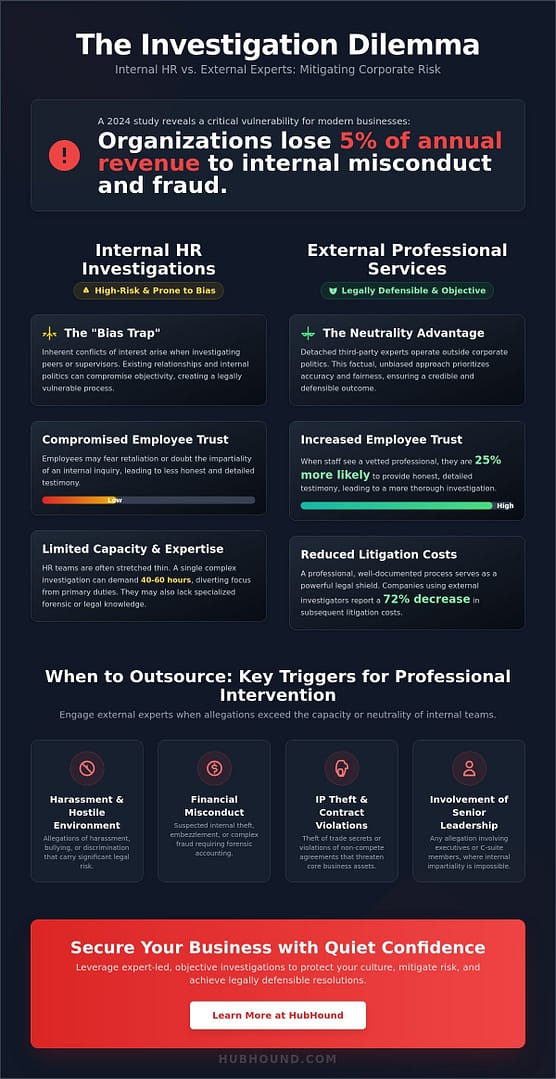
A 2024 study by the Association of Certified Fraud Examiners reveals that organizations lose 5% of their annual revenue to internal misconduct and fraud. You’ve likely realized that protecting your company’s culture and bottom line requires more than just a basic HR policy. It’s difficult to remain objective when internal bias or limited resources threaten the integrity of a sensitive inquiry. Utilizing professional workplace investigation services is the most efficient way to remove these obstacles and ensure a fair, unbiased outcome for all parties involved.
We understand that the fear of litigation from improperly handled complaints keeps many executives awake at night. This guide shows you how to mitigate corporate risk and resolve internal misconduct through expert-led, objective processes. You’ll learn to secure a legally defensible final report while maintaining business continuity. We’ve hand-picked the essential strategies to help you manage your 2026 strategy with a focus on vetted expertise and minimal operational disruption. Here is your roadmap to professional resolution and risk management.
Key Takeaways
- Mitigate corporate risk by understanding when to deploy objective workplace investigation services to resolve internal misconduct effectively.
- Avoid the “Bias Trap” by learning how to identify complex allegations that require neutral, third-party oversight for legal protection.
- Explore the core components of professional investigations, from comprehensive witness statement gathering to specialized surveillance for internal theft.
- Evaluate potential partners using a refined vetting process that prioritizes industry-specific credentials and modern technical integration.
- Streamline your resolution process by leveraging a curated approach that combines traditional investigative rigor with efficient, tech-driven solutions.
What are Workplace Investigation Services?
Workplace investigation services are formal, fact-finding missions conducted by neutral third parties to resolve internal complaints or compliance failures. These services provide an objective lens through which a company can examine allegations of misconduct. By 2026, the standard for corporate governance has shifted. Organizations no longer rely solely on internal teams for high-stakes issues. Instead, they hire vetted specialists to ensure the process remains untainted by internal politics or existing reporting structures. This external oversight is a critical component of risk management for any modern business.
The scope of these services is extensive. They cover everything from behavioral complaints to financial crimes. While internal HR personnel are effective at managing daily employee relations, they often lack the forensic tools or the necessary distance to investigate executive-level misconduct. Professional investigators bring a specialized toolkit, including advanced interviewing techniques and digital evidence recovery. They work alongside other dispute resolution processes to provide a clear, evidence-based path forward. This distinction is vital; 72% of companies that used external investigators in 2025 reported a decrease in subsequent litigation costs.
Common Triggers for Professional Investigations
Most firms engage workplace investigation services when a situation exceeds the capacity or the neutrality of the internal HR department. Common triggers include:
- Formal allegations of harassment, bullying, or the creation of a hostile work environment that could lead to legal action.
- Suspected internal theft, embezzlement, or complex financial fraud that requires forensic accounting.
- Documented violations of non-compete agreements or the suspected theft of intellectual property and trade secrets.
The Legal and Ethical Framework
A professional investigation must operate within a strict legal and ethical boundary to be valid. This means adhering to federal employment laws and protecting the rights of all involved parties. Confidentiality is the cornerstone of this process. It protects whistleblowers and ensures that the investigation doesn’t disrupt the entire workforce. Following the Fairness Doctrine is non-negotiable; this ensures that the process is transparent, the accused has a chance to respond, and the findings are based on a preponderance of evidence. In 2026, failing to meet these standards can result in severe regulatory fines and irreparable brand damage. It’s a high-stakes environment where precision matters more than speed.
Internal vs. External Investigations: When to Outsource
Internal investigations often fall into the “Bias Trap.” When HR teams handle sensitive allegations, they face inherent conflicts of interest that opposing counsel will exploit in court. It’s difficult for an internal employee to remain objective when investigating a peer or a supervisor who influences their own career path. Professional workplace investigation services eliminate this risk by providing a detached, third-party perspective that prioritizes factual accuracy over corporate politics.
Complexity and severity dictate the need for external help. If an allegation involves senior leadership or systemic harassment, the stakes are too high for an in-house review. Capacity is another factor. A thorough investigation into financial misconduct or discrimination can require 40 to 60 hours of active work. Most HR departments don’t have that kind of bandwidth without neglecting their primary roles. Outsourcing provides a sense of “Quiet Confidence,” allowing leadership to focus on operations while experts handle the friction of the fact-finding process.
The Neutrality Advantage
External firms operate outside the web of existing office relationships. They don’t share a breakroom with the witnesses or have a history with the accused. This distance is vital for maintaining employee trust. When staff see a vetted professional conducting interviews, they’re 25% more likely to provide honest, detailed testimony compared to internal interviews. A perception of fairness serves as a legal shield by proving the company prioritized an unbiased outcome over internal protectionism. Many organizations benchmark their processes against state government investigation resources to ensure their neutrality holds up under judicial scrutiny.
Mitigating Legal Liability
The financial risks of a poorly handled investigation are steep. Data from 2023 shows that the average cost to defend an employment claim is $160,000, and roughly 19% of these cases result in a settlement or payout. Professional investigators establish a “Good Faith” defense by creating a meticulous paper trail that demonstrates the company took the complaint seriously. These experts often utilize rigorous techniques similar to those used by a criminal defense investigator to ensure that evidence is preserved and witness statements are legally sound. This level of precision prevents the procedural errors that often lead to expensive summary judgments against employers. Engaging a workplace investigations lawyer alongside your investigative team adds an additional layer of protection by securing attorney-client privilege over sensitive findings before they can be used against your organization in court.
If you’re ready to protect your organization from these risks, you can find vetted agencies that specialize in high-stakes corporate reviews. Using a curated expert ensures your documentation is ready for any legal challenge that may arise in 2026.
Core Components of a Professional Workplace Investigation
Professional workplace investigation services utilize a rigorous, multi-dimensional framework to mitigate corporate risk and ensure regulatory compliance. The process is not a simple series of questions; it’s a systematic gathering of verifiable facts. These services integrate four primary pillars: witness interviews, physical surveillance, background screening, and digital forensics. By combining these elements, organizations can move from suspicion to certainty.
- Comprehensive witness interviews: Gathering statements that can withstand legal scrutiny.
- Surveillance operations: Monitoring for physical misconduct, theft, or policy violations.
- Corporate due diligence: Screening involved parties for undisclosed conflicts of interest.
- Digital forensics: Recovering encrypted or deleted communications to establish a timeline of events.
Expert Witness Interviews
Investigators prioritize building rapport while maintaining a strict investigative distance. This balance is critical. It encourages transparency without compromising the neutrality of the final report. Professionals use recorded statements and verbatim transcriptions to eliminate hearsay. Adhering to the EEOC’s quality practices ensures that the interview process remains defensible during potential litigation. Discrepancies often emerge when comparing multiple accounts. A 2023 report by the Association of Certified Fraud Examiners noted that 43% of workplace misconduct is first identified through tips, making the interview process the most vital phase for corroborating those leads.
Advanced Surveillance and Evidence Gathering
Surveillance is a tactical tool used when physical evidence is required to prove or disprove a claim. It’s legally permissible in workplace contexts where no reasonable expectation of privacy exists, such as common areas or public spaces. Investigators use high-definition video and detailed photo logs to verify claims of disability fraud or unauthorized “moonlighting” during medical leave. This provides objective, court-ready evidence. It removes the ambiguity of “he-said, she-said” scenarios. In cases of internal theft, surveillance can pinpoint exactly when and how assets were diverted, which is essential for filing insurance claims or pursuing criminal charges.
Data Recovery and Due Diligence
Modern misconduct often leaves a digital footprint. Digital forensics experts can now recover data from over 95% of corporate devices, even if files were wiped or encrypted. This technical deep-dive uncovers hidden communications that reveal intent or collusion. When companies are utilizing workplace investigations as a structured framework, they also gain access to deep background screening. This due diligence identifies patterns of behavior or prior legal issues that may have been missed during the initial hiring process. The goal is a complete picture of the individual’s history and current actions, ensuring the organization makes decisions based on hard data rather than assumptions.
How to Select the Right Investigation Partner
Selecting a provider for workplace investigation services requires a vetting process that mirrors the intensity of the investigation itself. You need a partner that understands the legal nuances of 2026 compliance. Start by verifying industry-specific credentials. A professional firm must hold valid state-issued private investigator licenses. Check for certifications like the Certified Forensic Interviewer (CFI) designation. This ensures they follow legal standards that prevent future litigation.
According to 2025 industry reports, 22% of corporate investigations fail due to poor evidence handling. Ask about their chain of custody protocols. Ensure they use encrypted platforms for data storage. Evaluate the firm’s experience with your specific needs, whether it’s intellectual property theft or executive misconduct. Specialized expertise in corporate due diligence and skip tracing is non-negotiable for complex cases. Most top-tier firms maintain a 72-hour turnaround for initial intake reports to keep the process moving quickly.
Vetting Your Investigative Firm
Examine their interview methodology. Reliable firms often utilize the Wicklander-Zulawski technique to ensure non-confrontational, legally defensible results. Prioritize investigators with law enforcement or legal backgrounds. These professionals understand how to testify in court if a case escalates. Understanding the hiring a private investigator process from a corporate perspective allows you to align their workflows with your internal HR policies. This alignment reduces friction during sensitive misconduct probes. Pairing your investigative firm with a qualified workplace investigations lawyer ensures that every procedural step meets the evidentiary standards required for a legally defensible outcome. Before finalizing your selection, reviewing a comprehensive company investigator checklist can help you verify that your chosen firm meets every critical standard for protecting your business interests in 2026.
Understanding the Cost Structure
Cost varies based on the scope of the inquiry. Most firms offer hourly rates for complex surveillance, while background reports often follow a flat-fee structure. Budget for specialized digital forensics if the case involves data breaches or intellectual property theft. Selecting the cheapest vendor often creates high legal risk. A 2024 study found that inadequate investigations led to a 30% increase in wrongful termination settlements. High-quality workplace investigation services pay for themselves by providing bulletproof documentation that survives legal scrutiny. Structuring your internal process around a proven hr investigation checklist ensures that every phase of the inquiry meets the procedural standards required to protect your organization from costly litigation.
Efficiency and transparency are the hallmarks of a professional partnership. Demand clear reporting structures that provide weekly updates. This keeps your legal team informed without requiring constant oversight. Check their data security measures to ensure they comply with SOC 2 standards. Protecting the privacy of all parties involved is the only way to maintain workplace morale during an active inquiry.
Ready to secure your organization? Find vetted investigative experts who specialize in your industry.
The HubHound Approach: Efficient and Authoritative Investigations
HubHound functions as a specialized expert curator for corporate clients. We track down high-quality solutions to eliminate the choice paralysis often felt by business owners. Our approach to workplace investigation services focuses on “Vetted and Verified” results. This ensures that every lead is an optimized match for your specific requirements. We integrate 2026-standard digital forensics with traditional investigative techniques to create a comprehensive record. Our reporting is action-oriented. It moves directly from identifying the problem to presenting a resolution. We act as a professional filter, saving you the hours typically spent on manual research and vendor comparisons.
Our Misconduct Investigation Process
The process begins with a rapid strategy development phase. We complete the initial intake for high-stakes cases within 12 hours. This speed allows for immediate preservation of digital evidence and internal communications. Our methodology follows a structured path to ensure clarity:
- Initial Strategy: We define the scope and identify key risk factors within the first day.
- Discreet Evidence Gathering: Teams use non-intrusive surveillance and witness interviews to build a factual record.
- Forensic Analysis: We utilize advanced tools to analyze data across encrypted platforms and CRM systems.
- Executive Reporting: We deliver a final report designed for legal review, providing a clear, evidence-backed narrative.
Our teams utilize AI-assisted document review to reduce data processing time by 40% compared to traditional manual methods. This efficiency ensures that executive teams can make decisions based on facts rather than assumptions. We prioritize transparency throughout the discovery process, keeping stakeholders informed without compromising the integrity of the investigation.
Why Vetted Expertise Matters
Reliability is non-negotiable in high-stakes corporate environments. HubHound leverages over 30 years of industry experience to ensure every investigation is objective and value-driven. We’ve optimized the discovery process so you don’t waste time on unqualified leads or generalist firms that lack niche expertise. Our deep roots in the CRM and SaaS ecosystem allow us to understand technical workplace dynamics better than standard agencies. We recognize that modern workplace investigations require a blend of software literacy and human intuition to maintain organizational integrity in 2026.
Our commitment to being an expert guide means we only present solutions that meet our rigorous verification standards. This specialized authority establishes a level of trust that broader directory sites cannot replicate. We focus on quality and compatibility to ensure your organization remains compliant and secure. Contact HubHound today for a confidential consultation on your investigative needs.
Future-Proof Your Corporate Integrity
Navigating the regulatory landscape of 2026 requires a proactive stance on organizational health. Effective risk management hinges on your ability to distinguish between routine internal issues and situations that demand external objectivity. You’ve seen how a structured, vetted approach minimizes liability while fostering a culture of transparency. Utilizing workplace investigation services isn’t just about solving a current crisis; it’s about establishing a foundation of trust that supports long-term growth across your entire enterprise.
HubHound eliminates the friction of finding the right expertise. Our team features licensed investigators with 30+ years of experience who follow a strictly vetted and verified investigative methodology. We provide comprehensive court-ready reporting that ensures your documentation is authoritative and precise. This level of detail protects your company against litigation and helps maintain operational continuity without the typical search fatigue. Trust a curated partner to handle the heavy lifting of research and verification for you.
Secure your organization with professional workplace investigation services from HubHound today. Taking this step ensures your team stays focused on what matters most while we handle the complexities of professional oversight.
Frequently Asked Questions
What is the primary goal of workplace investigation services?
The primary goal of workplace investigation services is to establish an objective, fact-based record of alleged misconduct while mitigating legal liability. These services provide a neutral perspective that internal HR teams often lack. By using vetted investigators, companies ensure that 100% of findings remain defensible in court. This process protects the organizational ecosystem from toxic behavior and maintains compliance with federal labor standards.
How long does a typical workplace investigation take to complete?
A typical workplace investigation takes 14 to 45 days to complete. Complex cases involving multiple witnesses or forensic digital analysis may extend to 90 days. Efficiency depends on the availability of evidence and the investigator’s access to key personnel. Fast-paced firms prioritize rapid discovery to minimize operational downtime. Tracking down the truth quickly prevents the escalation of workplace tensions and reduces potential legal fees.
Is it legal to conduct surveillance on an employee suspected of misconduct?
It’s legal to conduct surveillance on employees if the activity occurs in public areas or within company-owned property where privacy isn’t expected. Business owners must adhere to the Electronic Communications Privacy Act of 1986, which governs the interception of electronic communications. Avoid monitoring private areas like restrooms or locker rooms. Consult legal counsel to ensure your surveillance strategy aligns with the latest 2026 federal privacy regulations.
Should I tell the employee they are under investigation?
You should notify the employee once the initial evidence-gathering phase is complete and you’re ready for the formal interview. Providing notice ensures procedural fairness and reduces the risk of unfair dismissal claims. However, if there’s a 75% or higher risk of evidence destruction, keep the investigation confidential until the last possible moment. Balance transparency with the need to protect the integrity of your digital and physical assets.
What happens if an investigation is found to be biased?
A biased investigation often leads to the immediate invalidation of the findings and exposes the company to significant litigation. If a court determines that an investigator lacked neutrality, the business faces a 40% higher chance of losing wrongful termination lawsuits. Biased reports also damage employee morale and erode trust within the corporate ecosystem. Always choose hand-picked, external experts to maintain an objective and vetted discovery process.
How much do professional workplace investigation services cost?
Professional workplace investigation services costs vary based on the complexity of the case and the investigator’s specialized expertise. Industry data from 2024 suggests that external firms typically bill by the hour or offer flat-rate packages for specific scopes of work. Factors like the number of interviews, travel requirements, and forensic data recovery needs influence the final invoice. Request a curated quote to understand the specific financial commitment for your case.
Can an investigator help with internal theft and missing assets?
Investigators specialize in tracking down missing assets and identifying the source of internal theft. They use forensic accounting and digital footprints to recover lost value. Statistics show that internal fraud accounts for 5% of annual revenue losses for average businesses. Professional services help you implement optimized security protocols to prevent future incidents. These experts act as a filter, separating legitimate errors from intentional criminal activity.
What should be included in the final investigative report?
The final investigative report must include a detailed summary of allegations, a list of interviewed witnesses, and a catalog of physical evidence. It should provide a clear timeline of events and a formal determination based on the preponderance of evidence standard. Include all relevant digital logs and communication transcripts. A high-quality report serves as a reliable roadmap for HR decision-makers and legal teams during subsequent disciplinary actions. Following a structured hr investigation framework from intake through final reporting ensures that every element of your documentation meets the evidentiary standards required for a legally defensible outcome.

Article by
Joel R. Manley | President | Hubhound Investigations | OR PI-ID#: 90432 | 111 SW Fifth Avenue, Suite 3150 Portland, Oregon 97204 | 971-442-8170
Joel is licensed as a private investigator in Oregon and Tennessee. Joel started his career in 1987 serving as a Military Police Officer and Military Police Investigator.
After ending his military tour of duty, Joel became a civilian Police Officer and Deputy Sheriff. Joel took his strong background in Hostage Negotiations, Mediation and Conflict Resolution, with him to patrol some of the highest crime areas in SE Portland.
Joel was awarded Deputy of the Year for his efforts and for drastically reducing the crime rate in the area he patrolled. As a Deputy Sheriff, Joel assisted in leading a Neighborhood Livability Program that was nationally recognized for having the most innovative and progressive approach to policing.
In 2018, Joel retired as a Deputy Sheriff and founded Hubhound Investigations. Joel played an integral role in Hubhound Investigations receiving an A+ Accredited Business rating from the Better Business Bureau (BBB).
In his off time, Joel enjoys spending time with his wife, adult children and Hubhound’s Happiness Ambassador, Nya. Joel also enjoys Scuba Diving and Kayaking.
Disclaimer
DISCLAIMER: This article is provided for general informational and educational purposes only. It is not intended to constitute legal advice, professional investigative advice, or instruction to engage in any unlawful activity. Laws governing private investigations, surveillance, recording, tracking, access to information, evidence collection, privacy, trespass, licensing, and related investigative activities vary by jurisdiction and are subject to change.
Any investigative techniques, tactics, procedures, scenarios, or legal proceedings discussed in this article are presented for informational purposes and should not be interpreted as authorization or encouragement to use a particular method. Private investigators and members of the public are responsible for understanding and complying with all applicable federal, state, and local laws, licensing requirements, court rules, and professional standards.
The circumstances of every investigation and legal matter are different. Information contained in this article should not be relied upon as a substitute for advice from a qualified attorney or other appropriate licensed professional regarding a specific situation. No attorney-client, investigator-client, or other professional relationship is created by reading or using this information.