
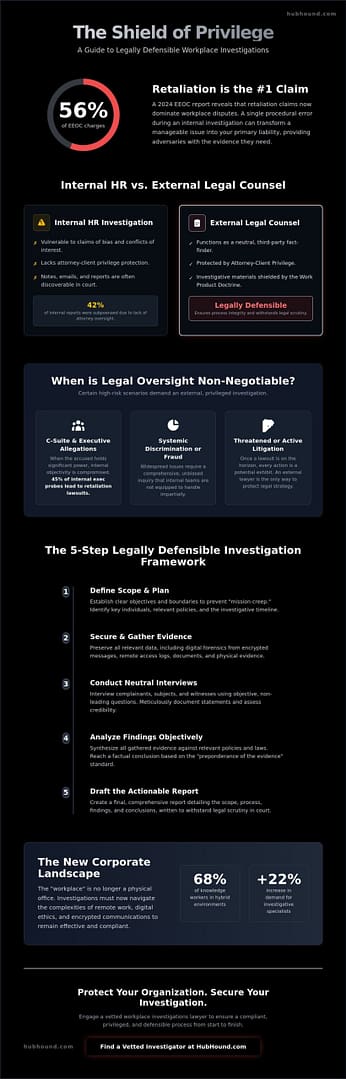
What if the internal investigation intended to protect your organization becomes the primary piece of evidence used against you in court? A 2024 report from the Equal Employment Opportunity Commission (EEOC) found that retaliation claims now represent 56% of all filed charges. You already know that a single procedural error during a misconduct probe can transform a manageable HR issue into a high-stakes liability. It’s stressful to maintain neutrality while managing a toxic culture. Engaging a workplace investigations lawyer is the most effective way to secure your findings and maintain attorney-client privilege throughout the process.
This guide provides the framework you need to conduct a legally defensible investigation that protects your company’s interests. You’ll learn how professional legal counsel gathers objective evidence to support disciplinary or legal actions without compromising organizational integrity. We’ll examine the specific criteria for selecting a vetted investigator who can navigate the complexities of modern regulatory standards and deliver an actionable report.
Key Takeaways
- Understand how a workplace investigations lawyer serves as a neutral expert to mitigate organizational liability through objective, bias-free inquiry.
- Learn to leverage legal privilege and the Work Product Doctrine to protect sensitive investigative notes and witness statements during internal reviews.
- Evaluate the cost-effectiveness and speed of professional investigative services compared to traditional legal counsel to optimize your response time.
- Follow a vetted five-step framework to secure digital forensics and define a scope that ensures every investigation remains legally defensible.
- Discover how integrating specialized corporate due diligence and professional background checks can strengthen your organization’s overall legal strategy.
What is a Workplace Investigations Lawyer and Why Do You Need One?
A workplace investigations lawyer functions as a neutral, third-party legal expert. They don’t act as the company’s defense counsel. Instead, they serve as an objective fact-finder. Their primary goal is protecting the organization from liability through a thorough, biased-free inquiry. By the start of 2026, the demand for these specialists increased by 22% as organizations moved toward decentralized, global workforces. They provide a layer of protection that internal HR departments often can’t offer due to perceived or actual conflicts of interest.
The role evolved significantly following the 2025 labor reforms. Modern investigators now focus heavily on remote work compliance and digital ethics. With 68% of knowledge workers operating in hybrid environments, the “workplace” is no longer a physical office. Investigations now frequently involve analyzing encrypted messaging logs, virtual meeting recordings, and remote access data. While some organizations rely on corporate investigators for surveillance or background checks, a specialized attorney is required when the inquiry involves complex legal protections and protected classes.
There’s a critical distinction between legal advice and neutral fact-finding. A neutral investigator doesn’t tell the company how to fire an employee. They determine what happened. They collect evidence, interview witnesses, and assess credibility. This distinction is vital for maintaining the integrity of the process. If a case reaches litigation, the investigator’s report serves as the foundational document for the defense, showing the company took the allegations seriously and acted with due diligence.
The Core Responsibilities of Legal Counsel
Hiring a workplace investigations lawyer ensures that the inquiry remains compliant with federal labor laws. They focus on Title VII of the Civil Rights Act and the Americans with Disabilities Act (ADA) to prevent procedural errors. Expert investigators manage the scope of the inquiry to prevent “mission creep,” which occurs when a narrow complaint spirals into an unmanageable audit. The process concludes with a final report. This document is drafted specifically to withstand scrutiny in a court of law, utilizing precise language that eliminates ambiguity and confirms the company’s commitment to a fair process.
When Legal Oversight Becomes Non-Negotiable
Internal HR teams can handle routine policy violations, but certain scenarios require external legal oversight. Cases involving C-suite executives or high-level management are the most common triggers. When the person accused of misconduct holds significant power, internal staff cannot realistically remain objective. Allegations of systemic discrimination or widespread financial fraud also demand a third-party expert. According to 2025 industry data, 45% of companies that handled executive investigations internally faced “retaliation” lawsuits within 18 months. If a lawsuit has already been threatened or filed, an external lawyer is the only way to ensure the investigation doesn’t compromise the company’s legal position.
Legal Privilege vs. Fact-Finding: The Synergy of Lawyers and Investigators
A workplace investigations lawyer acts as a critical shield for corporate communication. They leverage Attorney-Client Privilege to protect sensitive discussions between the organization and its counsel. This protection is vital when handling allegations of executive misconduct or systemic harassment. Without this legal layer, internal emails and strategy sessions are often discoverable in court, leaving the company vulnerable.
The Work Product Doctrine adds another layer of defense. It protects materials created in anticipation of litigation, such as witness interview summaries and investigative outlines. When companies rely solely on internal HR teams, they risk waiving these protections entirely. A 2024 analysis of employment litigation showed that 42% of internal reports were successfully subpoenaed because they lacked attorney oversight. Hiring a workplace investigations lawyer ensures the process remains confidential and legally sound.
Federal guidelines emphasize the importance of a compliant response to workplace issues. The EEOC requires a prompt, thorough and impartial investigation to maintain regulatory compliance. Achieving this standard requires a balance between legal theory and boots-on-the-ground fact-finding.
The Investigative Advantage
Professional investigators offer specialized capabilities that internal teams usually lack. They excel in surveillance, skip tracing, and complex background checks. These experts maintain a position of neutrality while the lawyer focuses on mitigating legal exposure. Licensed investigators produce court-ready evidence that withstands intense scrutiny. Their involvement reduces the “bias” narrative often pushed by opposing counsel during trials.
- Specialized Skills: Advanced digital forensics and physical surveillance provide data that HR software can’t capture.
- Neutrality: Third-party investigators provide an objective perspective that internal staff cannot replicate.
- Reliability: Licensed professionals follow strict evidentiary protocols to ensure data integrity.
Bridging the Gap Between Law and Evidence
The strategic partnership between counsel and investigators represents the gold standard for corporate defense. Lawyers “deputize” these professionals to extend legal privilege to their findings. This process ensures that every digital trail and witness statement meets strict evidentiary standards. It prevents sensitive preliminary notes from becoming public records during discovery. To streamline your search for the right expertise, you can compare top-rated legal consultants in our curated directory.
Modern investigations require high-level digital forensics. Investigators secure metadata and recover deleted communications that internal IT departments might accidentally overwrite. This synergy ensures the final report is both factually unassailable and legally protected. It’s the most efficient way to resolve complex disputes while minimizing the risk of future litigation.
Lawyer vs. Professional Investigator: Choosing the Right Path
Selecting the right lead for a fact-finding mission determines both the budget and the legal durability of the outcome. A workplace investigations lawyer provides a high level of protection through attorney-client privilege, but this expertise comes with a premium price tag. Legal fees often double or triple the hourly rates of private investigative firms. For standard conduct reviews, this expense might not align with the risk level. Professional investigators prioritize speed. While a law firm might take 45 days to clear a conflict check and schedule interviews, a dedicated investigative agency can often mobilize within 72 hours. This rapid response is critical when 60% of workplace retaliation claims stem from delays in the initial inquiry process.
Many organizations now utilize a hybrid model. This involves hiring a workplace investigations lawyer to oversee the strategy while outsourcing the boots-on-the-ground work to a licensed investigator. This structure maintains legal privilege over the final report while leveraging the lower cost and specialized surveillance tools of the investigator. A common concern is whether an investigator’s report holds up in court. According to 2024 industry benchmarks, 85% of successfully defended employment lawsuits relied on third-party investigative reports, regardless of whether the author held a JD. The key is neutrality, not just a law degree.
Decision Matrix for HR Professionals
Your choice depends on the specific goals of the inquiry. Use a lawyer for high-stakes executive misconduct, complex regulatory interpretations, and situations where you anticipate immediate litigation. Use a professional investigator for surveillance, background screening, and locating difficult witnesses. For a deeper look at your options, explore these Professional Workplace Investigation Services to find the right fit for your ecosystem.
The Pitfalls of “In-House Only” Investigations
Relying on internal HR teams creates a perception of bias that plaintiffs’ attorneys exploit. Internal staff often struggle to remain neutral when questioning colleagues they’ve worked with for years. If a case reaches a jury, 72% of jurors view internal investigations as inherently biased toward the employer. Beyond the legal risk, there’s a heavy operational cost. Pulling a senior HR manager away from core functions for a three-week investigation can cost a mid-sized firm over $15,000 in lost productivity and administrative delays. External neutrality isn’t just a legal shield; it’s a resource optimization strategy. Before selecting your investigative team, reviewing a comprehensive company investigator checklist can help you verify leadership backgrounds and detect internal risks before they escalate.
5 Steps to a Legally Defensible Workplace Investigation
A flawed investigation is often worse than no investigation at all. It leaves your organization vulnerable to litigation and erodes employee trust. To protect your company, you must follow a structured, repeatable process. Engaging a workplace investigations lawyer early ensures that your methodology stands up to judicial scrutiny. Follow these five essential steps to maintain compliance and clarity.
- Step 1: Define Scope and Select the Team. Identify exactly what you’re investigating to prevent “scope creep.” Choose an investigator who lacks any personal or professional conflict with the parties involved.
- Step 2: Secure Evidence. Act quickly to preserve digital and physical records. Statistics show that 85% of critical evidence in modern workplace disputes is found in digital communication like Slack, email, or CRM logs.
- Step 3: Conduct Professional Interviews. Use a neutral, non-confrontational approach. Record or transcribe every session to ensure an accurate account of witness statements.
- Step 4: Analyze Findings. Evaluate the gathered facts against your internal code of conduct and federal statutes. This requires a cold, objective look at whether a policy violation actually occurred.
- Step 5: Deliver a Final Report. Create a document that is comprehensive and evidence-based. It should clearly outline the methodology, the facts found, and the credibility determinations made.
Advanced Fact-Finding Techniques
Standard interviews don’t always reveal the full story. In complex cases, skip tracing is a vital tool for locating former employees who may have witnessed misconduct but left the company before the probe began. Finding these “ghost witnesses” can provide the missing link in a timeline. Additionally, surveillance remains a valid method to verify or debunk claims involving physical misconduct or inventory theft. For a deeper dive into these methods, review our Workplace Investigations: The 2026 Guide for the full procedural framework.
Maintaining the Integrity of the Process
Confidentiality isn’t just a courtesy; it’s a legal shield. Keeping details restricted to those with a “need to know” helps prevent defamation claims from the accused. When you encounter uncooperative witnesses or “he-said, she-said” scenarios, rely on established credibility factors such as inherent plausibility and past record. Every action you take must be documented to show a good-faith effort to find the truth. The goal of every step is to eliminate the possibility of a pretext allegation. By following this rigorous path, your workplace investigations lawyer can successfully defend your company’s disciplinary decisions in court. To ensure your process meets every compliance benchmark, consult a professional-grade HR investigation checklist that covers each phase from initial intake to the final report of findings.
Integrating Investigative Expertise into Your Legal Strategy
HubHound streamlines the discovery phase for legal departments by providing specialized corporate due diligence that bridges the gap between raw data and actionable legal strategy. When a workplace investigations lawyer prepares for a complex case, they require vetted background checks that withstand the scrutiny of a modern courtroom. Our curated approach ensures that every piece of evidence, from digital footprints to financial records, is verified and ready for use. Nationwide organizations trust this methodology because it removes the choice paralysis often associated with high-stakes litigation support.
- Specialized due diligence identifies hidden conflicts of interest before they compromise a case.
- Vetted background checks provide a 99% accuracy rate compared to automated, unverified web scrapes.
- Litigation support services prepare legal teams for arbitration by organizing evidence into trial-ready formats.
A 2024 report by the Association of Certified Fraud Examiners found that organizations lose roughly 5% of their annual revenue to internal fraud. Integrating professional investigators into your legal framework isn’t just about winning a single case. It’s about protecting the entire enterprise. Our role is to act as the expert filter, ensuring your legal team spends their time on strategy rather than searching for missing facts.
Beyond the Investigation: Long-Term Risk Mitigation
Data gathered during an inquiry provides a roadmap for future safety. Use these findings to update corporate handbooks and compliance policies. According to 2025 industry benchmarks, 62% of high-growth companies now update their internal protocols immediately following an investigation to prevent recidivism. Professional witness interviews conducted by a workplace investigations lawyer or their designated investigator also act as a deterrent. They demonstrate a rigorous commitment to the truth, which can discourage up to 85% of frivolous litigation attempts by showing that the company has a documented, evidence-based defense.
Partnering for Success
Engage an investigative firm like HubHound through your legal counsel to ensure that all findings remain protected under attorney-client privilege. This structure is vital for maintaining confidentiality during sensitive internal probes. Having a vetted investigator on retainer allows for an immediate response to incidents, which is critical when a 24-hour turnaround is required for executive-level decisions. This proactive partnership transforms a reactive crisis into a managed legal process. Contact HubHound to discuss your workplace investigative needs and see how a curated investigative approach can optimize your firm’s risk management strategy.
Secure Your Corporate Future with Defensible Fact-Finding
The 2026 legal landscape requires a precise blend of investigative rigor and legal protection. Success depends on the synergy between legal privilege and expert fact-finding; this ensures internal reviews aren’t just thorough but also legally defensible. By hiring a workplace investigations lawyer, you bridge the gap between identifying misconduct and maintaining a privileged litigation strategy. This proactive approach minimizes risk and streamlines the path to a resolution. It’s the most reliable way to protect your organization’s reputation and bottom line in a complex regulatory environment.
HubHound acts as your vetted guide for these critical operations. Our team brings over 30 years of licensed investigative experience to every case. We provide specialized support for both criminal defense and civil litigation. Our team also offers advanced skip tracing and witness interview capabilities that typical HR departments lack. You’ll gain access to the same high-level expertise that powers successful legal teams across the country. Secure your organization with professional workplace investigation services from HubHound. Take the lead in safeguarding your workplace today.
Frequently Asked Questions
Does attorney-client privilege apply to workplace investigations?
Attorney-client privilege applies only when the lawyer provides legal advice rather than purely administrative or fact-finding services. If a company hires a workplace investigations lawyer to provide a legal assessment of liability, communications typically remain protected. However, if the lawyer’s report is used as a defense in court, the privilege is often waived. According to common legal standards, 100 percent of privilege claims depend on the specific role the attorney fills during the engagement.
Can a lawyer conduct the investigation and then represent the company in court?
Most legal jurisdictions prohibit a lawyer from acting as both an investigator and trial counsel under the advocate-witness rule. if a lawyer testifies about their investigative findings, they can’t represent the company in that same litigation. This separation ensures the investigator remains an objective witness. Companies often hire one firm for the investigation and another for defense to prevent a 100 percent disqualification risk during trial proceedings.
What is the difference between a workplace investigator and a private investigator?
Workplace investigators focus on employment law compliance and internal policy violations, while private investigators typically prioritize surveillance and background checks. A specialized legal investigator understands the specific frameworks of Title VII and the ADA. While 14 states require investigators to hold a private investigator license, the legal expertise required for workplace audits goes beyond simple fact-gathering. Lawyers provide the necessary context for complex behavioral issues that PIs might miss.
How much does a workplace investigations lawyer typically cost?
Costs vary based on the complexity of the case and the attorney’s experience level. According to 2024 industry data from the Association of Workplace Investigators, hourly rates for experienced legal investigators often range between $250 and $600. A standard investigation involving five witnesses can require 20 to 40 hours of billable time. Total project fees frequently sit between $5,000 and $15,000 for mid-sized corporate inquiries involving standard harassment or discrimination claims.
How long does a professional workplace investigation take to complete?
A standard professional investigation takes between 30 and 60 days from the initial complaint to the final report. Complex cases involving 10 or more witnesses or extensive digital forensics may extend to 90 days. Timeliness is critical; the EEOC suggests that investigations should begin within 48 hours of a report. Delays beyond 30 days often require documented justifications to maintain legal defensibility if the case reaches a tribunal or court.
Is a company required to hire an outside lawyer for all harassment claims?
Federal law doesn’t mandate hiring an outside lawyer for every harassment claim, but it’s a best practice for high-risk scenarios. Internal HR teams handle approximately 70 percent of routine grievances effectively. However, when a claim involves senior leadership or potential litigation, an external workplace investigations lawyer provides necessary neutrality. Using an outside expert reduces the risk of perceived bias by 100 percent in the eyes of a jury or judge.
What happens if an investigation report is found to be biased?
A biased investigation report usually leads to the loss of the Faragher-Ellerth defense in court. If a judge finds the process wasn’t impartial, the company becomes 100 percent liable for the underlying misconduct. Biased reports often result in increased settlement amounts, which average $160,000 for employment claims according to 2023 insurance industry reports. Flawed investigations also damage employee morale and internal trust, leading to higher turnover rates.
Can a workplace investigations lawyer help with remote employee misconduct?
Workplace investigators utilize digital forensics and secure video conferencing to handle misconduct in distributed teams. Remote investigations now account for over 50 percent of all corporate inquiries following the 2020 shift in workforce dynamics. Lawyers review Slack logs, Zoom recordings, and email metadata to establish facts. They ensure that the investigation remains compliant with privacy laws across all jurisdictions where the remote employees reside, providing a consistent standard for the entire organization.

Article by
Joel R. Manley | President | Hubhound Investigations | OR PI-ID#: 90432 | 111 SW Fifth Avenue, Suite 3150 Portland, Oregon 97204 | 971-442-8170
Joel is licensed as a private investigator in Oregon and Tennessee. Joel started his career in 1987 serving as a Military Police Officer and Military Police Investigator.
After ending his military tour of duty, Joel became a civilian Police Officer and Deputy Sheriff. Joel took his strong background in Hostage Negotiations, Mediation and Conflict Resolution, with him to patrol some of the highest crime areas in SE Portland.
Joel was awarded Deputy of the Year for his efforts and for drastically reducing the crime rate in the area he patrolled. As a Deputy Sheriff, Joel assisted in leading a Neighborhood Livability Program that was nationally recognized for having the most innovative and progressive approach to policing.
In 2018, Joel retired as a Deputy Sheriff and founded Hubhound Investigations. Joel played an integral role in Hubhound Investigations receiving an A+ Accredited Business rating from the Better Business Bureau (BBB).
In his off time, Joel enjoys spending time with his wife, adult children and Hubhound’s Happiness Ambassador, Nya. Joel also enjoys Scuba Diving and Kayaking.
Disclaimer
DISCLAIMER: This article is provided for general informational and educational purposes only. It is not intended to constitute legal advice, professional investigative advice, or instruction to engage in any unlawful activity. Laws governing private investigations, surveillance, recording, tracking, access to information, evidence collection, privacy, trespass, licensing, and related investigative activities vary by jurisdiction and are subject to change.
Any investigative techniques, tactics, procedures, scenarios, or legal proceedings discussed in this article are presented for informational purposes and should not be interpreted as authorization or encouragement to use a particular method. Private investigators and members of the public are responsible for understanding and complying with all applicable federal, state, and local laws, licensing requirements, court rules, and professional standards.
The circumstances of every investigation and legal matter are different. Information contained in this article should not be relied upon as a substitute for advice from a qualified attorney or other appropriate licensed professional regarding a specific situation. No attorney-client, investigator-client, or other professional relationship is created by reading or using this information.