
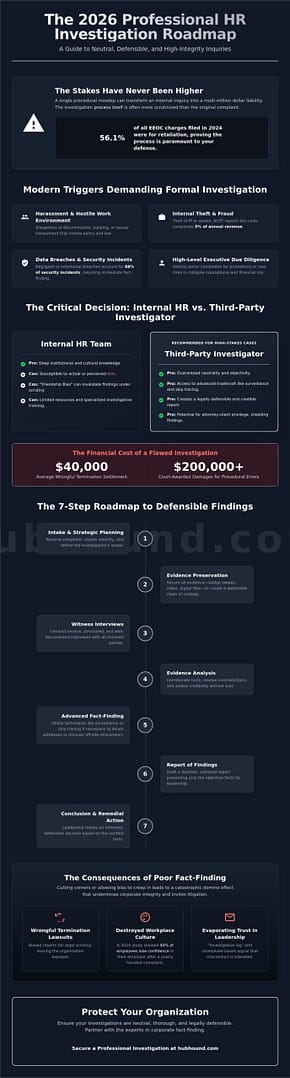
A professional hr investigation is far more than a corporate formality; it is a high-stakes search for truth that requires a hybrid of administrative rigor and advanced investigative tradecraft. You already know that a single procedural misstep can transform a standard internal inquiry into a multi-million dollar liability. In 2024, the EEOC reported that retaliation charges accounted for 56.1% of all private sector filings, proving that the process is often more scrutinized than the original complaint. This guide provides a vetted, professional-grade checklist designed to ensure your outcomes remain neutral and legally defensible.
You’ll gain a clear roadmap to navigate the complexities of gathering non-digital evidence and maintaining objectivity during sensitive interviews. We’ve hand-picked the essential steps to reduce organizational risk while clarifying the facts of workplace misconduct. This 2026 guide breaks down the investigation process into actionable phases, from the initial intake to the final report of findings, ensuring your team has the tools to protect corporate integrity.
Key Takeaways
- Identify modern 2026 triggers for an hr investigation, ranging from data breaches to internal theft, to ensure your process remains proactive.
- Evaluate the strategic advantages of internal teams versus licensed third-party investigators to maximize neutrality and reduce long-term litigation costs.
- Implement rigorous evidence preservation protocols, such as securing badge swipes and video footage, to create a defensible chain of custody.
- Utilize advanced investigative techniques like surveillance and skip tracing to locate witnesses and uncover misconduct that occurs off-site.
- Follow a vetted, step-by-step roadmap that simplifies complex inquiries and protects your organization’s reputation from retaliation claims.
Understanding the HR Investigation: Triggers and Objectives
An hr investigation is a systematic fact-finding process designed to determine the validity of workplace misconduct allegations. It is not a performance review or a casual chat; it is a rigorous administrative inquiry. The goal is to track down objective evidence that allows leadership to make informed, defensible decisions. In the 2026 corporate environment, these investigations have expanded beyond traditional harassment claims. Common triggers now include:
- Sexual harassment and hostile work environment claims.
- Internal theft of physical or intellectual property; the ACFE 2024 report estimates this costs companies 5% of annual revenue.
- Intentional or negligent data breaches, which account for 88% of all security incidents.
- High-level executive due diligence for new hires or promotions.
Maintaining organizational integrity is the primary objective. When you mitigate legal liability, you protect the company’s future. Many of these inquiries begin with employee reporting of misconduct, which serves as a critical mechanism for identifying internal risks. Ignoring these reports isn’t just poor management; it’s a legal risk. The “Duty to Investigate” is a clear legal standard. If a company knows or should have known about misconduct, they’re obligated to act immediately. A delay of just a few days can be interpreted as negligence in court.
When is a Formal Investigation Mandatory?
Not every workplace disagreement requires a full-scale inquiry, but you must recognize when informal resolution is no longer an option. If an allegation involves physical safety, financial fraud, or systemic discrimination, a formal hr investigation is mandatory. Regulatory requirements often dictate this process. For example, federal compliance standards require documented responses to reports of financial impropriety or safety violations. Watch for “red flag” scenarios like sudden shifts in financial records or multiple complaints against a single supervisor. These patterns demand immediate, professional intervention to stop potential damage.
The Consequences of Poor Fact-Finding
Cutting corners during the evidence-gathering phase is a recipe for disaster. Biased investigations frequently lead to wrongful termination lawsuits that are difficult to win. If your investigator starts with a conclusion and works backward, the resulting report won’t stand up to legal scrutiny. Beyond the courtroom, “investigative lag” destroys workplace culture. When employees see that misconduct goes unaddressed for weeks, trust in leadership evaporates. A 2024 study showed that 40% of employees lose confidence in their employer after a poorly handled internal complaint. To rebuild these cultural foundations, you can discover Michael Hingson for expert perspective on leadership and trust. Investigative neutrality is the cornerstone of a defensible report.
Internal HR vs. Third-Party Investigators: A Decision Framework
The decision to keep an hr investigation internal or outsource it determines your legal standing long before a case reaches a courtroom. While internal HR teams possess deep institutional knowledge, they often struggle with perceived or actual bias. The EEOC guidelines for investigations emphasize that a lack of impartiality can compromise the entire process. For high-stakes cases, engaging a workplace investigations lawyer provides an added layer of attorney-client privilege. This professional boundary shields sensitive findings from early discovery during litigation, allowing for a more candid assessment of facts.
Analyze the cost-benefit ratio before committing to an internal path. While a licensed private investigator requires an up-front fee, the average cost of a wrongful termination settlement reached $40,000 in 2023. Court-awarded damages frequently exceed $200,000 when procedural errors are found. Investing in a professional report now prevents a massive financial drain later. It’s about buying certainty in an unpredictable legal environment. External experts bring a level of administrative rigor that internal departments, often stretched thin by daily operations, simply cannot match.
The Neutrality Gap: When Internal Teams Are Too Close
Conflicts of interest are often invisible until they’re exposed in a deposition. “Friendship bias” occurs when an HR manager has worked alongside a subject for years, making it nearly impossible to remain objective. This proximity can invalidate an entire investigation in court. In cases involving C-suite executives, external oversight is non-negotiable. Corporate boards often demand third-party reports to fulfill their fiduciary duties. If a CEO is accused of misconduct, an internal HR director reporting to that CEO faces an impossible conflict. Using an outsider ensures that the investigation isn’t influenced by internal power dynamics or fear of retaliation. It provides the “optics of neutrality” that judges and juries expect.
Specialized Skills: Beyond the Interview Room
Standard HR software can track emails and login logs, but it can’t perform surveillance or locate a witness who has “gone dark.” Professional investigators bring tradecraft like skip tracing to find former employees who hold critical information but no longer answer company phone calls. When “digital footprints” aren’t enough to prove misconduct, physical evidence becomes the deciding factor. You must determine if your case requires professional workplace investigation services to ensure a thorough search for the truth. While IT can lock a laptop, a licensed investigator can conduct surveillance to confirm if a terminated employee is actively violating a non-compete agreement. If you need to scale your investigative capacity, find a vetted agency that specializes in corporate due diligence and complex misconduct cases.
The 2026 HR Investigation Checklist: 7 Essential Steps
Success in a modern hr investigation depends on a structured, repeatable process. You can’t rely on intuition; you need a vetted framework that withstands legal scrutiny. Start with these five foundational steps before moving into the final analysis and reporting phases. This guide to conducting a workplace investigation provides a baseline, but the 2026 standard requires deeper technical integration.
- Step 1: Immediate Evidence Preservation. Secure all digital and physical data before anyone knows a formal inquiry has begun. This includes email logs, badge swipes, and video footage. Digital evidence is fragile; a 2024 report found that 15% of critical evidence is lost when preservation is delayed by more than 48 hours.
- Step 2: Defining the Investigative Scope. Draft a clear scope document to prevent “scope creep.” If you’re investigating a specific theft, don’t let the inquiry drift into general performance issues unless they’re directly related.
- Step 3: Selecting the Investigator. Match the investigator to the case complexity. As discussed, high-profile executive cases usually require external, licensed professionals to maintain the optics of neutrality.
- Step 4: The Interview Phase. Sequence your interviews strategically. Start with the complainant, move to third-party witnesses, and save the subject for last. This allows you to confront the subject with the most complete set of facts.
- Step 5: Corroboration and Fact-Checking. This is the “Hound” phase. Cross-reference interview statements against the objective data secured in Step 1. If a witness claims they were off-site, but their badge swiped at 2:00 PM, you’ve identified a critical credibility gap.
Step 6: Analyzing the Preponderance of Evidence
Most corporate inquiries use the “preponderance of evidence” standard. This means you’re looking for what’s more likely than not to have occurred, typically a 51% certainty threshold. Move beyond “he-said, she-said” by weighting witness credibility through a professional framework. Consider the witness’s opportunity to observe the event, any potential motives for fabrication, and the consistency of their story over time. Synthesize these conflicting statements into a coherent timeline that accounts for every objective data point collected during the hr investigation.
Step 7: The Final Investigative Report
Your final report must be court-ready. Structure it with a clear summary, a detailed methodology section, factual findings, and attached exhibits. Avoid legal conclusions like “this was harassment.” Instead, stick to the facts: “the subject sent ten unsolicited messages after being asked to stop.” This protects the organization by providing the basis for a decision without making premature legal admissions. For a deeper look at maintaining long-term compliance, consult our Workplace Investigations: The 2026 Guide to ensure your internal culture remains resilient and transparent.
Advanced Techniques: Tracking the Truth with Professional Tradecraft
Standard hr investigation methods often reach their limits at the office door. When misconduct moves off-site or involves sophisticated concealment, you need professional tradecraft to bridge the evidence gap. This phase involves advanced tactics like surveillance, skip tracing, and forensic asset searches to build a complete picture of the truth. In 2024, the National Insurance Crime Bureau noted a significant rise in suspicious claims, proving that what happens outside the workplace directly impacts your bottom line. Don’t rely on guesswork when the stakes involve corporate integrity; instead, utilize vetted investigative methods to secure your interests.
Asset searches are another critical tool for identifying financial motives in cases of internal theft or embezzlement. If an employee’s lifestyle suddenly exceeds their salary, an asset search can uncover hidden accounts or property holdings that provide a motive for fraud. Similarly, witness interviews must be conducted using techniques that prioritize statement admissibility. A professional investigator knows how to structure questions to elicit factual admissions that hold up under the pressure of cross-examination during civil litigation. These advanced methods ensure that every stone is turned in your search for the truth.
The Role of Surveillance in Workplace Misconduct
Discreet observation is often the only way to confirm FMLA abuse or workers’ comp fraud. While an employee might claim a debilitating injury in an interview, surveillance footage may show them engaging in strenuous physical activity. Working with a corporate investigation firm ensures these operations stay within legal boundaries, avoiding claims of harassment or privacy violations. Surveillance provides the unfiltered reality that interviews often miss. It offers objective, undeniable proof that can resolve a case without the need for a lengthy trial.
Skip Tracing and Locating Key Witnesses
Witnesses who have “gone dark” or moved out of state present a major challenge for any hr investigation. Finding these individuals is critical for building a strong defense against wrongful termination or retaliation claims. Professional investigators utilize proprietary databases that go far beyond public records to track down elusive former associates. This process often intersects with professional process service, ensuring that once a witness is located, they are legally notified to provide testimony. If you’re struggling to locate a key witness for an upcoming hearing, contact an expert investigator to secure the testimony you need.
Securing Your Organization: Why HubHound is the Trusted Choice
HubHound functions as a vetted filter for organizations facing high-stakes misconduct claims. We understand that a modern hr investigation requires more than just a basic checklist; it demands a sophisticated integration of tradecraft and legal strategy. With three decades of licensed investigative experience, we’ve refined our process to deliver the clarity business owners need. Our team works as an insider guide, helping you track down the highest quality solutions for complex corporate challenges. We don’t just provide data; we provide the objective, hand-picked evidence necessary to protect your company’s future.
By integrating our findings with your existing legal strategy, we provide a layer of protection that internal departments often lack. This seamless litigation support ensures that every phase of the inquiry is defensible in court. Our expertise allows us to bridge the gap between administrative HR functions and professional investigative tradecraft. This dual approach offers several key advantages for your organization:
- Access to specialized proprietary databases for witness location and asset searches.
- Objective reports that satisfy the fiduciary duties of corporate boards.
- Streamlined evidence preservation that meets 2026 technical standards.
- Direct coordination with legal counsel to maintain attorney-client privilege.
Our Approach to Workplace Integrity
We prioritize discreet, action-oriented discovery that respects the professional’s time. You’ve likely felt the choice paralysis that comes with selecting an investigative agency or software tool. We alleviate this by providing clear, fact-based reports that move you straight to a solution. Our focus remains on optimization and efficiency within your corporate ecosystem. We’ve already done the heavy lifting of research, identifying the most effective methods for tracking truth in the modern workplace. This curated approach ensures that your leadership team can make informed decisions without the cognitive load of managing the investigation’s granular details.
Ready to Protect Your Interests?
Choosing a professional partner for an hr investigation is a critical step in safeguarding your corporate reputation and financial health. A specialized expert provides the quiet confidence and niche expertise required to resolve sensitive matters. Contact HubHound for a confidential consultation to transition from uncertainty to investigative clarity. Please be aware that our services are highly specialized for corporate environments. We focus exclusively on pure investigation, due diligence, and litigation support. We explicitly exclude personal bodyguard services to maintain our hyper-focus on being the most reliable investigative ally for growth-focused companies.
Strengthening Your Corporate Defenses for 2026
Corporate integrity isn’t a static achievement; it’s a continuous process of verification and response. You’ve learned that a defensible hr investigation relies on more than just internal policy. It requires a neutral framework that includes immediate evidence preservation and advanced tradecraft like skip tracing or surveillance. By following a rigorous 7-step checklist, you mitigate the risk of retaliation claims, which accounted for 56.1% of EEOC filings in 2024. This administrative rigor ensures that your findings remain objective and your leadership stays informed.
Don’t leave your organization’s reputation to chance when facing complex misconduct allegations. HubHound provides the specialized expertise needed to navigate high-stakes corporate due diligence with quiet confidence. Our licensed investigators bring over 30 years of experience to every case, delivering court-ready reporting and vetted evidence that clarifies the truth. Partner with HubHound for Professional HR Investigations and ensure your investigative process is both efficient and legally sound. You have the tools to protect your culture and your bottom line starting today.
Frequently Asked Questions
How long does a typical HR investigation take to complete?
Most inquiries take 20 to 45 business days to reach a final resolution. The timeline depends on witness availability and the volume of digital evidence that requires review. Complex cases involving forensic data recovery or multiple departments often extend toward the 60-day mark. Prompt action is essential to prevent investigative lag, which can erode employee trust and increase organizational risk.
Can an employee refuse to participate in an HR investigation?
An employee can refuse, but this typically constitutes a violation of company policy that leads to disciplinary action. Private sector employees don’t have a constitutional right to remain silent during an internal hr investigation. Most employment agreements include a mandatory duty to cooperate. If an employee refuses to speak, the company is entitled to make a determination based solely on the remaining available evidence.
What is the difference between an HR investigation and a criminal investigation?
The primary difference lies in the burden of proof and the ultimate objective. An hr investigation utilizes the “preponderance of evidence” standard, requiring only 51% certainty that a policy violation occurred. Criminal investigations are conducted by law enforcement and require proof “beyond a reasonable doubt” to determine if a statute was broken. Corporate inquiries focus on workplace safety and policy compliance rather than criminal prosecution.
Should we put the accused employee on administrative leave during the process?
Place the accused on administrative leave if there is a credible risk of retaliation, evidence tampering, or ongoing harm. Paid leave is the industry standard to avoid claims of pre-judgment or constructive discharge. In 2023, approximately 72% of organizations utilized temporary leave for high-severity cases involving safety or significant financial fraud. This separation protects the integrity of the fact-finding process while the inquiry continues.
How do we maintain confidentiality during a high-profile workplace investigation?
Limit information sharing to a strict “need-to-know” basis and utilize encrypted communication channels for all reports. You should instruct all participants not to discuss the matter, though you must remain mindful of NLRB rulings regarding employee rights. Engaging an external investigator creates a professional boundary that prevents office gossip. This approach ensures that sensitive details don’t leak before the final report is finalized and reviewed by counsel.
What happens if the complainant wants to withdraw their allegation mid-investigation?
The company must generally proceed with the inquiry if the allegations involve serious misconduct or legal violations. Once leadership becomes aware of a potential threat, the legal “Duty to Investigate” remains active regardless of the complainant’s current wishes. Continuing the process protects the organization from future liability and ensures that systemic issues aren’t ignored or hidden through informal private agreements.
Is it legal for a private investigator to conduct surveillance on an employee?
It is legal as long as the observation occurs in public spaces where there is no reasonable expectation of privacy. Licensed investigators must adhere to strict privacy laws and avoid intrusive methods like trespassing or illegal electronic monitoring. Surveillance is a standard tool for confirming FMLA abuse or workers’ compensation fraud. It provides objective proof of behavior that often contradicts statements made during an internal interview.
How much does a professional workplace investigation cost on average?
Costs vary based on the scope and complexity of the case, but mid-range inquiries typically involve 30 to 50 billable hours according to 2024 industry benchmarks. Cases involving C-suite executives or forensic data recovery require a higher investment due to the specialized skills required. These costs are small compared to the $40,000 average settlement for wrongful termination claims. Investing in professional fact-finding provides a defensible shield against multi-million dollar litigation outcomes.

Article by
Joel R. Manley | President | Hubhound Investigations | OR PI-ID#: 90432 | 111 SW Fifth Avenue, Suite 3150 Portland, Oregon 97204 | 971-442-8170
Joel is licensed as a private investigator in Oregon and Tennessee. Joel started his career in 1987 serving as a Military Police Officer and Military Police Investigator.
After ending his military tour of duty, Joel became a civilian Police Officer and Deputy Sheriff. Joel took his strong background in Hostage Negotiations, Mediation and Conflict Resolution, with him to patrol some of the highest crime areas in SE Portland.
Joel was awarded Deputy of the Year for his efforts and for drastically reducing the crime rate in the area he patrolled. As a Deputy Sheriff, Joel assisted in leading a Neighborhood Livability Program that was nationally recognized for having the most innovative and progressive approach to policing.
In 2018, Joel retired as a Deputy Sheriff and founded Hubhound Investigations. Joel played an integral role in Hubhound Investigations receiving an A+ Accredited Business rating from the Better Business Bureau (BBB).
In his off time, Joel enjoys spending time with his wife, adult children and Hubhound’s Happiness Ambassador, Nya. Joel also enjoys Scuba Diving and Kayaking.
Disclaimer
DISCLAIMER: This article is provided for general informational and educational purposes only. It is not intended to constitute legal advice, professional investigative advice, or instruction to engage in any unlawful activity. Laws governing private investigations, surveillance, recording, tracking, access to information, evidence collection, privacy, trespass, licensing, and related investigative activities vary by jurisdiction and are subject to change.
Any investigative techniques, tactics, procedures, scenarios, or legal proceedings discussed in this article are presented for informational purposes and should not be interpreted as authorization or encouragement to use a particular method. Private investigators and members of the public are responsible for understanding and complying with all applicable federal, state, and local laws, licensing requirements, court rules, and professional standards.
The circumstances of every investigation and legal matter are different. Information contained in this article should not be relied upon as a substitute for advice from a qualified attorney or other appropriate licensed professional regarding a specific situation. No attorney-client, investigator-client, or other professional relationship is created by reading or using this information.