
Hiring a private investigator isn’t just about finding facts; it’s about managing legal liability. If you’re looking to hire a private investigator in 2026, you likely feel the weight of choosing between a professional agency and an unlicensed “cowboy” who could compromise your case. It’s a legitimate worry since over 40 states and the District of Columbia now require strict licensing as of July 2025. You need evidence that stands up in court, not a legal headache that drains your budget.
We understand that this decision involves balancing cost against the quality of the outcome. This guide eliminates the guesswork by providing a vetted roadmap for identifying top tier agencies. You’ll learn to navigate fee structures, which currently range from $75 to $400 per hour for specialized services, and ensure your investigator follows the latest 2026 compliance standards. We’ll explore how to verify credentials, understand retainer structures between $400 and $2,500, and secure the court-admissible evidence you need to move forward with confidence.
Key Takeaways
- Identify the modern role of evidence specialists to ensure your investigation leverages the latest digital and physical surveillance tools.
- Protect your organization from legal liability by understanding the strict boundaries between professional investigation and unauthorized law enforcement activities.
- Apply a rigorous vetting framework to hire a private investigator with verified credentials and the specialized expertise needed for court-ready results.
- Optimize your investigative budget by establishing a clear scope of work and a formal service agreement during the initial intake process.
- Quantify the ROI of professional evidence by using curated background screenings and due diligence to mitigate long-term corporate risk.
Understanding the Role of a Professional Private Investigator
In 2026, the image of the lone detective in a dark alley is obsolete. Modern investigators operate as high-level evidence specialists who provide the vetted intelligence required for complex litigation and corporate decision-making. If you are researching What is a Private Investigator? to understand the scope of the profession, you’ll find they are essentially risk management partners. The Bureau of Labor Statistics projected an 8% growth in this field between 2022 and 2032, reflecting the increasing demand for specialized data in an era of digital misinformation.
Don’t confuse a basic public record search with a professional field investigation. While any manager can access surface-level data, professional investigators utilize proprietary databases and tactical field skills to uncover what’s intentionally hidden. This distinction is vital for corporate risk mitigation. Professional agencies provide an optimization of resources that internal departments cannot match, especially when court-admissible evidence is the required outcome. As of 2023, there were over 38,000 private investigators in the United States, with the most successful agencies specializing in strategic litigation support rather than simple information gathering. Understanding the full scope and standards of modern PI services is essential before engaging any investigative firm.
Core Services: From Background Screening to Surveillance
High-stakes hiring requires more than a standard credit pull. Integrating pre-employment background checks into your onboarding ecosystem prevents costly bad hires and protects your brand’s integrity. Professional surveillance is equally specialized. It isn’t just “watching” a subject; it’s the legal collection of high-definition evidence using advanced optics and GPS technology. For legal teams, skip tracing and locate investigations are essential tools for serving process or finding witnesses who’ve gone off the grid to avoid testimony.
Identifying the Turning Point: When to Hire an Expert
Knowing when to hire a private investigator is a strategic skill for any business leader. Most internal teams reach their limit when a case requires specialized surveillance equipment or moves beyond the digital footprint. Neutrality is another critical factor. In cases of internal fraud or workplace misconduct, a third-party investigator provides the objective distance needed to protect the company from bias claims during litigation. Before major acquisitions, using an expert to verify corporate due diligence ensures you aren’t inheriting undisclosed liabilities that could tank the deal’s value. When the risk of being wrong carries a higher price than the investigation itself, it’s time to bring in a professional.
Navigating the Legal and Ethical Boundaries of Investigation
Success in a modern investigation isn’t measured by the volume of information gathered, but by its legality. When you decide to hire a private investigator, you’re essentially hiring a consultant on the law of evidence. Professional investigators don’t operate under the “color of law.” Unlike police officers, they lack the authority to execute search warrants or make arrests. This distinction is critical because any evidence obtained through methods that violate privacy laws or civil rights will be discarded by a judge immediately. In 2026, legal compliance is the only path to a successful outcome. With over 40 states and the District of Columbia requiring strict licensing as of July 2025, the margin for error has disappeared.
Ethical boundaries are often where “budget” investigators fail. Using illegal shortcuts like wiretapping or unauthorized GPS tracking doesn’t just jeopardize your case; it exposes you to vicarious liability. If an investigator you’ve hired commits a crime to get information, you could face legal consequences as the hiring party. Professionalism means understanding Private Investigator Licensing and Legal Requirements to ensure every action taken is within the bounds of the law. This includes navigating the complexities of public versus private space and maintaining high standards during witness interviews or skip tracing operations.
The Scope of Authority: What a PI Can and Cannot Do
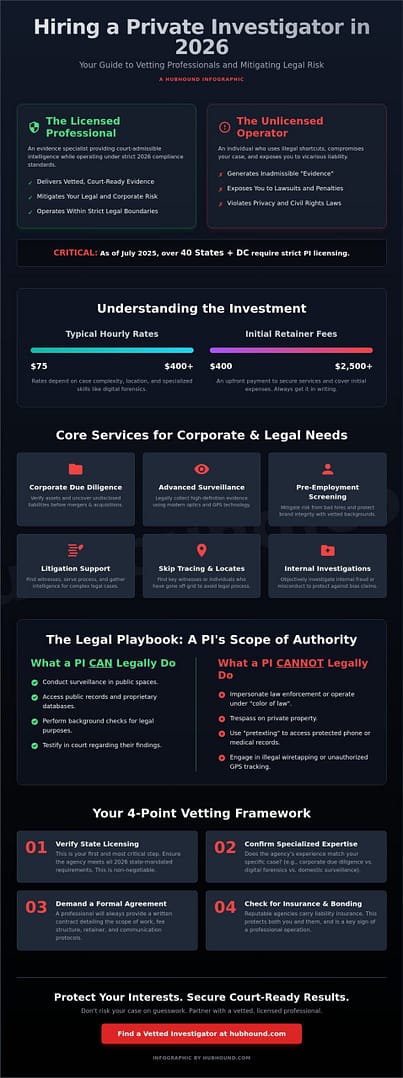
Legality in 2026 is strictly defined. While a PI can conduct surveillance in public areas, they can’t trespass on private property or use “pretexting” to obtain protected records like phone logs or medical history through deception. GPS tracking is also highly regulated. In many jurisdictions, it requires the consent of the vehicle owner or a specific legal justification. A vetted professional will refuse requests that cross these lines. They focus on obtaining non-public information through legitimate means, such as proprietary databases and OSINT (Open Source Intelligence) techniques that don’t violate federal privacy statutes.
Evidence Admissibility: Ensuring Results Hold Up in Court
The ultimate goal of any investigation is often its use in a courtroom. To achieve this, investigators must maintain a rigorous chain of custody for all physical and digital evidence. Using advanced surveillance techniques ensures that video and photographic evidence are time-stamped and verified for authenticity. This level of precision allows the investigator to serve as an expert witness during civil litigation, providing testimony that is both credible and unshakeable. If you need to secure your company’s future, it’s best to partner with a vetted agency that prioritizes compliance over convenience.
How to Evaluate and Vette a Private Investigative Agency
Vetting requires a shift from surface-level reviews to deep verification. In 2026, automated review bots and AI-generated testimonials can easily inflate an agency’s online reputation. To truly vet a firm, you must look past the star ratings and focus on hard data. Request their specific license number and verify its status through the appropriate state regulatory body. This isn’t just a suggestion; it’s a critical step to ensure you don’t accidentally hire an unlicensed operator. As of July 2025, more than 40 states and the District of Columbia require strict licensing, making this verification your first line of defense.
Evaluate the agency’s technological stack before signing a contract. A modern investigator should utilize advanced Open Source Intelligence (OSINT) tools, digital forensic software, and high-definition surveillance equipment. Ask about their data protection protocols. If an agency doesn’t prioritize the security of the information they collect, they’re a liability to your organization’s ecosystem. Professional firms should be able to explain how they store sensitive data and what encryption standards they use to prevent leaks.
Essential Credentials: Licensing and Insurance
Insurance is a non-negotiable requirement. Ensure the firm carries Professional Liability Insurance, also known as Errors and Omissions (E&O). This coverage protects you if an investigator makes a professional mistake that leads to legal or financial damages. Most professional agencies also maintain a $10,000 surety bond; this was a standard requirement for licensed firms as of July 2025. Verify that their license is current, as renewals are typically required every one to two years. Don’t hesitate to ask for a Certificate of Insurance (COI) directly from their provider to confirm active coverage.
Specialization vs. Generalization
Don’t hire a generalist for a complex corporate problem. If you need to address internal theft, harassment, or compliance violations, you should hire a specialist for workplace investigations rather than an agency that primarily handles domestic surveillance. Specialists understand the nuances of employment law and organizational integrity. When you hire a private investigator, you are paying for their specific expertise and their ability to navigate your industry’s unique risks.
Ask for redacted case studies or professional references relevant to your specific needs. These documents prove their ability to handle cases similar to yours without compromising previous clients’ confidentiality. Look for investigators with prior law enforcement or specialized corporate backgrounds. These professionals often possess superior interview skills and a deeper understanding of the chain of custody for evidence. Their experience ensures that the intelligence they gather is not just accurate, but also useful for your legal or management team.
A Step-by-Step Guide to the Hiring and Intake Process
Efficiency starts with a structured intake. To hire a private investigator effectively, you must arrive at the first meeting with a clear brief. This document should include all known names, relevant timelines, and verified facts. Avoid withholding information; professional investigators need the full picture to assess case feasibility and legal boundaries. Providing a complete data set at the start allows the agency to optimize their resources and reduces the time spent on preliminary discovery.
Managing expectations is equally vital during the intake phase. A professional investigator will never “guarantee” a specific outcome, such as proving a subject’s guilt or finding a missing person within 24 hours. In 2026, the only guarantee a vetted firm offers is the professional pursuit of evidence and the delivery of court-ready documentation. If an agency promises a specific result before the investigation begins, it is a significant red flag indicating a lack of professional integrity.
Preparing for the Initial Consultation
Use the first meeting to test the agency’s expertise and communication style. Ask about their specific experience with cases that mirror your current situation. Inquire about their reporting frequency and how they deliver evidence. A reliable firm will have a clear protocol for updates, ensuring you aren’t left wondering about the status of your case. Watch for investigators who seem overly eager to bypass legal hurdles; this behavior suggests they may take shortcuts that could jeopardize your case’s admissibility in court.
Understanding Fee Structures and Service Agreements
Transparency in pricing is a hallmark of a vetted firm. When calculating the private investigator cost, you’ll find that basic services typically range from $75 to $125 per hour. Specialized corporate work, digital forensics, or a team of multiple agents often commands rates between $150 and $450 per hour. Most firms require a retainer fee before work begins. These retainers generally range from $400 to $2,500 or more, depending on the projected scope of the project. Flat fees are also common for specific tasks:
- Background checks: $100 to $500
- Locating a missing person: $250 to $1,000
- Concealed financial asset searches: $500 to $2,500
Every engagement must be anchored by a formal service agreement. This contract should detail the scope of work, confidentiality clauses, and a breakdown of all potential expenses. It transforms a vague request into a professional engagement with clear deliverables. If you’re ready to secure high-quality intelligence, find a vetted investigative partner who prioritizes transparent billing and rigorous reporting protocols.
Maximizing the ROI of Your Investigative Investment
Viewing an investigation as a sunk cost is a strategic oversight. When you hire a private investigator, you’re securing leverage for legal settlements and preventing catastrophic corporate losses. High-quality intelligence often facilitates a favorable settlement before a case reaches trial, which saves significant capital in ongoing legal fees. The Bureau of Labor Statistics reported a median annual salary of $52,120 for investigators in May 2023, yet the financial impact of their work for corporate clients often reaches into the millions through recovered assets and mitigated risks.
The long-term value of thorough corporate due diligence cannot be overstated. Beyond solving an immediate crisis, investigative reports provide a blueprint for internal policy improvements. If an investigation uncovers a recurring vulnerability in your supply chain or a gap in your background screening process, you can implement targeted optimizations to prevent future incidents. This proactive approach transforms a reactive expense into a strategic asset for organizational growth. It’s about building a resilient ecosystem where risk is identified before it manifests as a loss.
Strategic Evidence Gathering for Legal Success
Professional witness interviews do more than gather facts; they test the strength of a legal position. By securing unshakeable statements early, your legal team can better predict trial outcomes. Skip tracing also plays a vital role in ROI by preventing costly delays in process service. When a subject intentionally evades service, every day of delay adds to your legal bill. Professional surveillance provides the objective, time-stamped documentation needed to resolve disability fraud or intellectual property theft cases quickly and decisively, ensuring the results are admissible in any court proceeding.
The HubHound Advantage: Professional Vetting
HubHound eliminates the choice paralysis that often accompanies high-stakes hiring. We act as an expert filter, curating a selection of investigative agencies that meet the highest standards of legal compliance and ethical evidence collection. Our “vetted” approach ensures you aren’t gambling with your company’s reputation or legal standing. We’ve done the heavy lifting of research, verifying that the partners in our ecosystem prioritize transparency and professional results. If you’re ready to secure the intelligence your case requires, contact our team for a confidential consultation to find the right hand-picked expert for your needs.
Securing Your Intelligence Strategy for 2026
Securing your organization’s future requires more than just gathering data; it requires a commitment to legal integrity and expert vetting. By following a structured intake process and verifying professional credentials, you protect your legal standing and ensure every piece of evidence is court-ready. The decision to hire a private investigator shouldn’t feel like a gamble. When you prioritize agencies that utilize advanced technological stacks and maintain rigorous ethical standards, you transform a potential liability into a high-ROI strategic asset that benefits your entire corporate ecosystem.
HubHound simplifies this complex discovery process by acting as your trusted filter in the investigative market. We bring over 30 years of combined investigative experience to every consultation, ensuring our network meets the highest professional benchmarks. Our team connects you with licensed and insured nationwide specialists who adhere to vetted and verified professional standards. Don’t leave your critical evidence to chance. Contact HubHound for a Professional Investigative Consultation to secure the clarity and results your case demands. You’ve done the hard work of identifying the problem; let us help you find the professional solution.
Frequently Asked Questions
Is it legal to hire a private investigator for workplace issues?
Yes, it’s legal for employers to use professional investigators to address internal fraud, harassment, or theft. The investigator must comply with federal privacy laws and avoid trespassing on private property during the process. Using a neutral third party provides the objective distance needed to protect your company’s ecosystem from bias claims during future litigation or employment tribunals.
How much does it typically cost to hire a private investigator in 2026?
Costs depend on the complexity of the task, with basic hourly rates averaging between $75 and $125 as of March 2026. Specialized services like digital forensics or corporate due diligence typically range from $125 to $400 per hour. Most firms require an upfront retainer between $400 and $2,500, while flat fees for background checks usually fall between $100 and $500.
Can a private investigator access private phone records or bank accounts?
No, investigators cannot legally access protected phone logs, text messages, or bank statements without a subpoena or the owner’s written consent. Federal statutes like the Gramm-Leach-Bliley Act prohibit the use of deception to obtain financial records. A professional agency focuses on identifies financial footprints through legal asset searches and Open Source Intelligence (OSINT) techniques instead of illegal shortcuts.
How long does a typical private investigation take to complete?
Timelines vary based on the project scope, ranging from 48 hours for a standard background check to several months for complex corporate fraud cases. Surveillance operations typically require 3 to 5 days of field activity to establish reliable patterns. Your service agreement should include specific milestones to keep the investigation efficient and aligned with your legal or management goals.
Will the person being investigated find out they are under surveillance?
Professional investigators utilize long-range optics and advanced camouflage techniques to remain undetected. Agencies that employ former law enforcement officers often maintain high success rates for remaining anonymous during field operations. While no firm can guarantee 100% secrecy, a vetted expert prioritizes discretion to ensure the subject doesn’t discover the active evidence collection process.
What happens if a private investigator discovers illegal activity?
The investigator’s primary responsibility is to document the findings for the client. While they aren’t always required to report crimes to the police, they must follow state-specific laws regarding mandatory reporting for certain high-level felonies. Usually, the investigator presents the evidence to your legal counsel, who then decides whether to involve law enforcement or proceed with civil action.
Can private investigator evidence be used in a court of law?
Yes, evidence is admissible if it was collected legally and follows a strict chain of custody. When you hire a private investigator, verify that they use time-stamped video and provide authenticated daily logs. These professionals often testify as expert witnesses, providing the objective verification that judges and juries require to make informed decisions in civil litigation.
What is the difference between a private investigator and a private detective?
The terms are generally used interchangeably in the industry, though “detective” often suggests a previous career in law enforcement. Some jurisdictions use one term over the other in their official licensing statutes, but the core responsibilities remain identical. Both roles focus on the professional collection of intelligence and the mitigation of risk within a regulated, licensed framework. For a comprehensive overview of how these PI services are structured, scoped, and standardized in 2026, reviewing current industry benchmarks is strongly recommended.

Article by
Joel R. Manley | President | Hubhound Investigations | OR PI-ID#: 90432 | 111 SW Fifth Avenue, Suite 3150 Portland, Oregon 97204 | 971-442-8170
Joel is licensed as a private investigator in Oregon and Tennessee. Joel started his career in 1987 serving as a Military Police Officer and Military Police Investigator.
After ending his military tour of duty, Joel became a civilian Police Officer and Deputy Sheriff. Joel took his strong background in Hostage Negotiations, Mediation and Conflict Resolution, with him to patrol some of the highest crime areas in SE Portland.
Joel was awarded Deputy of the Year for his efforts and for drastically reducing the crime rate in the area he patrolled. As a Deputy Sheriff, Joel assisted in leading a Neighborhood Livability Program that was nationally recognized for having the most innovative and progressive approach to policing.
In 2018, Joel retired as a Deputy Sheriff and founded Hubhound Investigations. Joel played an integral role in Hubhound Investigations receiving an A+ Accredited Business rating from the Better Business Bureau (BBB).
In his off time, Joel enjoys spending time with his wife, adult children and Hubhound’s Happiness Ambassador, Nya. Joel also enjoys Scuba Diving and Kayaking.
Disclaimer
DISCLAIMER: This article is provided for general informational and educational purposes only. It is not intended to constitute legal advice, professional investigative advice, or instruction to engage in any unlawful activity. Laws governing private investigations, surveillance, recording, tracking, access to information, evidence collection, privacy, trespass, licensing, and related investigative activities vary by jurisdiction and are subject to change.
Any investigative techniques, tactics, procedures, scenarios, or legal proceedings discussed in this article are presented for informational purposes and should not be interpreted as authorization or encouragement to use a particular method. Private investigators and members of the public are responsible for understanding and complying with all applicable federal, state, and local laws, licensing requirements, court rules, and professional standards.
The circumstances of every investigation and legal matter are different. Information contained in this article should not be relied upon as a substitute for advice from a qualified attorney or other appropriate licensed professional regarding a specific situation. No attorney-client, investigator-client, or other professional relationship is created by reading or using this information.