
Did you know that 80% of modern investigative work now happens behind a screen through Open-Source Intelligence (OSINT) rather than in the field? As the global investigation market reaches a projected $25.4 billion in 2026, the reliance on digital forensics and AI-powered tools has fundamentally changed how you must evaluate pi services. It’s common to feel overwhelmed by the legal complexities and ethical risks involved in gathering evidence that actually holds up in court. You need reliable results, but you can’t afford to hire an unvetted professional who might compromise your case or your corporate reputation.
This guide provides a clear framework for vetting professional investigators to ensure you receive curated, legally-defensible intelligence that effectively mitigates risk. You’ll learn how to navigate the full spectrum of investigative categories, understand current licensing standards across 44 states, and apply the specific strategies needed to secure court-ready evidence for your legal or private needs. We’ll break down the latest industry costs and technological shifts to give you total confidence in your next hire.
Key Takeaways
- Understand the shift from outdated tropes to intelligence-led operations that prioritize data-driven fact-finding and verification.
- Learn how to leverage vetted pi services to protect corporate assets and provide high-level support for complex legal cases.
- Discover the strategic application of surveillance and skip tracing to locate individuals and gather evidence that is admissible in court.
- Implement a robust vetting framework to identify licensed professionals and avoid common red flags that could compromise your investigation.
- Optimize your professional workflow by establishing clear objectives and building long-term partnerships with investigative experts.
Defining Modern PI Services in the Professional Landscape
Modern investigative work isn’t a cinematic trope. It’s a highly regulated, intelligence-led industry focused on objective fact-finding and verification. As the global market grows toward a $25.4 billion valuation by 2030, Defining Modern PI Services requires understanding the shift from anecdotal evidence to curated data. Licensed investigators act as an expert filter. They sift through massive datasets to provide the specific intelligence you need for legal or corporate decisions. This curated approach eliminates choice paralysis. It allows you to focus on strategy while experts handle the complex verification. High-quality pi services prioritize transparency and efficiency, ensuring that every piece of data is vetted before it reaches your desk.
The Evolution of Investigative Intelligence
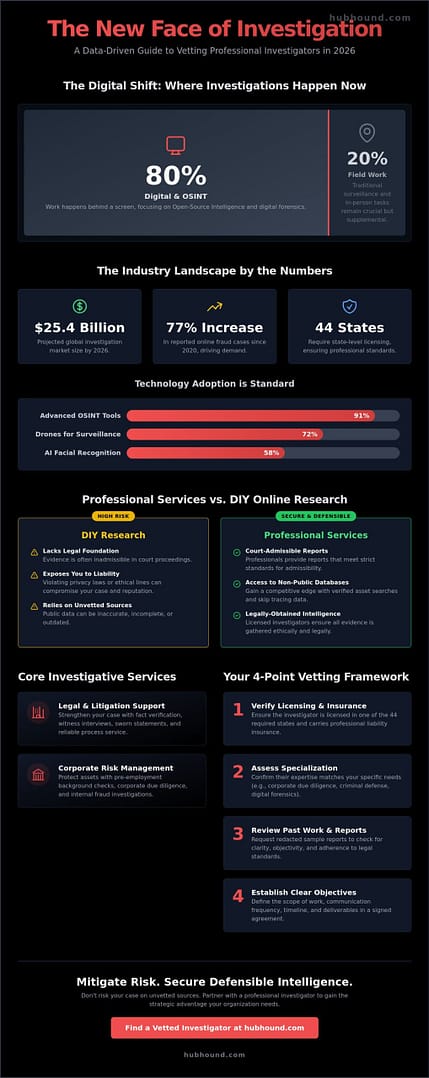
By May 2026, the industry has fully embraced a hybrid model. Fieldwork now accounts for just 20% of the typical investigative workflow. The remaining 80% relies on Open-Source Intelligence (OSINT) and digital forensics. Technology is the primary driver of this change. Recent data shows 91% of investigators employ advanced OSINT tools. Additionally, 72% of firms now use drones for surveillance, while 58% leverage AI-powered facial recognition. This isn’t just about collecting data; it’s about specialized niches. Modern firms focus on corporate due diligence and financial fraud to meet the 77% increase in online fraud cases reported since 2020. This specialization ensures that the intelligence provided is both relevant and actionable.
Professional Services vs. DIY Online Research
Relying on internet sleuthing is a high-risk gamble for any professional organization. DIY research often lacks the legal foundation required for court proceedings and can expose you to liability. Professional pi services provide reports that meet strict standards for admissibility. As of April 2026, 44 states require state-level licensing for these professionals. This regulation ensures the integrity of the evidence found. Licensed investigators also have access to proprietary, non-public databases that are off-limits to the general public. These sources provide verified asset searches and skip tracing data that standard search engines simply can’t reach. You gain access to a deeper ecosystem of information that is both verified and legally obtained. Don’t risk your case on unvetted sources. Use a professional to ensure your evidence is legally sound and ready for court.
Core Categories of Private Investigative Support
Selecting the right pi services depends on the specific “job to be done” within your legal or business framework. In the current professional landscape, modern agencies categorize their support into distinct functional areas to ensure high-quality, admissible results. This structure helps decision-makers move past choice paralysis by aligning investigative expertise with specific outcomes like risk mitigation or evidence discovery. By utilizing professional pi services, you gain access to specialized field operations and digital intelligence that go far beyond basic public record searches.
Legal and Litigation Support
Attorneys frequently leverage a criminal defense investigator to verify facts that might’ve been overlooked during initial reports. This support is critical for strengthening a case through meticulous witness interviews and the collection of sworn statements. Beyond discovery, investigators handle process service, which is a vital component of the legal ecosystem. Ensuring that legal documents are served correctly prevents procedural delays that can cost a firm thousands in lost time. It’s about building a foundation of evidence that stands up under cross-examination.
Corporate Risk Management
Protecting organizational assets requires more than just reactive measures. Implementing pre-employment background checks serves as a first line of defense against internal theft and liability. During mergers or partnerships, corporate due diligence acts as a vetting filter to uncover hidden financial risks or reputational threats. With online fraud investigations seeing a 77% increase since 2020, specialized workplace investigations are now essential for maintaining organizational integrity. These operations provide the clarity needed to make high-stakes decisions with confidence.
Domestic and Private Investigations
Private matters require a balance of high-tech tools and human discretion. Infidelity investigations remain a common request, but the complexity of finding missing adults has increased as individuals become more adept at obscuring their digital footprints. For property owners, landlord and tenant screening provides a data-driven approach to property risk management. If you’re feeling overwhelmed by these options, comparing top-rated agencies can help you find the niche expertise required for your specific situation. This curated approach ensures you find a professional who understands the unique sensitivities of your case.
Specialized Techniques: From Surveillance to Skip Tracing
Executing a successful investigation requires more than just persistence. It demands a technical ecosystem designed for precision. Professional pi services in 2026 utilize a specialized toolkit to bridge the gap between digital breadcrumbs and physical reality. This section explores the high-level methodologies used to track subjects and uncover hidden financial structures. With 91% of investigators now employing advanced OSINT tools as of May 2026, the ability to filter vast amounts of data has become a core competency. By leveraging these advanced techniques, you ensure that the intelligence gathered is both comprehensive and legally defensible.
Modern Surveillance Methodologies
Modern surveillance has evolved far beyond the grainy photos of the past. Today’s surveillance techniques involve a strategic mix of high-definition optics and aerial technology. Data from a 2023 industry report indicates that 72% of investigators now use drones to maintain anonymity while capturing clear evidence. This is particularly effective for verifying workplace injury reports or insurance claims where physical activity must be documented without alerting the subject. High-tier pi services prioritize legal boundaries to ensure that every frame of video is admissible in court. Investigators focus on public vantage points and avoid privacy violations that could tank a case. This disciplined approach protects the integrity of your evidence and your reputation.
Advanced Skip Tracing and Asset Searches
There’s a significant difference between a $20 online “people search” and professional skip tracing. Basic tools often rely on stale data that’s months or years old. In contrast, expert investigators use live, non-public databases to track individuals who have intentionally vanished. This process is essential for debt recovery or serving legal papers to elusive defendants. Beyond just finding people, specialized asset searches uncover property, vehicles, and hidden bank accounts. Investigators use digital forensics to analyze financial footprints and identify transfers designed to shield wealth. This level of scrutiny is required for civil litigation where the goal is to locate tangible assets for recovery. You aren’t just getting a name and address; you’re getting a vetted intelligence report that maps out a subject’s entire financial ecosystem. These reports provide the clarity needed to decide whether a legal pursuit is financially viable.
Vetting Your Investigator: Quality and Compliance Standards
Hiring an investigator is a high-stakes decision that requires more than a simple search. If you choose an unvetted agency, you risk more than just your budget; you risk the legal admissibility of your entire case. High-quality pi services operate within a strict ecosystem of compliance and ethics. You aren’t just paying for information. You’re paying for a legally-defensible process that protects your interests in court. Evaluating the cost of a private investigator requires a clear understanding of the potential ROI, especially when compared to the 77% increase in online fraud reported since 2020. Investing in professional verification now prevents catastrophic financial losses later.
Licensing and Regulatory Requirements
Licensure is the primary filter for quality. As of April 2026, 44 states and Washington, D.C. require state-level licensing for private investigators. While six states lack statewide mandates, municipal regulations often still apply. Licensure isn’t just a formality. It signifies that the investigator has passed rigorous background checks, completed mandatory training, and maintains professional liability insurance. A licensed professional is a prerequisite for any legal proceeding because their credentials provide the necessary weight to their testimony. Before signing any contract, use this checklist to verify an agency:
- Request an active state license number and verify it with the state regulatory board.
- Ask for proof of professional liability insurance to protect against potential errors.
- Ensure there’s a clear, written contract outlining the specific scope and fee structure.
- Check for a history of continuing education in specialized areas like digital forensics or OSINT.
Ethical Boundaries and Evidence Admissibility
The distinction between a professional investigator and an amateur lies in the ethical framework they follow. Professional intelligence gathering must respect the “Chain of Custody.” This ensures that evidence remains untainted from the moment of collection until it’s presented in court. Unethical behavior doesn’t just look bad; it can lead to a judge dismissing your entire case. For example, evidence gathered through illegal trespassing or unauthorized wiretapping is generally inadmissible and can lead to criminal charges for both the investigator and the client.
Professional investigators know exactly what they can and cannot do. They won’t offer to hack into private emails or record conversations without legal consent. Instead, they use proprietary databases and advanced surveillance to find information legally. This disciplined approach ensures that your evidence is ready for the courtroom. To ensure you’re working with the best in the industry, compare vetted investigative agencies that prioritize compliance as much as results. This curated approach saves you time and secures your legal standing across the country.
Strategic Implementation: Integrating PI Services into Your Workflow
Stop viewing pi services as an emergency-only resource. Successful organizations integrate investigative intelligence into their standard operating procedures to prevent losses before they happen. This proactive shift requires clear communication and a structured reporting process. Define your objectives early. When you provide an investigative team with specific, measurable goals, you eliminate wasted hours and ensure the final report aligns with your legal or corporate strategy. Interpreting findings becomes simpler when the data is curated to answer your most pressing business questions. With the U.S. private investigation industry generating $7.2 billion in revenue in 2022, it’s clear that top-tier firms are becoming essential components of the modern business ecosystem.
Scaling Investigations for Corporate Needs
High-volume operations like property management and corporate recruiting require seamless integration of investigative data. Don’t let background checks become a bottleneck in your workflow. Integrate professional reports directly into your HR or legal department’s existing software stack. This ensures every high-stakes hire or new partnership is vetted against the same rigorous standards. Having a vetted investigative partner on retainer offers a distinct advantage. It allows for immediate response times and a deeper understanding of your specific risk profile. This long-term alignment turns an external service into a reliable extension of your internal team. It’s about building a scalable framework for risk mitigation that grows with your company.
Partnering with a Vetted Investigative Firm
HubHound acts as your specialized expert curator in the investigative world. We do the heavy lifting of research to find high-efficiency solutions that fit your unique requirements. Transparency is the foundation of this partnership. Demand clear billing structures and regular progress updates to maintain control over your investigative budget. You deserve an ally who values your time and provides hand-picked expertise. By focusing on quality and compatibility, you can move from a state of uncertainty to one of total confidence in your data. Avoid the choice paralysis of searching through 3,496 different detective businesses. Instead, rely on a curated selection of professionals who understand the legal and ethical standards required for 2026.
Secure Your Intelligence Strategy for 2026
The shift toward digital-first intelligence is no longer a trend; it’s the industry standard. With 80% of investigative work now relying on OSINT and advanced forensics, selecting the right pi services is a strategic necessity for any growth-focused organization. You’ve learned how to navigate the complex regulatory landscape where 44 states require strict licensure to ensure your evidence remains admissible in court. By moving from a reactive mindset to a proactive integration of investigative tools, you protect your assets from the 77% rise in online fraud reported since 2020. This disciplined approach ensures that your data is both actionable and legally sound.
Don’t let choice paralysis stall your progress. HubHound provides a curated path to high-efficiency results by connecting you with professionals who prioritize transparency and legal compliance. Our network features licensed investigators with 30+ years of experience specialized in delivering court-ready evidence and thorough corporate due diligence. This hand-picked approach ensures you receive maximum ROI without the cognitive load of unvetted research. Use these insights to build a more resilient and informed business ecosystem.
Discover Vetted Investigative Solutions at HubHound and take full control of your organizational intelligence today. You have the framework; now it’s time to leverage expert insight for a more secure future.
Frequently Asked Questions
What is the most common service offered by a private investigator?
Background checks and surveillance are the most frequent requests in the current investigative landscape. Background checks range from $100 to $900 in 2026 and provide essential verification for high-stakes hiring and tenant screening. Surveillance follows closely, with 72% of investigators now using drones to document activity for insurance fraud or domestic cases. These services provide the foundational data needed for both personal and professional decision-making.
Can a private investigator legally track someone without their knowledge?
Investigators can legally conduct surveillance in public spaces where there’s no reasonable expectation of privacy. This includes documenting movements on public roads, in parks, or at business locations to verify claims or activities. However, they cannot use illegal GPS tracking on a vehicle without the owner’s consent or trespass on private property. Adhering to these strict legal boundaries is what separates professional pi services from illegal stalking or harassment.
How much do professional PI services typically cost in 2026?
The average hourly rate for a private investigator in 2026 ranges between $68 and $125 for standard tasks. Specialized services, such as digital forensics or complex financial fraud investigations, typically cost between $125 and $400 per hour. Many agencies also offer flat-rate packages for specific needs. For example, professional skip tracing usually costs between $700 and $1,200, while comprehensive asset searches range from $1,000 to $1,600 depending on the complexity.
What is the difference between skip tracing and a background check?
Skip tracing is a specialized process used to locate individuals who have intentionally disappeared or moved without leaving a forwarding address. A background check focuses on verifying the history and character of a known individual, including their criminal record, employment history, and financial standing. While a background check builds a profile of a person you’ve already found, skip tracing is the high-level tool required to find them in the first place.
Are private investigator reports admissible in a court of law?
Investigative reports are admissible in court if the evidence was gathered legally by a licensed professional. This requires a strict adherence to the chain of custody and detailed documentation of all investigative steps. Since 44 states require state-level licensing as of April 2026, using a licensed investigator ensures that the findings meet the necessary judicial standards. This professional oversight prevents your evidence from being dismissed due to procedural errors or ethical violations.
What should I look for when vetting a private investigation firm?
Verify that the agency holds an active state-level license and carries professional liability insurance to protect your interests. Look for a firm that demonstrates niche expertise in your specific area of need, such as corporate due diligence or digital forensics, rather than a generalist. High-tier pi services will always provide a clear written contract and maintain total transparency regarding their investigative methodologies and fee structures. Avoid any firm that promises to perform illegal acts like hacking.
Can a private investigator help with workplace misconduct cases?
Private investigators are a critical resource for resolving workplace misconduct cases involving internal theft, harassment, or policy violations. They provide an objective, third-party perspective that is essential for protecting an organization from liability during sensitive HR disputes. With online fraud investigations seeing a 77% increase since 2020, investigators also play a vital role in identifying digital misconduct and protecting intellectual property. Their findings provide the curated intelligence needed to maintain organizational integrity.
Do private investigators provide personal bodyguard services?
Most private investigators do not provide personal bodyguard services, as this typically requires a separate executive protection or private security license. While some large agencies may offer both services, the two roles involve different training and operational goals. Investigators focus on information gathering, fact-finding, and verification. Bodyguards focus on physical protection and threat neutralization. Always check an agency’s specific credentials if you require physical security rather than investigative intelligence.

Article by
Joel R. Manley | President | Hubhound Investigations | OR PI-ID#: 90432 | 111 SW Fifth Avenue, Suite 3150 Portland, Oregon 97204 | 971-442-8170
Joel is licensed as a private investigator in Oregon and Tennessee. Joel started his career in 1987 serving as a Military Police Officer and Military Police Investigator.
After ending his military tour of duty, Joel became a civilian Police Officer and Deputy Sheriff. Joel took his strong background in Hostage Negotiations, Mediation and Conflict Resolution, with him to patrol some of the highest crime areas in SE Portland.
Joel was awarded Deputy of the Year for his efforts and for drastically reducing the crime rate in the area he patrolled. As a Deputy Sheriff, Joel assisted in leading a Neighborhood Livability Program that was nationally recognized for having the most innovative and progressive approach to policing.
In 2018, Joel retired as a Deputy Sheriff and founded Hubhound Investigations. Joel played an integral role in Hubhound Investigations receiving an A+ Accredited Business rating from the Better Business Bureau (BBB).
In his off time, Joel enjoys spending time with his wife, adult children and Hubhound’s Happiness Ambassador, Nya. Joel also enjoys Scuba Diving and Kayaking.
Disclaimer
DISCLAIMER: This article is provided for general informational and educational purposes only. It is not intended to constitute legal advice, professional investigative advice, or instruction to engage in any unlawful activity. Laws governing private investigations, surveillance, recording, tracking, access to information, evidence collection, privacy, trespass, licensing, and related investigative activities vary by jurisdiction and are subject to change.
Any investigative techniques, tactics, procedures, scenarios, or legal proceedings discussed in this article are presented for informational purposes and should not be interpreted as authorization or encouragement to use a particular method. Private investigators and members of the public are responsible for understanding and complying with all applicable federal, state, and local laws, licensing requirements, court rules, and professional standards.
The circumstances of every investigation and legal matter are different. Information contained in this article should not be relied upon as a substitute for advice from a qualified attorney or other appropriate licensed professional regarding a specific situation. No attorney-client, investigator-client, or other professional relationship is created by reading or using this information.