
The moment a tenant vanishes with an unpaid balance, your role shifts from property management to active debt recovery. It’s a frustrating transition that often leaves landlords facing significant financial gaps and the looming challenge of serving legal notices to a ghost. You shouldn’t have to absorb the cost of a skipped lease just because a former resident decided to disappear.
We understand that the inability to locate a debtor creates a bottleneck in your business operations. This guide provides the professional investigative techniques you need to learn how to find a tenant who skipped rent without violating complex privacy laws. By leveraging specialized skip tracing data and rigorous assessment methods, you can bridge the gap between a missing person and a legal judgment.
We’ll examine the 2026 legal landscape, including FDCPA compliance and the latest database tools that offer accuracy rates as high as 85%. You’ll discover how to transition from DIY searches to professional-grade locate investigations that secure a current address and facilitate the successful recovery of your lost revenue.
Key Takeaways
- Differentiate between property vacancy and legal abandonment to ensure your recovery efforts remain compliant with 2026 regulations.
- Discover how to find a tenant who skipped rent by utilizing professional-grade proprietary databases that provide real-time location data.
- Identify the hidden risks of DIY “people search” platforms and learn how to avoid illegal tactics that could jeopardize your legal standing.
- Secure a path toward financial recovery by transitioning from a successful locate investigation to professional process service and asset searches.
- Strengthen your risk management strategy with advanced tenant screening techniques designed to flag high-risk behaviors before they lead to a skip.
Understanding Tenant Abandonment vs. Skipping Rent
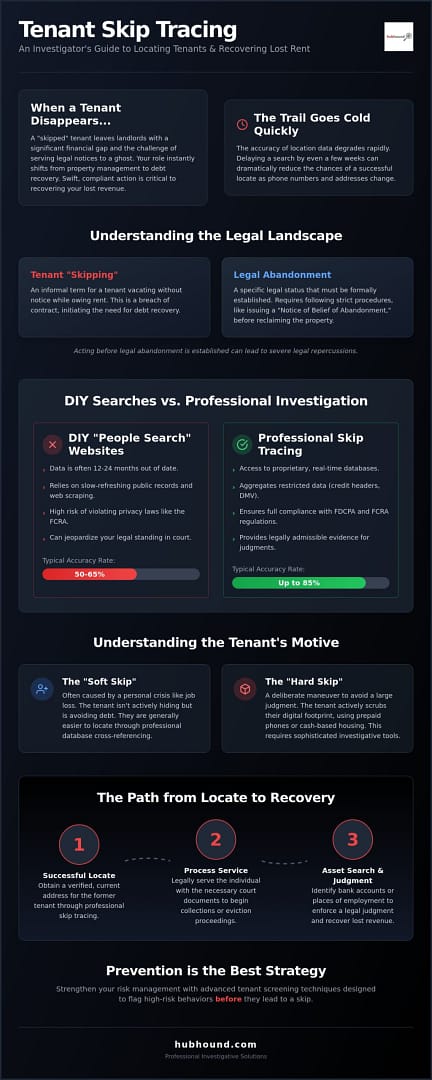
Skipping rent isn’t just a move; it’s a breach of contract that leaves you with a financial deficit. While “skipping” is an informal term for a tenant vacating without notice while owing funds, “abandonment” is a specific legal status. You must verify that the property is legally abandoned before you begin the process of reclaiming the space or searching for the individual. If you act too early or without proper documentation, you risk legal repercussions that can outweigh the lost rent.
Speed is your greatest asset. The trail for a skipped tenant goes cold quickly as they change phone numbers, update mailing addresses, or move in with acquaintances. Professional investigators often refer to this as a “hot” trail. Understanding What is Skip Tracing? is the first step in realizing that the data you need is most accessible immediately after the disappearance. Delaying your search by even a few weeks can significantly reduce the accuracy of the location data available in proprietary databases.
Start by logging the discovery. Take high-resolution photographs of the premises to document the condition and any items left behind. In 2026, a 30-day period is the most common standard for holding abandoned personal property, though some timelines are as short as 7 days. Documenting every item ensures you don’t violate these holding period laws while you determine how to find a tenant who skipped rent. These records also provide a clear inventory should the tenant later claim that valuable property was mishandled.
The Legal Prerequisites for a Search
Review your lease agreement for specific abandonment clauses. Most modern leases define the number of days of absence and non-payment required to trigger abandonment. In many jurisdictions, you must issue a Notice of Belief of Abandonment and wait a statutory period before entering. Documentation is your primary defense. If a tenant later claims they were unlawfully locked out, your dated photos and the filed notice serve as your evidentiary shield. Always maintain compliance with the Fair Credit Reporting Act (FCRA) when accessing data. Using a professional partner like HubHound ensures your search remains within these strict legal frameworks.
Why Tenants “Skip” and What it Tells You
Identifying the motive helps determine the difficulty of the search. A soft skip often involves a tenant moving due to a personal crisis or job loss. They aren’t necessarily hiding; they’re just avoiding the debt. A hard skip is a professional maneuver where the tenant actively scrubs their digital footprint to avoid an eviction or a large judgment. A hard skip might involve the use of prepaid phones or moving into short-term rentals that don’t require credit checks. This level of evasion requires sophisticated investigative tools that go beyond basic social media searches. Their level of stealth dictates whether you can find them through basic outreach or if you require deep-database locate investigations.
Professional Skip Tracing: How Investigators Find “Ghosts”
Skip tracing is a tiered process that separates professional investigators from DIY attempts. While public records like voter registrations or property deeds offer a starting point, they rarely provide the real-time accuracy needed for a successful locate. Professional investigators rely on proprietary databases that aggregate restricted data from thousands of sources, including credit reporting headers and motor vehicle records. Learning how to find a tenant who skipped rent involves understanding that the most valuable data sits behind a firewall of professional licensing and regulatory oversight. Investigators cross-reference disparate data points, such as a recent professional certification or a new vehicle registration, to triangulate a location. This selective filtering process eliminates false positives and ensures the target is correctly identified before field resources are deployed.
Many landlords initially turn to consumer “people search” websites, but these platforms are often 12 to 24 months out of date. They rely on web scraping and public records that refresh slowly, which is why budget-tier services only reach accuracy rates of 50% to 65%. In contrast, professional investigative tools access credit header data. This information updates the moment a tenant applies for a new credit card, a car loan, or even certain types of employment. By cross-referencing these financial pings with established legal procedures for tenant abandonment, an investigator can build a verified timeline of the tenant’s movement. This level of technical expertise is what allows professionals to track individuals who have intentionally gone dark.
The Digital and Financial Paper Trail
Digital footprints are difficult to erase entirely. Utility hookups are the most reliable indicator of a new physical location. When a tenant establishes power, water, or internet services, those records generate a “ping” in professional databases. Investigators also monitor recent address updates on financial files. Even if a tenant attempts to hide, their need for basic services often reveals their new coordinates. Analyzing National Change of Address (NCOA) requests is another standard step, though professional “skips” frequently bypass this to avoid detection. Identifying these pings requires the specialized software connectivity that only licensed investigators possess.
Advanced Surveillance and Field Work
When the digital trail goes cold, physical investigation becomes necessary. This is where surveillance operations play a critical role. A database might suggest an address, but only physical confirmation can prove the tenant is actually residing there. Field work includes interviewing neighbors or former associates to gather leads that databases miss. This human intelligence often uncovers the “hidden” details of a tenant’s new life, such as a new place of employment or a frequent hangout. If you have reached a dead end with digital tools, a professional locate investigation is the logical next step to ensure you can serve process successfully and recover your assets.
DIY Methods vs. Professional Investigative Services
The appeal of a $20 “instant” search tool is often a false economy. These budget platforms aggregate stale data that rarely leads to a successful recovery. When you’re determining how to find a tenant who skipped rent, relying on outdated information wastes weeks of your time while the trail goes cold. Professional access saves you from the manual labor of cross-referencing dead-end leads. Beyond efficiency, DIY methods carry significant privacy risks. Engaging in “pretexting”, the act of using a false identity to gain information, is illegal and can lead to severe penalties under the Fair Debt Collection Practices Act (FDCPA).
Maintaining professional distance is vital for avoiding illegal eviction claims or harassment suits. If your search methods are deemed coercive or deceptive, you could lose your right to collect the arrears entirely. Professional investigators provide court-ready evidence, ensuring that every data point found is admissible if you proceed with litigation. This documentation proves you’ve followed due diligence, protecting your reputation and your legal standing. It transforms a collection effort from a personal dispute into a formal legal process.
Limits of Public Record Searches
Court records and voter registrations are lagging indicators. A tenant who skipped rent last month won’t appear in these files for several quarters, if at all. Tracking individuals who move across state lines is nearly impossible with basic public searches, as records are siloed by jurisdiction. Professional skip tracers bypass these limitations by accessing non-public “dark” data. This includes restricted financial and utility records that update in real-time. This connectivity allows for a nationwide search that identifies a tenant’s location regardless of how far they’ve traveled to avoid their obligations.
The Investigative Advantage
For high-value rent arrears, leveraging professional locate investigations provides a clear strategic edge. There is a psychological advantage to a professional third-party inquiry. Tenants who ignore a landlord’s calls often respond differently when they realize a licensed investigator is involved. This process ensures all searches remain within the bounds of national privacy laws, shielding you from liability. By choosing a specialized partner like HubHound, you replace guesswork with verified results, moving your case from a “ghost” to a successful service of process.
From Locating to Recovery: Legal and Financial Next Steps
Locating a former resident is a critical milestone, but it doesn’t automatically result in debt recovery. Once you’ve identified how to find a tenant who skipped rent, your focus must shift to the legal mechanics of collection. A current address is simply the starting point for a money judgment. To convert a locate into a recovery, you must bridge the gap between discovery and enforcement through professional process service and comprehensive asset identification. This transition requires a move from investigative data to actionable legal filings.
Professional Process Service
Success in court requires proof of service. While many landlords believe taping a notice to a former door is sufficient, most jurisdictions require personal service for money judgments. If a tenant is actively “avoiding service,” standard methods will fail. Professional process servers use the data gathered during skip tracing to execute service at places of employment, family gatherings, or other verified locations. A valid Affidavit of Service is the only document the court accepts as proof that the defendant was properly notified. Without it, your case cannot proceed, regardless of the strength of your evidence. This document is your ticket to a formal hearing and eventual judgment.
Asset Searches and Due Diligence
A judgment is only valuable if it’s collectible. Before investing in litigation, you must determine if the tenant has garnishable assets or if they are “judgment-proof.” Identifying current employment is the first step toward wage garnishment. Beyond income, locating bank accounts and tangible property like vehicles or real estate provides additional avenues for recovery. Utilizing corporate due diligence techniques allows you to uncover hidden financial interests that a standard credit check might miss. This assessment ensures you aren’t “throwing good money after bad” by pursuing individuals with no means to pay.
If the search reveals significant assets, work with legal counsel to initiate bank levies or liens. If the tenant is currently unemployed, a recorded judgment remains on their record, often appearing when they attempt to secure future housing or financing. This long-term strategy ensures that your right to recovery is preserved. To ensure your legal papers reach the right hands, engage a partner specializing in professional process service to finalize the locate-to-recovery pipeline.
Preventing the Skip: The Role of Rigorous Screening
Proactive risk management is the only way to eliminate the need for recovery operations. While previous sections detailed how to find a tenant who skipped rent, the most efficient business strategy is to prevent the skip from occurring. Data from decades of investigative work shows a high correlation between past financial evasion and future lease defaults. A tenant who has skipped on a previous landlord or utility provider is statistically likely to repeat the behavior. Relying on “gut feelings” or basic social media checks is a liability; you need a data-driven gatekeeping process that identifies these patterns before a lease is signed.
Standard credit scores often fail to tell the whole story. A “professional tenant” might maintain a decent score by prioritizing credit card payments while systematically defaulting on rent. These individuals understand how to navigate the legal system to delay evictions, eventually vanishing before a judgment is entered. A comprehensive landlord/tenant screening protocol looks beyond the three-digit number. It examines eviction filings, civil litigation history, and cross-state records that standard consumer reports might miss. This level of scrutiny identifies “high-risk” applicants who have mastered the art of the soft skip.
Advanced Background Screening Techniques
Verification is the core of rigorous screening. Professional investigators look for “fake” references, such as friends posing as former landlords or supervisors. We cross-reference employment history to ensure stability and income accuracy. If an applicant is a business owner, we analyze workplace investigation patterns and corporate filings to verify the legitimacy of their operations. This selective filtering process ensures that the person moving into your property has a verified history of professional and financial integrity. Unexplained gaps in residence or vague employment details are immediate red flags that warrant deeper investigation.
The Value of Professional Screening
The financial math is clear. A professional screening that costs approximately $100 can save you upwards of $10,000 in lost rent, property damage, and legal fees. Beyond the immediate cost savings, a rigorous investigative process has a powerful deterrent effect. High-risk tenants typically avoid properties that require professional-grade background checks, as they know their history of “skipping” will be discovered. Moving toward a “zero-skip” strategy requires a commitment to transparency and technical validation. By partnering with a specialized agency like HubHound, you leverage three decades of investigative expertise to secure your revenue and protect your assets from the start.
Secure Your Rental Revenue with Professional Recovery
Recovering lost rent requires a strategic shift from property management to technical investigation. You’ve seen that the path to a successful recovery involves more than just a basic search; it requires a deep understanding of legal abandonment, proprietary data access, and professional process service. While DIY methods often lead to outdated leads and potential legal risks, professional skip tracing provides the accuracy necessary for court-ready results. Mastering how to find a tenant who skipped rent is about replacing uncertainty with verified data and actionable intelligence.
HubHound provides the specialized expertise needed to track down missing debtors and restore your financial stability. Our licensed investigators bring over three decades of experience to every case, utilizing proprietary database access and delivering court-ready skip tracing reports. We bridge the gap between a vanished tenant and a successful legal judgment, ensuring your recovery efforts remain compliant and effective. Find your missing tenant with HubHound’s professional skip tracing services today. You don’t have to navigate the recovery process alone; professional support is available to help you reclaim what you’re owed and protect your business for the future.
Frequently Asked Questions
Is it legal to track a tenant who owes me money?
It’s entirely legal to track a former tenant to recover unpaid rent, provided you adhere to federal laws like the Fair Debt Collection Practices Act (FDCPA). You have a legitimate business interest in locating an individual to serve legal papers or collect a debt. However, you must avoid harassment or deceptive “pretexting” tactics that could lead to significant fines or the loss of your right to collect.
How much does it cost to hire a private investigator for skip tracing?
Professional skip tracing costs vary based on the depth of the investigation and the accuracy of the data required. In 2026, automated services range from budget tiers with 50% accuracy to premium options with 85% accuracy. For complex “hard skips” where a tenant is actively hiding, an investigator may charge a flat fee or an hourly rate to conduct surveillance and field interviews.
Can I find a tenant using only their social security number?
A social security number is one of the most effective identifiers for determining how to find a tenant who skipped rent. It allows investigators to access credit header data, which updates the moment the individual applies for new credit or utilities. While a name and last known address are helpful, the SSN provides a unique digital anchor that bridges jurisdictional gaps across the country.
What happens if I find the tenant but they have no money?
If a tenant is “judgment-proof,” meaning they have no garnishable wages or bank assets, you can still secure a legal judgment. These judgments remain valid for several years and often appear on future credit reports or housing applications. This long-term approach ensures you’re positioned to collect if their financial situation improves, such as through new employment or a tax refund.
How long does a professional skip trace usually take?
A database-driven skip trace typically yields results within 24 to 72 hours. If the search requires field work, such as verifying a physical location or conducting surveillance, the timeline may extend to a week or more. The speed often depends on how recently the tenant has generated a new digital footprint through utility hookups or credit applications.
What info do I need to give an investigator to start a search?
To initiate a search, provide the tenant’s full name, date of birth, and social security number. Any secondary details, such as their last known place of employment, vehicle descriptions, or contact information for emergency references, significantly increase the success rate. This information allows investigators to cross-reference multiple data points to confirm the target’s current location with high precision.
Can I serve legal papers myself once I find the skipped tenant?
You shouldn’t serve legal papers yourself if you’re a party to the lawsuit. Most jurisdictions require a neutral third party, such as a professional process server or a sheriff, to deliver the documents. This ensures the service is legally valid and provides the court with a verified Affidavit of Service, which is essential for obtaining a money judgment.
Does a skipped tenant affect my ability to re-rent the unit immediately?
You can re-rent the unit as soon as you’ve legally established abandonment and cleared the premises. Ensure you’ve followed the statutory holding periods for any abandoned personal property, which often lasts 30 days. Once you’ve documented the condition of the unit and filed the necessary notices, you’re free to prepare the space for a new, properly screened tenant. For landlords in the South Carolina region, using Houzpics | Real Estate Photographers in Hilton Head, SC can help you create a high-impact listing that attracts the right applicants and prevents future skips.

Article by
Joel R. Manley | President | Hubhound Investigations | OR PI-ID#: 90432 | 111 SW Fifth Avenue, Suite 3150 Portland, Oregon 97204 | 971-442-8170
Joel is licensed as a private investigator in Oregon and Tennessee. Joel started his career in 1987 serving as a Military Police Officer and Military Police Investigator.
After ending his military tour of duty, Joel became a civilian Police Officer and Deputy Sheriff. Joel took his strong background in Hostage Negotiations, Mediation and Conflict Resolution, with him to patrol some of the highest crime areas in SE Portland.
Joel was awarded Deputy of the Year for his efforts and for drastically reducing the crime rate in the area he patrolled. As a Deputy Sheriff, Joel assisted in leading a Neighborhood Livability Program that was nationally recognized for having the most innovative and progressive approach to policing.
In 2018, Joel retired as a Deputy Sheriff and founded Hubhound Investigations. Joel played an integral role in Hubhound Investigations receiving an A+ Accredited Business rating from the Better Business Bureau (BBB).
In his off time, Joel enjoys spending time with his wife, adult children and Hubhound’s Happiness Ambassador, Nya. Joel also enjoys Scuba Diving and Kayaking.
Disclaimer
DISCLAIMER: This article is provided for general informational and educational purposes only. It is not intended to constitute legal advice, professional investigative advice, or instruction to engage in any unlawful activity. Laws governing private investigations, surveillance, recording, tracking, access to information, evidence collection, privacy, trespass, licensing, and related investigative activities vary by jurisdiction and are subject to change.
Any investigative techniques, tactics, procedures, scenarios, or legal proceedings discussed in this article are presented for informational purposes and should not be interpreted as authorization or encouragement to use a particular method. Private investigators and members of the public are responsible for understanding and complying with all applicable federal, state, and local laws, licensing requirements, court rules, and professional standards.
The circumstances of every investigation and legal matter are different. Information contained in this article should not be relied upon as a substitute for advice from a qualified attorney or other appropriate licensed professional regarding a specific situation. No attorney-client, investigator-client, or other professional relationship is created by reading or using this information.