
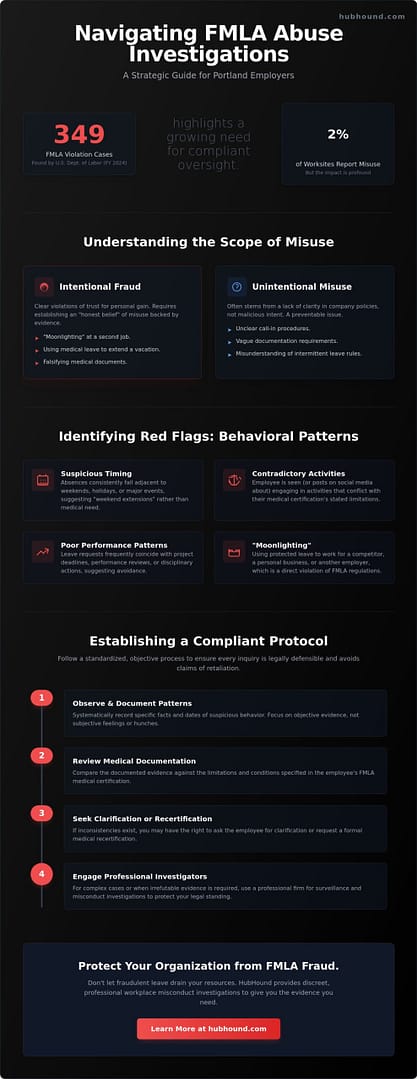
The U.S. Department of Labor found 349 FMLA violation cases in fiscal year 2024, a steady increase from the previous year that highlights a growing tension between employee rights and employer oversight. While only 2% of worksites report active misuse, the financial and operational strain of fraudulent leave can be devastating for growth-focused companies. If you’re researching what to do if you suspect FMLA abuse Portland, you’re likely looking for a way to verify claims without triggering a retaliation lawsuit. It’s a difficult balance to strike when 2025 legal trends show courts are increasingly focused on how employers handle the timing of leave requests and medical documentation.
We understand that distinguishing between a legitimate medical crisis and a pattern of absenteeism is a significant burden for any management team. This guide provides the legal strategies and investigative steps you need to identify and document abuse while protecting your organization from costly litigation. You’ll learn a clear protocol for handling suspicious leave, how to gather evidence that holds up in court, and ways to reduce absenteeism through professional workplace misconduct investigations and better vetting processes. By the end of this article, you’ll have a vetted framework to protect your productivity and your legal standing.
Key Takeaways
- Identify behavioral red flags like holiday-adjacent absences and social media activity that contradict medical certifications.
- Differentiate between legitimate investigative steps and illegal FMLA interference to avoid expensive retaliation lawsuits.
- Establish a standardized internal protocol for what to do if you suspect FMLA abuse Portland to ensure every inquiry remains objective and legally defensible.
- Document patterns of suspicious behavior and review medical documentation to provide clear evidence for potential Department of Labor audits.
- Deploy professional workplace misconduct investigations and surveillance operations when internal HR resources aren’t enough to confirm complex fraud cases.
Defining FMLA Abuse: Understanding the Scope of Misuse
The Family and Medical Leave Act of 1993 serves as a critical safety net for the American workforce. It guarantees eligible employees up to 12 weeks of unpaid, job-protected leave for specific medical and family reasons. However, the complexity of this federal mandate creates opportunities for exploitation. Distinguishing between a legitimate medical necessity and a fraudulent claim is the first step toward maintaining organizational integrity. While a 2026 report from the National Partnership for Women & Families suggests that less than 2% of worksites report active misuse, the impact of that small percentage is profound. When you are evaluating what to do if you suspect FMLA abuse Portland, you must first understand the legal boundaries of a “serious health condition.” Federal standards define this as an illness, injury, or mental condition that involves inpatient care or continuing treatment by a healthcare provider.
Passive monitoring is an insufficient strategy for the modern workforce. Relying solely on automated tracking systems often overlooks the behavioral patterns that suggest fraud. Leave abuse creates a significant financial burden, primarily through lost productivity and the increased stress placed on remaining staff. In 2025, approximately 11.3 million workers needed leave but could not afford it, yet those who misuse the system drain resources that should support honest employees. Active verification ensures that your leave programs remain sustainable and available for those who truly need them.
Intentional Fraud vs. Unintentional Misuse
Intentional fraud often manifests as “moonlighting” at a second job or using medical leave to extend a vacation. These are clear violations of the trust inherent in the employer-employee relationship. Conversely, unintentional misuse usually happens when company policies lack clarity. If your internal handbooks don’t explicitly outline call-in procedures or documentation requirements, employees may inadvertently violate the rules. Professional corporate investigation firms play a vital role here. They help identify systemic patterns of abuse that internal HR teams might miss, providing a vetted layer of oversight that protects the organization.
The Burden of Proof for Employers
To challenge a suspicious claim, you must establish an “honest belief” that the employee is practicing fraud. This legal doctrine protects employers who take action based on specific, articulable facts rather than mere hunches. When considering what to do if you suspect FMLA abuse Portland, remember that documentation is your strongest asset. You need a clear trail of evidence before initiating a formal investigation. The legal threshold for a workplace misconduct inquiry requires more than just a feeling; it requires documented inconsistencies between the medical certification and the employee’s observed behavior. Using a structured protocol ensures your response is both objective and legally defensible.
Identifying Red Flags: Behavioral Patterns That Signal Abuse
Detecting leave abuse requires a shift from passive tracking to active observation of behavioral trends. While the majority of employees use leave for legitimate recovery, a small percentage utilize the system for personal gain. If you’re trying to determine what to do if you suspect FMLA abuse Portland, start by analyzing the timing of absences. Patterns that consistently align with weekends, holidays, or major sporting events are a primary red flag. For example, an employee whose intermittent flare-ups only occur on Mondays and Fridays is likely stretching their time off. These “weekend extensions” disrupt scheduling and signal that the leave may not be tied to a genuine medical necessity.
Physical inconsistencies offer another clear signal of potential fraud. If an employee claims a debilitating back injury but is later seen performing heavy yard work or participating in high-impact sports, the medical certification no longer aligns with reality. Moonlighting is another common form of abuse. Some individuals use protected leave to work for a competitor or focus on their own business ventures. Referencing the Employer’s Guide to the FMLA can help you understand your rights to request recertification when circumstances change significantly or when you receive information that casts doubt on the employee’s stated reason for leave.
Intermittent Leave Vulnerabilities
Intermittent leave is often cited by HR professionals as the most difficult form of FMLA to manage. Because it allows for unpredictable absences in small increments, it’s highly susceptible to patterned use that defies medical logic. You should track the frequency and duration of these absences against the original medical certification. If the healthcare provider estimated two episodes per month but the employee is missing eight days, you have a legitimate basis for inquiry. For complex cases involving suspected fraud, utilizing professional workplace misconduct investigations can provide the necessary clarity to move forward.
Digital and Social Footprints
Social media monitoring has become a standard tool for identifying leave fraud in the modern workplace. A public post showing an employee on a strenuous hiking trip while on “bed rest” provides timestamped evidence that is difficult to dispute in court. However, you must handle digital evidence with care. Focus on public information and avoid invasive tactics that could lead to privacy claims. Documentation of these digital footprints serves as a foundation for any subsequent disciplinary action. Verified social media activity, when paired with professional surveillance operations, creates a comprehensive evidence file that withstands legal scrutiny.
Navigating Legal Risks: Avoiding Interference and Retaliation
Retaliation remains the most frequent claim filed by employees under the FMLA, with the U.S. Department of Labor finding that termination accounted for 31% of all violations in fiscal year 2024. When you’re managing a suspicious leave request, the line between a legitimate inquiry and illegal interference is often thin. FMLA interference occurs when an employer discourages or denies an employee’s right to take protected leave. To stay compliant, your actions must focus on verifying the medical necessity rather than questioning the employee’s entitlement to the benefit itself. This distinction is vital when deciding what to do if you suspect FMLA abuse Portland, as a misstep can lead to costly litigation even if you’re certain fraud is occurring.
Maintaining strict confidentiality is another pillar of a legally sound investigation. Only individuals directly involved in the decision-making process should have access to medical certifications or investigative reports. Exposing an employee’s medical details to unauthorized staff can trigger privacy lawsuits and weaken your defense in a retaliation claim. A professional approach requires that all investigative data be siloed and handled with the same level of care as the medical records themselves. This mitigates the risk of a “hostile environment” claim during the inquiry process.
The Honest Belief Rule
The “Honest Belief” rule is a powerful defense that protects employers from liability when they make adverse employment decisions based on a reasonable suspicion of fraud. If an employer can demonstrate that they acted on specific, articulable facts that led them to believe the employee was abusing leave, courts often uphold the decision. For instance, if an employee is observed engaging in physical activities that contradict their medical restrictions, the employer’s “honest belief” in the abuse provides a layer of protection against retaliation claims. Objective evidence carries significantly more weight in court than subjective hunches or office gossip. You don’t need absolute proof of fraud; you need a reasonable, well-documented basis for your conclusion.
Proper Use of Medical Certifications
You have the right to seek clarification or authentication of medical documentation, but you must follow the procedures outlined in the Employer’s Guide to the Family and Medical Leave Act. Clarification involves contacting the healthcare provider to understand handwriting or the meaning of a response, while authentication is verifying that the provider actually completed the form. If you have reason to doubt the initial certification, you may request a second or even a third opinion at the company’s expense. Working with experts to conduct workplace investigations ensures that your data collection remains within the bounds of federal law. This structured approach helps you avoid the “interference” trap while still holding employees accountable for their leave usage.
Establishing a Compliant Internal Investigation Protocol
Consistency is the hallmark of a defensible investigation. When your team is deciding what to do if you suspect FMLA abuse Portland, having a standardized protocol prevents accusations of bias or selective enforcement. This process ensures that every inquiry is rooted in objective data rather than supervisor intuition. A structured approach not only identifies fraud but also protects the rights of employees who are using leave appropriately. By following a clear sequence of steps, you can gather the evidence necessary to support an “honest belief” defense while maintaining organizational integrity.
- Step 1: Review the initial FMLA request. Compare the current pattern of absences against the original medical certification to identify deviations or inconsistencies.
- Step 2: Document behavior. Log specific instances of suspicious activity, including dates, times, and the exact nature of the behavioral inconsistency.
- Step 3: Conduct internal interviews. Speak with supervisors and team leads to understand the operational impact and gather preliminary observations.
- Step 4: Engage professional services. Use objective verification methods to confirm suspected fraud without exposing internal staff to unnecessary legal risk.
- Step 5: Review evidence. Finalize the case file with HR and legal leadership to ensure all data meets the threshold for adverse employment action.
The Role of Witness Statements
Objective observations from co-workers can provide critical context, but they must be handled with care to avoid fostering a toxic culture. You should structure these interviews to focus on observable behaviors rather than personal opinions or medical guesses. Using neutral third-party interviewers ensures that the resulting witness interviews and statements are court-ready and free from internal politics. These statements serve as a secondary layer of verification that supports your primary documentation and helps prove that your belief in the abuse was reasonable and well-founded.
Documentation and Chain of Custody
Documentation is the foundation of your case. You must create a dedicated “leave file” that remains separate from the general personnel file to comply with privacy regulations. The timeline of events is the most critical piece of evidence you will produce. If an investigation eventually leads to a Department of Labor audit, having a timestamped, chronological record of your inquiries demonstrates a commitment to compliance. Ensure all digital evidence and physical logs are stored securely to maintain a clear chain of custody. For a vetted approach to gathering this data, consider our workplace misconduct investigations to ensure your evidence is professionally managed and legally defensible.
Professional Investigative Support: Protecting Organizational Integrity
Internal HR teams excel at tracking leave balances and reviewing medical forms. However, they’re rarely trained or equipped to conduct field-based verification. When determining what to do if you suspect FMLA abuse Portland, the final phase often involves shifting from internal documentation to external verification. Relying on software to monitor leave is a start, but it can’t see what an employee is doing once they’ve clocked out. Professional investigators fill this gap by providing an objective, third-party perspective that internal staff simply cannot offer without risking accusations of bias or harassment.
The transition from suspicion to action requires undeniable proof. A final investigative report serves as the definitive record used by legal teams to justify adverse employment actions. By employing advanced surveillance techniques, organizations can obtain high-definition video evidence that confirms or refutes an employee’s medical claims. This level of proof is essential for the “Honest Belief” defense. It moves the conversation from a hunch to a documented reality of physical activity inconsistent with medical restrictions.
Discreet Surveillance and Verification
Professional surveillance involves documenting physical activities that directly contradict the limitations listed on a medical certification. If an employee claims they can’t sit for more than 20 minutes but is filmed driving for four hours to a vacation home, the fraud becomes evident. Investigators also look for “side hustles” or secondary employment that the employee may be performing while on leave. Using professional surveillance operations ensures that the evidence is gathered legally, maintaining a clean chain of custody that withstands the scrutiny of a Department of Labor audit. This external oversight is much more effective than internal staff attempts, which often lack the necessary equipment and legal training.
Integrating Investigations into Corporate Strategy
Robust verification processes do more than just catch individual bad actors; they serve as a powerful deterrent across the entire organization. When employees know that the company actively vets suspicious claims, the frequency of “patterned” absences often drops significantly. You can use these investigative findings to refine your future leave policies and close the loopholes that allowed the abuse to occur. HubHound acts as a specialized curator in this ecosystem, helping you identify the most effective investigative strategies for your specific needs. This proactive approach helps mitigate the 31% termination-related violation rate by ensuring every decision is backed by vetted evidence.
Ultimately, your goal is to protect the organization’s productivity while supporting those with legitimate needs. Professional workplace misconduct investigations provide the clarity required to make high-stakes decisions with confidence. By the time you reach the final report, your suspicion should be replaced by a clear, actionable path forward. This ensures your organization remains efficient, compliant, and focused on growth. If you are still weighing what to do if you suspect FMLA abuse Portland, remember that professional verification is the most reliable way to protect your legal standing.
Protecting Your Organization’s Future Through Verified Accountability
Transitioning from passive tracking to active, objective verification is the only way to mitigate legal risks while maintaining operational efficiency. By establishing a standardized internal protocol and leveraging the “Honest Belief” rule, you can address suspicious patterns without triggering interference claims. Determining what to do if you suspect FMLA abuse Portland requires a strategic shift from internal suspicion to external validation. This proactive stance ensures that your leave programs remain a sustainable resource for employees with legitimate medical needs.
HubHound is your expert filter for navigating these complex workplace challenges. We provide access to licensed investigators with decades of industry experience who deliver detailed, court-ready investigative reports. Our team offers specialized expertise in workplace misconduct and surveillance operations, ensuring your evidence is vetted and reliable. Secure your organization with professional investigative services from HubHound.
You have the power to protect your team’s productivity and your company’s legal standing. By following a structured, evidence-based approach, you can eliminate fraud while fostering a culture of transparency and trust. Start building a more resilient organization today.
Frequently Asked Questions
Is it legal to put an employee on surveillance if I suspect FMLA abuse?
Yes, surveillance is legal if conducted in public spaces and based on articulable suspicion of fraud. Courts generally uphold this when the investigation is discreet and doesn’t interfere with the leave itself. It’s a standard tool for those determining what to do if you suspect FMLA abuse Portland. Use licensed professionals to ensure the evidence remains admissible in court and avoids privacy violation claims that could lead to a 2026 civil lawsuit.
Can I fire an employee for FMLA abuse if I have proof of fraud?
You can terminate an employee for FMLA fraud if your investigation confirms a violation of company policy. The key is proving the employee lied about their condition or intended to use the leave for non-qualifying reasons. Courts typically support employers who act on a well-documented honest belief of misconduct. Always review the findings with legal counsel before taking final action to mitigate retaliation risks and ensure compliance with federal standards.
How do I handle an employee who is working another job while on FMLA?
Review your company’s moonlighting policy first to see if secondary employment is prohibited during any type of leave. If the employee’s second job requires physical tasks that their medical certification claims they can’t perform, you have clear evidence of abuse. Document the specific duties of the second role. This inconsistency provides a solid basis for requesting recertification or initiating a workplace misconduct investigation to protect your organization’s resources.
What happens if the medical certification seems legitimate but the behavior is suspicious?
Suspicious behavior that contradicts a legitimate-looking certification warrants a request for recertification or a second opinion. If you observe an employee engaging in activities they shouldn’t be able to do, you have a significant change in circumstances. This allows you to ask the healthcare provider to confirm if the new behavior is consistent with the diagnosis. Objective evidence of the behavior is required to trigger this process and maintain legal defensibility.
Can an employer ask for a recertification of FMLA leave?
Employers can generally request recertification every 30 days in connection with an absence. However, you can ask for it sooner if the employee requests an extension or if you receive information that casts doubt on the leave’s validity. This is a primary strategy for what to do if you suspect FMLA abuse Portland. You must allow the employee at least 15 calendar days to provide the updated documentation according to federal Department of Labor standards.
What is the “Honest Belief” defense in FMLA litigation?
The Honest Belief defense protects you from liability if you can show your decision was based on a reasonable, good-faith suspicion of fraud. You don’t need absolute proof of a lie; you need a documented set of facts that would lead a reasonable person to believe abuse occurred. This defense is a cornerstone of FMLA litigation, helping employers prevail in 2025 retaliation cases where documentation was handled correctly by HR leadership.
How does intermittent leave abuse differ from continuous leave abuse?
Intermittent leave abuse typically involves patterned absences, such as taking every other Friday off or missing days adjacent to holidays. Continuous leave abuse usually involves using the entire 12-week block for non-medical reasons, such as traveling or working elsewhere. Intermittent abuse is significantly more common and harder to detect without meticulous tracking of frequency and duration against the original certification. Meticulous documentation is required to identify these specific trends.
Should I use my own staff to conduct surveillance on an employee?
You shouldn’t use internal staff for surveillance because it often leads to claims of harassment or stalking. Untrained employees don’t understand the legal boundaries of privacy and can’t provide the court-ready reports necessary for a defense. Professional investigators provide a neutral, third-party perspective. They use advanced equipment to gather evidence while maintaining a clean chain of custody that internal staff cannot replicate, ensuring the findings are legally actionable.

Article by
Joel R. Manley | President | Hubhound Investigations | OR PI-ID#: 90432 | 111 SW Fifth Avenue, Suite 3150 Portland, Oregon 97204 | 971-442-8170
Joel is licensed as a private investigator in Oregon and Tennessee. Joel started his career in 1987 serving as a Military Police Officer and Military Police Investigator.
After ending his military tour of duty, Joel became a civilian Police Officer and Deputy Sheriff. Joel took his strong background in Hostage Negotiations, Mediation and Conflict Resolution, with him to patrol some of the highest crime areas in SE Portland.
Joel was awarded Deputy of the Year for his efforts and for drastically reducing the crime rate in the area he patrolled. As a Deputy Sheriff, Joel assisted in leading a Neighborhood Livability Program that was nationally recognized for having the most innovative and progressive approach to policing.
In 2018, Joel retired as a Deputy Sheriff and founded Hubhound Investigations. Joel played an integral role in Hubhound Investigations receiving an A+ Accredited Business rating from the Better Business Bureau (BBB).
In his off time, Joel enjoys spending time with his wife, adult children and Hubhound’s Happiness Ambassador, Nya. Joel also enjoys Scuba Diving and Kayaking.
Disclaimer
DISCLAIMER: This article is provided for general informational and educational purposes only. It is not intended to constitute legal advice, professional investigative advice, or instruction to engage in any unlawful activity. Laws governing private investigations, surveillance, recording, tracking, access to information, evidence collection, privacy, trespass, licensing, and related investigative activities vary by jurisdiction and are subject to change.
Any investigative techniques, tactics, procedures, scenarios, or legal proceedings discussed in this article are presented for informational purposes and should not be interpreted as authorization or encouragement to use a particular method. Private investigators and members of the public are responsible for understanding and complying with all applicable federal, state, and local laws, licensing requirements, court rules, and professional standards.
The circumstances of every investigation and legal matter are different. Information contained in this article should not be relied upon as a substitute for advice from a qualified attorney or other appropriate licensed professional regarding a specific situation. No attorney-client, investigator-client, or other professional relationship is created by reading or using this information.