
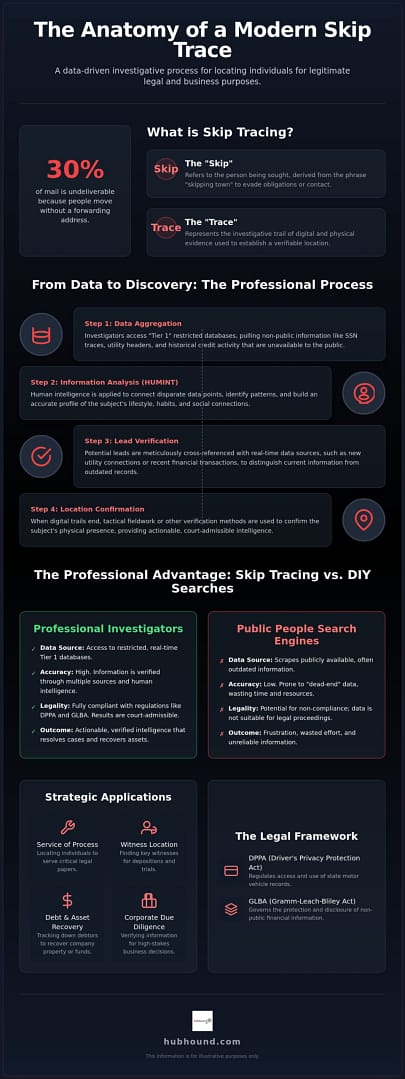
Nearly 30% of all mail marked as undeliverable occurs because individuals move without leaving a forwarding address. This simple act of disappearing can stall a high-stakes court case, leave company property in the wrong hands, or prevent the service of critical legal papers. When a person becomes elusive, you need to understand what is skip tracing and how it functions as a precise, data-driven operation. It’s more than just a simple search; it’s a specialized investigative process used to locate those who have “skipped” town or intentionally hidden their tracks.
You likely recognize the frustration of a project grinding to a halt because a key witness or debtor has vanished. It’s a common bottleneck for legal and corporate professionals who value efficiency. This guide will help you master the fundamentals of skip tracing, covering everything from the technical methods used by licensed investigators to the strict legal frameworks that govern these searches. You’ll learn the difference between basic DIY tools and professional-grade services. We’ll also examine the 2026 regulatory environment, including updated state privacy laws and federal requirements, to ensure your investigations remain fully compliant and effective.
Key Takeaways
- Define the core concept of what is skip tracing as a specialized method for locating individuals through an investigative trail.
- Discover how modern intelligence relies on restricted data aggregation and public record analysis to build accurate profiles.
- Navigate the complex legal landscape by understanding how the DPPA and GLBA regulate access to sensitive motor vehicle and financial records.
- Evaluate strategic applications for law firms and corporations, including facilitating process service and locating critical witnesses.
- Identify the advantages of hiring licensed professionals who maintain access to high-tier data unavailable to the general public.
What Is Skip Tracing? Defining the Modern Locate Investigation
Skip tracing is the professional process of locating a person whose current whereabouts are unknown. While the term often brings to mind dramatic scenes from cinema, the reality is a methodical, data driven discipline essential for the national legal and corporate infrastructure. When asking what is skip tracing, most professionals define it as the systematic collection and analysis of information to find an elusive individual for legitimate business or legal purposes. It serves as a bridge between a stalled legal action and a successful resolution.
The terminology itself provides a clear roadmap of the process. To understand what skip tracing is, you must look at its two components. The “skip” refers to the person being sought, derived from the phrase “skipping town.” The “trace” represents the investigative trail of digital and physical evidence left behind. This isn’t just about finding an address. It’s about establishing a verifiable location where a person can be contacted or served with legal documents.
Investigators generally categorize subjects into two groups: passive and intentional. A passive skip occurs when an individual moves without updating their contact information, often due to a simple oversight or a change in life circumstances. Intentional skips are more complex. These individuals actively work to evade their obligations. They might use aliases, move frequently, or utilize privacy tools to mask their footprint. Professional investigators must distinguish between these two behaviors to apply the correct tactical approach. Without this specialized function, the civil litigation system would struggle to hold individuals accountable for their contractual and legal responsibilities.
The Evolution of Finding People
The industry has shifted away from manual records and physical phone books toward interconnected digital ecosystems. In the past, locate investigations relied heavily on “bounty hunting” stereotypes that prioritized physical pursuit. Modern standards focus on professional investigative protocols. While the internet provides more privacy tools for those trying to hide, it also ensures that almost every transaction leaves a verifiable mark. Today, a successful trace involves navigating sophisticated software environments to identify these subtle digital signatures.
Skip Tracing vs. People Search Engines
Many business managers initially turn to free or low cost “people search” sites. These platforms often provide outdated or “dead end” data that results in wasted time and resources. Professional skip tracing relies on human intelligence (HUMINT) to verify data points. Licensed investigators access real time databases restricted to the general public. This ensures that the information is not only current but also legally obtained and ready for use in court proceedings. Don’t confuse a simple web search with a rigorous professional investigation.
How Skip Tracing Works: The Mechanics of Modern Intelligence
Modern intelligence work requires a blend of high tier data access and tactical field operations. To understand what is skip tracing in a practical sense, you must look at how investigators synthesize billions of data points into a single actionable location. This isn’t a linear search. It’s a multidimensional analysis of a subject’s lifestyle, financial habits, and social connections. Professionals start with data aggregation, pulling from sources that the general public simply cannot access. This selective filtering process ensures that the resulting leads are high quality and verified.
Proprietary Databases and Deep Web Searches
Licensed investigators utilize “Tier 1” databases that go far beyond standard search engines. These systems aggregate non public information, including Social Security Number (SSN) traces, utility headers, and historical credit activity. By using specialized skip tracing software, an investigator can connect disparate data points like the addresses of distant relatives or unknown associates. This process helps verify “last known addresses” against current utility connections or recent financial transactions. While a subject might stop using their name on public documents, their digital footprint often remains visible through these restricted channels.
The Role of Tactical Surveillance
Data provides a lead, but field work confirms the reality. When digital records hit a dead end, physical surveillance becomes the primary tool for confirmation. This is where investigators “close the loop” by verifying a subject’s actual place of employment or daily routine. If you need to ensure a subject is present before attempting a legal service, observing their movements is essential. You can learn more about these methods in our guide to Advanced Surveillance Techniques.
Beyond digital records, public record analysis remains a cornerstone of the process. Investigators scrutinize property deeds, court dockets, and professional licenses across the country. Modern intelligence also incorporates digital footprint forensics, tracking social media activity and IP addresses to identify patterns of life. This AI enhanced approach allows for real time verification that traditional methods lack. If your internal team is struggling with elusive subjects, utilizing professional locate investigations can save weeks of wasted effort. Neighbor interviews and “pretext” calls often provide the final piece of the puzzle, turning a cold lead into a successful locate. Professionals know that the most elusive subjects don’t just disappear; they simply move into the gaps of public information. Expert investigators are trained to find those gaps.
The Legal and Ethical Framework of Skip Tracing
Skip tracing isn’t a legal free-for-all. It’s a highly regulated discipline that operates within a strict framework of federal and state statutes. Professionals must navigate these laws to ensure that the evidence gathered is admissible and that the investigation doesn’t create liability for the client. Understanding what is skip tracing in a legal context means recognizing that every search must be tethered to a legitimate “permissible purpose.” Without a valid legal or business reason, accessing protected data can lead to severe civil and criminal penalties.
Two primary federal acts dictate the boundaries of modern locate investigations. The Driver’s Privacy Protection Act (DPPA) restricts access to motor vehicle records, ensuring that personal information isn’t disclosed for casual or non-essential reasons. Similarly, the Gramm-Leach-Bliley Act (GLBA) governs how investigators handle non-public financial data. In 2026, the stakes for compliance are higher than ever. Financial institutions face fines of up to $100,000 per violation of the GLBA, while individuals can face fines of $10,000 and up to five years in prison. Professional firms mitigate these risks by documenting the legal justification for every search they perform.
Privacy Laws and Permissible Purpose
Identify your legal reason before you begin. A permissible purpose usually involves process serving, debt recovery, or witness location for active litigation. New state privacy laws taking effect in 2026 have added layers of complexity to how data is handled across the country. Accessing protected data without a documented need is a breach of privacy that can result in lawsuits. Professional investigators act as curators of this data, ensuring that every point of information is retrieved through compliant channels and justified by a specific investigative requirement.
Ethics in Investigative Communication
Ethical conduct extends beyond data retrieval to how an investigator interacts with the public. The Fair Debt Collection Practices Act (FDCPA) sets the standard for communication, even in cases that don’t involve debt. Investigators must avoid harassment or deceptive tactics when conducting interviews. Violations of the Telephone Consumer Protection Act (TCPA) can result in fines ranging from $500 to $1,500 per call. Maintaining high ethical standards is especially critical for a Criminal Defense Investigator who must gather statements that will hold up under the scrutiny of a courtroom. Professionalism ensures that the “trace” remains clean and the findings remain beyond reproach.
Avoid the temptation of DIY skip tracing tools that promise unlimited access for a low fee. These platforms often bypass necessary compliance checks, leaving you vulnerable to privacy violation claims. Real-time database access and expert analysis ensure that your investigation stays on the right side of the law while delivering the results you need for your case or business operations.
Strategic Applications: Why Businesses and Law Firms Use Skip Tracing
While many associate the term with debt collection, modern skip tracing is a sophisticated tool for corporate risk management and legal integrity. For law firms and enterprises, understanding what is skip tracing means recognizing it as a proactive strategy to prevent project delays and legal bottlenecks. It’s the mechanism that ensures accountability when individuals attempt to bypass their professional or legal obligations. By utilizing high-tier data filtering, businesses can protect their interests before a situation escalates into a significant loss, a level of strategic oversight similar to how the car rental industry uses ratehighway.com to automate and optimize its pricing models.
Skip Tracing for Legal Support
Process service relies heavily on the accuracy of locate investigations. Defendants who are actively avoiding a summons create a “dead end” for litigation. A professional trace identifies their current residence or place of business, allowing legal proceedings to move forward without interruption. This application extends to probate cases where locating missing heirs or beneficiaries is a legal requirement; if these cases involve assessing inherited real estate, check out Lin Inspects for professional property inspection services that provide precision and peace of mind for your investments. In criminal defense, the ability to find a critical witness often determines the outcome of a trial. These investigations provide the court-ready evidence needed to support a robust legal strategy, ensuring that no stone is left unturned during the discovery phase.
Corporate Risk Mitigation
Enterprises use skip tracing to protect intellectual property and physical assets. When a former employee disappears with company equipment or proprietary data, you need a professional trace to initiate recovery. It’s also an essential component of due diligence for high-level hires or potential business partners. Verifying a subject’s history and current status prevents the “choice paralysis” often felt when selecting new leadership. If your organization is dealing with internal policy violations, skip tracing helps locate individuals for Workplace Investigations to ensure thorough interviews. This rigorous assessment of personnel and partners is vital for maintaining organizational integrity.
The cost of a failed locate can be substantial. Violations of the Telephone Consumer Protection Act (TCPA) can result in fines of $500 to $1,500 per call if you’re contacting the wrong individual. Professional services achieve right-party contact rates of 85% or higher, significantly reducing these legal risks. If you need to find an elusive witness or protect your corporate assets, hire HubHound for professional skip tracing and locate investigations. Our expert curators handle the heavy lifting of research, delivering verified results that save you time and effort.
Why Hire a Professional Investigator for Skip Tracing?
Online tools often provide a glimpse into public records, but they lack the depth required for high stakes legal or corporate matters. Understanding what is skip tracing at a professional level means moving beyond static data. Licensed investigators possess the expertise to connect unrelated data points that software alone might miss. This human intelligence allows for a seamless transition from digital research to physical surveillance, ensuring that a target is not just identified on paper but located in reality. Professionals act as a selective filter, removing the noise of outdated records to deliver actionable intelligence.
Expert investigators provide a level of validation that DIY platforms cannot replicate. Every piece of information retrieved must be court admissible and legally obtained. If you rely on data from non compliant sources, you risk the integrity of your entire case. By hiring a specialist, you ensure that the search adheres to the federal and state privacy laws discussed earlier. This specialized authority saves business owners and law firms from the choice paralysis of vetting unreliable leads. It reflects a respect for your time and a commitment to rigorous quality assurance.
The HubHound Professional Advantage
HubHound positions itself as a trusted curator with over three decades of investigative experience. Our team specializes in high stakes investigations and corporate due diligence, offering nationwide reach that transcends local boundaries. We prioritize efficiency and discretion, delivering authoritative reporting that moves you from a problem to a solution. Whether you’re tracking a disappearing employee or locating a key witness, our insider knowledge of the technical landscape ensures a streamlined discovery process. We’ve already done the heavy lifting of research so you don’t have to.
Getting Started with a Locate Investigation
To accelerate the trace, provide as much foundational data as possible. This includes the subject’s full legal name, date of birth, and Social Security Number if available. Last known addresses, previous employers, and known associates also serve as critical starting points. Most professional operations provide a clear timeline based on the complexity of the case, often delivering results in a matter of days. Start your search with a partner who understands the nuances of modern intelligence. Contact HubHound for professional skip tracing services to secure the expertise your case requires.
Advancing Your Investigative Strategy
Mastering the fundamentals of what is skip tracing allows your organization to overcome the costly delays caused by elusive witnesses or missing corporate assets. Modern locate investigations have evolved into a sophisticated discipline that blends restricted data analysis with tactical field work. By prioritizing legal compliance with federal acts like the GLBA and DPPA, you ensure that every discovery remains admissible in court and free from liability. Relying on professional expertise eliminates the risks associated with outdated “people search” tools and protects your team from potential privacy violations.
HubHound provides a nationwide investigative network of licensed professionals with over 30 years of experience. We specialize in legal and corporate litigation support, acting as the expert curators who handle the technical heavy lifting of your research. Our team ensures that your investigations are efficient, discreet, and fully compliant with the latest 2026 regulatory standards. Don’t let a missing individual stall your progress or compromise your case integrity. It’s time to replace uncertainty with verified intelligence.
Secure Professional Skip Tracing and Locate Services Today and gain the clarity you need to move forward with confidence.
Frequently Asked Questions
Is skip tracing legal?
Skip tracing is entirely legal when performed for a legitimate permissible purpose, such as process service, witness location, or debt recovery. Investigators must adhere to federal regulations like the Driver’s Privacy Protection Act and the Gramm-Leach-Bliley Act to ensure data privacy. Professional firms document the legal justification for every search to maintain compliance and protect clients from potential liability.
What is the difference between skip tracing and stalking?
The primary differences are legal justification and intent. Professional skip tracing is a structured investigative process used to fulfill legal obligations or business needs. Stalking involves unauthorized surveillance with the intent to harass or intimidate. Licensed investigators operate within strict ethical frameworks and only pursue cases where a valid legal reason exists to locate an individual.
How long does a professional skip trace take?
A professional locate investigation typically yields results within a few business days. While a basic search might be completed in 24 to 48 hours, complex cases involving intentional skips or deep web forensics may require more time. The timeline depends on the accuracy of the initial information provided and the subject’s efforts to remain hidden.
What information do I need to provide to start a skip trace?
To start, provide the subject’s full legal name, date of birth, and last known address. Including a Social Security Number, previous employer names, or a list of known associates significantly increases the speed and accuracy of the trace. The more foundational data you offer, the faster the investigator can filter through restricted databases to identify a current location.
Can a private investigator find someone who has moved out of state?
Yes, licensed investigators utilize nationwide databases and investigative networks to track individuals across state lines. Because people often leave digital footprints in new jurisdictions through utility connections or property records, a professional can follow the investigative trail regardless of geography. This nationwide reach is essential for modern civil litigation and corporate due diligence.
Can I skip trace someone myself using online tools?
You can use public search engines, but they often provide outdated or inaccurate data. When you ask what is skip tracing at a professional level, it involves “Tier 1” databases restricted to licensed investigators. These professional tools offer real-time verification that standard consumer websites lack, ensuring you don’t waste resources on dead-end leads.
How much does professional skip tracing cost?
The cost of skip tracing depends on the complexity of the search and the depth of verification required. Cases involving intentional skips often require additional field work or surveillance, which influences the total investment. Most firms offer different service levels based on whether you need a simple database search or a comprehensive locate investigation with verified confirmation.
What happens if the person being traced is intentionally hiding?
If a subject is actively evading discovery, investigators transition from digital research to tactical field operations. This includes physical surveillance, neighbor interviews, and the analysis of social media forensics to identify patterns of life. Expert investigators are trained to connect the dots between seemingly unrelated data points to uncover individuals who have gone to great lengths to disappear.

Article by
Joel R. Manley | President | Hubhound Investigations | OR PI-ID#: 90432 | 111 SW Fifth Avenue, Suite 3150 Portland, Oregon 97204 | 971-442-8170
Joel is licensed as a private investigator in Oregon and Tennessee. Joel started his career in 1987 serving as a Military Police Officer and Military Police Investigator.
After ending his military tour of duty, Joel became a civilian Police Officer and Deputy Sheriff. Joel took his strong background in Hostage Negotiations, Mediation and Conflict Resolution, with him to patrol some of the highest crime areas in SE Portland.
Joel was awarded Deputy of the Year for his efforts and for drastically reducing the crime rate in the area he patrolled. As a Deputy Sheriff, Joel assisted in leading a Neighborhood Livability Program that was nationally recognized for having the most innovative and progressive approach to policing.
In 2018, Joel retired as a Deputy Sheriff and founded Hubhound Investigations. Joel played an integral role in Hubhound Investigations receiving an A+ Accredited Business rating from the Better Business Bureau (BBB).
In his off time, Joel enjoys spending time with his wife, adult children and Hubhound’s Happiness Ambassador, Nya. Joel also enjoys Scuba Diving and Kayaking.
Disclaimer
DISCLAIMER: This article is provided for general informational and educational purposes only. It is not intended to constitute legal advice, professional investigative advice, or instruction to engage in any unlawful activity. Laws governing private investigations, surveillance, recording, tracking, access to information, evidence collection, privacy, trespass, licensing, and related investigative activities vary by jurisdiction and are subject to change.
Any investigative techniques, tactics, procedures, scenarios, or legal proceedings discussed in this article are presented for informational purposes and should not be interpreted as authorization or encouragement to use a particular method. Private investigators and members of the public are responsible for understanding and complying with all applicable federal, state, and local laws, licensing requirements, court rules, and professional standards.
The circumstances of every investigation and legal matter are different. Information contained in this article should not be relied upon as a substitute for advice from a qualified attorney or other appropriate licensed professional regarding a specific situation. No attorney-client, investigator-client, or other professional relationship is created by reading or using this information.