
What if the difference between a granted protective order and a dismissed petition came down to a single piece of metadata? For many seeking legal protection, the fear of a petition being denied due to “he-said, she-said” scenarios is a paralyzing reality. You might be struggling to determine exactly what evidence do I need for a restraining order when preparing to face a respondent in court. It’s common to feel overwhelmed by the legal threshold required to prove imminent danger, especially when your safety and sense of security are on the line.
This 2026 investigative guide provides the clarity needed to navigate the evidence collection process with professional precision. You’ll learn the specific types of documentation required to secure a protective order and how professional investigative techniques can strengthen your case. We’ll explore everything from digital footprints to third-party witness statements, providing a clear roadmap to ensure your presentation to the judge is authoritative and successful. By moving from subjective fear to objective proof, you can achieve the legal backing and safety you deserve.
Key Takeaways
- Identify the legal threshold required to prove both past incidents of abuse and the credible threat of future harm under the preponderance of evidence standard.
- Secure foundational third party documentation, including police reports and medical records, to establish an objective narrative for the court.
- Determine what evidence do I need for a restraining order in Oregon by collecting authenticated digital communication logs and social media activity.
- Utilize professional surveillance operations and neutral witness statements to eliminate reliance on conflicting personal testimonies.
- Organize your findings into a chronological exhibit system to ensure a streamlined and professional presentation during your court hearing.
The Legal Threshold: What You Must Prove for a Restraining Order
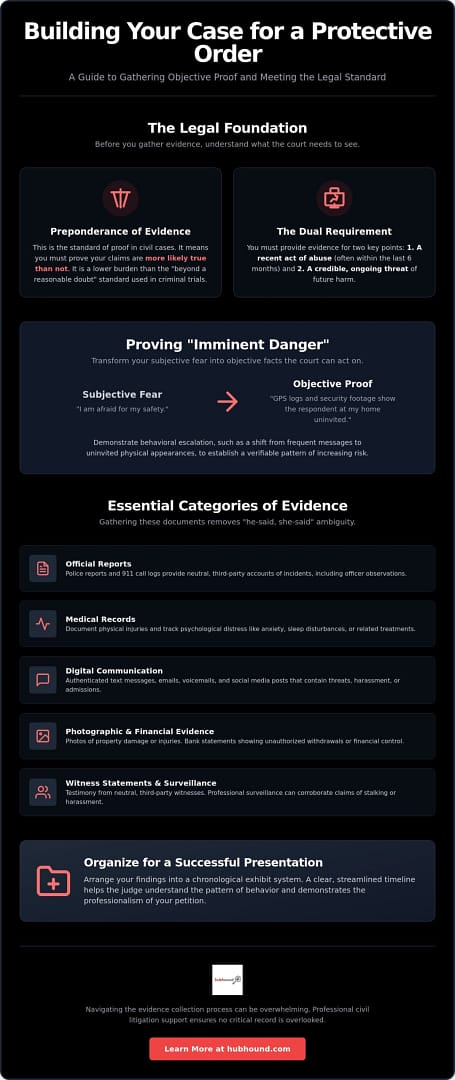
Securing a protective order requires meeting a specific legal standard known as the preponderance of evidence. Unlike criminal trials that require proof beyond a reasonable doubt, civil courts only require you to prove that your claims are more likely true than not. A Restraining order serves as a proactive shield rather than a reactive punishment. To succeed, your petition must satisfy a dual requirement: you must demonstrate that a qualifying act of abuse occurred recently and that you remain in credible, ongoing danger.
When determining what evidence do I need for a restraining order, the timeline is your most critical asset. Most jurisdictions enforce a strict statutory window, often requiring the last incident of abuse to have occurred within the previous six months. If the most recent event falls outside this period, the court may view the threat as stale. Legal abuse extends far beyond physical violence; it includes threats of bodily harm, sexual abuse, and coercive control. You must present facts that show the respondent intentionally caused or attempted to cause injury, or placed you in fear of immediate harm.
Proving “Imminent Danger”
Courts prioritize the concept of imminent danger when deciding whether to grant a permanent order. A judge evaluates the likelihood that the respondent will harm you in the near future if the court doesn’t intervene. You can prove this by identifying behavioral escalations. For instance, if a respondent’s behavior has shifted from sending frequent messages to appearing uninvited at your home, this demonstrates an increasing risk. Use objective data, such as GPS logs or security footage, to support your subjective fear. This transforms your personal anxiety into a verifiable pattern of risk that a judge can act upon.
Qualifying Relationships and Jurisdictional Basics
The specific evidence you need often depends on your relationship with the respondent. Domestic protective orders generally apply to family members, people living in the same household, or those who’ve been in an intimate relationship. If your situation involves someone outside these categories, such as a neighbor or a stranger, you may need to pursue a stalking protective order instead. Each category has different evidentiary requirements. Ensure your documentation proves the nature of your relationship and meets the general filing requirements of your civil court system. This alignment is vital to prevent your petition from being dismissed on technical grounds before the evidence is even reviewed.
Essential Categories of Physical and Documentary Evidence
While the legal threshold establishes the general requirements for a petition, your physical documentation provides the objective foundation a judge needs to issue a protective order. Documentary evidence effectively removes the “he-said, she-said” element of a hearing by providing a verifiable record of events. Police reports and 911 call logs are among the most powerful tools in your arsenal. These records serve as neutral, third-party accounts of an incident, often including the officer’s observations of your emotional state and any visible injuries at the scene. Official guidelines, such as those found in the Family Abuse Prevention Act (FAPA) instructions, emphasize the importance of these factual accounts when building a case for protection.
Medical records offer another layer of clinical proof. Beyond documenting physical injuries, these files can track psychological distress, sleep disturbances, or anxiety treatments linked to the respondent’s behavior. Determining what evidence do I need for a restraining order often starts with gathering these official records to demonstrate a pattern of harm. Property damage is equally relevant. Photos of broken doors, smashed phones, or damaged household items show a loss of control and an escalation of violence. Additionally, financial records can prove economic abuse. Bank statements showing unauthorized withdrawals or records of the respondent withholding necessary funds for childcare or housing help establish a pattern of coercive control. Securing these documents can be difficult while managing a crisis, which is why many turn to experts for civil litigation support to ensure no critical record is overlooked.
The Importance of Third-Party Documentation
Independent records carry significantly more weight in court than personal diaries because they’re created by professionals with no personal stake in the outcome. Request official reports from local law enforcement agencies as soon as possible, as some departments have retention limits on dispatch recordings. Don’t overlook workplace or school incident reports. If the respondent caused a disturbance at your job or your child’s school, the administrative logs from those institutions serve as vital evidence that the behavior is impacting multiple areas of your life.
Physical Evidence Preservation
Proper preservation is the difference between admissible evidence and a missed opportunity. When photographing injuries, use a common object like a coin or ruler next to the bruise to provide scale. Take photos from multiple angles and in different lighting to ensure clarity. Never “clean up” a scene of property damage before documenting it thoroughly. Maintaining a clear chain of custody is also important; keep physical objects in a secure, unaltered state. In complex cases, forensic evidence, such as analyzed clothing or damaged electronics, can provide the definitive proof needed to secure a long-term ruling.
Leveraging Digital Evidence and Communication Logs
Digital trails often provide the most consistent record of harassment or stalking. While many petitioners assume a simple screenshot is sufficient, courts increasingly require more rigorous authentication. When you ask what evidence do I need for a restraining order in Oregon, the answer lies in the technical details. Screenshots can be manipulated or taken out of context. To ensure your digital evidence is admissible, you must provide full message threads that include sender information, date and time stamps, and, where possible, digital metadata. This level of detail confirms the authenticity of the communication and prevents the respondent from claiming the messages were fabricated.
Social media platforms are another vital source of documentation. Harassment often manifests through public posts, tagged photos, or aggressive comments. Capture these interactions immediately. Beyond public profiles, direct messages often contain the most explicit threats. Similarly, call logs and voicemail recordings serve as objective proof of the frequency and duration of contact. A log showing fifty calls in a single hour demonstrates a pattern of behavior that a single testimony cannot convey. If the respondent is using GPS or location tracking to monitor your movements, these technical violations of your privacy constitute significant evidence of stalking and boundary interference.
Preserving Digital Footprints
Act quickly to secure your digital records. Export message logs directly from your device or use specialized software to create a forensic copy of your communications. This process preserves the metadata that proves when and where a message was sent. Apps like Snapchat or Signal present a unique challenge due to disappearing messages. Use a second device to photograph the screen if you cannot export the data. Always maintain cloud-based backups of your evidence. If your physical device is damaged or stolen, your case remains secure in a remote environment.
Proving Cyberstalking and Digital Harassment
Identifying a pattern is the key to proving cyberstalking. A single message might seem harmless, but a coordinated campaign across multiple platforms signals a clear threat. Use civil litigation support to organize these disparate digital files into a cohesive timeline. This professional oversight is particularly useful when dealing with spoofing or anonymous accounts. Investigators can often track the source of “burner” numbers or fake profiles to the respondent. Linking these anonymous actions to the individual is a critical step in demonstrating the full scope of the harassment to a judge.
Professional Surveillance and Third-Party Testimony
Judges often view testimony from friends or family members with skepticism due to inherent bias. To overcome this, you must prioritize neutral third-party evidence that provides an objective account of the situation. If you’re researching what evidence do I need for a restraining order in Oregon, professional investigative reports offer a level of credibility that personal accounts lack. A licensed investigator acts as an unbiased observer, documenting facts without the emotional cloud of a personal dispute. Their reports are structured specifically for legal review, ensuring every observation is backed by verifiable data. Obtaining statements from individuals like building managers, security guards, or retail clerks provides a layer of objectivity that is difficult to challenge in court.
Utilizing surveillance techniques is particularly effective in cases of stalking or boundary violations. While a petitioner might feel they’re being followed, an investigator can capture high-definition proof of the respondent’s presence at your home, workplace, or frequently visited locations. This approach also allows for the collection of “lifestyle” evidence. For instance, if a respondent claims they’re unable to travel or remain in a specific area, surveillance footage showing them active and mobile directly contradicts their testimony. When you consider what evidence do I need for a restraining order in Oregon, remember that a single neutral witness or a professional surveillance log can often outweigh multiple statements from close associates.
The Investigator Advantage
Safety is the primary benefit of hiring a professional to gather evidence. An investigator can conduct surveillance from a distance, ensuring you don’t have to risk direct contact with the respondent to document their behavior. This distance prevents escalation while building a robust file for your hearing. Professional surveillance provides court-ready video evidence that serves as an indisputable record of the respondent’s conduct. Using these professional resources allows you to focus on your recovery while experts handle the high-risk task of documentation.
Identifying and Locating Key Witnesses
Neutral witnesses often hold the key to a successful ruling, but finding them and convincing them to participate can be difficult. Investigators use skip tracing to locate individuals who may have witnessed past abuse but have since moved or changed contact information. Once located, conducting formal witness interviews allows you to uncover corroborating stories that strengthen your narrative. These statements must be formalized into admissible affidavits to ensure they carry weight during the hearing. Finally, professional process service ensures the respondent is legally notified of the proceedings, preventing them from claiming they were unaware of the court date.
Don’t leave your safety to chance; secure the professional civil litigation support you need to build a case that stands up to scrutiny.
Organizing Your Evidence for a Successful Presentation
The final step in securing protection is transforming a collection of documents into a persuasive legal argument. When you determine what evidence do I need for a restraining order in Oregon, your focus must shift from volume to organization. A judge often has only a few minutes to review your file before making a decision. If your evidence is disorganized, the core message regarding your safety can get lost in the noise. Creating a chronological timeline is the most effective way to demonstrate a pattern of behavior rather than isolated incidents. This structure helps the court see the progression of the respondent’s actions and the increasing risk to your safety.
Use an “Exhibit” system to label and index your documentation for the judge. Assign a letter or number to each item, such as “Exhibit A: Police Report” or “Exhibit B: Authenticated Text Thread.” This system allows you to reference specific proof quickly during your testimony, which projects confidence and clarity. Preparing for a contested hearing also requires anticipating the respondent’s counter-claims. They may attempt to characterize your evidence as retaliatory or taken out of context. HubHound supports legal teams by conducting a comprehensive evidence review, ensuring every piece of documentation is verified and strategically positioned for judicial scrutiny.
Structuring Your Narrative
Connect each incident directly to the statutory requirements of your jurisdiction. If the law requires proof of “imminent danger,” highlight the specific behaviors in your timeline that show recent escalation. Ensure your oral testimony matches your written records exactly. Inconsistencies, even minor ones, can damage your credibility in a high-stakes environment. Summarize complex data into clear charts or bulleted lists to reduce the cognitive load for the judge, making it easier for them to rule in your favor.
Final Preparation Checklist
Verify that all digital evidence is accessible on a laptop or tablet in the courtroom, but never rely solely on technology. Bring three physical copies of every exhibit: one for the judge, one for the respondent, and one for yourself. It is also beneficial to consult with a criminal defense investigator to identify any remaining gaps in your narrative. This final audit ensures your case is airtight and that you have the necessary documentation to secure a sense of safety and legal backing.
- Verify all digital files are backed up in the cloud.
- Check the battery levels on any devices used for presentation.
- Confirm the location and time of the hearing 24 hours in advance.
- Review your timeline one last time to ensure chronological accuracy.
Securing Your Legal Protection with Verifiable Proof
Transitioning from a state of fear to a position of legal strength requires more than just a statement of facts. It demands a rigorous approach to evidence collection that prioritizes objective, third-party verification over personal anecdotes. By focusing on authenticated digital logs, neutral witness statements, and professional surveillance, you remove the ambiguity that often leads to petition denials. When you stop asking what evidence do I need for a restraining order in Oregon and start implementing a structured investigative plan, you gain the clarity necessary to navigate the civil court system successfully.
Professional oversight ensures that your documentation meets the highest standards of judicial scrutiny. HubHound provides over three decades of investigative experience to help you build an airtight case. Our team consists of licensed and insured professional investigators who specialize in delivering court-ready evidence documentation. Secure the evidence you need with professional investigative support from HubHound. Taking these strategic steps today establishes the legal boundaries you need for long-term safety and peace of mind.
Frequently Asked Questions
Is a “he-said-she-said” situation enough to get a restraining order?
Testimony alone can be sufficient if the judge finds your account credible, but relying solely on personal statements is risky. Courts operate on the preponderance of evidence standard, meaning they must believe your version is more likely true than not. You can strengthen a personal account by adding neutral witness statements or digital logs that provide an objective secondary record of the events.
How far back can the evidence go for a protective order petition?
Statutory requirements usually dictate that the most recent incident of abuse must have occurred within the last 180 days to qualify for a petition. While the court focuses on this recent window, you can present older evidence to establish a long-term pattern of behavior. This historical context is vital for proving that the respondent poses a credible, ongoing threat to your safety.
Can I use recordings of conversations as evidence in court?
Admissibility depends on whether your jurisdiction follows one-party or all-party consent laws for recording. If the recording was obtained legally, it can serve as definitive proof of verbal threats, admissions, or harassment. Always verify the specific recording statutes in your area before attempting to enter audio or video files into the official court record during your hearing.
What happens if I don’t have physical evidence of abuse?
Lack of physical injuries or property damage doesn’t disqualify you from receiving a protective order. When asking what evidence do I need for a restraining order in Oregon, remember that digital footprints and behavioral patterns are equally valid. You can use text messages, social media interactions, and professional surveillance logs to prove stalking, coercive control, or credible threats of future harm.
Do I need a lawyer to present my evidence at a restraining order hearing?
You aren’t legally required to have an attorney to file a petition or present your case in court. Many individuals successfully navigate the process “pro se” by using the standardized forms provided by the judicial department. However, professional support can be beneficial for organizing complex digital files or conducting skip tracing to locate and interview neutral third-party witnesses.
How does a judge decide if my evidence is “credible”?
Judges evaluate credibility by looking for consistency between your oral testimony and your written documentation. They prioritize third-party records, such as police reports and medical files, because these documents are created by neutral professionals. Any contradictions between your statements and your exhibits can significantly damage your reliability and lead to the denial of your petition.
Can text messages from a blocked number be used as evidence?
Messages from blocked or “spoofed” numbers are admissible if you can reasonably link them to the respondent. This is often achieved through forensic metadata or by identifying specific language and knowledge unique to that individual. Professional investigators can help authenticate these messages by tracing the digital origin of the communication to ensure it meets the court’s standards for evidence.
What should I do if the respondent is destroying evidence?
Document the destruction immediately by taking photos of damaged items or noting the dates when digital accounts were deleted. Use cloud-based backups to protect your existing files from being tampered with or erased. Alerting the court to the intentional destruction of evidence can lead to a negative inference against the respondent, which may help support your claim of a credible threat.

Article by
Joel R. Manley | President | Hubhound Investigations | OR PI-ID#: 90432 | 111 SW Fifth Avenue, Suite 3150 Portland, Oregon 97204 | 971-442-8170
Joel is licensed as a private investigator in Oregon and Tennessee. Joel started his career in 1987 serving as a Military Police Officer and Military Police Investigator.
After ending his military tour of duty, Joel became a civilian Police Officer and Deputy Sheriff. Joel took his strong background in Hostage Negotiations, Mediation and Conflict Resolution, with him to patrol some of the highest crime areas in SE Portland.
Joel was awarded Deputy of the Year for his efforts and for drastically reducing the crime rate in the area he patrolled. As a Deputy Sheriff, Joel assisted in leading a Neighborhood Livability Program that was nationally recognized for having the most innovative and progressive approach to policing.
In 2018, Joel retired as a Deputy Sheriff and founded Hubhound Investigations. Joel played an integral role in Hubhound Investigations receiving an A+ Accredited Business rating from the Better Business Bureau (BBB).
In his off time, Joel enjoys spending time with his wife, adult children and Hubhound’s Happiness Ambassador, Nya. Joel also enjoys Scuba Diving and Kayaking.
Disclaimer
DISCLAIMER: This article is provided for general informational and educational purposes only. It is not intended to constitute legal advice, professional investigative advice, or instruction to engage in any unlawful activity. Laws governing private investigations, surveillance, recording, tracking, access to information, evidence collection, privacy, trespass, licensing, and related investigative activities vary by jurisdiction and are subject to change.
Any investigative techniques, tactics, procedures, scenarios, or legal proceedings discussed in this article are presented for informational purposes and should not be interpreted as authorization or encouragement to use a particular method. Private investigators and members of the public are responsible for understanding and complying with all applicable federal, state, and local laws, licensing requirements, court rules, and professional standards.
The circumstances of every investigation and legal matter are different. Information contained in this article should not be relied upon as a substitute for advice from a qualified attorney or other appropriate licensed professional regarding a specific situation. No attorney-client, investigator-client, or other professional relationship is created by reading or using this information.