
In the high-stakes environment of 2026 litigation, the difference between a multi-million dollar judgment and a total dismissal rarely hinges on a clever legal argument. It depends on who possesses the most rigorous factual record. You likely recognize that while an attorney interprets the law, they can’t manufacture the proof needed to verify an opposing party’s claims or uncover hidden assets. This is where the strategic role of private investigator in civil cases becomes the decisive factor in your legal strategy.
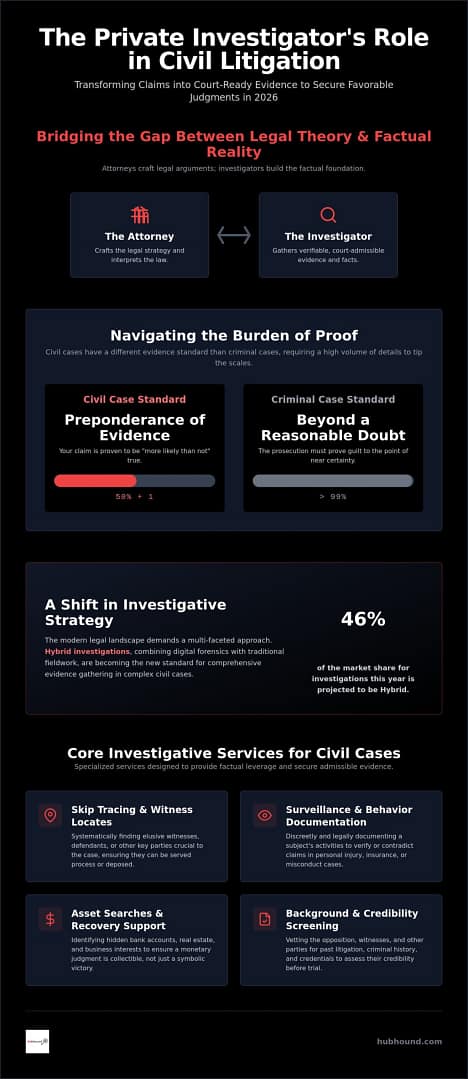
You need concrete evidence that withstands judicial scrutiny, not just suspicions. This article shows you how professional investigators provide the factual foundation and admissible evidence necessary to tip the scales in complex civil litigation. We’ll examine the shift toward hybrid investigations, which are projected to account for 46% of the market this year. You’ll also learn how to identify high-quality partners who deliver court-ready witness statements and skip tracing results that move your case from a stalemate to a favorable settlement.
Key Takeaways
- Distinguish between legal strategy and factual discovery. Professional investigators build the evidentiary foundation that empowers attorneys to secure favorable judgments.
- Understand the critical role of private investigator in civil cases when navigating the “preponderance of evidence” standard. Precise documentation is essential for tipping the scales in non-criminal litigation.
- Utilize skip tracing and surveillance as tactical tools for locating elusive witnesses and verifying the authenticity of opposing party claims across a nationwide landscape.
- Identify strategic gaps in your factual record or witness list early. Evaluating the credibility of the opposition before discovery begins prevents costly setbacks during trial.
- Prioritize court-ready evidence by partnering with licensed experts who understand the evolving regulatory environment of 2026.
Understanding the Strategic Role of Private Investigators in Civil Litigation
Civil litigation moves on the strength of evidence. While an attorney crafts the legal theory, the actual building blocks of the case come from the field. A civil investigator specializes in non-criminal legal support, focusing on disputes between individuals or organizations. The role of private investigator in civil cases is to transform anecdotal claims into verifiable data points that a judge or jury can accept. They act as the bridge between a client’s allegations and the physical or digital proof required to sustain them.
Civil cases operate on the “preponderance of evidence” standard. This requires proving that your claim is more likely than not. It’s a lower bar than criminal proof, yet it often demands a higher volume of discrete details to build a persuasive narrative. The role of private investigator in civil cases involves securing these details through rigorous fact-finding. By identifying weaknesses in your own case or the opposition’s early on, an investigator acts as a risk management tool. You don’t want to discover a witness is unreliable or a key document is missing while you’re standing in front of a judge.
Factual Foundation vs. Legal Argument
Attorneys bridge the gap between a client’s story and the law. Investigators bridge the gap between that story and reality. Civil litigation support is the systematic gathering of facts to support or refute legal claims. By providing objective, third-party verification, an investigator removes the “he-said, she-said” dynamic that stalls many disputes. The duties of a private investigator in this context include everything from asset searches to verifying professional credentials. This neutrality is vital. A report from a licensed third party carries significantly more weight in court than the testimony of an interested party.
The Symbiotic Relationship with Legal Counsel
Think of an investigator as the “boots on the ground” for desk-bound legal teams. Attorneys are often constrained by the walls of their offices. They rely on field experts to conduct interviews, perform surveillance, and serve process. Using specialized investigators for discovery tasks often optimizes legal fees. It allows the attorney to focus on high-level strategy while the PI handles the labor-intensive work of tracking down witnesses or documenting physical evidence. Even when the case involves complex liability, the same essential support for legal defense is required; precision and admissibility are the only metrics that matter. This partnership ensures that no stone is left unturned before the discovery deadline passes.
Core Investigative Services for Civil Cases: Beyond the Courtroom
Successful litigation requires more than just knowing what happened. It requires proof that can be presented in court. The role of private investigator in civil cases extends far beyond simple observation. It involves a suite of specialized services designed to provide the factual leverage needed for asset recovery or liability determination. Asset searches, for instance, identify hidden bank accounts, real estate, or business interests. These searches ensure a judgment is actually collectible rather than just a symbolic victory. Background screening vettes parties for past litigation history, allowing you to assess the credibility of a witness or opposing party before they take the stand. Identifying a “professional plaintiff” early can save thousands in legal fees.
This principle of technical verification extends to property disputes. For those involved in litigation over new-build quality, securing a professional snagging list Ireland provides the admissible evidence required to prove construction failures and support claims for remediation or damages.
Surveillance and Evidence Collection
In personal injury or workplace misconduct disputes, behavior documentation is paramount. Professional investigators use Advanced Surveillance Techniques to discreetly capture activities that may contradict a plaintiff’s claims. This objective viewpoint highlights the strategic value of a private investigator when building a defense against fraudulent claims. Modern surveillance in 2026 involves more than just a camera. It requires a deep understanding of privacy laws and data protection to ensure evidence remains admissible. Maintaining a strict chain of custody for both digital and physical evidence is the only way to prevent your most valuable proof from being thrown out during a pre-trial motion.
Skip Tracing and Locating Individuals
Litigation often stalls because a key witness or defendant has vanished. Skip tracing leverages proprietary databases and field intelligence to locate individuals who are intentionally hiding from legal obligations. This process is the backbone of successful process service. Without a verified location, the case cannot move forward. The role of private investigator in civil cases often begins with this fundamental task. Utilizing a Comprehensive Guide to Finding Missing Adults helps legal teams understand the depth of research required to track elusive subjects across state lines. If you are struggling to move a case forward due to missing parties, reviewing our civil litigation support options can provide the necessary breakthrough. Professional skip tracing ensures that even the most evasive individuals are brought within the reach of the court.
Civil vs. Criminal Investigations: Navigating Burden of Proof
Legal outcomes depend heavily on the standard of proof required by the court. In criminal proceedings, the prosecution faces the daunting task of proving guilt beyond a reasonable doubt. Civil litigation operates on a different threshold known as the preponderance of evidence. This means you must show that your claim is more than 50% likely to be true. The role of private investigator in civil cases is to provide the volume of data necessary to cross this finish line. While a criminal investigator might focus on a single piece of forensic proof, a civil investigator builds a mountain of smaller, corroborating details that collectively tip the scales in your favor.
The Preponderance of Evidence Standard
Winning a civil judgment often comes down to who has the most consistent factual narrative. Investigators help tip these scales by even 1% through the systematic collection of objective facts. In cases that would otherwise devolve into a “he-said, she-said” stalemate, third-party verification is the deciding factor. This is particularly relevant in domestic matters such as child custody or infidelity investigations. By documenting a pattern of behavior through surveillance and digital footprints, an investigator provides the court with a clear, undeniable record. These details move the case away from emotional testimony toward an evidence-based conclusion.
Corporate and Workplace Investigations
Corporate litigation presents unique challenges that require a high degree of organizational integrity. When internal theft or workplace misconduct occurs, companies often find themselves in a precarious legal position. Using a neutral third party to conduct a thorough inquiry is essential for protecting the brand and ensuring any resulting litigation is successful. A professional report provides the admissible evidence needed to support disciplinary actions or recover lost assets. For more information on these protocols, see our Workplace Investigations Guide.
The role of private investigator in civil cases within the corporate sector also involves mitigating future risks. By identifying the root cause of a dispute, such as a breach of fiduciary duty or a violation of non-compete agreements, investigators allow businesses to resolve issues before they escalate. This proactive approach relies on extensive documentation of granular details that internal teams might overlook. Whether the case involves a personal dispute or a multi-million dollar corporate fraud, the cumulative weight of the evidence remains the most powerful tool in your legal arsenal.
When to Hire a Private Investigator for Your Legal Strategy
Timing is often the most critical variable in successful litigation. Waiting until the discovery phase is nearly over to engage professional support often results in missed opportunities. The role of private investigator in civil cases is most effective when integrated during the initial strategy sessions. To determine if your case requires this level of specialized oversight, follow these four assessment steps.
- Step 1: Identify gaps in the factual record. Review your current witness list and physical evidence. If you rely solely on client testimony without third-party corroboration, your foundation is weak.
- Step 2: Evaluate opposing party credibility. Don’t take the opposition’s background at face value. A professional vetting process can uncover a history of litigious behavior or undisclosed conflicts of interest.
- Step 3: Verify physical claims through surveillance. If the case involves personal injury or claims of disability, objective documentation is required to confirm or refute the extent of the reported limitations.
- Step 4: Assess process service difficulty. If parties are actively evading service, you need a specialist who combines skip tracing with tactical delivery to keep the court calendar on track.
Early Intervention and Discovery
Engaging an investigator early prevents the loss of volatile evidence. Digital footprints can be erased; physical scenes change; and witnesses move. Securing statements while memories are fresh and unbiased provides a significant advantage over statements taken months later after witnesses have been coached. Early intervention allows your legal team to build a narrative based on verified facts rather than assumptions. This proactive approach ensures that the role of private investigator in civil cases serves as a strategic asset from day one.
Evaluating Credibility and Backgrounds
Background checks are not just administrative formalities; they are tools for impeachment. Uncovering prior fraudulent claims or a criminal history can change the entire trajectory of a civil trial. This “impeachment evidence” often forces a settlement before a case even reaches a jury. When protecting high-value business interests, consult a Corporate Investigation Firm Guide to understand the depth of vetting required for complex litigation. Verifying the integrity of every participant ensures that your strategy remains resilient against surprises during cross-examination.
Integrating Professional Investigations with HubHound
Selecting a partner for civil litigation support requires a rigorous assessment of their technical capabilities and historical performance. HubHound operates as a nationwide resource for law firms and corporations, providing the specialized focus needed to resolve complex disputes. The role of private investigator in civil cases is to act as an extension of your legal team, ensuring that every piece of evidence gathered is both factual and admissible. By centralizing your investigative needs with a single, high-capacity agency, you streamline the discovery process and maintain a consistent standard of quality across all operations.
Expertise and Experience
HubHound brings over three decades of industry experience to every engagement. This longevity is a testament to our commitment to precision and “court-ready” reporting. Our investigators specialize in workplace misconduct, corporate due diligence, and high-stakes civil support. We understand that a report is only valuable if it withstands the scrutiny of opposing counsel. Our team delivers documentation that is verified, organized, and ready for immediate integration into your legal filings. This professional rigor ensures that the role of private investigator in civil cases provides a clear path toward a favorable settlement or judgment.
Confidentiality and Ethics
Operating within the strict boundaries of privacy laws and ethical frameworks is a non-negotiable requirement for modern investigations. HubHound prioritizes transparency and compliance in every surveillance operation and background screening. Hiring licensed investigators is essential for maintaining the integrity of your case. Unlicensed or unethical practices can lead to the dismissal of evidence or even legal liability for your firm. For a deeper understanding of how to evaluate these criteria, review our Professional Buying Guide to identify the highest standards in the industry.
Securing professional investigative support starts with a focused consultation to identify the specific needs of your case. We work with you to map out a strategy that addresses factual gaps, locates missing witnesses, and verifies the claims of the opposing party. This collaborative approach ensures that your legal strategy is supported by a foundation of undeniable truth. Contact HubHound today to integrate specialized investigative expertise into your next civil litigation project.
Securing Your Factual Advantage in 2026 Litigation
Successful litigation depends on the strength of your evidence, not just the quality of your arguments. The strategic role of private investigator in civil cases is to provide the objective verification needed to meet the preponderance of evidence standard. This process involves more than just gathering data; it involves curating a narrative based on verified facts that can survive even the most aggressive pre-trial motions. By identifying factual gaps and locating key witnesses early, you transform a vulnerable claim into a resilient legal position.
Partner with a team that understands the nuances of modern discovery. HubHound provides nationwide service coverage supported by licensed investigators with over 30 years of field experience. We specialize in delivering court-ready evidence and detailed reporting that withstands rigorous judicial scrutiny. This commitment to quality saves your firm time and ensures you are never surprised during the discovery process. Don’t leave your case outcomes to chance when you can rely on professional insight.
We are ready to help you build a stronger foundation for your next case and secure the results your clients expect.
Frequently Asked Questions
How does a private investigator find hidden assets in a civil case?
Investigators locate hidden assets by cross-referencing proprietary financial databases, public property records, and corporate filings. They track digital footprints and Uniform Commercial Code (UCC) filings to identify business interests, real estate, or high-value vehicles that aren’t immediately visible. This systematic search ensures that any future judgment is collectible rather than just a symbolic legal win.
Is the evidence gathered by a private investigator admissible in court?
Evidence is admissible if it’s obtained through legal means that respect established privacy laws and ethical frameworks. The role of private investigator in civil cases is to maintain a strict chain of custody and provide objective, third-party documentation. Professional reporting that follows 2026 legal standards ensures that surveillance footage and witness statements withstand challenges from opposing counsel during pre-trial motions.
Can a private investigator help with process serving for a lawsuit?
Investigators are highly effective at process service, especially when a party is intentionally evasive. They use skip tracing tools to verify a current address and then execute service in the field using tactical observation. This dual approach prevents the litigation from stalling due to an inability to notify the defendant or key witnesses.
What is the difference between a civil investigator and a criminal investigator?
Civil investigators focus on disputes between private parties, while criminal investigators focus on violations of state or federal law. The burden of proof in civil matters is a “preponderance of evidence,” which requires a high volume of corroborating detail. Criminal cases require proof “beyond a reasonable doubt,” which involves different forensic standards and often targets a single, definitive piece of evidence.
How much does it cost to hire a private investigator for a civil matter?
Costs depend on the complexity of the investigation and the specific services required, such as surveillance or deep-level background vetting. Fees are typically structured as either hourly rates or flat rates for specific tasks like skip tracing. You should evaluate the potential return on investment, as the role of private investigator in civil cases often leads to higher settlements or the recovery of significant hidden assets.
Can a private investigator interview witnesses for my lawyer?
Yes, investigators regularly conduct witness interviews to secure fresh, unbiased statements while memories are most accurate. These professional interviews provide legal teams with a clear understanding of what a witness will say before they are formally deposed. This proactive discovery phase allows attorneys to refine their strategy based on verified information rather than client assumptions.
What happens if a private investigator discovers illegal activity during a civil case?
If an investigator uncovers criminal activity, they document the findings and report them directly to the client and their legal counsel. The attorney then determines the strategic impact on the civil case and decides whether the information must be disclosed to law enforcement. Investigators maintain professional neutrality to ensure the information remains a credible and admissible tool for the legal team.

Article by
Joel R. Manley | President | Hubhound Investigations | OR PI-ID#: 90432 | 111 SW Fifth Avenue, Suite 3150 Portland, Oregon 97204 | 971-442-8170
Joel is licensed as a private investigator in Oregon and Tennessee. Joel started his career in 1987 serving as a Military Police Officer and Military Police Investigator.
After ending his military tour of duty, Joel became a civilian Police Officer and Deputy Sheriff. Joel took his strong background in Hostage Negotiations, Mediation and Conflict Resolution, with him to patrol some of the highest crime areas in SE Portland.
Joel was awarded Deputy of the Year for his efforts and for drastically reducing the crime rate in the area he patrolled. As a Deputy Sheriff, Joel assisted in leading a Neighborhood Livability Program that was nationally recognized for having the most innovative and progressive approach to policing.
In 2018, Joel retired as a Deputy Sheriff and founded Hubhound Investigations. Joel played an integral role in Hubhound Investigations receiving an A+ Accredited Business rating from the Better Business Bureau (BBB).
In his off time, Joel enjoys spending time with his wife, adult children and Hubhound’s Happiness Ambassador, Nya. Joel also enjoys Scuba Diving and Kayaking.
Disclaimer
DISCLAIMER: This article is provided for general informational and educational purposes only. It is not intended to constitute legal advice, professional investigative advice, or instruction to engage in any unlawful activity. Laws governing private investigations, surveillance, recording, tracking, access to information, evidence collection, privacy, trespass, licensing, and related investigative activities vary by jurisdiction and are subject to change.
Any investigative techniques, tactics, procedures, scenarios, or legal proceedings discussed in this article are presented for informational purposes and should not be interpreted as authorization or encouragement to use a particular method. Private investigators and members of the public are responsible for understanding and complying with all applicable federal, state, and local laws, licensing requirements, court rules, and professional standards.
The circumstances of every investigation and legal matter are different. Information contained in this article should not be relied upon as a substitute for advice from a qualified attorney or other appropriate licensed professional regarding a specific situation. No attorney-client, investigator-client, or other professional relationship is created by reading or using this information.