
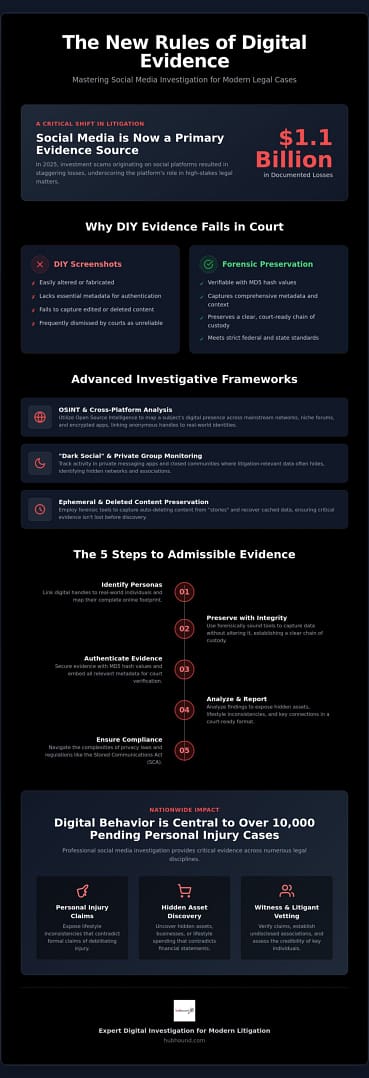
In 2025, investment scams starting on social media reached $1.1 billion in losses, highlighting a massive shift in where digital malfeasance occurs. For legal professionals, a social media investigation for legal cases is no longer an optional add-on. It’s a core requirement for modern civil and criminal litigation. You’ve likely felt the pressure of filtering through an overwhelming amount of digital noise only to worry if your evidence will be dismissed due to a lack of authentication.
It’s a valid concern because courts now demand a high standard of proof, moving beyond simple screenshots to require forensically sound documentation. This guide will help you master the complexities of identifying, preserving, and authenticating social media evidence to strengthen your legal strategy. We’ll explore how to leverage AI-powered tools and expert discovery techniques to uncover hidden assets, verify witness claims, and produce court-ready reports that stand up to rigorous assessment.
Key Takeaways
- Identify why DIY screenshots are insufficient for 2026 litigation and how to transition to forensically sound preservation methods.
- Leverage advanced OSINT frameworks to link anonymous digital handles to real-world litigants and key witnesses.
- Secure evidence integrity by capturing MD5 hash values and metadata to meet strict court authentication standards.
- Apply social media investigation for legal cases to expose hidden assets or lifestyle inconsistencies that contradict formal legal claims.
- Navigate the complexities of the Stored Communications Act (SCA) by partnering with specialized investigators who ensure ethical and legal compliance.
The Evolution of Social Media Investigation for Legal Cases
In 2026, a social media investigation for legal cases is a forensic discipline rather than a casual search. It involves the systematic identification, preservation, and analysis of digital evidence across diverse platforms. Relying on simple “DIY” screenshots is a strategic mistake that often leads to evidence being dismissed in court. Modern litigation requires a comprehensive look at the “digital shadow.” This includes metadata, geolocation data, and deleted interactions that standard captures miss. Observe the transition from mainstream platforms to fragmented ecosystems. Users now distribute their digital presence across niche forums, encrypted messaging apps, and ephemeral story formats. An effective investigation must track these movements across the entire digital landscape to build a complete profile of the subject.
Why Social Media is Indispensable in 2026
Social media provides a real-time window into a litigant’s behavior. It allows legal teams to establish intent and state of mind with high precision. As of July 2026, more than 10,000 individual personal injury cases are pending nationwide that rely heavily on digital behavior patterns. The use of social media in legal and criminal investigations has evolved from monitoring public posts to analyzing complex, encrypted, and ephemeral data streams. A plaintiff claiming a debilitating injury might inadvertently post footage of physical activity on a niche fitness app. These digital footprints often reveal hidden networks and associations that would remain invisible through traditional background checks or physical surveillance alone.
The Limitations of Traditional Discovery
Standard subpoenas are frequently too slow to capture ephemeral content. By the time a platform responds, the relevant data may be purged. Professional investigators at HubHound bypass these hurdles by utilizing advanced discovery tools that monitor for live changes. They focus on the gap between what a user chooses to share and the data they inadvertently leave behind. This proactive approach ensures that edited or deleted content is preserved before it vanishes. It provides a level of depth that general litigation support software cannot match. Relying on an expert curator to handle the heavy lifting of digital research saves time and ensures the evidence is court-ready. Professional social media investigation for legal cases ensures that no critical data point is lost to a “privacy setting” hurdle that would stop a standard legal assistant.
Advanced Techniques for Identifying Digital Footprints
Identifying a subject’s true digital footprint requires more than a standard search engine query. It demands a rigorous social media investigation for legal cases that accounts for intentional obfuscation. Professional investigators use specific frameworks to link anonymous handles back to real-world identities by analyzing registration data, recovery email patterns, and linguistic markers. This process moves beyond the surface level. It tracks a subject’s activity across “Dark Social” platforms and private messaging apps where litigation-relevant data often hides. By the time a case reaches discovery, an investigator should have already mapped the subject’s digital movements to ensure no evidence is purged or hidden.
OSINT Frameworks and Cross-Platform Analysis
Open Source Intelligence (OSINT) is a structured methodology for legal data mining that transforms raw information into actionable evidence. Investigators use these frameworks to map a subject’s presence across multiple digital ecosystems, from professional networks to obscure hobbyist forums. By analyzing the frequency and timing of metadata, experts can identify a subject’s “pattern of life.” This includes their typical locations, active hours, and primary associates. This level of detail is crucial for maintaining compliance with DOJ guidance on social media investigation policies. It ensures that the collection process respects privacy boundaries while maximizing evidentiary value for the legal team.
Preserving Ephemeral and Deleted Content
The rise of auto-delete features on platforms like Snapchat and Instagram Stories presents a significant challenge in 2026. Standard discovery methods often fail here because the data disappears before a subpoena is even processed. Forensic tools are now required to recover cached data and historical versions of pages from secondary sources. These digital findings often serve as the foundation for physical verification. For instance, a geo-tagged post might lead an investigator to deploy specific surveillance techniques to confirm a subject’s physical capabilities or associations. This transition from digital discovery to physical observation is a hallmark of a high-tier investigation.
Effective social media investigation for legal cases also uses geo-fencing to identify potential witnesses who were present at a specific time and place. This provides a pool of individuals for witness interviews that might otherwise be overlooked during traditional discovery. This multi-layered approach ensures that the digital evidence is not just found, but is also verifiable and useful for building a winning case strategy.
Admissibility and Authentication: Making Evidence Stick
Collecting data is only half the battle. For a social media investigation for legal cases to be effective, the results must survive the scrutiny of the courtroom. Many legal professionals mistakenly believe that social media evidence is “self-authenticating” under Federal Rules of Evidence 902(13) or (14). While these rules facilitate the authentication of certain electronic records, they don’t automatically prove who was behind the keyboard. A screenshot is a visual representation, not a forensic record. Without the underlying code and metadata, opposing counsel can easily argue that the image was manipulated or taken out of context. You need a verified process that links the digital content to a specific individual and proves that the data hasn’t been altered since the moment of capture.
Meeting the Standards of Rule 901
Rule 901 requires evidence that is sufficient to support a finding that the item is what the proponent claims it to be. In 2026, this means moving beyond visual identification. Authenticating social media posts requires a rigorous approach. Use this four-step checklist to ensure your findings are court-ready:
- Capture unique identifiers: Document the specific URL, Account ID, and platform-specific profile markers.
- Generate hash values: Use MD5 or SHA-256 algorithms to create a digital fingerprint of every file at the time of collection.
- Document the methodology: Record the “Who, When, and How” of the collection process to maintain a clear chain of custody.
- Secure a qualified witness: Ensure the investigator who performed the discovery is available to testify regarding the tactical use of social media in investigations and the integrity of the data.
Metadata: The Secret to Admissibility
Metadata serves as the invisible backbone of digital evidence. Beyond the visible image, professional tools extract EXIF data, IP logs, and timestamps that provide a definitive timeline of activity. This forensic depth allows you to verify the origin of a specific post or message even if the user later attempts to delete it. By capturing this data, you can effectively overcome hearsay objections. While social media posts are often considered hearsay, they frequently fall under exceptions such as party-opponent admissions or statements against interest. Integrating these forensic findings into your broader civil litigation support strategy ensures that your evidence is not just discovered, but also admissible. This level of verification is what separates a professional social media investigation for legal cases from a casual search that collapses under cross-examination.
Strategic Applications Across Legal Case Types
The utility of a social media investigation for legal cases depends entirely on the specific objectives of the litigation. While the previous section detailed how to make evidence stick, this section focuses on where that evidence creates the most leverage. Different case types require distinct search parameters and analytical frameworks. You must tailor your discovery process to the specific legal hurdles of your matter, whether you’re defending a corporation or representing a private individual. It’s about moving from broad data collection to targeted intelligence that directly addresses the elements of your case.
Civil Litigation and Insurance Defense
In personal injury and insurance defense, digital behavior provides the most compelling rebuttal to physical claims. As of July 2026, there are over 10,000 individual personal injury cases pending nationwide that involve social media liability, but the technology is equally vital for defending against fraudulent disability claims. If a plaintiff claims a sedentary lifestyle due to injury, but geotagged posts show them participating in recreational sports, the case dynamics shift instantly. This strategic filtering of data is a core component of a high-tier corporate investigation firm that prioritizes value over volume. Beyond fraud detection, social media helps establish a definitive timeline of events in complex contract disputes by tracking the communication patterns and public statements of the parties involved.
Criminal Defense and Witness Impeachment
Criminal defense attorneys use digital discovery to identify exculpatory evidence or impeach prosecution witnesses. Scouring a witness’s digital footprint often reveals bias, inconsistent statements, or proof of a prior relationship with the defendant that was not disclosed. Digital check-ins and background metadata can also serve as a modern alibi, providing timestamped proof of a subject’s location. In complex criminal matters involving missing adults, social media analysis often provides the last known location or intent of an individual before their disappearance. This forensic approach ensures that the defense team isn’t blindsided by witness testimony that contradicts the digital record.
Family Law and Employment Disputes
In family law, social media remains the primary tool for identifying hidden assets or assessing parental fitness. Large, unexplained purchases posted to private accounts can contradict financial affidavits and provide grounds for asset recovery. Similarly, employment law cases involving workplace misconduct or non-compete violations often hinge on digital interactions. If an ex-employee is recruiting clients through a professional network in violation of a contract, the digital trail is often the only smoking gun. Professional social media investigation for legal cases identifies these patterns quickly, allowing for a more efficient path to resolution. It’s about finding the truth behind the curated public persona to ensure a fair legal outcome.
Partnering with a Professional Investigative Agency
Relying solely on automated software is a significant risk in high-stakes litigation. While digital discovery tools provide raw data, they lack the evaluative judgment required to identify nuanced behavioral patterns or hidden connections. A professional social media investigation for legal cases requires an expert curator who understands both the technical landscape and the legal consequences of every finding. This specialized expertise ensures that your evidence is not only found but is also contextualized within the broader case strategy. A comprehensive investigative report provides significant leverage during settlement negotiations, often forcing a resolution before the case reaches a courtroom. It transforms a collection of posts into a coherent narrative of behavior.
Ethical and Legal Compliance
Compliance with the Stored Communications Act (SCA) is mandatory for any digital discovery process. Investigators must avoid “friending” or “pretexting” traps that could disqualify otherwise valuable evidence. These deceptive tactics violate platform terms of service and can lead to ethical sanctions for the legal team. Professional investigators act as neutral third-party curators of facts. They maintain a clear boundary between public and private digital spaces, ensuring that all data is gathered through legal and ethical channels. This rigorous adherence to protocol protects the integrity of the case and the reputation of the law firm. It ensures that the evidence remains untainted by procedural errors that opposing counsel could exploit.
Leveraging HubHound for Legal Success
HubHound brings over 30 years of experience to every social media investigation for legal cases. We handle the heavy lifting of digital research, allowing your legal team to focus on trial preparation and high-level strategy. Our process integrates digital discovery with traditional investigative methods to provide a complete picture of a subject’s activity. Once a key witness is identified through their digital footprint, we transition seamlessly to conducting witness interviews & statements to verify the findings on the ground. This multi-layered approach provides a level of validation that software alone cannot achieve.
Streamline your discovery process by outsourcing the technical complexities to licensed experts who understand the nuances of digital footprints. We provide court-ready reports that emphasize quality, transparency, and compatibility with your existing litigation strategy. Our team focuses on rigorous validation and quality assurance to ensure every data point is defensible. Contact us at HubHound to initiate a forensic social media review and ensure your evidence is ready for the rigors of 2026 litigation.
Securing the Digital Advantage in 2026 Litigation
Success in modern litigation hinges on the ability to transform digital noise into court-ready intelligence. You’ve seen how standard screenshots fail the authentication test and why forensic-grade metadata is now the baseline for admissibility. By prioritizing MD5 hash values and a rigorous chain of custody, you protect your evidence from being dismissed under Rule 901. A professional social media investigation for legal cases provides the clarity needed to expose hidden assets, verify alibis, and impeach witnesses with precision.
HubHound supports your strategy with 30+ years of investigative experience, offering forensic-grade metadata preservation and expert witness testimony to validate every finding. We handle the technical heavy lifting so you can focus on trial preparation.
Strengthen your case with evidence that stands up to the highest scrutiny and ensures your legal strategy remains resilient.
Frequently Asked Questions
Is social media evidence admissible in court in 2026?
Social media evidence is fully admissible in 2026 as long as it satisfies the Federal Rules of Evidence regarding relevance and authentication. Courts have moved away from viewing digital posts as inherently unreliable. Instead, they focus on whether the proponent can prove the record’s integrity. A successful social media investigation for legal cases ensures that every post is backed by technical documentation that withstands defense challenges.
Can an investigator access private social media accounts legally?
Legal access is limited to public information or data obtained through authorized discovery channels. Investigators must not use deceptive friend requests or “pretexting” to bypass privacy settings. Such actions violate the Stored Communications Act and can result in the evidence being excluded. We focus on ethical data mining and OSINT frameworks to gather intelligence without compromising the legal standing of your case.
How do you authenticate a social media post for trial?
Authentication requires more than just identifying the user’s handle. You must document the unique Account ID, capture the underlying metadata, and generate a cryptographic hash value at the moment of collection. This creates a digital fingerprint that proves the content remained unchanged. A licensed investigator then serves as a qualified witness to explain the technical methodology used during the capture process to the court.
What happens if a subject deletes their social media post during litigation?
Deleting content during active litigation often triggers spoliation of evidence claims and court-ordered sanctions. If a subject removes a post, investigators can often recover cached versions or historical data through forensic tools. Proactive monitoring is essential. By identifying and preserving the digital shadow early, you ensure that temporary deletions don’t undermine the facts of the case or your overall strategy.
How much does a professional social media investigation cost?
Costs for these services are generally structured as either hourly rates or flat-fee packages depending on the complexity of the matter. Factors affecting the total include the number of profiles investigated, the depth of the forensic analysis, and the need for expert witness testimony. You should evaluate service providers based on their technical capabilities and adherence to rigorous validation standards rather than looking for the lowest price.
Can social media activity be used to prove a person’s location?
Digital activity is a primary source for establishing a subject’s location at a specific time. Geotags embedded in posts and EXIF data attached to images provide precise coordinates. Even if a user disables location services, IP logs and background metadata often reveal the network used to access the platform. This data is critical for verifying alibis or countering claims in personal injury and insurance litigation.
What is the difference between a screenshot and a forensic capture?
A screenshot is merely a visual representation that is easily manipulated and lacks evidentiary weight. In contrast, a forensic capture secures the entire data packet, including headers, IP addresses, and MD5 hash values. This technical depth is required to meet modern authentication standards. It ensures the social media investigation for legal cases produces a result that is verifiable and resistant to claims of tampering.
How long does a typical social media investigation take for a legal case?
The timeline for an investigation varies based on the subject’s activity levels and the number of platforms involved. A standard background sweep might be completed within 48 to 72 hours. However, a comprehensive forensic review involving deleted content recovery or deep-web searches can take several weeks. Rapid discovery is often necessary to preserve ephemeral data before it reaches its automated deletion threshold.

Article by
Joel R. Manley | President | Hubhound Investigations | OR PI-ID#: 90432 | 111 SW Fifth Avenue, Suite 3150 Portland, Oregon 97204 | 971-442-8170
Joel is licensed as a private investigator in Oregon and Tennessee. Joel started his career in 1987 serving as a Military Police Officer and Military Police Investigator.
After ending his military tour of duty, Joel became a civilian Police Officer and Deputy Sheriff. Joel took his strong background in Hostage Negotiations, Mediation and Conflict Resolution, with him to patrol some of the highest crime areas in SE Portland.
Joel was awarded Deputy of the Year for his efforts and for drastically reducing the crime rate in the area he patrolled. As a Deputy Sheriff, Joel assisted in leading a Neighborhood Livability Program that was nationally recognized for having the most innovative and progressive approach to policing.
In 2018, Joel retired as a Deputy Sheriff and founded Hubhound Investigations. Joel played an integral role in Hubhound Investigations receiving an A+ Accredited Business rating from the Better Business Bureau (BBB).
In his off time, Joel enjoys spending time with his wife, adult children and Hubhound’s Happiness Ambassador, Nya. Joel also enjoys Scuba Diving and Kayaking.
Disclaimer
DISCLAIMER: This article is provided for general informational and educational purposes only. It is not intended to constitute legal advice, professional investigative advice, or instruction to engage in any unlawful activity. Laws governing private investigations, surveillance, recording, tracking, access to information, evidence collection, privacy, trespass, licensing, and related investigative activities vary by jurisdiction and are subject to change.
Any investigative techniques, tactics, procedures, scenarios, or legal proceedings discussed in this article are presented for informational purposes and should not be interpreted as authorization or encouragement to use a particular method. Private investigators and members of the public are responsible for understanding and complying with all applicable federal, state, and local laws, licensing requirements, court rules, and professional standards.
The circumstances of every investigation and legal matter are different. Information contained in this article should not be relied upon as a substitute for advice from a qualified attorney or other appropriate licensed professional regarding a specific situation. No attorney-client, investigator-client, or other professional relationship is created by reading or using this information.