
Most “people search” databases are little more than digital graveyards for outdated information. When you’re trying to serve process or finalize a corporate due diligence report, relying on these automated tools often leads to a frustrating dead end. You’ve likely experienced the drain on resources when a lead results in a vacant lot or a disconnected phone number. High-quality skip tracing services offer a necessary departure from this cycle of wasted time. Locating an individual who is intentionally evasive or simply difficult to track requires a sophisticated blend of proprietary data and human intelligence.
You need more than a list of potential matches; you need human-verified results that provide a clear path forward. This guide illustrates how professional skip tracing services bridge the gap between fragmented data points and physical locations. We examine the rigorous assessment process used to transform raw information into court-ready evidence. Discover the methods used by seasoned investigators to identify elusive subjects and secure the verified addresses necessary for legal success. We’ll show you how to streamline your search process and achieve the due diligence required for rapid case resolution.
Key Takeaways
- Understand how professional investigators use “seed” information to build a reliable path through the digital and physical footprints of evasive subjects.
- Learn why human-verified intelligence is critical for bypassing the 30 to 90 day data decay found in standard automated databases.
- Identify the criteria for selecting a licensed partner for skip tracing services to ensure all locate reports are court-ready and compliant.
- Discover how professional locates serve as the foundational first step for successful process service and civil litigation support.
- Recognize the limitations of software-only tools when tracking individuals who hide behind complex structures like shell companies or anonymous PO boxes.
What are Skip Tracing Services? Beyond the Digital Footprint
Skip tracing is the tactical process of locating individuals who have intentionally or unintentionally left their last known address without providing a forwarding contact. The term “skip” originates from the idiomatic expression “skipping town,” describing a person departing a location quickly to evade legal or financial obligations. To understand the foundational history and broader context of this field, one might ask, What is Skip Tracing? Historically, this discipline relied on manual searches through physical ledgers and courthouse records. Modern skip tracing services have evolved into a high-tech investigative branch that utilizes real-time digital intelligence and proprietary data streams to find subjects who don’t want to be found.
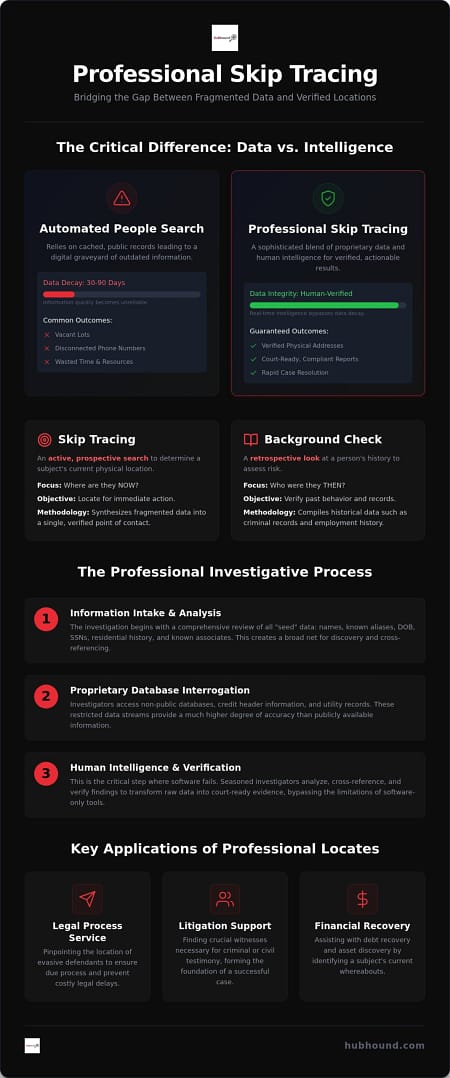
Don’t confuse professional investigative services with the “people search” websites marketed to the general public. Consumer-grade sites often rely on cached, public records that can be significantly out of date. Professional investigators access non-public databases, credit header information, and utility records that provide a much higher degree of accuracy. This distinction is critical for business managers who need reliable, actionable intelligence rather than a list of disconnected phone numbers and vacant addresses. High-quality skip tracing services bridge the gap between raw, stagnant data and human-verified results.
The Core Purpose of Professional Locates
Professional locates serve as the technical backbone for several critical business and legal functions. Efficiency is the primary driver in these operations. For a legal team, an unserved summons is a stalled case. Professional skip tracing ensures that process servers have a verified physical address, which minimizes failed service attempts and prevents costly legal delays. Key applications include:
- Legal Process Service: Pinpointing the location of evasive defendants to ensure due process.
- Litigation Support: Finding crucial witnesses who are necessary for criminal or civil testimony.
- Financial Recovery: Assisting financial institutions with debt recovery and asset discovery by identifying the subject’s current whereabouts.
Skip Tracing vs. Standard Background Checks
It’s common to conflate these two services, but their objectives are fundamentally different. A background check is a retrospective look at a person’s history. It focuses on criminal records, employment verification, and past behavior to assess risk. In contrast, skip tracing is a prospective, active search for a current physical location. While a background check might tell you who a person was five years ago, skip tracing tells you where they are today. This requires a targeted investigative approach that synthesizes fragmented data points into a single, verified point of contact. This active methodology is essential for resolving cases where the subject is actively hiding or has simply fallen off the grid.
The Professional Skip Tracing Process: A Step-by-Step Breakdown
Professional skip tracing isn’t a series of random searches or lucky guesses. It is a forensic discipline that follows a rigorous, repeatable methodology to ensure every lead is actionable and accurate. While automated tools offer speed, they often lack the precision required for legal or financial finality. Licensed investigators follow a structured workflow that transforms fragmented “seed” data into a verified physical location. This process ensures that organizations avoid the liability of acting on incorrect or outdated information while maximizing the efficiency of their investigative resources.
Step 1: Information Intake and Analysis
The investigation begins with a comprehensive review of all available identifiers. This intake phase involves collecting names, known aliases, dates of birth, and social security numbers. Beyond basic identifiers, investigators analyze residential history and known associates. Identifying the specific reason for the search allows an investigator to tailor their tactical approach. For example, finding a witness for civil litigation support requires a different set of priorities than tracking an evasive debtor. By mapping out family members and business affiliations early, the investigator creates a broader net for discovery and cross-referencing to ensure no potential lead is overlooked.
Step 2: Proprietary Database Interrogation
Once the initial analysis is complete, investigators move into “walled garden” databases. These platforms are GLBA-compliant and strictly restricted to law enforcement and licensed private investigators. These sources provide access to credit header data, utility records, and DMV filings that aren’t indexed by standard search engines. Proprietary databases provide real-time updates that public records lack. This stage utilizes professional standards that recognize skip tracing as a formal, necessary step in professional account management and legal discovery. Accessing these non-public streams is what allows professionals to identify new service connections or recent credit activity that suggests a subject’s current whereabouts.
Step 3: Manual Verification and Reporting
The final phase is what separates high-tier skip tracing services from automated search engines. Data alone isn’t proof; it’s just a lead. Investigators perform manual verification to remove false positives and stale information that could waste your time. This might involve discreet inquiries or “boots on the ground” confirmation to ensure the subject currently resides at the identified address. The result is a human-verified locate report that meets the high standards of due diligence required by courts nationwide. This level of verification is essential for ensuring your skip tracing / locate investigations result in successful process service rather than another dead end. By synthesizing multiple data points into a single verified location, the investigator provides the clarity needed for rapid case resolution.
Why Software Alone Fails: The Value of Human Intelligence
Relying exclusively on automated databases is a strategic error in modern investigations. While technology provides the raw material, it often lacks the context required to find a subject who is actively avoiding detection. Even the most advanced skip tracing services suffer from data decay. Most proprietary databases are 30 to 90 days behind a subject’s actual physical movements. For a professional needing court-ready results, acting on three-month-old data is a recipe for a failed service attempt and wasted capital.
The “Evasive Subject” problem further complicates the search. Individuals with significant legal or financial liabilities don’t leave a clean digital trail. They often hide behind shell companies, use anonymous PO boxes, or register assets in the names of associates. Algorithms are designed to follow established links; they aren’t programmed to recognize when a link has been intentionally falsified. Professional investigators provide the critical layer of human intelligence needed to spot these patterns and bypass the obstacles that stall automated systems.
The Limitations of Automated Data
Automated platforms frequently generate “false positives” that can derail an entire case. Software struggles to distinguish between individuals with common names or relatives who share similar identifiers. For example, a database might return a “hit” for a subject’s father or cousin because they lived at the same residence five years ago. Debtors and those involved in workplace misconduct often intentionally pollute their digital footprints by creating false data trails. A database hit is merely a lead. Without human verification, it is not a successful locate.
The Role of OSINT and Digital Forensics
Modern skip tracing requires a synthesis of data interrogation and Open Source Intelligence (OSINT). Investigators track digital breadcrumbs across social media platforms, professional forums, and niche community boards to identify “lifestyle” clues. These clues often reveal a subject’s current habits, such as a regular gym attendance or a recent check-in at a specific business. This digital forensic work provides the context that databases miss. In complex cases, investigators may integrate surveillance techniques to confirm a subject’s presence at a location before finalizing a report. This transition from digital intelligence to physical confirmation ensures that the final address provided is accurate and actionable.
Efficiency in locating elusive individuals comes from knowing when to move beyond the screen. An algorithm cannot conduct a discreet inquiry or analyze the nuance of a subject’s social connections. By combining technical access with investigative intuition, professionals deliver a level of reliability that software alone cannot replicate. This human-centric approach is what transforms raw data into verified, court-admissible evidence.
Key Applications: When Your Organization Needs Professional Locates
Professional skip tracing services provide the foundational intelligence required to resolve complex organizational challenges. While many associate these locates exclusively with process servers, the applications extend deep into the financial and corporate sectors. For instance, these services are the backbone of successful missing adults investigations, where locating a person is the first step in a much larger recovery or safety effort. Additionally, verified locate reports are often the deciding factor in whether a legal judgment can actually be collected or if it remains a paper-only victory.
In the high-stakes environment of mergers and acquisitions, professional locates serve as a critical component of corporate due diligence. Identifying the current whereabouts and affiliations of key stakeholders ensures that business interests are protected before capital is committed. By bridging the gap between raw data and physical confirmation, these services move cases from a standstill to a resolution.
Legal and Litigation Support
Courts require a high standard of effort before allowing alternative methods of legal notification. This “due diligence” standard is often the hurdle that stalls litigation. If you can’t find a defendant, you can’t move forward. Professional skip tracing services provide the documented proof of effort necessary to satisfy the court for service by publication. Beyond defendants, legal teams rely on these services for:
- Finding “lost” witnesses: Locating individuals whose testimony is vital to the case outcome but who have moved since the incident.
- Probate and Estates: Locating heirs for estate settlements to ensure timely and legal distribution of assets.
- Judgment Enforcement: Identifying the current physical location of debtors to facilitate the seizure of assets or garnishment of wages.
Corporate and Financial Risk Mitigation
Financial institutions and corporate entities use skip tracing to protect their bottom line. When a commercial loan defaults, the ability to locate the debtor quickly determines the success of recovery efforts. Similarly, tracing former employees is essential for workplace misconduct investigations where the subject has resigned to avoid accountability. These locates are also used to verify the current location of high-value assets for repossession or seizure. This proactive approach minimizes the time and resources wasted on dead-end leads and focuses efforts on verified, actionable addresses.
Selecting a Skip Tracing Partner for Reliable Results
Selecting the right investigative partner is a critical decision for any business manager. It’s a selective filtering process that distinguishes between high-quality resources and low-tier data brokers. When evaluating skip tracing services, prioritize agencies that offer more than just a software “hit.” You need a partner that understands the legal nuances of your specific industry, whether you’re managing civil litigation support or corporate due diligence. Speed is a valuable metric, but it shouldn’t come at the expense of human verification. A fast result that leads to a vacant lot is a waste of your professional time.
Identify partners that demonstrate a deep investigative methodology. This involves looking beyond the digital footprint to uncover physical locations through rigorous assessment. A specialized expert curator in this field won’t just provide a list of possibilities; they’ll deliver a single, verified address backed by evidence. This functional approach ensures you can extract the necessary information with minimal cognitive load, reflecting a respect for your organization’s resources.
Compliance and Ethical Standards
Compliance isn’t optional. It’s the foundation of legal reliability. Ensure your chosen agency strictly follows the Fair Credit Reporting Act (FCRA) and Gramm-Leach-Bliley Act (GLBA) guidelines. Don’t risk using “black market” or non-compliant data brokers. These sources create significant legal liability for your organization and often provide unusable data. Professional investigators maintain a clear audit trail for their findings. This ensures the information provided is court-ready and obtained through legitimate channels. Transparency separates professional-grade locates from the unverified claims found on consumer-level search sites.
The HubHound Advantage: Precision Locates
HubHound functions as an indispensable ally for growth-focused companies. We combine elite data access with over 30 years of investigative expertise to deliver results that automated tools simply can’t match. As licensed investigators, we have access to restricted “walled garden” databases that are unavailable to the general public or software-only agencies. This status allows us to perform a deeper interrogation of data points. We ensure every report we deliver is human-verified and accurate.
Our team does the heavy lifting of research so you don’t have to. We understand the nuances of the technical landscape and provide the niche expertise required to locate even the most elusive individuals. Whether you’re dealing with evasive defendants or complex asset discovery, our process is designed for maximum efficiency and transparency. Stop wasting resources on dead-end leads. Work with a partner that values your time and provides the verified proof of due diligence your case requires.
Take the first step toward efficient case resolution. Our team is ready to help you track down the highest quality solutions for your investigative needs.
Frequently Asked Questions
What is the difference between skip tracing and a background check?
Skip tracing focuses on identifying a subject’s current physical location, while a background check provides a retrospective look at their history. Background checks analyze criminal records, past employment, and credit history to assess risk. In contrast, professional skip tracing services use real-time data to pinpoint where a person resides today. This active investigative approach is essential when a subject has intentionally moved without a forwarding address to evade legal or financial obligations.
How long does a professional skip trace investigation typically take?
The duration of an investigation depends on the subject’s level of evasion and the quality of the initial seed data provided. Standard locates using proprietary databases often yield results within 48 to 72 hours. However, complex cases involving subjects who use shell companies or anonymous PO boxes may require several days of manual verification and OSINT analysis. Efficiency is a priority, but investigators ensure every lead is human-verified before delivering a final, court-ready report.
Can skip tracing find someone who has moved out of the country?
Professional investigators can often locate individuals who have moved across international borders by utilizing global data networks and specialized OSINT techniques. International searches require a nuanced approach, as data privacy laws and public record availability vary significantly by country. Investigators analyze digital footprints, international travel records, and social media activity to track movements. While these investigations are more labor-intensive than domestic searches, they remain a viable option for high-stakes legal and corporate due diligence cases.
Is skip tracing legal for finding a person who owes me money?
Skip tracing is a legal and recognized process for locating debtors, provided the investigation is conducted by licensed professionals following GLBA and FCRA guidelines. Creditors have a permissible purpose to seek current contact information for individuals who have defaulted on financial obligations. Professional skip tracing services ensure that all data is obtained through compliant channels, providing a clear audit trail. This legal reliability is critical for ensuring that any subsequent legal actions or asset repossessions stand up under judicial scrutiny.
What information do I need to provide to start a skip trace?
To initiate an effective search, provide as much seed information as possible, including the subject’s full name, date of birth, and social security number. Last known addresses, previous phone numbers, and names of known associates or family members also serve as valuable starting points. Providing the specific reason for the search allows the investigator to tailor their methodology. High-quality initial data reduces the time spent filtering through false positives and accelerates the delivery of a verified location.
Why should I hire a private investigator for skip tracing instead of using an app?
Hiring a licensed investigator provides access to walled garden databases that are strictly unavailable to the general public or consumer-grade apps. Apps often rely on stale, cached data that can be 90 days behind reality. Investigators provide a critical layer of human intelligence, conducting manual verification to confirm a subject’s presence at a specific location. This ensures you receive actionable intelligence rather than a list of disconnected phone numbers, saving your organization time on failed service attempts.
What happens if the skip tracing service cannot find the person?
If a subject cannot be located, a professional service provides a comprehensive due diligence report documenting every investigative step taken. This report is essential for legal proceedings, as it proves to the court that an exhaustive effort was made to find the individual. This documentation often allows legal teams to move forward with alternative methods, such as service by publication. Even when a physical address isn’t found, the verified record of the search serves as vital evidence for case resolution.

Article by
Joel R. Manley | President | Hubhound Investigations | OR PI-ID#: 90432 | 111 SW Fifth Avenue, Suite 3150 Portland, Oregon 97204 | 971-442-8170
Joel is licensed as a private investigator in Oregon and Tennessee. Joel started his career in 1987 serving as a Military Police Officer and Military Police Investigator.
After ending his military tour of duty, Joel became a civilian Police Officer and Deputy Sheriff. Joel took his strong background in Hostage Negotiations, Mediation and Conflict Resolution, with him to patrol some of the highest crime areas in SE Portland.
Joel was awarded Deputy of the Year for his efforts and for drastically reducing the crime rate in the area he patrolled. As a Deputy Sheriff, Joel assisted in leading a Neighborhood Livability Program that was nationally recognized for having the most innovative and progressive approach to policing.
In 2018, Joel retired as a Deputy Sheriff and founded Hubhound Investigations. Joel played an integral role in Hubhound Investigations receiving an A+ Accredited Business rating from the Better Business Bureau (BBB).
In his off time, Joel enjoys spending time with his wife, adult children and Hubhound’s Happiness Ambassador, Nya. Joel also enjoys Scuba Diving and Kayaking.
Disclaimer
DISCLAIMER: This article is provided for general informational and educational purposes only. It is not intended to constitute legal advice, professional investigative advice, or instruction to engage in any unlawful activity. Laws governing private investigations, surveillance, recording, tracking, access to information, evidence collection, privacy, trespass, licensing, and related investigative activities vary by jurisdiction and are subject to change.
Any investigative techniques, tactics, procedures, scenarios, or legal proceedings discussed in this article are presented for informational purposes and should not be interpreted as authorization or encouragement to use a particular method. Private investigators and members of the public are responsible for understanding and complying with all applicable federal, state, and local laws, licensing requirements, court rules, and professional standards.
The circumstances of every investigation and legal matter are different. Information contained in this article should not be relied upon as a substitute for advice from a qualified attorney or other appropriate licensed professional regarding a specific situation. No attorney-client, investigator-client, or other professional relationship is created by reading or using this information.