
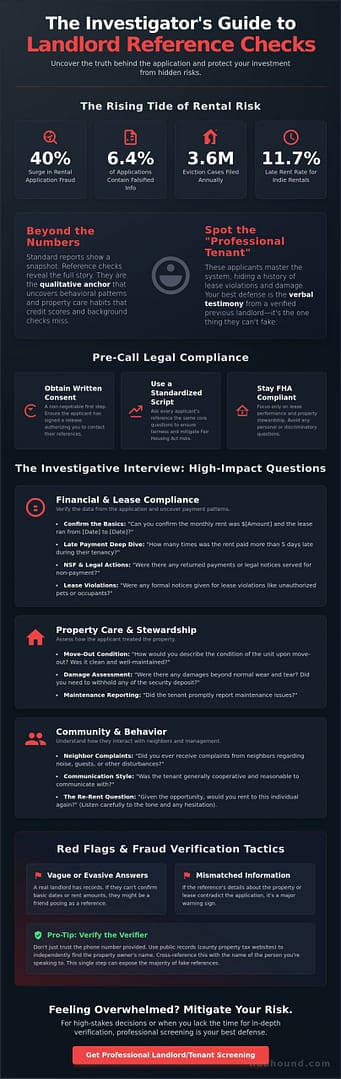
In 2024, rental application fraud surged by 40%, with 6.4% of reviewed applications containing manipulated documents. You’ve likely felt that sinking feeling when a candidate looks flawless on paper, yet your gut suggests a hidden risk. Verifying a tenant’s history requires more than a casual chat; it demands a tactical approach to the questions to ask a landlord reference check. By treating this call as an investigative interview, you can bypass the “professional tenant” and identify real liabilities before they move in.
We recognize the pressure to fill vacancies quickly while avoiding the high cost of a problem tenant, particularly as 3.6 million eviction cases are filed annually across the country. This guide provides a professional investigator’s framework for verifying rental history and spotting red flags that others miss. You’ll gain a standardized list of high-impact questions and a reliable system for identifying fake references. We’ll examine the best practices for conducting these calls with confidence, ensuring your final leasing decision is backed by verified facts rather than polished fiction.
Key Takeaways
- Utilize reference checks as a qualitative anchor to uncover behavioral insights that standard credit scores and background reports often miss.
- Master the critical questions to ask a landlord reference check to reveal hidden patterns of late payments and lease compliance issues.
- Assess property stewardship and interpersonal dynamics by investigating past neighbor complaints and the tenant’s history of unit maintenance.
- Apply investigative verification tactics to expose fraudulent references by cross-referencing landlord identity through public property records.
- Determine when to transition from manual phone calls to professional landlord/tenant screening to mitigate risk in high-stakes leasing decisions.
The Strategic Role of Landlord Reference Checks in Tenant Screening
A landlord reference check serves as the qualitative anchor of a robust screening process. While data points like credit scores and criminal records provide a quantitative baseline, they often fail to capture the behavioral nuances that define a successful tenancy. In an era where rental application fraud increased by 40% in a single year, relying solely on automated reports is a significant risk. You need to verify the person behind the paperwork to ensure they are a fit for your property.
The “professional tenant” phenomenon underscores why these checks are vital. These individuals are experts at navigating the system; they often maintain clean enough records to pass basic filters while hiding a history of property damage or lease violations. Their primary weakness is the verbal testimony of a previous property manager. By identifying the right questions to ask a landlord reference check, you adopt an investigator’s mindset. Your goal isn’t just to confirm dates; it’s to find inconsistencies between the applicant’s claims and the reality of their rental history. For instance, if an applicant claims they never had pets, but a previous landlord mentions a “pet deposit dispute,” you’ve identified a critical character flaw that no credit report would ever reveal.
Why Written Data Isn’t Enough
Automated screening reports provide a historical snapshot of financial reliability, but they don’t account for property care. A tenant might have a perfect credit score yet leave a unit in disrepair or disrupt an entire building with noise complaints. Criminal background checks are also limited; they rarely include civil disputes or “soft” lease violations that never reached a courtroom. Direct human testimony provides the essential context that software overlooks, such as whether a tenant was communicative during maintenance issues or followed community rules. In 2025, late rent payment rates for independently owned rentals increased to 11.7%, making it even more important to understand the story behind a late payment rather than just seeing a mark on a report.
Legal Prerequisites: Consent and Compliance
Before picking up the phone, ensure you have secured written consent from the applicant. This is a non-negotiable step for legal compliance and protects you from potential privacy claims. Under the Fair Housing Act (FHA), your screening process must remain consistent and non-discriminatory across the board. Using a standardized list of questions to ask a landlord reference check for every applicant helps mitigate legal risk. This structured approach ensures that you treat all candidates fairly while gathering the high-quality data needed to protect your investment. Keep your inquiries focused strictly on lease performance and property stewardship to stay within FHA boundaries and avoid invasive or personal topics.
Essential Questions for Financial and Lease Compliance
While a standard tenant screening report provides a high-level overview of an applicant’s creditworthiness, it often lacks the granular details of monthly lease compliance. You must verify that the financial data on the application aligns with the landlord’s records. Start by confirming the basics: the unit type, the exact monthly rent amount, and the lease duration. Discrepancies here are immediate red flags. For example, if an applicant claims they paid higher rent than they actually did, they may be trying to artificially inflate their perceived income-to-rent ratio.
Your investigation should prioritize the “Late Rent” deep dive. In June 2025, late payment rates for independently owned rentals reached 11.7%, up from 8.8% the previous year. This trend makes it vital to ask about the frequency and duration of any delays. Don’t just ask if they paid; ask how often they were more than five days late and if they adhered to any necessary repayment plans. High-impact questions to ask a landlord reference check include inquiries about recurring NSF (non-sufficient funds) notices or any legal filings for non-payment. If you require deeper verification of these financial patterns, professional landlord/tenant screening can provide the rigorous assessment needed for high-value properties.
Verifying the Rental Timeline
Ask for specific start and end dates to identify any gaps in the applicant’s history. These gaps often hide “skipped” leases or periods of housing instability. Confirm the exact address to ensure the applicant isn’t omitting a property where they had a poor experience. It’s also critical to determine if the tenant stayed for the full term. Breaking a lease early without a legal or agreed-upon cause suggests a lack of commitment to the contractual terms you are about to offer.
Payment Reliability and Arrears
Go beyond binary “yes or no” questions regarding rent. Inquire if the landlord ever had to serve a “Pay or Quit” notice. This legal step indicates a serious breakdown in the tenant-landlord relationship. You should also check for any outstanding balances or utility liens left behind at the property. A tenant who leaves a trail of unpaid utility bills is a significant liability, as these debts can sometimes complicate the transition for new occupants or even result in liens against the property owner in certain jurisdictions.
Notice and Move-out Protocols
A major gap in most screening processes is ignoring the exit phase. Ask the previous landlord if the tenant provided the required 30 or 60-day notice before vacating. Proper notice is a hallmark of a professional tenant who respects the landlord’s need to minimize vacancy time. Furthermore, ask if they followed all move-out protocols, such as returning keys on time and leaving the unit in the condition required by the lease. A tenant who ignores exit procedures is likely to cause similar administrative friction for you.
Behavioral and Property Care Questions: Beyond the Basics
Financial compliance is the floor, but behavioral stewardship is the ceiling of a successful tenancy. While credit reports highlight financial risk, they don’t show if a tenant smoked in a non-smoking unit or housed unauthorized guests. When refining your list of questions to ask a landlord reference check, you must target qualitative data that impacts your property’s long-term value. Asset protection starts with understanding how a tenant interacts with their physical environment and their neighbors.
Evaluating property care provides a clearer picture of the hidden costs associated with a tenant. A candidate who pays on time but leaves behind thousands of dollars in damage is a liability, not an asset. Understanding these nuances requires a structured interview approach that moves beyond “yes” or “no” answers. You should also review the federal guidelines on Tenant Background Checks and Your Rights to ensure your inquiry remains compliant while you gather this essential intelligence. Maintaining this balance allows you to screen for character without overstepping legal boundaries.
Property Condition at Move-Out
Did the tenant treat the unit with respect? The status of the security deposit is your most reliable indicator. Ask the previous landlord if the deposit was returned in full or if deductions were necessary. You need to distinguish between normal wear and tear, such as minor carpet matting, and actual damage like holes in drywall, permanent stains, or deep-set odors. Inquire about the cleanliness of the unit during routine inspections. A tenant who maintains a tidy home is less likely to attract pests or ignore slow leaks that could lead to significant water damage.
Social and Community Impact
Interpersonal dynamics often dictate the stability of a multi-unit environment. Ask if there were significant noise complaints or police calls associated with the unit. These events often signal deeper behavioral issues that aren’t captured in a standard criminal search. Analyze how the tenant handled repair requests. Were they cooperative and appreciative, or combative and demanding? A hostile tenant can drain your administrative resources and increase turnover in neighboring units. Finally, verify rule adherence regarding unauthorized long-term guests or unapproved pets. These violations often lead to increased wear on the property and potential liability issues.
The “Ultimate Question” serves as your final filter: “Would you rent to this individual again?” If the answer is anything other than a confident “yes,” ask for the specific reason. This response often reveals the “why” behind the data. It helps you decide if the risk aligns with your specific property management strategy. By focusing on these behavioral questions to ask a landlord reference check, you ensure that your next tenant is as reliable in their behavior as they are in their payments.
Spotting the ‘Professional Tenant’: Red Flags and Verification Tactics
“Professional tenants” are experts at manipulating the screening process. They often present a polished application supported by a network of fake references. Identifying the right questions to ask a landlord reference check is only half the battle; you must also verify that the person on the other end of the line is a legitimate property owner. In 2024, fraud detection services reported that 6.4% of applications contained manipulated documents. This statistic highlights the necessity of a rigorous validation process that goes beyond surface-level conversation.
One common tactic is the “Fake Landlord” trap, where an applicant provides the phone number of a friend or relative. To counter this, cross-reference the provided name and address against public property records. If the names don’t match, ask for clarification. Be wary of the “Glowing Reference” paradox. A current landlord might provide an unnaturally positive review simply to encourage a problematic tenant to vacate their property. Always prioritize the feedback from the previous landlord, who has no financial incentive to see the tenant move into your unit.
Investigative Verification Techniques
Effective verification requires you to challenge the reference’s knowledge of the property. Ask specific questions to ask a landlord reference check that only an owner would know, such as the location of the nearest cross-street or the specific layout of the building. Check the reference’s phone number against online directories and professional property management websites. If you suspect a deceptive identity, you can use skip tracing techniques to verify the landlord’s actual business address and contact details. This investigative layer ensures you are speaking with a professional peer rather than a masquerading accomplice.
Verbal Cues and Evasiveness
Listen for subtle verbal cues during the interview. Long pauses, overly rehearsed answers, or a refusal to provide specific dates and dollar amounts are significant red flags. Legitimate landlords usually have rent ledgers and lease agreements readily available. If a reference seems unsure about the monthly rent or the exact dates of the tenancy, they are likely a personal contact. Note any inconsistencies between the story told by the applicant’s employer and the previous landlord. For comprehensive protection against sophisticated fraud, consider professional Landlord/Tenant screening to secure your investment with verified data.
Scaling Your Screening: From DIY Calls to Professional Background Reports
Managing a single property might allow for manual verification, but scaling your portfolio requires a shift from DIY efforts to professional rigor. While you’ve learned the critical questions to ask a landlord reference check, executing these calls consistently takes significant time. In high-value real estate transactions, the risk of a single bad placement outweighs the cost of expert intervention. Professional landlord/tenant screening provides a level of due diligence that automated platforms simply can’t match, especially when identifying sophisticated “professional tenants” who’ve scrubbed their digital footprints.
Investigators often uncover hidden evictions or civil judgments that don’t appear on standard reports. These professionals integrate reference checks into a broader workplace investigations or corporate due diligence framework. This ensures that an applicant’s professional standing and rental history align, creating a 360-degree view of their reliability. By moving beyond the basic questions to ask a landlord reference check, you protect your assets from the 11.7% of renters who currently face financial strain and payment delays.
The Limits of Automated Screening
“Instant” background checks are often plagued by lag times in court reporting or miss out-of-state records entirely. They’re also vulnerable to identity theft, where an applicant uses stolen credentials to pass a credit check. Automated tools lack the human intuition to spot a fake landlord or a rehearsed script. In high-stakes corporate housing scenarios, professional surveillance techniques may even be necessary to verify occupancy patterns or property use. You can’t rely on a software algorithm to detect the subtle evasiveness of a fraudulent reference.
Partnering with an Investigative Expert
Outsourcing the heavy lifting of reference verification increases your operational efficiency. It also ensures that your process remains fully compliant with the Fair Credit Reporting Act (FCRA). A licensed investigative firm understands the nuances of permissible purpose and adverse action, shielding you from potential litigation. Don’t leave your investment to chance with shallow, automated data. Secure your property with HubHound’s professional screening services.
Secure Your Investment with Investigative Precision
Effective tenant screening requires moving beyond automated data to uncover the behavioral patterns that define a stable tenancy. By mastering the strategic questions to ask a landlord reference check, you transform a routine task into a powerful fraud detection tool. You must prioritize the verification of the reference’s identity through public records and value the feedback from previous landlords over current ones. These proactive steps protect your property from sophisticated tenants who specialize in bypassing standard filters.
For high-value properties or complex portfolios, manual verification often becomes a significant administrative liability. HubHound provides the niche expertise needed to navigate this technical landscape with quiet confidence. Our licensed investigators bring over 30 years of experience to every deep-dive verification, ensuring all reports are fully FCRA-compliant and rigorous. We identify the nuances that automated software misses, saving you time and reducing the risk of choice paralysis. Request a Professional Tenant Screening Report from HubHound to eliminate uncertainty from your leasing process. Protecting your portfolio starts with the right intelligence.
Frequently Asked Questions
Can a previous landlord give a bad reference?
Yes, a previous landlord can provide a negative reference as long as the information is truthful and based on documented facts. Professional property managers typically focus on objective data like late payments, property damage beyond wear and tear, or formal eviction filings. To ensure accuracy, compare their report against the applicant’s claims and look for evidence of lease non-compliance. Factual reporting is a standard part of the industry’s verification process.
What should I do if a landlord reference is unreachable?
If a reference is unreachable after multiple attempts, ask the applicant for alternative documentation such as rent receipts, canceled checks, or an official rent ledger. Persistent silence from a former landlord can sometimes indicate a skipped lease or a non-existent reference. You should also verify if the property is currently managed by a company that requires a formal written request rather than a phone call. Don’t approve an application without some form of verification.
Are there questions that are illegal to ask a former landlord?
You must avoid any inquiries that touch upon protected classes under the Fair Housing Act, including race, religion, familial status, or disability. Stick strictly to lease-related performance and financial reliability. Asking about a tenant’s personal lifestyle or medical history is legally high-risk and could lead to discrimination claims. Maintaining a standardized list of questions to ask a landlord reference check ensures your process remains compliant and objective across all applicants.
How do I verify if a landlord reference is real or fake?
Verify the reference’s identity by cross-referencing the property address with public tax records or ownership directories. If the name provided by the applicant doesn’t match the record of the owner or the registered property management firm, ask for a professional explanation. You can also use skip tracing tools to confirm the landlord’s contact information and business history. This ensures you aren’t speaking with a friend of the applicant masquerading as a professional.
How many years of rental history should I check for a new tenant?
Standard practice is to review the last three to five years of rental history, covering at least the two most recent landlords. This timeframe allows you to identify long-term patterns in property care and financial consistency. Checking only the current landlord is risky, as they might provide a positive review just to encourage a problematic tenant to move out. A multi-year view provides a much more accurate risk assessment for your investment.
What is the most important question to ask a landlord reference?
The most critical inquiry is asking if the landlord would rent to the individual again. This “ultimate question” forces the reference to provide a bottom-line assessment of the tenant’s overall performance. If they hesitate or offer a qualified “no,” it typically indicates underlying issues that didn’t result in a formal eviction but still caused significant administrative or financial friction. It’s the most telling indicator of future behavior.
What are the biggest red flags during a tenant reference call?
Major red flags include vague responses regarding rent amounts, an inability to provide specific lease dates, and overly rehearsed praise. If a reference sounds like a personal friend rather than a professional manager, treat the information with skepticism. Inconsistencies between the application data and the verbal report are high-priority warnings. These discrepancies often suggest that the applicant is attempting to hide a history of late payments or property damage.
Should I ask for a written reference or do a phone call?
A phone call is generally superior because it allows you to listen for verbal cues, pauses, and tone, which often reveal more than a written form. However, a written reference provides a clear paper trail for your records and helps maintain compliance. The most effective strategy for the questions to ask a landlord reference check is to conduct a phone interview first and then request a brief email confirmation of the key facts.

Article by
Joel R. Manley | President | Hubhound Investigations | OR PI-ID#: 90432 | 111 SW Fifth Avenue, Suite 3150 Portland, Oregon 97204 | 971-442-8170
Joel is licensed as a private investigator in Oregon and Tennessee. Joel started his career in 1987 serving as a Military Police Officer and Military Police Investigator.
After ending his military tour of duty, Joel became a civilian Police Officer and Deputy Sheriff. Joel took his strong background in Hostage Negotiations, Mediation and Conflict Resolution, with him to patrol some of the highest crime areas in SE Portland.
Joel was awarded Deputy of the Year for his efforts and for drastically reducing the crime rate in the area he patrolled. As a Deputy Sheriff, Joel assisted in leading a Neighborhood Livability Program that was nationally recognized for having the most innovative and progressive approach to policing.
In 2018, Joel retired as a Deputy Sheriff and founded Hubhound Investigations. Joel played an integral role in Hubhound Investigations receiving an A+ Accredited Business rating from the Better Business Bureau (BBB).
In his off time, Joel enjoys spending time with his wife, adult children and Hubhound’s Happiness Ambassador, Nya. Joel also enjoys Scuba Diving and Kayaking.
Disclaimer
DISCLAIMER: This article is provided for general informational and educational purposes only. It is not intended to constitute legal advice, professional investigative advice, or instruction to engage in any unlawful activity. Laws governing private investigations, surveillance, recording, tracking, access to information, evidence collection, privacy, trespass, licensing, and related investigative activities vary by jurisdiction and are subject to change.
Any investigative techniques, tactics, procedures, scenarios, or legal proceedings discussed in this article are presented for informational purposes and should not be interpreted as authorization or encouragement to use a particular method. Private investigators and members of the public are responsible for understanding and complying with all applicable federal, state, and local laws, licensing requirements, court rules, and professional standards.
The circumstances of every investigation and legal matter are different. Information contained in this article should not be relied upon as a substitute for advice from a qualified attorney or other appropriate licensed professional regarding a specific situation. No attorney-client, investigator-client, or other professional relationship is created by reading or using this information.