
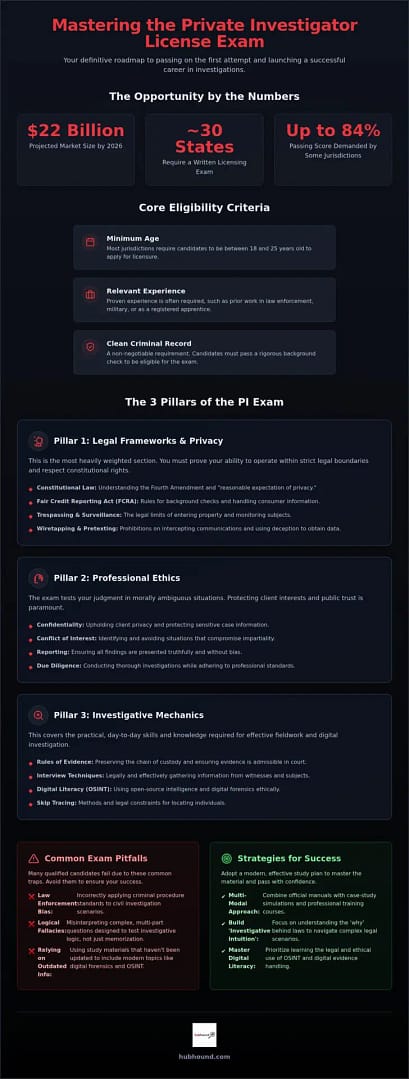
With the private investigation market projected to reach $22 billion in 2026, the barrier between you and a lucrative career often comes down to a single hurdle: the private investigator license exam. Approximately 30 states require this written assessment, often demanding passing scores as high as 84%. It’s understandable if you feel overwhelmed by dry government manuals or fear that a single failed attempt will stall your professional momentum. You want to start working, not get stuck in a cycle of retesting with outdated materials.
This guide eliminates that uncertainty by providing a definitive roadmap to exam mastery. You’ll learn how to navigate complex legal definitions and core competencies using proven study strategies designed for the modern professional. We’ve curated the most relevant information to help you bypass information overload and focus on what actually appears on the test. We’ll examine the specific topics you must master, from surveillance ethics to civil litigation support, and provide the tools needed to pass on your first attempt. By the end of this article, you’ll have a clear, actionable plan to secure your license and join the ranks of elite investigative professionals.
Key Takeaways
- Identify the core eligibility criteria for professional practice, including specific age, experience, and background standards required for national licensure.
- Master the primary pillars of the private investigator license exam, with a heavy focus on constitutional law, privacy rights, and investigative mechanics.
- Avoid the common “law enforcement bias” and other logical pitfalls that frequently lead to high failure rates among experienced candidates.
- Implement a multi-modal study approach using case-study simulations to build the investigative intuition necessary for complex legal scenarios.
- Utilize professional mastery courses led by industry experts to streamline your preparation and ensure a successful result on your first attempt.
Understanding the Private Investigator License Exam Requirements
The private investigator license exam serves as the definitive gateway to professional practice. It ensures that every practitioner possesses the technical knowledge and ethical grounding required to handle sensitive information. For a foundational Private investigator overview, one can see how the role has evolved from simple fieldwork to a complex mix of legal and digital expertise. In 2026, the industry is more regulated than ever. A significant majority of jurisdictions, specifically 46 out of 51, mandate state-level licensing. Regulatory bodies use these examinations to maintain industry integrity and protect public safety. This oversight ensures that practitioners understand the gravity of their access to private data.
Eligibility criteria typically involve a combination of age, experience, and background standards. Most jurisdictions set the minimum age between 18 and 25 years. Candidates must often prove relevant experience, such as prior work in law enforcement, military intelligence, or as an apprentice under a licensed investigator. A clean criminal record is mandatory. Passing a rigorous background check is a non-negotiable step before you can even sit for the private investigator license exam. These prerequisites ensure that only individuals with a proven track record of reliability enter the field.
The Purpose of Professional Licensing
Licensing establishes a critical baseline for legal knowledge and surveillance protocols. It protects the public by ensuring that investigators understand the boundaries of privacy law and constitutional rights. This process effectively distinguishes professional investigators from unlicensed practitioners who might lack the training to handle evidence legally. By mandating a standardized test, regulatory bodies verify that you can perform duties like witness interviews or corporate due diligence without compromising the integrity of a legal case. It’s about maintaining a high standard of professional conduct that clients can trust.
Common Jurisdictional Overlaps
While there is no single national exam, most state-level tests share significant overlaps in content. You can expect questions regarding the legality of surveillance, the rules of evidence, and ethical conduct during skip tracing operations. In 2026, there is a distinct shift toward digital literacy. Modern exams now incorporate questions on open-source intelligence (OSINT) and digital forensics. Understanding these national standards is essential. It prepares you to operate within a hybrid model that blends traditional fieldwork with sophisticated online research. This broad knowledge base allows an investigator to remain compliant across different environments while providing high-quality litigation support. Utilizing resources from HubHound can help you synthesize these complex national standards into actionable knowledge for your testing day.
Core Subjects: What is Actually on the PI Exam?
The private investigator license exam evaluates your ability to apply complex legal principles to real-world scenarios. It rests on three primary pillars: Law, Ethics, and Investigative Mechanics. While memorizing statutes is necessary, the exam prioritizes “investigative logic.” This means you must demonstrate an understanding of why certain actions are legal or ethical in specific contexts. Most exams heavily weight constitutional law and privacy rights, as these form the boundaries of all professional fieldwork. You’ll need to prove you can make split-second decisions that withstand legal scrutiny in a courtroom.
Legal Frameworks and Privacy Statutes
Mastering the Fair Credit Reporting Act (FCRA) is critical, particularly for those performing pre-employment background checks. You must distinguish between what’s publicly accessible and what requires specific consent. Privacy statutes also define the “reasonable expectation of privacy.” This concept dictates where you can legally conduct surveillance without violating Fourth Amendment principles. The exam will test your knowledge on:
- Trespassing: The legal consequences of entering private property without authorization.
- Wiretapping: The strict federal and state prohibitions against illegal interception of electronic communications.
- Pretexting: The ethical and legal limits of using a ruse to obtain information, especially regarding financial records.
Understanding these boundaries prevents your evidence from being suppressed in court and protects your professional standing. It’s about knowing the law well enough to operate right at its edge without crossing over.
Investigative Techniques and Evidence
Technical proficiency is tested through questions on evidence collection and surveillance. You must know the best practices for surveillance techniques, including maintaining a low profile and documenting activities with timestamped precision. Evidence is useless without a documented chain of custody. The exam will challenge your knowledge of how to handle, store, and transfer physical or digital evidence to ensure it remains court-admissible.
Additionally, you’ll encounter scenarios regarding interviewing strategies for missing adults and witness statements. These questions assess your ability to gather facts without using coercive or illegal tactics. Success requires moving beyond rote memorization to understand the “why” behind the rules. If you find these legal nuances confusing, consider enrolling in Professional Online License Exam Mastery Courses to sharpen your investigative intuition and ensure you’re prepared for the 2026 testing standards.
Why Most Candidates Fail: Common PI Exam Pitfalls
Success on the private investigator license exam requires more than just memorizing facts. High failure rates often stem from a fundamental perspective error. Candidates frequently over-complicate simple legal scenarios or focus too heavily on “exciting” fieldwork topics while ignoring the administrative rules that govern the profession. You must approach the test with a mindset focused on compliance and risk mitigation rather than just results. In the approximately 30 states that require a written assessment, the difference between passing and failing often comes down to how you interpret the role of a private citizen versus a state agent.
The Trap of Law Enforcement Thinking
Former law enforcement officers often face the biggest challenge during testing. This “law enforcement bias” leads candidates to answer questions based on police protocol rather than the specific limitations of private investigator law. Unlike the police, PIs don’t have special search or seizure powers. Questions regarding “arrest authority” are frequent stumbling blocks. A private investigator generally operates under the same citizen’s arrest statutes as any other person. You must adapt to the civil litigation focus of private work, where the rules of engagement differ significantly from criminal law enforcement. Relying on police habits instead of statutory PI limits is a fast track to a failing grade.
Misinterpreting Ethical Dilemmas
Ethics questions are designed to test your reaction to conflicts of interest and the boundaries of professional conduct. The exam often presents scenarios where the line between persistent investigation and harassment is blurred. Candidates fail when they choose the most aggressive investigative path rather than the most legally sound one. Identifying the correct “next step” in an ethical scenario is vital. For example, if a witness refuses to speak, your legal options are limited compared to a government agent. The test evaluates your ability to recognize these stop signs. Understanding these nuances is exactly what HubHound’s Professional Online License Exam Mastery Courses are designed to clarify, helping you avoid these common traps.
Poor time management also contributes to errors in complex case studies. These scenarios require you to synthesize multiple legal and ethical rules under pressure. If you spend too much time on straightforward administrative questions, you won’t have the mental bandwidth for the heavy-duty analysis required at the end of the test. Balance your pace and stay focused on the specific regulatory environment of the private sector. Avoid the temptation to rush through the “boring” sections, as administrative and licensing rules carry significant weight in your final score.
Effective Study Strategies for Aspiring Private Investigators
Passing the private investigator license exam requires a strategic shift from passive reading to active engagement. A multi-modal study approach is the most efficient way to ensure retention of complex legal frameworks and investigative protocols. By combining reading with practice tests and active recall, you move beyond surface-level familiarity to deep mastery. This method is particularly effective for building the investigative intuition needed to solve the case-study simulations found in modern assessments. You aren’t just memorizing rules; you’re learning to apply them under pressure. High-quality simulations force you to weigh competing ethical and legal priorities, mirroring the decision-making process required in professional practice.
The Power of Practice Exams
Utilizing practice assessments is indispensable for identifying gaps in your legal knowledge before they become failures on test day. Use these assessments to simulate the actual exam environment, which significantly reduces anxiety for the 2026 testing cycle. Don’t just check your score. Analyze every wrong answer to understand why a specific legal scenario required a different response. This selective filtering process allows you to focus your energy on high-impact topics rather than wasting time on areas you already master. Consistent simulation builds the mental stamina needed for the three-to-four-hour testing windows common in many jurisdictions.
Active Recall and Flashcards
Active recall forces your brain to retrieve information rather than just recognizing it on a page. Create flashcards for technical definitions and administrative specifics, including:
- Skip tracing: The process of locating individuals who have gone missing or are evading legal obligations.
- Due diligence: The rigorous assessment of a person or business to identify potential risks.
- Administrative timelines: Specific deadlines for license renewals and mandatory reporting requirements.
For the most complex PI laws, use the Feynman Technique. Explain the law in simple terms as if you were teaching it to a novice. If you can’t explain it clearly, you don’t understand it well enough for the private investigator license exam. This process highlights exactly where your comprehension breaks down, allowing for targeted review and reinforcement.
In addition to individual study, join professional forums to gain insights from those who have recently passed. These communities provide a real-world perspective on current testing trends and administrative code changes. Focus your efforts on the specific codes of the licensing body, as these segments often carry significant weight. Studying the administrative fine print ensures you aren’t caught off guard by questions regarding corporate structure or reporting mandates. Combining peer support with rigorous, validated study materials ensures you enter the testing center with quiet confidence and a clear roadmap to success.
Mastering the Exam with HubHound’s Professional Training
HubHound’s Professional Online License Exam Mastery Courses represent the premier preparation tool for candidates seeking more than just a passing score. While generic guides offer surface-level facts, these courses provide a deep dive into the practical application of investigative law. Success on the private investigator license exam is not just a regulatory requirement; it’s the foundation of your professional reputation. By mastering these core competencies now, you establish a standard of integrity that will define your entire career. This training transforms the exam from a hurdle into a strategic advantage for your future practice.
Why Industry Experience Matters in Prep
Our curriculum is designed by licensed investigators with over 30 years of field experience. This background ensures that you learn from professionals who actually perform the tasks described in the exam questions. You gain unique insights into how privacy laws and constitutional boundaries apply to modern 2026 surveillance operations. This approach bridges the gap between abstract legal theory and the daily reality of a PI. The training emphasizes high-level corporate investigation firm standards, ensuring you’re prepared for the most rigorous professional environments.
Practical experience is woven into every module. We focus on the nuances of workplace investigations and corporate due diligence. This specialized knowledge allows you to visualize the scenarios presented on the test. When you encounter a complex question about skip tracing or witness interviews, you won’t just guess. You’ll answer based on established industry best practices that have been validated over decades of successful operations. This level of preparation ensures that your knowledge is both deep and court-admissible.
Take the Next Step in Your Career
Efficiency is a priority for growth-focused professionals. Our online, self-paced mastery training allows you to prepare without disrupting your current schedule. This flexible environment mirrors the digital tools you’ll use in the field, emphasizing a respect for your time and cognitive load. HubHound supports you beyond the initial testing phase by providing access to professional resources that remain relevant as you grow your practice. We’re committed to your long-term success in the investigative sector.
View this preparation as a strategic investment in your future. The private investigator license exam is the first of many professional milestones. Mastering this material gives you the confidence to handle high-stakes cases with legal precision from day one. Take the final step toward your professional goals. Join the ranks of licensed investigators who prioritize quality, transparency, and niche expertise. Visit HubHound today to begin your journey toward professional mastery.
Secure Your Professional Future
Success on the private investigator license exam marks your transition into the professional sector. You now have a clear roadmap of the core subjects required for 2026. This includes everything from constitutional privacy limits to advanced surveillance mechanics. Recognizing common pitfalls like law enforcement bias ensures you approach the test with the specific mindset regulatory bodies demand. Preparation is the key. Effective study strategies build a foundation of investigative logic that serves you throughout your entire career.
HubHound provides specialized tools to bridge the gap between theory and field reality. We do the heavy lifting. Our courses are designed by investigators with over 30 years of experience. This ensures comprehensive coverage of 2026 national investigative standards. Don’t let information overload or outdated materials delay your career start. Use these strategies to master the material and pass with quiet confidence on your first attempt.
Your journey toward becoming an elite investigator begins with a single, decisive step. Take control of your preparation. Join the ranks of the nation’s most trusted professionals today.
Frequently Asked Questions
What is the passing score for the private investigator license exam?
State-level requirements vary across the country, but passing scores for the private investigator license exam typically fall between 70% and 84%. Since there is no national standard, you must verify the specific threshold with your state’s licensing board. Achieving a high score is essential, as some jurisdictions limit retake opportunities. Our mastery courses focus on helping you exceed these benchmarks by focusing on the core legal and ethical principles tested nationwide.
How many times can I retake the PI exam if I fail?
Retake policies are determined at the state level, with many jurisdictions allowing candidates to retest after a mandatory waiting period. Some states allow unlimited attempts within a year, while others impose a cap before requiring additional training. Failing can significantly delay your career start and result in additional fees. We recommend thorough preparation using professional resources to ensure you pass on your first attempt and avoid these administrative and financial setbacks.
Are there specific study guides for the 2026 private investigator exam?
Yes, professional study guides are available, but you should prioritize resources updated for 2026 standards. HubHound offers Professional Online License Exam Mastery Courses specifically designed to address the current investigative landscape. These courses simplify complex topics like constitutional law and digital evidence handling. Avoid generic manuals that lack the depth required to pass the modern private investigator license exam, as they often rely on outdated statutes or surface-level summaries.
Does the PI exam cover digital forensics and cyber investigations?
Modern examinations increasingly incorporate questions on digital literacy and electronic evidence. While the depth varies by state, you can expect to be tested on the legal boundaries of open-source intelligence (OSINT) and digital forensics. Understanding how to handle digital evidence without compromising its integrity is a core competency in 2026. Our training modules cover these technical aspects to ensure you are prepared for the hybrid nature of contemporary investigative work.
How long should I study before taking the private investigator license exam?
Most successful candidates dedicate four to six weeks of consistent study before sitting for the exam. This timeframe allows you to move through the material using a multi-modal approach that includes active recall and practice tests. If you have prior experience in legal or law enforcement sectors, you might reduce this time, but you still need to master PI-specific statutes. Using a structured mastery course can streamline this process by focusing on high-impact topics.
Can I take the private investigator license exam online?
While some states have introduced remote proctoring, the majority of jurisdictions require you to take the exam in person at a designated testing center. You must check with your specific state regulatory body for their current delivery methods. Regardless of the format, the content remains rigorous and focused on state-specific laws. If online testing is available, ensure your environment meets the strict security and technical requirements mandated by the proctoring service.
Is previous law enforcement experience helpful for the PI exam?
Previous law enforcement experience provides a strong foundation in investigative mechanics, but it can also lead to a “law enforcement bias.” Many former officers fail the private investigator license exam because they answer based on police powers rather than the limitations of a private citizen. You must learn the specific civil statutes and privacy laws that govern private practice. Our courses help bridge this gap by highlighting the critical differences between public and private sector authority.
What documents do I need to bring to the PI exam testing center?
You typically need to provide at least two forms of valid, government-issued identification, such as a driver’s license or passport. Some centers also require your exam authorization letter or proof of application. Check your specific state’s requirements at least 48 hours before your appointment. Arriving without the correct documentation will result in a forfeited fee and a canceled session. Ensure your identification matches the name on your application exactly to avoid administrative delays.

Article by
Joel R. Manley | President | Hubhound Investigations | OR PI-ID#: 90432 | 111 SW Fifth Avenue, Suite 3150 Portland, Oregon 97204 | 971-442-8170
Joel is licensed as a private investigator in Oregon and Tennessee. Joel started his career in 1987 serving as a Military Police Officer and Military Police Investigator.
After ending his military tour of duty, Joel became a civilian Police Officer and Deputy Sheriff. Joel took his strong background in Hostage Negotiations, Mediation and Conflict Resolution, with him to patrol some of the highest crime areas in SE Portland.
Joel was awarded Deputy of the Year for his efforts and for drastically reducing the crime rate in the area he patrolled. As a Deputy Sheriff, Joel assisted in leading a Neighborhood Livability Program that was nationally recognized for having the most innovative and progressive approach to policing.
In 2018, Joel retired as a Deputy Sheriff and founded Hubhound Investigations. Joel played an integral role in Hubhound Investigations receiving an A+ Accredited Business rating from the Better Business Bureau (BBB).
In his off time, Joel enjoys spending time with his wife, adult children and Hubhound’s Happiness Ambassador, Nya. Joel also enjoys Scuba Diving and Kayaking.
Disclaimer
DISCLAIMER: This article is provided for general informational and educational purposes only. It is not intended to constitute legal advice, professional investigative advice, or instruction to engage in any unlawful activity. Laws governing private investigations, surveillance, recording, tracking, access to information, evidence collection, privacy, trespass, licensing, and related investigative activities vary by jurisdiction and are subject to change.
Any investigative techniques, tactics, procedures, scenarios, or legal proceedings discussed in this article are presented for informational purposes and should not be interpreted as authorization or encouragement to use a particular method. Private investigators and members of the public are responsible for understanding and complying with all applicable federal, state, and local laws, licensing requirements, court rules, and professional standards.
The circumstances of every investigation and legal matter are different. Information contained in this article should not be relied upon as a substitute for advice from a qualified attorney or other appropriate licensed professional regarding a specific situation. No attorney-client, investigator-client, or other professional relationship is created by reading or using this information.