
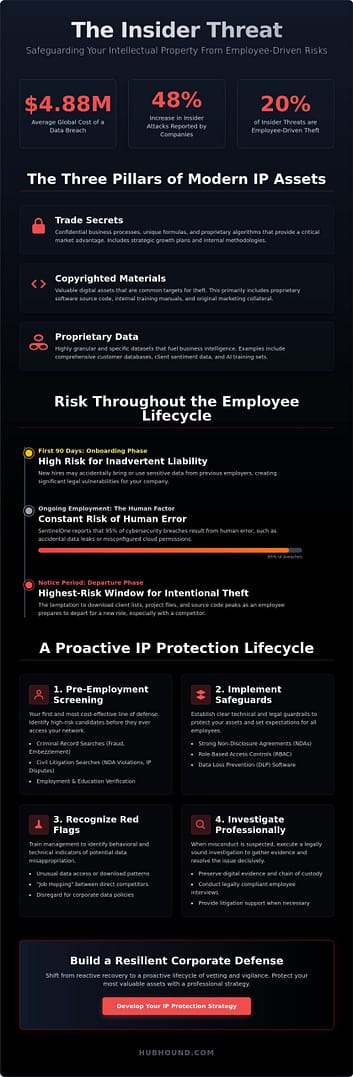
48% of companies reported an increase in insider attacks in 2026, with employee-driven theft accounting for 20% of those threats. If you feel like your competitive advantage is walking out the door with every departing staff member, you are right to be concerned. Preventing intellectual property theft from employees is no longer a simple IT task; it is a core business survival strategy. With the average global cost of a data breach reaching $4.88 million this year, the stakes for your trade secrets have never been higher.
We understand the frustration of balancing team trust with the legal uncertainty of workplace monitoring. You shouldn’t have to wait for a massive litigation bill to take action against internal risks. This article promises to help you safeguard your company’s proprietary data through a proactive lifecycle of screening, monitoring, and professional investigation. We’ll provide a comprehensive prevention checklist, explain how pre-employment background checks serve as your first line of defense, and outline the exact steps for investigating suspected misconduct before the damage becomes permanent.
Key Takeaways
- Identify the high-value assets most vulnerable to modern insider threats, including AI training sets and proprietary source code.
- Utilize pre-employment background checks as a critical first layer of defense in preventing intellectual property theft from employees.
- Recognize the behavioral and technical red flags that indicate a potential data breach or trade secret misappropriation by current staff.
- Execute workplace misconduct investigations with professional precision to resolve suspected IP theft while maintaining legal standards.
- Build a resilient corporate strategy that shifts from reactive recovery to a proactive lifecycle of vetting and vigilance.
Understanding the Modern Landscape of Employee Intellectual Property Theft
In 2026, intellectual property is the primary driver of corporate valuation. It no longer consists solely of physical blueprints; it now encompasses proprietary AI training data, high-level source code, and granular client sentiment databases. Successfully preventing intellectual property theft from employees starts with recognizing that these digital assets are highly portable. While many leaders focus on external hackers, 20% of insider threats originate from your own staff. This risk is particularly acute in the technology sector, which experiences 34% of all IP theft incidents according to 2026 industry data.
The Three Pillars of IP Assets
Modern businesses must secure three distinct categories of intellectual property to remain competitive:
- Trade Secrets: These include confidential business processes, unique formulas, and proprietary algorithms that provide a market advantage.
- Copyrighted Materials: Software code is the most common target here, along with internal manuals and original marketing collateral.
- Proprietary Data: This involves strategic growth plans, customer databases, and the specific datasets used to refine internal machine learning models.
The Economic Impact of Data Exfiltration
The financial consequences of a breach are staggering. As of May 2026, the average global cost of a data breach has reached $4.88 million. This figure includes direct losses from stolen competitive advantages and the high costs of civil litigation support required to recover assets. Beyond the balance sheet, companies face severe reputational damage that can alienate investors and erode partner trust for years.
Understanding why employees compromise data is essential for a proactive strategy. Some act out of financial desperation or are recruited through Industrial Espionage Overview tactics by competitors. Others may be poached by rivals and feel entitled to take their work product with them. However, not all loss is malicious. SentinelOne reports that 95% of cybersecurity breaches result from human error, such as accidental data leakage through unsecured personal accounts or misconfigured cloud permissions.
Risk levels fluctuate throughout the employee lifecycle. The first 90 days of employment are critical, as new hires may inadvertently bring or use data from previous employers, creating legal liability. Conversely, the notice period is the highest-risk window for intentional theft. When an employee prepares to depart, the temptation to download client lists or project files peaks. Preventing intellectual property theft from employees during these transitions requires a combination of strict technical controls and rigorous professional oversight to ensure your trade secrets don’t leave the building.
Pre-Employment Screening: Preventing IP Theft Before the First Day
Many organizations rely on digital firewalls to secure their data, but this approach is fundamentally reactive. The most effective security layer is established before an employee ever accesses your network. Comprehensive background screening serves as your primary defense in preventing intellectual property theft from employees. It’s far more cost-effective to identify high-risk candidates during the recruitment phase than to initiate litigation after a breach has occurred. A standard vetting process should include:
- Criminal Record Searches: Identify history of fraud, embezzlement, or theft.
- Civil Litigation Searches: Uncover past involvement in trade secret disputes or NDA violations.
- Employment Verification: Ensure a candidate’s professional history is consistent and transparent.
Integrity interviews allow you to assess a candidate’s ethical framework regarding data ownership. During these sessions, focus on their understanding of proprietary rights and their previous experience with sensitive information. Look for patterns in “job hoppers” who move between direct competitors every 12 to 18 months. This behavior often indicates a strategy of leveraging proprietary knowledge for career advancement or poaching client lists. Additionally, verify educational credentials for technical roles. Falsified qualifications often correlate with a higher propensity for workplace misconduct and a disregard for corporate policy.
Advanced Due Diligence for Executive Hires
High-stakes leadership roles require more than a standard database search. These individuals often have access to your most sensitive strategic plans and AI training data. Advanced vetting involves a deep-dive into undisclosed business interests or potential conflicts of interest that could compromise your firm’s data. Engaging a corporate investigation firm ensures that executive hires are scrutinized for any affiliations that could lead to industrial espionage or unauthorized data sharing.
The Role of Past Performance and Reference Checks
Reference checks must be strategic rather than administrative. Ask specific questions about a candidate’s adherence to previous NDAs and their handling of sensitive project data in their previous roles. According to the FBI on Insider Threats, identifying behavioral red flags early is the best way to deter malicious activity. If standard references seem curated or vague, a professional private investigator can uncover hidden professional history that basic HR tools might miss. This level of scrutiny is essential for protecting your competitive advantage. Conducting thorough workplace misconduct investigations starts with knowing exactly who you are bringing into your inner circle.
Implementing Technical and Legal Safeguards in the Workplace
Securing assets within the corporate environment requires a dual-pronged approach that combines legal deterrents with technical barriers. Once an employee is vetted and onboarded, the focus shifts to maintaining a controlled digital environment. Preventing intellectual property theft from employees is most successful when you eliminate the opportunity for unauthorized access before it occurs. This begins with a rigorous legal framework that establishes clear ownership of all work products created during the term of employment.
Technical safeguards should follow a “Zero Trust” architecture. This model assumes that internal threats are just as likely as external ones, requiring every user to be authenticated and authorized for specific data sets. Restrict access on a “need to know” basis to ensure that a developer in one department cannot access the client databases of another. Monitoring software can provide an additional layer of security, but you must balance these tools with current privacy laws. Clearly communicate your monitoring policies to staff to ensure transparency and legal compliance.
Regular IP audits are essential for maintaining this perimeter. You can’t protect what you haven’t mapped. Conduct quarterly reviews to identify where sensitive data “lives” and who has accessed it recently. If an audit reveals unusual patterns, such as bulk downloads or access from unauthorized devices, it may be time to initiate workplace misconduct investigations to address the risk before the data is exfiltrated.
Modern Employment Agreements
Update your employment contracts to reflect the 2026 digital landscape. Every agreement needs specific IP Assignment clauses that transfer ownership of all inventions and code to the company. Address the risks of remote work by including strict Bring Your Own Device (BYOD) policies. Your “Return of Property” clause must be explicit about digital assets; ensure it covers the handover of all encryption keys, cloud credentials, and local copies of proprietary files.
Managing the AI Insider Threat
Generative AI has introduced a new vector for accidental and intentional data loss. Employees may inadvertently feed proprietary source code or strategic plans into public AI models, making that data part of the public training set. Establish clear policies that prohibit the use of company data in unauthorized AI tools. Implement technical blocks at the network level to prevent the integration of unvetted AI plugins. If a leak is suspected, civil litigation support can help you navigate the complex process of proving trade secret misappropriation in an AI-driven environment.
Detecting Red Flags and Conducting Workplace Misconduct Investigations
Detection is the final barrier when technical controls fail. While previous sections focused on vetting and legal frameworks, preventing intellectual property theft from employees in real-time requires a sharp eye for behavioral shifts. Malicious insider threats currently take an average of 142 days to detect. This delay often results in irreparable damage to trade secrets and market positioning. To shorten this window, monitor for specific red flags: unusual login times outside of standard working hours, unauthorized bulk downloads, or a sudden, unexplained interest in restricted projects. When a whistleblower reports suspicious activity, treat the information as a lead that requires verification, not an immediate grounds for termination.
Adhere to the “Investigation First” rule. Never confront an employee based on a hunch or a single suspicious log entry. Premature confrontation often leads to the destruction of digital evidence or claims of wrongful termination. Workplace surveillance is a powerful tool, but it must be conducted within the bounds of the law. Generally, employers have the right to monitor activities on company-owned devices and networks, provided they have established clear policies. If you suspect a breach, move quietly to secure the facts before the suspect can wipe their footprint.
The Role of Professional Surveillance
When high-value trade secrets are at stake, digital logs may not tell the whole story. Utilizing surveillance techniques can help document unauthorized physical meetings with competitors or the use of personal devices to photograph proprietary screens. Digital forensics experts can recover deleted files and track the usage of external drives that bypass standard cloud monitoring. Maintaining a strict chain of custody for this evidence is vital. If the case moves to a courtroom, your documentation must prove that the evidence remained untampered from the moment of discovery.
Managing Workplace Misconduct Investigations
Internal theft cases are emotionally charged and legally complex. Hiring an external expert to lead workplace investigations prevents claims of internal bias and ensures a fair, objective process. Professional investigators follow a structured methodology to interview witnesses, analyze data, and document findings for potential civil or criminal litigation. This objective approach protects the organization’s integrity while building a solid case for asset recovery.
If you suspect an employee is currently exfiltrating sensitive data, don’t wait for the damage to escalate. Secure your competitive advantage by initiating a professional workplace misconduct investigation today.
Developing a Proactive IP Protection Strategy with HubHound
Effective corporate security requires a shift from siloed departments to a unified lifecycle approach. IT teams often identify the technical “how” of a data breach, but they rarely possess the tools to address the “who” or the “why.” HubHound bridges this critical gap by integrating professional investigative expertise with your existing corporate governance. This strategy ensures that preventing intellectual property theft from employees is a continuous process rather than a one-time setup. By connecting pre-employment vetting with active workplace monitoring and professional offboarding, you create a defensive perimeter that is difficult to penetrate.
An ongoing partnership with an investigative agency provides a level of depth that internal HR or IT teams cannot match. While software can flag a download, an investigator can provide the context necessary for legal enforcement. We transform raw data into admissible evidence. This proactive stance moves your company beyond simple compliance and into a position of high-level asset protection. It’s about having an expert guide who understands the nuances of the technical and legal landscape, allowing you to focus on growth without the constant fear of losing your competitive edge.
Customized Vetting Solutions
One size doesn’t fit all in corporate security. You must tailor your pre-employment background checks to match the sensitivity of the specific role. A lead software architect requires a deeper level of corporate due diligence than a general administrative hire. Additionally, consider regular re-screening for long-term employees in key positions. Personal circumstances and financial pressures change over time, and these shifts can create new insider risks. In one recent case, proactive re-vetting identified a senior executive with undisclosed financial ties to a direct competitor, allowing the firm to secure its strategic roadmap before a breach occurred.
Ready for Immediate Response
Sudden departures are high-risk events that demand an immediate, structured response. If a key employee leaves under suspicious circumstances, you don’t have time to interview investigators; you need a partner already familiar with your protocols. HubHound provides rapid response for digital forensics and surveillance operations to ensure no proprietary data leaves with the departing staff. We help you maintain a clean chain of custody for all evidence, preparing you for any necessary civil litigation support. Secure your assets and gain peace of mind. Contact HubHound for a confidential consultation today.
- Are your background checks aligned with the risk level of each role?
- Do you have a “Zero Trust” architecture for your most sensitive AI and source code data?
- Is there a clear protocol for workplace misconduct investigations in your employee handbook?
- Have you established a partnership with an investigative firm for rapid response during terminations?
- Are your digital keys and access credentials revoked and audited immediately upon employee exit?
Securing Your Corporate Future through Vigilance
Protecting your company’s most valuable assets requires more than just high-end software; it demands a culture of professional vigilance. By integrating rigorous pre-employment screening with active misconduct detection, you transform your security from a reactive cost center into a strategic advantage. Preventing intellectual property theft from employees is an ongoing commitment that spans from the initial offer letter to the final exit interview. This lifecycle approach ensures that your trade secrets and AI training data remain exactly where they belong: within your organization.
Don’t leave your competitive edge to chance or wait for a breach to occur. With over 30 years of investigative experience, HubHound provides the specialized expertise in workplace misconduct and corporate due diligence needed to protect your interests. Our licensed and insured professional investigators offer the objective clarity required to resolve internal threats efficiently. Protect your business interests with HubHound’s expert investigative services. Your company’s growth depends on the integrity of your data, and the right partnership makes that integrity a certainty.
Frequently Asked Questions
What is the most common way employees steal intellectual property?
Unauthorized downloads to personal cloud storage or external drives are the most frequent methods of internal data theft. While phishing accounts for 42% of external IP theft cases, insiders often use their legitimate credentials to exfiltrate files during their final weeks of employment. This “notice period” represents the highest risk window for any organization. Restricting hardware port access and monitoring large file transfers are essential technical steps for preventing intellectual property theft from employees.
Can I legally monitor my employees’ private emails if I suspect IP theft?
You generally cannot monitor an employee’s private personal email accounts without explicit consent, even if they access them on company hardware. However, you can monitor all activity on corporate email systems and company-owned devices if you have established a clear, written policy. Review your employee handbook to ensure it states that staff have no expectation of privacy when using company resources. Always consult legal counsel before initiating deep-dive surveillance into personal accounts.
What should I do the moment I suspect an employee is taking data to a competitor?
Secure the suspect’s digital environment immediately by freezing their access and preserving server logs. Avoid confronting the individual until you have gathered concrete evidence through a professional investigation. Sudden changes in access or direct accusations can lead the employee to delete critical forensic trails or wipe personal devices. Contact an investigative firm to begin documenting the activity quietly. This ensures you maintain a clean chain of custody for any future civil litigation support.
Are non-compete agreements still valid for preventing IP theft in 2026?
Non-compete agreements face heavy restrictions in 2026, as federal regulators have moved to limit their enforceability nationwide. You should focus instead on robust non-disclosure agreements (NDAs) and IP assignment clauses. These legal tools protect the assets themselves rather than restricting a worker’s future employment. Ensure your contracts clearly define what constitutes a trade secret. This shift in legal strategy is a cornerstone of modern corporate protection and risk management.
How does a background check help prevent intellectual property theft?
Background checks identify candidates with a history of civil litigation related to trade secret misappropriation or previous non-disclosure violations. This vetting process serves as a filter to keep high-risk individuals out of sensitive roles. By verifying past employment and checking for undisclosed business interests, you identify potential conflicts before they become threats. It is the most cost-effective way of preventing intellectual property theft from employees before they ever enter your network.
What is the difference between a trade secret and a patent in employee theft cases?
Patents provide public, federally registered protection for inventions, but they eventually expire after 20 years. Trade secrets include any confidential business information, such as algorithms or client lists, that provides a competitive edge and is kept secret. In employee theft cases, trade secrets are often the primary target because they don’t require public disclosure. If an employee leaks a trade secret, it can lose its legal protection entirely. This makes internal confidentiality protocols vital.
How long does a typical workplace misconduct investigation take?
A typical workplace misconduct investigation usually lasts from two weeks to several months depending on the case complexity. Simple cases involving clear-cut digital logs might resolve quickly. Complex scenarios involving encrypted files, external storage, or international coordination take significantly longer. The timeline depends on the volume of data and the cooperation of witnesses. Professional investigators prioritize accuracy over speed to ensure the findings hold up in court or during arbitration proceedings.
What are the legal consequences for an employee who steals company secrets?
Employees face significant civil liabilities, including permanent injunctions and heavy monetary damages for lost profits and unjust enrichment. Under federal laws like the Defend Trade Secrets Act, they can also face criminal prosecution, resulting in substantial fines and prison time. Companies can seek to recover the value of the stolen IP and the costs of the investigation itself. These consequences serve as a powerful deterrent when clearly communicated during the onboarding process and exit interviews.

Article by
Joel R. Manley | President | Hubhound Investigations | OR PI-ID#: 90432 | 111 SW Fifth Avenue, Suite 3150 Portland, Oregon 97204 | 971-442-8170
Joel is licensed as a private investigator in Oregon and Tennessee. Joel started his career in 1987 serving as a Military Police Officer and Military Police Investigator.
After ending his military tour of duty, Joel became a civilian Police Officer and Deputy Sheriff. Joel took his strong background in Hostage Negotiations, Mediation and Conflict Resolution, with him to patrol some of the highest crime areas in SE Portland.
Joel was awarded Deputy of the Year for his efforts and for drastically reducing the crime rate in the area he patrolled. As a Deputy Sheriff, Joel assisted in leading a Neighborhood Livability Program that was nationally recognized for having the most innovative and progressive approach to policing.
In 2018, Joel retired as a Deputy Sheriff and founded Hubhound Investigations. Joel played an integral role in Hubhound Investigations receiving an A+ Accredited Business rating from the Better Business Bureau (BBB).
In his off time, Joel enjoys spending time with his wife, adult children and Hubhound’s Happiness Ambassador, Nya. Joel also enjoys Scuba Diving and Kayaking.
Disclaimer
DISCLAIMER: This article is provided for general informational and educational purposes only. It is not intended to constitute legal advice, professional investigative advice, or instruction to engage in any unlawful activity. Laws governing private investigations, surveillance, recording, tracking, access to information, evidence collection, privacy, trespass, licensing, and related investigative activities vary by jurisdiction and are subject to change.
Any investigative techniques, tactics, procedures, scenarios, or legal proceedings discussed in this article are presented for informational purposes and should not be interpreted as authorization or encouragement to use a particular method. Private investigators and members of the public are responsible for understanding and complying with all applicable federal, state, and local laws, licensing requirements, court rules, and professional standards.
The circumstances of every investigation and legal matter are different. Information contained in this article should not be relied upon as a substitute for advice from a qualified attorney or other appropriate licensed professional regarding a specific situation. No attorney-client, investigator-client, or other professional relationship is created by reading or using this information.