
Your most trusted, long-term employees are statistically the most likely to commit high-value fraud because they understand the nuances of your operational weaknesses. When you first notice inventory shrinking or ledger discrepancies, the emotional weight of betrayal is often as heavy as the financial loss itself. Achieving true peace of mind after suspecting an employee of theft requires moving beyond gut feelings and adopting a factual, evidence-based approach. You’re likely worried about the risk of wrongful termination or the stress of a direct confrontation without proof. These concerns are valid, as a misstep in your response could lead to legal liabilities that far exceed the original loss.
We understand that you need a clear, professional path forward that protects your company’s reputation and bottom line. This article outlines the transition from high-stress suspicion to absolute certainty through specialized investigative strategies. You’ll learn how to identify high-quality resources that provide the surveillance and witness statements necessary for asset recovery. We’ll preview a structured framework for restoring business security, ensuring that your next move is backed by rigorous assessment rather than emotional reaction.
Key Takeaways
- Avoid the strategic error of immediate confrontation to prevent evidence destruction and potential wrongful termination liabilities.
- Discover how workplace misconduct investigations provide the objective, court-ready proof required to restore peace of mind after suspecting an employee of theft.
- Evaluate advanced technical tools like digital forensics and discreet surveillance to uncover sophisticated patterns of time, data, or inventory theft.
- Implement a tactical five-step framework to transition from high-stress suspicion to a structured, evidence-based resolution.
- Shift from a reactive to a proactive security posture by integrating rigorous pre-employment background checks into your standard hiring workflow.
Navigating the Initial Shock of Suspected Employee Theft
The initial discovery of potential fraud is jarring. It often feels like a personal betrayal. You must treat it as a technical failure in your internal controls rather than a character flaw. Employee theft isn’t limited to missing cash from a register. It encompasses intellectual property theft, payroll fraud, and time theft, which costs U.S. employers up to $550 billion annually according to research. Gaining peace of mind after suspecting an employee of theft starts with a commitment to a factual, non-emotional process. You must move from a state of alarm to a state of observation.
Many owners feel an immediate urge to confront the individual. This is a strategic error. A premature confrontation allows a sophisticated perpetrator to delete digital footprints or destroy physical logs. By understanding embezzlement and how it manifests as a breach of trust, you can better appreciate the need for a discreet approach. Maintain strict confidentiality. If the suspect realizes they’re under scrutiny, your chance to secure objective proof vanishes. Silence is your most effective investigative tool during this window.
The Risks of a Rushed Reaction
Emotional accusations create massive legal vulnerabilities. If you terminate an employee based on a “gut feeling” without a workplace misconduct investigation, you open the door to defamation or wrongful termination claims. Internal HR teams often struggle with this phase. Their existing relationships with staff can introduce bias, either through over-protectiveness or personal resentment. A rushed reaction often “spooks” the suspect before digital evidence is properly mirrored or secured. You need a neutral, expert review to ensure the process remains legally defensible.
First Steps for Business Owners
Focus on containment and documentation. Your goal is to stop the immediate financial bleed without alerting the suspect that an investigation is underway. This requires a level of tactical precision that protects your operations while gathering data.
- Audit access points: Discreetly review digital login credentials and physical keycard logs to identify patterns of unusual after-hours activity.
- Maintain a private log: Record specific dates, times, and financial discrepancies in a secure file that is not stored on the company network.
- Identify the “bleed”: Determine exactly which assets are at risk. Is it physical inventory, sensitive client data, or unauthorized vendor payments?
Professional intervention is your most reliable path to clarity. By documenting the discrepancies quietly, you provide specialized investigators with the starting points they need for surveillance or forensic recovery. This disciplined approach is the only way to achieve lasting peace of mind after suspecting an employee of theft. It ensures that when you finally take action, your decision is backed by irrefutable, objective data rather than suspicion.
Why Objective Evidence Outweighs Intuition in Workplace Investigations
Intuition is a powerful business tool, but it’s a liability during a fraud investigation. Relying on a “gut feeling” that a long-term employee is stealing creates a cycle of anxiety and indecision. True peace of mind after suspecting an employee of theft comes when you replace these internal suspicions with irrefutable data. While circumstantial red flags, such as sudden lifestyle changes, justify an inquiry, they aren’t enough to support disciplinary action. You need “smoking gun” evidence that links the individual to specific, unauthorized actions.
Professional workplace investigations shift the heavy burden of proof from your shoulders to a specialized investigative team. This distance is vital. It allows you to maintain your role as a leader while experts handle the granular search for truth. Knowing the facts, even if they confirm your worst fears, provides the psychological closure needed to move forward. It eliminates the “what if” scenarios that keep business owners awake at night. Objective proof ensures that your response is defensive, legal, and final.
The Limitations of Internal HR Audits
Standard bookkeeping software is designed for operational efficiency, not fraud detection. Sophisticated embezzlement schemes often bypass automated alerts by manipulating vendor records or inflating expense reports. HR teams frequently face a conflict of interest; they’ve likely worked alongside the suspect for years, making it difficult to maintain neutrality. While you can check out Humae to implement AI-powered HR management that enhances oversight, professional investigators are still needed to identify the subtle behavioral and data patterns that standard software and biased teams often overlook. They track the digital and physical breadcrumbs that standard audits miss.
Building a Court-Ready Case
Securing evidence is only half the battle. You must also ensure that evidence is admissible in a legal setting. This requires a strict adherence to the chain of custody. Any gap in how data is collected or handled can render it useless in court. Following a robust theft prevention policy helps establish these standards before an incident occurs. Professional witness interviews also play a critical role. They transform workplace hearsay into credible, documented statements that support civil litigation. If you’re ready to secure your evidence, exploring workplace misconduct investigations is a logical next step to protect your assets.
Advanced Investigative Tools for Uncovering Internal Misconduct
Moving from a state of suspicion to a state of certainty requires more than just better oversight. It demands a specialized toolkit designed to bypass the evasion tactics used by dishonest staff. Standard IT logs often fail to capture the nuance of a sophisticated theft, but advanced tools—similar to the high-end systems managed by The Vermont Hollywood—can bridge that gap. Achieving peace of mind after suspecting an employee of theft depends on your ability to deploy these resources without disrupting daily operations. Professional investigators use a combination of digital forensics, physical observation, and structured interviews to build an irrefutable record of events.
Digital forensics is a cornerstone of modern corporate investigations. It allows experts to recover deleted emails, track unauthorized data transfers to personal cloud accounts, and identify hidden partitions on company hardware. This technical deep dive is essential to properly handle suspicions while ensuring that your response is based on hard data rather than conjecture. When combined with witness interviews, these findings transform workplace rumors into signed, documented statements that hold weight in legal proceedings. This multi-layered approach ensures that no detail is left to chance.
Surveillance and Covert Operations
Physical surveillance is the most effective way to confirm the theft of physical inventory or unauthorized use of company assets. Professional investigators utilize discreet surveillance techniques to document misconduct as it happens. These operations are conducted within strict legal boundaries to ensure that all gathered evidence remains admissible. High-definition video evidence often has a profound impact on an investigation, frequently leading to a confession once the suspect is presented with irrefutable visual proof of their actions. This clarity is a vital step in restoring peace of mind after suspecting an employee of theft.
Skip Tracing and Asset Recovery
The investigation shouldn’t stop if a suspect resigns or disappears. Skip tracing allows investigators to locate individuals who have left the company while still in possession of stolen property or sensitive data. This process involves a rigorous assessment of public records, social footprints, and financial indicators to track down the subject. Experts utilize corporate due diligence to identify hidden accounts or liquid assets that may be used for restitution. These professional locate investigations are essential for ensuring that process service can be completed, allowing you to pursue asset recovery through civil litigation effectively.
A 5-Step Framework for Restoring Business Security
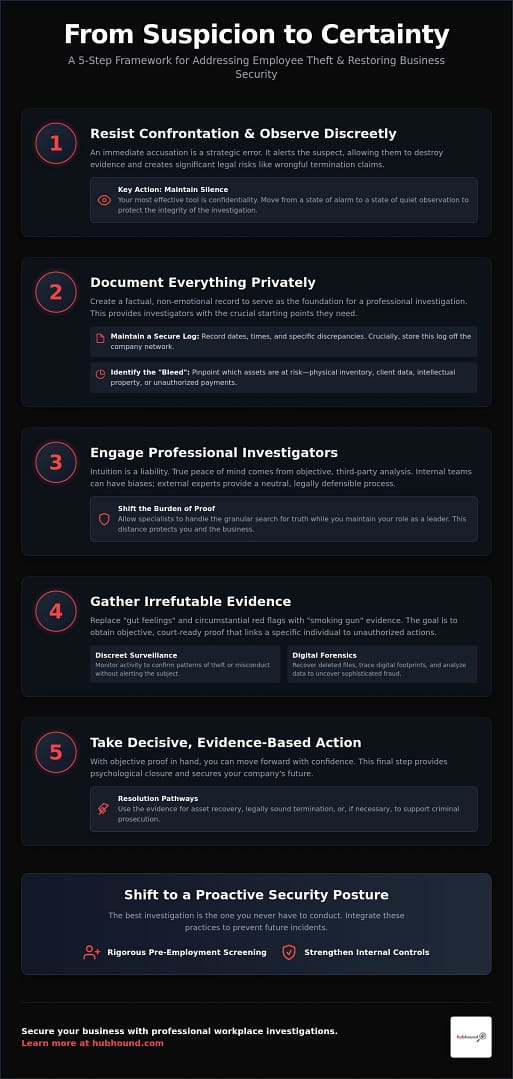
Restoring operational stability requires a structured methodology that moves beyond detection into resolution and prevention. Securing peace of mind after suspecting an employee of theft is a multi-stage process that requires tactical discipline. You cannot simply stop at identifying a discrepancy; you must follow through to ensure the threat is neutralized and your systems are hardened against future breaches. This five-phase framework provides a roadmap for business owners to transition from uncertainty to a secure, fortified environment.
- Phase 1: Professional Consultation. Review your initial findings with an investigative expert to determine if the evidence warrants a full-scale inquiry. This prevents overreaction and ensures your next steps are legally sound.
- Phase 2: Tactical Investigation. Deploy specialized tools such as surveillance or digital forensics. This phase focuses on gathering irrefutable proof that identifies the perpetrator and the extent of the loss.
- Phase 3: Legal Coordination. Use the gathered evidence to build a case for civil litigation support or criminal reporting. This ensures that your documentation meets the rigorous standards required by the judicial system.
- Phase 4: Resolution. Execute disciplinary or legal actions based on undeniable facts. This removes the emotional weight of the decision and focuses on protecting the company’s interests.
- Phase 5: System Hardening. Update your internal controls and hiring protocols. This final phase ensures that the vulnerabilities exploited during the theft are permanently sealed.
Coordinating with Legal Counsel
Investigative reports are the foundation of a successful legal strategy. They simplify the work for your employment attorney by providing a clear, chronological narrative of misconduct. These reports transform vague suspicions into actionable data for depositions. Additionally, professional investigators handle the complexities of process service, ensuring that legal documents are delivered correctly and according to statutory requirements. This precision prevents procedural delays in your recovery efforts. Preparing for witness interviews with a professional ensures that statements are documented accurately, providing reliable testimony if the case proceeds to a hearing.
Updating Internal Controls
Preventing a recurrence starts with a rigorous assessment of your current vulnerabilities. You must implement more comprehensive corporate due diligence for all future hires to identify high-risk candidates before they join your team. Reviewing access logs and financial oversight protocols must become a recurring task rather than a reactive response. There is also a significant psychological benefit to this process. Showing your team that misconduct is identified and resolved with professional precision reinforces a culture of integrity. If you are ready to begin the recovery process, evaluate specialized investigative services to secure the evidence you need today.
Securing Your Business Future with Professional Support
Investing in professional investigative services is a strategic move to mitigate future risk. While the immediate goal is resolving a current crisis, the long-term benefit is a fortified organizational structure. Engaging an expert curator of evidence ensures that your business doesn’t just survive an incident of theft but learns from it. This transition from a reactive posture to a proactive one is the final step in achieving lasting peace of mind after suspecting an employee of theft. It allows you to shift your mental energy back to scaling your operations rather than policing your staff.
Ongoing corporate due diligence serves as a continuous filter for your business environment. It isn’t just for current crises; it’s a tool for vetting potential high-level partners and evaluating the integrity of your supply chain. By maintaining a rigorous assessment process, you minimize the cognitive load associated with choice paralysis when selecting new leaders or vendors. This insider expertise saves time and prevents the financial drain associated with undetected misconduct. Professional support provides the selective filtering necessary to keep your company’s growth on a secure trajectory.
Prevention as a Growth Strategy
Thorough screening is the most cost-effective defense against workplace theft. By integrating pre-employment background checks into your standard workflow, you identify red flags before an individual ever gains access to your assets. This isn’t just about exclusion. It’s about building a culture of integrity. When employees know that the organization maintains transparent, professional investigative policies, it acts as a powerful deterrent. You gain the confidence that comes from knowing a specialized expert is monitoring your environment, allowing you to lead with transparency rather than suspicion.
Taking the First Step Toward Resolution
Initiating a discreet consultation is the most critical move you can make today. You can begin this process without alerting your staff or disrupting the daily rhythm of your office. Before your first meeting with an investigator, organize the private incident log and access audits mentioned earlier in this guide. Having these data points ready allows the investigator to perform a more efficient initial assessment. Reclaiming your peace of mind after suspecting an employee of theft requires a partner who values efficiency and niche expertise. Consult with HubHound today to start your workplace investigation and secure the future of your business.
Moving Toward a Resolved and Secure Workplace
Transitioning from suspicion to resolution requires a commitment to objective data and professional oversight. You’ve learned that immediate confrontation is a strategic error and that true clarity comes from specialized tools like digital forensics and surveillance. These methods provide the irrefutable proof necessary to protect your business and finally achieve peace of mind after suspecting an employee of theft. By replacing gut feelings with documented facts, you remove the legal and emotional risks associated with internal misconduct.
HubHound offers the specialized expertise needed to navigate these high-stakes situations. Our licensed investigators bring over 30 years of experience to every case, providing deep expertise in workplace misconduct and digital forensics. We deliver confidential, court-ready reporting that ensures your next move is legally defensible and final. Get the certainty you need with HubHound professional investigations.
Don’t let uncertainty stall your company’s growth or compromise your leadership. Implementing professional investigative frameworks allows you to restore a culture of integrity and reclaim your focus. You’ve already done the hard work of identifying a potential issue; now it’s time to resolve it with precision and confidence.
Frequently Asked Questions
Can I fire an employee immediately if I suspect them of theft?
Termination based on suspicion alone is a high-risk strategy that often leads to wrongful termination or defamation lawsuits. You should prioritize a formal workplace misconduct investigation to secure objective proof before taking disciplinary action. This structured approach ensures that your decision is legally defensible and protects the company’s reputation. Establishing a factual record is the only way to mitigate the risk of costly litigation following a dismissal.
Is it legal to use surveillance cameras to catch an employee stealing?
It is generally legal to use surveillance in areas where employees lack a reasonable expectation of privacy, such as stockrooms, loading docks, and sales floors. You must avoid placing cameras in private areas like restrooms or changing rooms to remain compliant with privacy laws. Professional surveillance operations ensure that all gathered footage is captured within legal boundaries. This ensures the evidence remains admissible in court or during internal disciplinary hearings.
How much does a workplace misconduct investigation usually cost?
The total investment for an investigation depends on the specific requirements of the case, such as the duration of surveillance or the complexity of digital forensics. Factors like the number of subjects and the volume of data to be analyzed will influence the scope of work. You should request a professional consultation to define the investigative goals and receive a tailored assessment. This ensures you only pay for the specialized resources necessary to resolve your specific situation.
What happens if a professional investigator finds no evidence of theft?
Finding no evidence of misconduct provides a vital form of peace of mind after suspecting an employee of theft. It allows you to rule out internal betrayal and focus on other potential issues, such as vendor errors or system glitches. This objective validation prevents you from making a wrongful accusation that could permanently damage staff morale. Knowing the truth, even when it contradicts your initial suspicion, is essential for maintaining a healthy workplace culture.
Can a private investigator help recover stolen company assets?
Professional investigators utilize skip tracing and corporate due diligence to locate individuals and the assets they have misappropriated. They identify hidden accounts and track the physical movement of company property to provide a clear path for recovery. While investigators do not personally seize property, their detailed reports provide the necessary foundation for civil litigation support. This documentation is critical for successfully pursuing restitution through the judicial system or insurance claims.
How do I handle an investigation without ruining employee morale?
Maintaining strict confidentiality is the most effective way to protect morale during an active inquiry. Conduct the investigation discreetly and only involve essential decision-makers to prevent the spread of workplace rumors. By using a neutral third-party investigator, you demonstrate that the process is fair and based on facts rather than personal bias. When employees see that misconduct is handled with professional precision, it reinforces a culture of accountability and integrity.
What is the difference between an internal audit and a professional investigation?
Internal audits are routine reviews of financial records and operational compliance conducted by your own staff. In contrast, professional investigations are targeted, forensic inquiries into specific acts of misconduct. Investigators use specialized tools like digital forensics and surveillance that go beyond standard bookkeeping. This professional approach is designed to uncover sophisticated fraud patterns that internal teams often lack the technical training or objectivity to identify effectively.
Should I involve the police before or after hiring a private investigator?
Hiring a private investigator first allows you to present law enforcement with a comprehensive, “prosecution-ready” package of evidence. Police departments are often resource-constrained and may be unable to initiate an investigation based on suspicion alone. By providing a professional report that includes witness statements and surveillance footage, you make it significantly easier for authorities to take action. This proactive step increases the likelihood of a successful criminal prosecution and asset recovery.

Article by
Joel R. Manley | President | Hubhound Investigations | OR PI-ID#: 90432 | 111 SW Fifth Avenue, Suite 3150 Portland, Oregon 97204 | 971-442-8170
Joel is licensed as a private investigator in Oregon and Tennessee. Joel started his career in 1987 serving as a Military Police Officer and Military Police Investigator.
After ending his military tour of duty, Joel became a civilian Police Officer and Deputy Sheriff. Joel took his strong background in Hostage Negotiations, Mediation and Conflict Resolution, with him to patrol some of the highest crime areas in SE Portland.
Joel was awarded Deputy of the Year for his efforts and for drastically reducing the crime rate in the area he patrolled. As a Deputy Sheriff, Joel assisted in leading a Neighborhood Livability Program that was nationally recognized for having the most innovative and progressive approach to policing.
In 2018, Joel retired as a Deputy Sheriff and founded Hubhound Investigations. Joel played an integral role in Hubhound Investigations receiving an A+ Accredited Business rating from the Better Business Bureau (BBB).
In his off time, Joel enjoys spending time with his wife, adult children and Hubhound’s Happiness Ambassador, Nya. Joel also enjoys Scuba Diving and Kayaking.
Disclaimer
DISCLAIMER: This article is provided for general informational and educational purposes only. It is not intended to constitute legal advice, professional investigative advice, or instruction to engage in any unlawful activity. Laws governing private investigations, surveillance, recording, tracking, access to information, evidence collection, privacy, trespass, licensing, and related investigative activities vary by jurisdiction and are subject to change.
Any investigative techniques, tactics, procedures, scenarios, or legal proceedings discussed in this article are presented for informational purposes and should not be interpreted as authorization or encouragement to use a particular method. Private investigators and members of the public are responsible for understanding and complying with all applicable federal, state, and local laws, licensing requirements, court rules, and professional standards.
The circumstances of every investigation and legal matter are different. Information contained in this article should not be relied upon as a substitute for advice from a qualified attorney or other appropriate licensed professional regarding a specific situation. No attorney-client, investigator-client, or other professional relationship is created by reading or using this information.