
What if the most expensive part of your legal case isn’t the private investigator’s fee, but the billable hours your lawyer spends performing tasks they aren’t trained for? You are likely facing the dual pressure of rising legal fees and the persistent fear that missing evidence will derail your outcome. It’s a common frustration to feel that your attorney simply doesn’t have the bandwidth to track down every lead. You may find yourself stuck when justifying the cost of a private investigator to my lawyer, especially when you are already managing a significant retainer.
We understand that every investment in your case must be calculated and results-driven. This article provides a professional framework to present a business case to your attorney that positions an investigator as a high-yield asset. You’ll learn how to prove that professional surveillance, witness interviews, or skip tracing can actually lower your total legal bill by streamlining the discovery process. We will show you how to secure the evidence needed to force a settlement while protecting your budget from unnecessary administrative bloat.
Key Takeaways
- Understand how raw evidence functions as a strategic lever that dictates the strength of your legal arguments.
- Discover the ethical risks of having your attorney personally track down leads, including potential disqualification under Model Rule 3.7.
- Evaluate the billable efficiency of specialists to reduce total costs, as investigators often perform tasks like skip tracing in a fraction of the time required by legal staff.
- Master the framework for justifying the cost of a private investigator to my lawyer by identifying factual gaps and framing the investigator as a force multiplier.
- Identify the criteria for selecting a licensed professional partner capable of delivering court-ready evidence that integrates seamlessly with your existing legal strategy.
The Strategic Advantage: Why Factual Evidence is Your Lawyer’s Best Tool
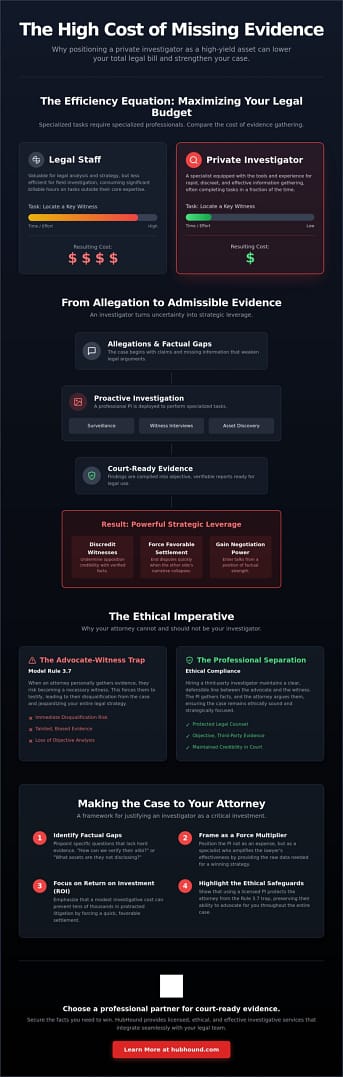
A lawyer’s strategy is only as strong as the facts supporting it. While your attorney excels at interpreting legal theory and navigating the courtroom, they often lack the specialized resources required for deep factual discovery. This is where a private investigator becomes an essential asset. Think of your legal team as a high performance engine; the lawyer is the driver, but the investigator provides the high octane fuel of raw data. By separating the legal theory from the factual reality, you ensure that every motion filed is backed by verified intelligence rather than just hopeful allegations. When justifying the cost of a private investigator to my lawyer, it helps to frame the PI as the primary source of this factual reality.
Bridging the Gap Between Allegations and Evidence
Legal discovery is often reactive. Your attorney typically receives a file from the opposing side and analyzes what is already there. An investigator is proactive. They go beyond the provided documents to find what was omitted, hidden, or ignored. This distinction is vital because a professional report provides the concrete foundation for successful cross-examination. Whether it is verifying a witness’s location or uncovering undisclosed assets, these findings turn investigative leads into admissible evidence. This transformation can shift the entire trajectory of a case before it ever reaches a jury. It is about justifying the cost of a private investigator to my lawyer as a way to secure a faster, more decisive victory.
The Power of Leverage in Negotiations
Litigation is frequently a game of leverage. Uncovering a single smoking gun via surveillance or comprehensive background checks can end a multi year dispute in a matter of weeks. Early intervention by a professional team like HubHound allows you to identify weaknesses in the opposing party’s claims before they can be solidified. This creates a psychological advantage that often forces the other side to negotiate from a position of weakness. Consider these strategic benefits:
- Discrediting Witnesses: Use verified history or contradictory surveillance to undermine the opposition’s credibility.
- Asset Discovery: Identify undisclosed business interests that change the financial scope of a settlement.
- Efficiency: Force a settlement once the other side realizes their factual narrative is compromised.
The threat of what an investigator might find is often enough to force a favorable settlement. This proactive approach protects your interests and prevents your budget from being consumed by endless billable hours spent on a case with no clear resolution.
The Ethics Argument: Why Your Lawyer Cannot Be Your Investigator
Attorneys are bound by strict ethical codes that limit their ability to act as both a representative and a source of evidence. If a lawyer performs their own surveillance or conducts interviews without a witness, they blur the lines of their professional role. You’ll find that justifying the cost of a private investigator to my lawyer is easier when you frame it as a safeguard for their law license. Professional investigators provide the necessary distance to keep the legal strategy focused on the courtroom while ensuring the facts remain untainted by the appearance of bias.
The Rule 3.7 Trap: Avoiding Attorney Disqualification
Model Rule 3.7 is a potential trap for any legal team. This rule generally prohibits a lawyer from acting as an advocate at a trial where they are likely to be a necessary witness. If your attorney personally uncovers a key piece of evidence or hears a confession, they may be forced to testify. This scenario often leads to their immediate disqualification from the case. Imagine losing your chosen counsel mid trial because they became a witness to the facts. Using a third party prevents this disaster. It ensures that the person who finds the facts is not the person who has to argue them. Maintaining this separation is a core component of the Ethical Use of Private Investigators in modern litigation.
Objective Analysis vs. Zealous Advocacy
Juries and judges view lawyers as zealous advocates. Because their primary job is to push your specific side of the story, their claims are often met with a degree of skepticism. A licensed investigator operates as an independent professional. Their reports are viewed as objective records of reality, which gives their findings a level of credibility that an attorney’s assertions cannot match. When justifying the cost of a private investigator to my lawyer, point out that an independent report carries more weight with a jury than a lawyer’s summary of events.
This approach also protects your case through the Work Product Doctrine. When an attorney directs an investigator, the resulting files are typically shielded from discovery by the opposition. This “umbrella of confidentiality” keeps sensitive investigative leads private. For those managing complex claims, professional civil litigation support ensures that every piece of evidence is gathered ethically and remains protected from opposing counsel. It’s a strategic move that preserves the integrity of your legal team while maximizing your leverage.
The ROI of Investigation: Comparing Hourly Rates and Billable Efficiency
Many clients view a private investigator as an added expense on top of already high legal fees. This is a fundamental misunderstanding of resource allocation. In reality, a specialist is a cost saving tool that protects your legal budget. When you focus on the return on investment, justifying the cost of a private investigator to my lawyer shifts from a defensive conversation to a strategic one. You aren’t asking to spend more; you’re proposing a way to spend more effectively.
Attorney Rates vs. Investigator Specialization
The math is straightforward. Senior attorneys often bill at rates significantly higher than the national average for a private investigator. Paying a lawyer several hundred dollars per hour to perform basic skip tracing or social media deep dives is a poor use of funds. Investigators utilize proprietary databases and specialized software that most law firms don’t maintain. These tools allow a PI to locate a witness or verify an asset in two hours, whereas a paralegal might spend ten hours manually searching public records to achieve the same result. The Role of Private Investigators is to provide this technical efficiency so your lawyer can focus on high level legal theory. A forty hour surveillance operation by a specialist costs significantly less than one week of intensive trial preparation by a senior partner.
Shortening the Litigation Lifecycle
Investigative intervention early in a case prevents “dead end” legal motions. If you can prove through skip tracing that a defendant has no reachable assets or that a key witness is unreliable, your lawyer can adjust their strategy immediately. This prevents months of billable hours spent chasing leads that lead nowhere. Winning a case at the deposition stage is always more cost effective than proceeding to a full trial. By providing your attorney with verified facts before a single deposition begins, you create the leverage needed to force a settlement. Engaging a professional Corporate Investigation Firm ensures that your discovery phase is streamlined and result oriented. This proactive approach shortens the litigation lifecycle, which is the most effective way to reduce your total legal bill. Ultimately, justifying the cost of a private investigator to my lawyer is about proving that expert fact finding is the fastest route to a resolution.
The Pitch: How to Present the Private Investigator Option to Your Lawyer
Presenting the investigative option to your attorney requires a shift from a defensive posture to a proactive business case. Most lawyers are hesitant to suggest additional costs because they don’t want to appear as if they are padding the bill. You must lead the conversation by identifying a specific factual gap in your current legal strategy. Whether it’s a witness whose story doesn’t align with the records or a defendant who claims to have no assets, highlighting these holes makes the need for a specialist obvious. Frame the investigator as a force multiplier that allows your lawyer to focus on high level legal arguments while the field work is handled by experts.
Start by suggesting a limited scope preliminary investigation. This minimizes initial risk and allows the attorney to see the quality of the intelligence provided before committing to a larger budget. By justifying the cost of a private investigator to my lawyer as a strategic trial prep tool, you position the expense as a way to gain an immediate tactical advantage. Providing your lawyer with a vetted professional like HubHound also removes the administrative burden of them having to find and vet a reliable partner themselves.
Identifying the Right Investigative Trigger
Timing is critical when proposing investigative services. If your case relies on the credibility of a few key individuals, suggest professional witness interviews & statements to lock in their testimony before memories fade or stories change. In civil fraud or infidelity matters, you might convince your lawyer to utilize modern surveillance techniques to gather visual evidence that a deposition simply cannot provide. An asset search pitch is particularly effective early in litigation; it ensures there is actually money to collect before you spend thousands on filing fees and discovery motions.
Handling Lawyer Objections
Your lawyer may argue that they have a paralegal who can handle the research. Address this directly by pointing out that while paralegals are excellent at record searches, they aren’t trained for field surveillance or difficult witness locates. PIs possess specialized database access and tactical experience that office staff simply don’t have. If your attorney expresses concern about rogue investigators or ethical boundaries, emphasize that you have selected a licensed, insured firm that understands court-ready evidence standards. Propose a not-to-exceed budget for the first phase. This gives the lawyer control over the spend while allowing the investigator to prove their value through a tangible report. To begin this process with a vetted professional partner, present the investigative plan as a way to streamline the path to a favorable settlement.
Choosing a Professional Partner: Why HubHound is the Right Choice for Your Legal Team
The final step in justifying the cost of a private investigator to my lawyer is selecting a partner who operates with the same level of precision as a top tier law firm. A poorly chosen investigator can become a liability, potentially tainting evidence or creating ethical headaches for your counsel. Conversely, a professional firm acts as a seamless extension of your legal team. When you present an investigator who is licensed, insured, and has a court ready mindset, you remove the lawyer’s primary concern: risk. HubHound provides this level of security by ensuring every operation is conducted within strict legal and ethical boundaries.
Transparency is a core requirement for modern legal support. You need a partner who provides clear, documented reporting that your attorney can use immediately without additional interpretation or verification. This efficiency is what makes the business case for an investigator so compelling. By providing comprehensive civil litigation support, HubHound allows your lawyer to move from discovery to deposition with a complete factual record in hand.
Expertise That Lawyers Trust
Attorneys value specialists who understand the nuances of the legal system. HubHound brings over 30 years of experience to the table, offering a team of licensed investigators who know exactly what makes evidence admissible in a courtroom. This deep background is particularly evident in complex criminal defense investigations, where the difference between a lead and a usable fact can change the outcome of a trial. Our team excels at high quality process service and skip tracing, ensuring that even the most difficult to serve parties are located efficiently. We also provide specialized strategies for locating missing adults, a service that often proves vital in probate or family law matters where heirs or witnesses have disappeared.
The HubHound Difference
Professionalism shouldn’t be a variable. HubHound delivers detailed, admissible reports that require zero cleanup from your legal team. We understand that your lawyer’s time is best spent on advocacy, not on fixing sloppy investigative notes. Our reports are structured to be used as exhibits or to form the basis of a cross examination. This level of quality is a primary factor when justifying the cost of a private investigator to my lawyer; the output is a finished product, not a raw file. To move your case forward, the best next step is to schedule a joint consultation. This allows you, your attorney, and our team to align on a strategy that maximizes your leverage while minimizing billable waste. Contact HubHound today to discuss your case strategy and see how we can strengthen your legal position.
Master Your Legal Outcome with Strategic Intelligence
Integrating a specialist into your legal strategy is about more than just finding facts; it’s about creating leverage that forces a resolution. By separating the roles of advocate and investigator, you protect your attorney from ethical disqualification while ensuring that every claim is backed by admissible evidence. You’ve seen that the efficiency of a specialist results in a lower total legal bill by preventing months of fruitless discovery. Successfully justifying the cost of a private investigator to my lawyer requires focusing on the tangible ROI that professional field work provides. When your legal team has the right data, they can negotiate from a position of strength.
With over three decades of industry experience, HubHound provides the niche expertise required to support complex litigation. Our team of licensed and insured professional investigators delivers results in both criminal defense and civil litigation support. Empower your legal team with HubHound’s professional investigative services. Take the next step toward a decisive victory by bringing the right experts onto your team today.
Frequently Asked Questions
Will my lawyer be mad if I suggest hiring a private investigator?
Most attorneys welcome the addition of a professional investigator because it provides them with better factual leverage. Your lawyer wants to win, and they know that high quality evidence makes their job easier. If you frame the suggestion as a way to provide them with the “ammunition” they need for trial, they’ll likely appreciate the initiative. This approach is key when justifying the cost of a private investigator to my lawyer as a strategic partnership rather than a critique of their work.
Can the evidence a private investigator finds actually be used in court?
Yes, evidence gathered by a licensed professional is generally admissible provided it was obtained through legal means. This includes surveillance footage, verified records, and sworn witness statements. Professional investigators understand the rules of evidence and maintain a strict chain of custody. This ensures that the findings can withstand challenges from opposing counsel. Amateur or “self-help” investigation often results in evidence being thrown out, making a pro worth the investment.
Is the cost of a private investigator tax-deductible or billable to the other side?
In many corporate or business related cases, investigative fees are considered a deductible business expense. In civil litigation, you can often petition the court to include these costs in a final judgment against the losing party. While this depends on the specific nature of your case and the court’s rules, investigative fees are frequently classified as “costs of litigation.” Discuss this with your CPA or attorney to see how it applies to your situation.
What happens if the investigator doesn’t find anything useful?
A “negative” result is still a valuable piece of intelligence because it eliminates a dead end. Knowing that a specific asset doesn’t exist or that a witness’s story doesn’t hold up prevents your lawyer from wasting billable hours on a failing strategy. This saves you money in the long run by focusing your legal budget only on leads that have a high probability of success. Every investigation provides clarity, which is essential for making informed decisions.
How do I know if my lawyer’s ‘internal investigator’ is actually qualified?
Ask for their specific license number and a summary of their field experience. Many law firms use paralegals for “investigative” tasks, but these individuals often lack the specialized training, database access, and surveillance equipment of a dedicated PI. A qualified investigator should have a background in law enforcement or specialized private sector training. If they don’t have a standalone license, they may not be able to testify as an expert witness in the same way.
Can a private investigator help with a case that is already in the trial phase?
Yes, though early intervention is always more effective. During a trial, an investigator can perform emergency skip tracing to locate a missing witness or conduct background checks on surprise witnesses introduced by the opposition. This “11th hour” support is a powerful way of justifying the cost of a private investigator to my lawyer when the stakes are at their highest. Rapid response intelligence can change the momentum of a trial in a single afternoon.
Does a private investigator have to follow the same rules as the police?
Private investigators aren’t government agents, so they aren’t bound by the Fourth Amendment in the same way the police are. They don’t need warrants to conduct surveillance in public places. However, they must strictly follow all state and federal privacy laws, including anti-stalking and trespassing statutes. Professional investigators know where the legal lines are drawn, ensuring that their work remains ethical and the evidence remains usable in a court of law.
How much should I expect to pay for an initial investigative retainer?
Retainers are standard in the industry and act as a credit against the investigator’s hourly work and expenses. The amount varies based on the complexity of the case and the estimated hours required for the initial phase. A simple background check might have a smaller flat fee, while multi day surveillance will require a more substantial deposit. Most firms provide a customized estimate after an initial consultation to ensure the budget aligns with your specific goals.

Article by
Joel R. Manley | President | Hubhound Investigations | OR PI-ID#: 90432 | 111 SW Fifth Avenue, Suite 3150 Portland, Oregon 97204 | 971-442-8170
Joel is licensed as a private investigator in Oregon and Tennessee. Joel started his career in 1987 serving as a Military Police Officer and Military Police Investigator.
After ending his military tour of duty, Joel became a civilian Police Officer and Deputy Sheriff. Joel took his strong background in Hostage Negotiations, Mediation and Conflict Resolution, with him to patrol some of the highest crime areas in SE Portland.
Joel was awarded Deputy of the Year for his efforts and for drastically reducing the crime rate in the area he patrolled. As a Deputy Sheriff, Joel assisted in leading a Neighborhood Livability Program that was nationally recognized for having the most innovative and progressive approach to policing.
In 2018, Joel retired as a Deputy Sheriff and founded Hubhound Investigations. Joel played an integral role in Hubhound Investigations receiving an A+ Accredited Business rating from the Better Business Bureau (BBB).
In his off time, Joel enjoys spending time with his wife, adult children and Hubhound’s Happiness Ambassador, Nya. Joel also enjoys Scuba Diving and Kayaking.
Disclaimer
DISCLAIMER: This article is provided for general informational and educational purposes only. It is not intended to constitute legal advice, professional investigative advice, or instruction to engage in any unlawful activity. Laws governing private investigations, surveillance, recording, tracking, access to information, evidence collection, privacy, trespass, licensing, and related investigative activities vary by jurisdiction and are subject to change.
Any investigative techniques, tactics, procedures, scenarios, or legal proceedings discussed in this article are presented for informational purposes and should not be interpreted as authorization or encouragement to use a particular method. Private investigators and members of the public are responsible for understanding and complying with all applicable federal, state, and local laws, licensing requirements, court rules, and professional standards.
The circumstances of every investigation and legal matter are different. Information contained in this article should not be relied upon as a substitute for advice from a qualified attorney or other appropriate licensed professional regarding a specific situation. No attorney-client, investigator-client, or other professional relationship is created by reading or using this information.