
Most workplace grievances fail not because the mistreatment didn’t happen, but because the victim lacked a professional investigative framework to document it. It’s exhausting to face daily hostility while fearing retaliation for simply speaking up. You likely feel the weight of a toxic culture, yet translating that emotional distress into a high-quality legal claim often feels like a confusing hurdle. Understanding how to prove a hostile work environment in Oregon requires moving beyond anecdotal complaints toward rigorous, admissible evidence that meets current 2026 standards.
This guide provides the professional framework you need to substantiate your experience. You’ll learn about the critical evidence standards required for success, such as the five year statute of limitations for fairness act violations and the one year deadline for filing administrative complaints with labor bureaus. We’ll provide a clear checklist of necessary documentation and explain how professional workplace misconduct investigations transform personal experiences into objective facts. This roadmap ensures you can identify high-quality resources and move from a state of uncertainty to a position of documented clarity.
Key Takeaways
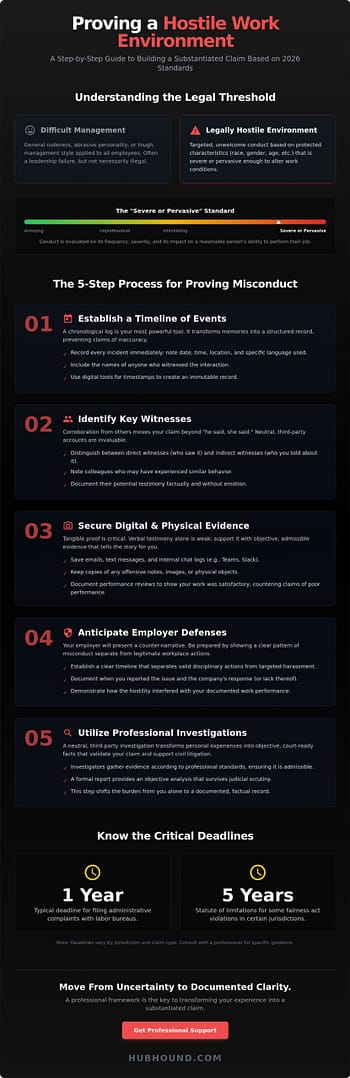
- Identify the “severe or pervasive” threshold to distinguish a difficult management style from a legally actionable hostile environment.
- Master the documentation process and learn how to prove a hostile work environment in Oregon by maintaining a contemporaneous log of all incidents.
- Secure digital and physical evidence, including messaging records and offensive materials, to move beyond simple verbal testimony.
- Anticipate common employer defenses by establishing a clear timeline that separates valid disciplinary actions from targeted misconduct.
- Utilize workplace misconduct investigations to obtain neutral, court-ready evidence that validates your experience and supports civil litigation.
Defining the Legal Threshold for a Hostile Work Environment
A difficult supervisor is a common professional hurdle, but a legally hostile environment is a specific evidentiary category. To succeed in a claim, you must demonstrate that the conduct in question meets the “severe or pervasive” standard. This means the behavior isn’t just annoying or rude; it’s intense enough to interfere with your ability to work or frequent enough to create a persistent atmosphere of toxicity. Professional investigators use the legal definition of a hostile work environment to filter these grievances. They look for actions that a reasonable person in your position would find abusive.
Determining how to prove a hostile work environment in Oregon requires analyzing the intent behind the conflict. Legally actionable hostility isn’t general meanness. It must be linked to protected characteristics like race, gender, age, religion, or disability. If a manager is equally abrasive to everyone, it is likely a management failure rather than a legal violation. However, if the behavior targets specific groups, it triggers legal protections. Investigators focus on documenting these specific links to build a case that survives judicial scrutiny. They apply the “reasonable person” standard to evaluate the impact of the conduct, considering several factors:
- The frequency of the discriminatory behavior.
- The severity of the actions, such as physical threats or extreme verbal abuse.
- Whether the conduct unreasonably interfered with work performance.
- The power dynamic between the parties involved.
The Difference Between Bullying and Harassment
Workplace friction often crosses into illegal territory when it becomes discriminatory. Bullying is frequently personality-driven, while harassment is identity-driven. Investigators document patterns of behavior over time to identify discriminatory intent. They track who is targeted, what language is used, and whether the behavior escalates. This selective filtering process allows professionals to distinguish between a “bad boss” and a systemic legal risk. Clear evidence of a pattern is often the difference between a dismissed complaint and a successful civil claim.
Employer Liability and the Duty to Investigate
Organizations become legally responsible for employee conduct once they are aware of the issue. An employer’s response, or lack of one, significantly impacts the strength of a case. If a company fails to act after a formal report, they may be held liable for the continued harassment. This is why following established workplace investigations protocols is essential for maintaining organizational integrity. A rigorous, neutral investigation ensures that all facts are gathered according to professional standards, protecting the rights of all involved parties.
The 5-Step Process for Proving Workplace Misconduct
Transforming a series of personal grievances into a substantiated legal claim requires a shift from emotional reaction to methodical data collection. Understanding how to prove a hostile work environment in Oregon starts with recognizing that your testimony is only one part of the equation. You need a structured investigative framework to survive the scrutiny of defense counsel and regulatory bodies. This process moves through five distinct phases of evidence gathering, starting with the most immediate actions you can take to protect your professional standing. By following these steps, you ensure that every incident is recorded with the precision required for civil litigation support.
Step 1: Establishing a Timeline of Events
A chronological log is your most powerful tool during a deposition. It prevents the defense from claiming your memory is selective or inaccurate. Record every incident immediately after it occurs, noting the date, time, and specific language used. Include the names of anyone who witnessed the interaction. Referencing Oregon’s laws on workplace harassment helps you categorize these events correctly from the start. Digital timestamps are crucial for evidence because they provide an immutable record of when an entry was created, preventing accusations of retroactive fabrication.
Step 2: Identifying Key Witnesses
Corroboration is the bedrock of any workplace misconduct case. You must distinguish between direct witnesses, who saw the harassment firsthand, and character witnesses, who can only speak to your reputation. Professional witness interviews are often necessary to secure statements before memories fade or loyalties shift. Investigators often track down former employees who have left the company. These individuals are frequently more willing to provide honest accounts because they no longer fear internal retaliation.
The third step involves navigating the internal reporting structure. You must establish a formal record of the behavior by reporting it to HR or management according to company policy. This creates a “paper trail” that proves the organization was aware of the issue. Even if the internal response is inadequate, the act of reporting exhausts your administrative remedies and strengthens your position. Simultaneously, you must focus on evidence preservation. Secure all digital footprints, including Slack messages, emails, and social media interactions that demonstrate a pattern of hostility. Don’t rely on company servers to store this data; maintain personal copies of every relevant communication.
Finally, engaging an external investigator provides the neutrality required for a high-quality case. A third-party perspective eliminates the bias often found in internal HR reviews. If you are unsure of your next move, a professional evaluation of your current evidence can save significant time. You can identify high-quality resources for workplace misconduct investigations to ensure your evidence meets the rigorous standards of the 2026 legal landscape. This professional support transforms a confusing experience into a clear, actionable path toward resolution.
Essential Evidence: Beyond ‘He Said, She Said’
Evidence is the bridge between a personal grievance and a successful legal resolution. Without objective data, a claim often dissolves into a “he said, she said” stalemate that favors the employer. Learning how to prove a hostile work environment in Oregon requires a shift from subjective feeling to objective proof. You must identify high-quality artifacts that confirm your experience. This process involves a selective filtering of communications, physical records, and third-party observations. By gathering these data points early, you ensure your case meets the rigorous assessment standards required in 2026.
Digital Forensics in Workplace Claims
Modern harassment rarely stays verbal. It leaves a digital footprint across Slack, Teams, and internal email servers. Recovering deleted messages is a common investigative task that often reveals a hidden pattern of misconduct. You should also consider the admissibility of personal device data. If harassment occurs via personal text or social media, it’s vital to preserve these records with metadata intact. In some instances, professional surveillance techniques can document off-site misconduct or verify interactions that occur outside the office. These digital records provide an immutable timeline that defense counsel cannot easily dismiss.
The Power of Corroboration
A single witness statement can change the trajectory of a claim. Corroboration provides the neutrality that personal testimony lacks. Investigators focus on identifying bystanders who observed the behavior but have no personal stake in the outcome. Understanding Oregon’s anti-discrimination laws helps you identify which interactions constitute illegal conduct. Professional investigators conduct neutral, non-leading interviews to ensure these statements remain admissible. They also look for “me too” evidence. If multiple employees report similar treatment from the same supervisor, the case moves from an isolated incident to a documented pattern of systemic hostility.
Circumstantial evidence also plays a critical role. This includes documenting sudden, unexplained changes in your performance reviews or a pattern of disparate treatment where you are held to different standards than your peers. These shifts often follow a report of misconduct, suggesting retaliation. While one bad review might be a management choice, a sudden drop in ratings following a complaint is a red flag. Keep copies of all performance records and disciplinary notes. These documents help prove that the hostility is not a reaction to your work quality but a result of a toxic environment. Gathering this evidence within the one-year deadline for administrative complaints is essential for maintaining your legal options.
Addressing Common Objections and Legal Defenses
Proving a claim isn’t just about your evidence. It’s about anticipating the employer’s counterarguments. When figuring out how to prove a hostile work environment in Oregon, you must prepare for common legal defenses designed to shift blame. Employers often rely on a “performance-based” defense or the “failure to report” doctrine to avoid liability. A professional investigative approach focuses on identifying the inconsistencies in these claims before they reach a courtroom. It’s about finding the gaps in their narrative and exposing the truth behind sudden shifts in workplace dynamics.
Dismantling the Performance Defense
Employers frequently argue that disciplinary actions were based on work quality rather than discriminatory intent. To dismantle this, investigators perform a side-by-side comparison of performance reviews. If your ratings were consistently high for years but plummeted exactly when the hostility began, that’s a red flag. This shift often points to “pretextual” reasons for demotion or termination. Using corporate investigation methods allows for a deep dive into internal communications. We look for inconsistencies in how management applied rules to you versus your peers, identifying patterns of disparate treatment that undermine their defense.
Overcoming the Failure to Report
The defense often claims you didn’t use internal reporting channels, citing the Faragher-Ellerth doctrine. You can overcome this by documenting a legitimate fear of retaliation or showing that the reporting structure was compromised. If the harasser is the person you are supposed to report to, the system is fundamentally broken. Investigators look for evidence that management “knew or should have known” about the environment through informal complaints or visible patterns of behavior. In extreme cases, the environment becomes so unbearable that you are forced to resign, which is legally recognized as constructive discharge. Proving this requires a rigorous assessment of the working conditions that made staying impossible.
Defense counsel may also attempt to categorize harassment as “stray remarks” or isolated incidents. They argue that a few offensive comments don’t meet the legal threshold for hostility. Investigative depth is the only way to counter this argument effectively. By mapping a comprehensive timeline of behavior, you transform these supposedly isolated events into a documented systemic pattern. This level of detail shows the cumulative effect of the toxicity on your professional life. If you need to validate your experience against these common defenses, our workplace misconduct investigations provide the neutral evidence collection required for a successful claim.
Why Professional Workplace Investigations Are Critical for Success
Neutrality is the cornerstone of a successful claim. Internal HR departments often face inherent conflicts of interest because they report to the same management structure being accused of misconduct. This bias can lead to “filtered” internal reports that downplay the severity of your experience. A third-party investigator eliminates this risk by providing an objective, outside perspective. Identifying how to prove a hostile work environment in Oregon requires more than just a list of complaints; it requires a professional investigative framework that transforms subjective feelings into court-ready data.
Investigators work alongside legal counsel to bridge the gap between raw facts and legal theory. While an attorney focuses on the application of the law, the investigator focuses on the discovery and validation of evidence. This partnership ensures that your case is built on a foundation of verified statements and preserved digital footprints. The cost-benefit analysis of hiring a professional is clear. Losing a claim due to insufficient or poorly documented evidence is far more expensive than investing in a high-quality investigation from the start. Professional reports move your case beyond anecdotal stories toward a rigorous, admissible narrative.
The Role of the Licensed Investigator
Licensed investigators ensure that all data collection occurs within strict legal and ethical boundaries. They understand the nuances of privacy laws and the specific requirements for digital evidence admissibility. If your case goes to trial, an investigator provides expert testimony regarding the methods used to gather and verify information. This testimony adds a layer of authority that personal statements often lack. The chain of custody is a rigorous documentation process that records the chronological sequence of possession and control for every piece of evidence to prevent claims of tampering or loss. By maintaining this chain, investigators protect the integrity of your claim from the moment an incident is logged until it reaches the hands of a judge.
Next Steps: Moving from Complaint to Resolution
Initiating a confidential consultation with an investigative firm is the first step toward reclaiming your professional narrative. During an initial evidence review, professionals evaluate your current documentation and identify gaps that need to be filled. They look for patterns of disparate treatment and corroborating witnesses who can validate your claims. This is the final step in understanding how to prove a hostile work environment in Oregon through a professional lens. Securing the long-term value of professional employee investigations ensures that you aren’t just filing a complaint, but building a strategic path to resolution. Reach out to a specialized firm today to begin the selective filtering process that turns your experience into admissible proof.
Secure Your Professional Future with Objective Evidence
Success in a workplace claim depends on your ability to move beyond personal testimony toward a framework of objective, admissible facts. You’ve learned that documenting a chronological timeline and identifying neutral witnesses are the first steps in dismantling common employer defenses. Understanding how to prove a hostile work environment in Oregon requires this level of investigative rigor to ensure your experience meets the high evidence standards of the 2026 legal landscape. Don’t leave your career to chance by relying on internal HR processes that may lack the necessary neutrality.
A professional investigation provides the clarity needed for civil litigation support and long-term resolution. Our team of licensed investigators brings over 30 years of experience to every case, specializing in workplace misconduct and civil litigation. We provide the expert witness testimony and neutral reports required to validate your claims in a professional environment. Contact HubHound for a confidential workplace misconduct investigation to begin securing the evidence you need. You deserve a workplace defined by integrity and respect. Taking this step ensures you have a specialized ally dedicated to uncovering the truth.
Frequently Asked Questions
Is a hostile work environment the same as having a mean boss?
No, a hostile work environment requires discriminatory behavior targeting a protected characteristic like race, gender, or age. While a difficult manager might be abrasive to everyone, legal hostility involves harassment that a reasonable person would find abusive. Investigators look for this specific link to distinguish between poor management and illegal conduct.
Can I record conversations at work to prove my case?
Recording legality depends on whether you are in a one-party or all-party consent jurisdiction. You must verify specific wiretapping statutes before recording any verbal interactions to ensure the evidence remains admissible. Additionally, many employee handbooks prohibit unauthorized recording, which could lead to disciplinary action regardless of the legal status of the recording itself.
How long do I have to file a hostile work environment claim?
Filing deadlines are governed by statutes of limitation that vary depending on the type of claim and the agency involved. For many workplace fairness claims, you may have up to five years to pursue legal action, while administrative complaints often require filing within one year. Understanding how to prove a hostile work environment in Oregon involves tracking these critical dates to ensure your right to sue remains intact.
What happens if I am fired after reporting a hostile work environment?
Termination following a report of harassment is categorized as retaliation, which is a prohibited practice under civil rights laws. If you are fired after making a good-faith report, you may have grounds for a separate retaliation claim. Professional investigators document the timing of your report against the timing of the termination to establish a causal link for civil litigation support.
Do I need a lawyer before I hire a private investigator?
You don’t need a lawyer to engage an investigative firm, though many professionals recommend a collaborative approach. An investigator can gather the raw evidence and witness statements needed to build a case before you even consult an attorney. This proactive data collection often helps a legal team evaluate the strength of your claim more efficiently.
What qualifies as ‘pervasive’ behavior in an investigation?
Pervasive behavior is defined by the frequency and regularity of the misconduct over a period of time. In a professional investigation, this means documenting a consistent pattern of abuse rather than a single, isolated remark. If the behavior happens daily or weekly and creates a toxic atmosphere that impacts your ability to perform your job, it likely meets the pervasive threshold.
Can an investigator find proof of harassment if it happened in person with no witnesses?
Investigators can substantiate claims of private harassment by identifying patterns of disparate treatment or finding other victims with similar experiences. They use digital forensics to recover deleted messages or examine metadata from communications that occurred around the time of the incident. Often, a harasser’s behavior follows a predictable cycle that can be documented through circumstantial evidence.
How much does a professional workplace investigation cost?
The cost of a workplace investigation depends on the complexity of the case and the number of witnesses required for interviews. Factors such as the volume of digital evidence to be analyzed and the necessity of surveillance operations will influence the final budget. You should discuss the specific scope of your needs with an investigative firm to receive an accurate assessment for your situation.

Article by
Joel R. Manley | President | Hubhound Investigations | OR PI-ID#: 90432 | 111 SW Fifth Avenue, Suite 3150 Portland, Oregon 97204 | 971-442-8170
Joel is licensed as a private investigator in Oregon and Tennessee. Joel started his career in 1987 serving as a Military Police Officer and Military Police Investigator.
After ending his military tour of duty, Joel became a civilian Police Officer and Deputy Sheriff. Joel took his strong background in Hostage Negotiations, Mediation and Conflict Resolution, with him to patrol some of the highest crime areas in SE Portland.
Joel was awarded Deputy of the Year for his efforts and for drastically reducing the crime rate in the area he patrolled. As a Deputy Sheriff, Joel assisted in leading a Neighborhood Livability Program that was nationally recognized for having the most innovative and progressive approach to policing.
In 2018, Joel retired as a Deputy Sheriff and founded Hubhound Investigations. Joel played an integral role in Hubhound Investigations receiving an A+ Accredited Business rating from the Better Business Bureau (BBB).
In his off time, Joel enjoys spending time with his wife, adult children and Hubhound’s Happiness Ambassador, Nya. Joel also enjoys Scuba Diving and Kayaking.
Disclaimer
DISCLAIMER: This article is provided for general informational and educational purposes only. It is not intended to constitute legal advice, professional investigative advice, or instruction to engage in any unlawful activity. Laws governing private investigations, surveillance, recording, tracking, access to information, evidence collection, privacy, trespass, licensing, and related investigative activities vary by jurisdiction and are subject to change.
Any investigative techniques, tactics, procedures, scenarios, or legal proceedings discussed in this article are presented for informational purposes and should not be interpreted as authorization or encouragement to use a particular method. Private investigators and members of the public are responsible for understanding and complying with all applicable federal, state, and local laws, licensing requirements, court rules, and professional standards.
The circumstances of every investigation and legal matter are different. Information contained in this article should not be relied upon as a substitute for advice from a qualified attorney or other appropriate licensed professional regarding a specific situation. No attorney-client, investigator-client, or other professional relationship is created by reading or using this information.