
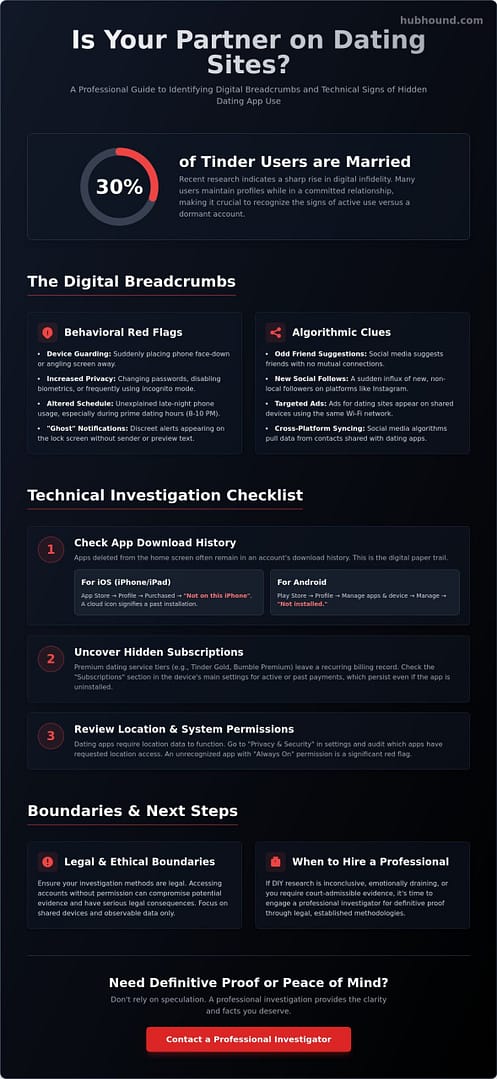
Recent 2026 research indicates that 30% of Tinder users are already married. This data reflects a sharp rise in digital infidelity that leaves many people feeling isolated or gaslit by their partners. If you’re facing this uncertainty, you need to know how to find out if my partner is on dating sites without compromising your legal standing or personal privacy. It’s frustrating to deal with technical confusion when you simply need the truth. You deserve a clear path to definitive proof or the peace of mind that comes from a thorough investigation.
This guide provides a professional methodology to verify a digital presence using legal and discreet tactics. You’ll learn to identify hidden footprints and understand the limitations of common search tools. We’ll examine the effectiveness of AI-driven verification platforms and the specific digital markers that signify an active dating profile. This article details how to execute a systematic search and identifies the exact moment a situation warrants professional surveillance operations or a formal infidelity investigation to secure the facts you need.
Key Takeaways
- Identify technical indicators like battery usage and hidden app store history to uncover concealed digital footprints.
- Discover how to find out if my partner is on dating sites using OSINT methodology and specialized search engines while understanding their accuracy limitations.
- Understand the legal and ethical boundaries of digital investigation to ensure you don’t violate privacy laws or compromise potential evidence.
- Evaluate when to transition from DIY research to professional surveillance operations to obtain court-ready evidence and physical verification.
The Digital Breadcrumbs: Common Signs of Dating App Use
Uncovering digital infidelity requires a shift from emotional reaction to analytical observation. Digital footprints are often subtle. They manifest as micro-behaviors and algorithmic anomalies that most users overlook. When considering how to find out if my partner is on dating sites, start by evaluating the distinction between an abandoned profile and an active one. Verified data from 2026 suggests that 30% of Tinder users are married, yet many maintain profiles they haven’t accessed in months. A profile’s existence isn’t always proof of current activity. Look for “ghost” notifications. These are alerts that appear on a locked screen without a sender name or preview text. Many online dating services use these discreet alerts to protect user privacy from prying eyes.
Behavioral Red Flags and Device Guarding
Watch for defensive physical posture. If a partner suddenly places their phone face-down or silences all notifications when you enter the room, it suggests a need for visual privacy. Evaluate screen-time data if you have shared access. A sharp increase in late-night usage or the frequent use of “incognito” browser tabs indicates a desire to bypass history logs. Password updates on shared devices serve as another indicator. If biometric locks are suddenly disabled or codes changed without explanation, the digital environment has become restricted. These shifts are rarely accidental. They represent a conscious effort to compartmentalize a digital life.
Cross-Platform Syncing and Algorithm Clues
Algorithms are often more observant than people. Social media platforms use shared metadata and location pings to suggest connections. If your partner’s Facebook “Suggested Friends” list starts featuring individuals with no mutual connections, the platform may be pulling from phone contacts or proximity data shared with dating apps. Understanding how to find out if my partner is on dating sites involves looking at how these apps interact with the broader ecosystem of your shared digital life. Instagram “follows” are equally telling. A sudden influx of new, non-local follows often correlates with recent matches. Pay attention to targeted advertising. Ad networks track cookies across devices on the same Wi-Fi. If your shared tablet or television begins displaying ads for specific dating platforms, someone on the network is triggering those tracking pixels. It’s a technical breadcrumb that’s difficult to erase.
Active users also leave traces in their communication rhythm. Sudden, unexplained absences during “prime” dating hours, typically between 8:00 PM and 10:00 PM, may align with peak app usage. If these behavioral shifts occur alongside technical anomalies, the probability of active app use increases. Identifying these signs is the first step in a professional investigative process.
Technical Indicators: How to Check Devices and App Stores
Behavioral changes offer the first clue, but technical logs provide the empirical data needed for a definitive conclusion. Devices are objective witnesses. They record installations, location pings, and battery consumption even when a user attempts to hide their tracks. When you’re researching how to find out if my partner is on dating sites, your primary objective is to audit the device’s history rather than just the visible home screen. Apps can be hidden in folders or “offloaded” to save space, but they rarely disappear from the underlying system architecture.
App Store and Download History
Start with the digital paper trail in the app store. On iOS, open the App Store, tap the profile icon, and select “Purchased.” Use the “Not on this iPhone” tab to see every app ever downloaded under that Apple ID. If you see a dating app with a cloud icon next to it, it was previously installed and then deleted. On Android, navigate to the Play Store, tap the profile icon, select “Manage apps & device,” then tap “Manage” and filter by “Not installed.” This reveals the entire library of past downloads. Don’t forget to check the “Subscriptions” section in the main device settings. Paid tiers like Tinder Gold or Bumble Premium leave a recurring billing record that persists even if the app is uninstalled. Understanding the psychological reasons for using dating apps can help you interpret whether a found subscription represents a momentary lapse or a sustained pattern of behavior.
Location Services and System Permissions
Dating apps rely heavily on proximity data to function. Review the “Privacy & Security” menu to see which apps have requested location access. If an app you don’t recognize has “Always On” permissions, it’s a significant red flag. You should also examine “Significant Locations” within the System Services menu. This feature logs frequently visited coordinates, which can help verify if a partner is visiting unfamiliar residential areas. Additionally, check the Bluetooth connection history. Burner phones or secondary devices often leave a trace in the paired devices list. If you find technical evidence that contradicts your partner’s claims, professional infidelity investigations can help you bridge the gap between digital suspicion and physical proof.
Battery usage statistics serve as a final technical audit. Navigate to the battery settings to view energy consumption over the last 10 days. This list shows every app that has drawn power, including those that may have been deleted immediately after use. If a dating app appears here with a high percentage of “on-screen” time, it confirms active and recent engagement. These technical steps are the most reliable way to determine how to find out if my partner is on dating sites without relying on guesswork or confrontational tactics.
Evaluating Online Search Tools and AI Engines
Digital investigations rely heavily on Open Source Intelligence, or OSINT. OSINT is the collection of data from publicly available sources for investigative purposes. If you’re researching how to find out if my partner is on dating sites, automated tools offer a fast way to aggregate data from social networks, public registries, and dating app APIs. These platforms build a profile of a person’s digital presence by scanning millions of data points simultaneously. While they provide speed, you must evaluate their accuracy and privacy standards with a critical eye.
Reverse Image and Username Searches
Reverse image searches are a primary tool for identifying active profiles across the web. If your partner has taken new professional headshots or high-quality selfies, use Google Lens or specialized tools like Social Catfish to track where those images appear. Social Catfish offers a 3-day image search trial for $6.87, which converts to a monthly subscription of approximately $28.97. This helps you identify if a specific photo is hosted on a dating platform’s server. Similarly, search for unique usernames across multiple social networks. People often reuse “handles” for convenience. This creates a traceable link between a public social media account and a private dating profile that might otherwise go unnoticed.
The Risks of Third-Party ‘Cheater Search’ Sites
Paid “cheater-search” engines like Cheaterbuster or CheatEye target specific platforms but have significant limitations. Cheaterbuster typically charges $17.99 per search, while CheatEye offers a single search for approximately $17.90. These tools often focus exclusively on Tinder and may return “false positives.” Some unregulated sites highlight old, inactive profiles to justify their fees or drive subscription sales. You also face significant privacy risks. Providing your partner’s email or phone number to these services effectively hands sensitive data to unvetted third parties who may harvest that information for data brokerage or marketing.
AI integration is a growing trend in the vetting economy. In 2026, 68.8% of singles use at least one AI-powered dating platform. While AI tools use facial recognition to scan databases, they still struggle with “incognito” or “hidden” profiles. Many apps allow users to remain invisible to anyone they haven’t already “liked,” meaning these profiles aren’t public-facing and cannot be indexed by standard OSINT tools. If you’re looking for how to find out if my partner is on dating sites, remember that a negative report from an automated tool isn’t a definitive clearance. It simply means the tool couldn’t access that specific, private data layer. For a more rigorous assessment, you’ll need to look beyond automated search results.
Legal and Ethical Boundaries of Digital Investigation
Digital discovery feels like a personal right when trust is compromised, but the legal reality is far more complex. When navigating how to find out if my partner is on dating sites, you must distinguish between public discovery and illegal intrusion. Accessing a private account without explicit consent can violate federal privacy laws, including the Computer Fraud and Abuse Act (CFAA). While technical logs and OSINT tools provide a starting point, crossing the line into unauthorized access creates significant legal liability. Evidence obtained through “self-help” hacking is frequently excluded from civil litigation and family court proceedings, rendering your efforts useless in a legal context.
Privacy Laws and Unauthorized Access
Privacy is not waived simply because you share a household. Logging into a partner’s personal email or social media accounts without their password being voluntarily shared for that purpose constitutes a breach of privacy. There is a sharp legal distinction between a shared family computer and a private personal device. If a device is used exclusively by one individual, the expectation of privacy remains high. Professional criminal defense investigators prioritize the chain of custody and legal evidence gathering to avoid these pitfalls. They ensure that every piece of data is collected through methods that withstand judicial scrutiny.
Ethical Considerations for the Relationship
The psychological impact of covert snooping often outweighs the benefit of the discovery. Constant digital monitoring can lead to a cycle of hyper-vigilance that damages your own mental health. When suspicion reaches a point where you feel compelled to bypass security protocols, the underlying trust is already absent. We often see parallels in workplace investigations, where neutral third parties handle sensitive discovery to maintain organizational integrity. Applying a similar level of objectivity to your personal life prevents emotional escalation and ensures you’re making decisions based on facts rather than technical misinterpretations.
Personal safety must remain your primary concern. If an investigation leads to a confrontation, the presence of definitive, legally obtained proof prevents the “gaslighting” that often occurs when evidence is circumstantial. Relying on professional civil litigation support ensures that your findings are documented correctly and safely. This professional distance protects you from the legal risks of DIY digital searching while providing the clarity needed to move forward. Avoid the temptation to use unethical methods that could be used against you in future legal disputes.
Professional Surveillance: When to Hire an Investigator
Digital footprints provide the “where” and “when,” but they rarely provide the “who” or “what” with absolute certainty. While learning how to find out if my partner is on dating sites is a critical first step, digital data is often dismissed as circumstantial in a legal or high-stakes personal setting. A profile can be outdated, spoofed, or even shared. Physical surveillance operations bridge this gap by providing high-definition, time-stamped evidence of real-world interactions. Professional advanced surveillance techniques ensure that this evidence is gathered legally, maintaining a clear chain of custody that DIY methods simply cannot replicate. This transition from digital monitoring to physical observation is often the only way to secure definitive proof.
The Limitations of Digital Evidence
A dating app notification is a lead, not a final conclusion. When individuals suspect their digital trail is being monitored, they often “go dark,” migrating to encrypted platforms or secondary “burner” devices that leave no trace on shared Wi-Fi networks. In these scenarios, licensed investigators apply strategies similar to those used for missing adults to track physical movements and identify patterns of behavior that don’t exist in the digital space. This methodology identifies secret meetings or secondary residences that a simple phone audit would miss. A professional report provides a neutral, third-party account of events, which is essential for personal closure or when preparing for civil litigation support.
Selecting a Trusted Investigative Partner
Choose an agency based on their specialization in infidelity investigations and their commitment to discretion. A reputable firm understands the sensitive nature of these cases and prioritizes client confidentiality throughout the discovery process. During a consultation, expect a rigorous assessment of your existing evidence and a clear explanation of how field operations will be conducted. This selective filtering process ensures that the investigation remains focused on high-quality results rather than wasted hours. If you need definitive answers without the legal risks of DIY snooping, contact HubHound for a professional consultation. Our team manages the technical and physical complexities of discovery, allowing you to make informed decisions based on verified facts.
Relying on a professional ensures that your search for the truth doesn’t result in legal blowback or further emotional distress. Investigators act as your expert guide through a complex landscape of privacy laws and technical hurdles. By combining digital auditing with professional surveillance, you move from a state of uncertainty to a position of clarity. This comprehensive approach is the most efficient way to resolve questions about how to find out if my partner is on dating sites while protecting your long-term interests.
Securing Definitive Proof and Peace of Mind
Navigating the technical and emotional complexities of digital infidelity requires a shift from suspicion to strategy. You’ve identified the breadcrumbs and audited the technical logs, but digital traces are often just the beginning of the story. Understanding how to find out if my partner is on dating sites involves recognizing the limitations of DIY tools and the legal risks of unauthorized access. When digital clues suggest a pattern of secrecy, professional intervention becomes the most efficient path to resolution. It’s about moving beyond the screen to verify real-world actions and secure the truth.
Our team of licensed investigators brings over 30 years of experience to every case. We provide discreet surveillance operations and court-ready reports that transform circumstantial suspicion into conclusive evidence. With national coverage for comprehensive background checks and field investigations, we ensure your discovery process is legal and thorough. This professional distance protects your legal standing while delivering the facts you need to make a final decision.
Secure Professional Evidence with HubHound’s Infidelity Investigation Services
You don’t have to manage this uncertainty alone. Taking a professional approach ensures you protect your rights while gaining the clarity needed to move forward with confidence. The truth is accessible, and the right methodology makes the discovery process as streamlined as possible.
Frequently Asked Questions
Is it illegal to check my partner’s phone for dating apps?
Checking a phone without permission is a legal gray area that often leans toward unauthorized access. Accessing private data without explicit consent can trigger federal privacy violations under the Computer Fraud and Abuse Act. It’s safer to observe physical behaviors or use public records rather than risking a breach of privacy laws that could make evidence inadmissible in court.
Can someone have a dating profile without actually being on the app?
Yes, an active profile doesn’t always indicate a currently active user. Many online dating platforms keep profiles in the rotation until the account is manually deleted rather than just uninstalled. If you’re investigating how to find out if my partner is on dating sites, look for “last active” timestamps or updated photos to confirm current usage rather than relying on the profile’s mere existence.
How do I find hidden apps on my partner’s phone?
Locate hidden apps by searching the App Library on iOS or checking the “Hidden Apps” folder in the Android app drawer settings. You can also view the full list of installed software in the device’s storage or battery management menus. These system-level lists cannot be manually hidden by the user and will show every application that has drawn power recently.
Are there free websites to see if someone is on a dating site?
Truly free investigative websites are rare and often unreliable. Most platforms offer a free initial scan but require payment for specific details or verified matches. Manual reverse image searches and username audits across social platforms are the most effective cost-free methods for identifying a digital presence without falling for data-harvesting scams.
What should I do if I find my partner on a dating app?
Document the findings with screenshots or time-stamped logs before taking any action. Avoid an immediate, emotional confrontation that might lead to the destruction of evidence or digital logs. Consult with a professional to determine if the digital trail is sufficient or if physical surveillance is necessary to provide a definitive conclusion for legal or personal purposes.
How much does it cost to hire a private investigator for infidelity?
Costs for professional infidelity investigations are determined by the complexity of the case and the hours of surveillance required. Every situation is unique and requires a different level of resources. You should contact a licensed agency to discuss your specific requirements and receive a tailored estimate for their investigative services.
Can a private investigator find ‘hidden’ or ‘incognito’ dating profiles?
Investigators use specialized OSINT techniques to find profiles that are hidden from standard search engines or app-based discovery. While “incognito” modes protect users from other app members, they don’t erase the digital footprints left in metadata or communication logs. Professional surveillance can also verify activity and physical meetings that digital tools simply miss.
Will my partner know if I search for their name on a dating app search engine?
Most third-party search engines are discreet and don’t notify the subject of the search. However, some platforms may track your own IP address or require social media integration which could leave a trace. When researching how to find out if my partner is on dating sites, always use a private browser and avoid tools that demand access to your personal contacts.

Article by
Joel R. Manley | President | Hubhound Investigations | OR PI-ID#: 90432 | 111 SW Fifth Avenue, Suite 3150 Portland, Oregon 97204 | 971-442-8170
Joel is licensed as a private investigator in Oregon and Tennessee. Joel started his career in 1987 serving as a Military Police Officer and Military Police Investigator.
After ending his military tour of duty, Joel became a civilian Police Officer and Deputy Sheriff. Joel took his strong background in Hostage Negotiations, Mediation and Conflict Resolution, with him to patrol some of the highest crime areas in SE Portland.
Joel was awarded Deputy of the Year for his efforts and for drastically reducing the crime rate in the area he patrolled. As a Deputy Sheriff, Joel assisted in leading a Neighborhood Livability Program that was nationally recognized for having the most innovative and progressive approach to policing.
In 2018, Joel retired as a Deputy Sheriff and founded Hubhound Investigations. Joel played an integral role in Hubhound Investigations receiving an A+ Accredited Business rating from the Better Business Bureau (BBB).
In his off time, Joel enjoys spending time with his wife, adult children and Hubhound’s Happiness Ambassador, Nya. Joel also enjoys Scuba Diving and Kayaking.
Disclaimer
DISCLAIMER: This article is provided for general informational and educational purposes only. It is not intended to constitute legal advice, professional investigative advice, or instruction to engage in any unlawful activity. Laws governing private investigations, surveillance, recording, tracking, access to information, evidence collection, privacy, trespass, licensing, and related investigative activities vary by jurisdiction and are subject to change.
Any investigative techniques, tactics, procedures, scenarios, or legal proceedings discussed in this article are presented for informational purposes and should not be interpreted as authorization or encouragement to use a particular method. Private investigators and members of the public are responsible for understanding and complying with all applicable federal, state, and local laws, licensing requirements, court rules, and professional standards.
The circumstances of every investigation and legal matter are different. Information contained in this article should not be relied upon as a substitute for advice from a qualified attorney or other appropriate licensed professional regarding a specific situation. No attorney-client, investigator-client, or other professional relationship is created by reading or using this information.