
Did you know that the total cost of a bad executive hire can reach up to $1 million when you account for indirect damages and lost momentum? Most business leaders rely on standard HR software and a “gut feeling” during the interview process, yet still face sleepless nights worrying about hidden financial skeletons or past workplace misconduct. Feeling secure about a new high-level hire shouldn’t depend on luck or the limitations of automated screening tools that often miss nuanced red flags. While AI has become a core component of executive search in 2026, it cannot replace the depth of a human-led investigation.
You can replace hiring anxiety with absolute certainty by adopting a rigorous, investigative approach to executive validation. We understand the pressure of protecting your company reputation while pursuing growth-focused leadership. This article provides a clear framework for verifying executive-level history and a standardized due diligence protocol. You’ll learn how to move beyond basic background checks to achieve true peace of mind before signing a high-stakes contract. By the end of this guide, you will have the tools to identify high-quality resources and evaluate top-tier candidates with expert precision.
Key Takeaways
- View executive recruitment through the lens of a comprehensive risk mitigation strategy to protect company reputation and financial health.
- Learn why automated software provides a false sense of security and how human-led investigative research uncovers what digital scraping misses.
- Utilize a professional corporate due diligence framework to rigorously validate credentials and identify potential workplace misconduct.
- Establish a standardized protocol for feeling secure about a new high-level hire by initiating deep-dive screening at the final shortlist stage.
- Convert investigative findings into onboarding confidence by addressing nuances early and tailoring the integration of your new leader.
The High Stakes of Executive Hiring and the Illusion of Security
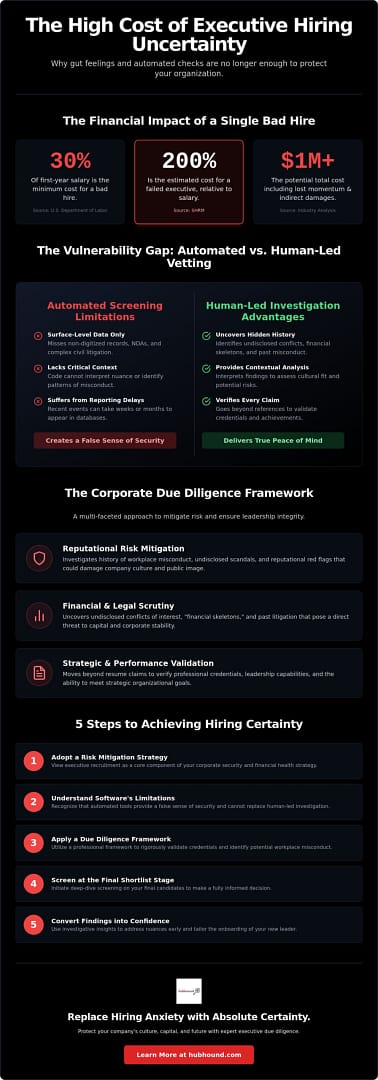
Executive-level hiring security isn’t a passive state of mind. It’s a proactive risk mitigation strategy designed to protect an organization’s most critical assets: its culture, its capital, and its future. When you’re feeling secure about a new high-level hire, that confidence should stem from data, not intuition. The stakes are simply too high for anything less. According to the U.S. Department of Labor, a bad hire costs at least 30% of their first-year salary. For executives, the Society for Human Resource Management (SHRM) estimates this figure reaches 200%. In some cases, a single failed leadership appointment can cost a company up to $1 million when indirect damages are factored in.
The process of investigating the backgrounds of top-tier candidates requires a standard far beyond the automated checks used for entry-level staff. While a junior employee might only need a criminal record scan, a C-suite executive holds the keys to the entire enterprise. This necessitates a “Trust but Verify” philosophy. You should start with the assumption of professional competence but validate every claim with clinical precision. This approach forms the foundation of modern corporate security, ensuring that leadership transitions strengthen the company rather than destabilize it.
The Anatomy of a High-Level Hiring Risk
High-level risks are multifaceted and often deeply hidden. Reputational damage is perhaps the most difficult to repair. If an executive has a history of workplace misconduct that wasn’t uncovered, the resulting scandal can alienate clients and tank employee morale. Financial risks are equally pressing. Undisclosed conflicts of interest or “financial skeletons” can lead to legal liabilities or compromised decision-making. Finally, resume padding isn’t just about small exaggerations. It’s about misrepresenting the ability to meet strategic organizational goals, which can set a company back years in a competitive national market.
Why Traditional Trust Metrics Fail at the C-Suite
Standard HR protocols often crumble when facing sophisticated candidates. Reference calls are notoriously unreliable at this level because candidates provide a curated list of peers who are predisposed to offer praise. Additionally, high-level candidates often possess significant charisma. This professional polish can allow them to bypass standard HR filters that might catch a less experienced applicant. Professional investigative research is required to see past the interview performance. Executive Due Diligence is an exhaustive investigative process that utilizes forensic-level verification to ensure every professional claim and historical detail is accurate.
Why Automated Background Checks Leave You Vulnerable
Speed often comes at the expense of accuracy. Many organizations rely on instant background reports that promise results in seconds. While these tools are efficient for high-volume entry-level roles, they create a dangerous false sense of security when vetting leadership. Database-scraping software only identifies what has already been digitized and indexed. It lacks the nuance required for a comprehensive understanding of risk. Feeling secure about a new high-level hire requires looking past the surface-level data that automated tools provide. Code cannot think; it only matches strings of text, which means it often misses the context of a candidate’s professional history.
High-level candidates often have clean records in shallow databases. This isn’t always because they’ve never had issues. Rather, it’s often because their professional history involves complex civil litigation, non-disclosure agreements, or misconduct that hasn’t resulted in a criminal conviction. Automated systems don’t possess the cognitive ability to cross-reference disparate data points. They can’t detect a pattern of behavior that suggests a cultural mismatch or a potential for workplace misconduct. When a candidate has spent years in senior roles, they often have the resources and knowledge to manage their digital footprint, making human-led investigative analysis essential to uncovering the truth.
The Limitations of Public Record Aggregators
Public record aggregators suffer from significant technical gaps. Reporting delays are common; a record might take weeks or months to appear in a national database after a local court filing. Many jurisdictions don’t participate in centralized digital networks, leaving massive holes in a candidate’s history. Relying on self-reported data in digital applications is another pitfall. If a candidate omits a previous employer where they faced disciplinary action, a basic software scan will likely never find it. No record found is a technical status, not a guarantee of a clean history. These gaps are exactly where the most significant risks often hide.
The Investigative Advantage of Professional Agencies
Professional agencies provide a depth of insight that software simply cannot reach. By utilizing rigorous pre-employment background checks, investigators can access non-digitized records held at local courthouses or specialized archives. This human-led analysis identifies subtle red flags, such as conflicting dates in a career history or unexplained gaps in professional tenure. Instead of just identifying isolated legal incidents, an investigative approach uncovers behavioral patterns. This ensures your organization is feeling secure about a new high-level hire through verified facts rather than assumptions. If you want to ensure your next executive appointment is built on a foundation of transparency, it’s time to evaluate your current corporate due diligence protocols.
The Corporate Due Diligence Framework for Absolute Certainty
Building a framework for absolute certainty requires moving beyond the “safe” communication strategies often touted by general hiring consultants. Organizations must implement a rigorous investigative structure to mitigate risk and maximize value during the leadership transition. Feeling secure about a new high-level hire is only possible when every professional claim has been cross-referenced against independent, verified sources. This framework begins with the forensic verification of professional credentials and educational history. It’s common for candidates to misrepresent graduation dates or specific degree titles to obscure career gaps or a lack of specialized training. A professional investigation verifies these details at the source, ensuring the foundational data of the resume is accurate.
Civil litigation history provides a vital window into a candidate’s professional friction points. Unlike criminal records, civil suits often reveal patterns of breach of contract, harassment allegations, or intellectual property disputes. For an executive, these are critical indicators of future performance and potential liability. Workplace misconduct investigations further refine this profile. They uncover behavioral issues that never reached a courtroom but caused significant damage at previous firms. By identifying these red flags early, you protect your organization from the high costs of a failed appointment described in earlier sections.
Verifying the Unverifiable: Track Record and Reputation
Standard references are a starting point; blind interviews are the destination. This process involves speaking with former colleagues, subordinates, and vendors who were not on the candidate’s provided list. It allows you to assess a candidate’s true impact at previous organizations, separating their individual contributions from general company success. For those seeking a deeper due diligence context, consulting a corporate investigation firm provides the specialized resources needed to conduct these sensitive inquiries with total discretion.
Financial Integrity and Conflict of Interest
Executives often hold interests that could conflict with your organization’s strategic goals. Identifying undisclosed business interests or directorships is a standard pillar of a professional due diligence framework. To facilitate this, you can discover Secretary of State Directory to check for registered business entities and corporate filings nationwide. Asset searches go a step further. They verify financial stability and ensure the candidate isn’t living beyond their means, which is a known precursor to corporate fraud. Feeling secure about a new high-level hire means knowing your new leader isn’t a liability for future regulatory audits. This level of scrutiny ensures that your financial and reputational interests remain protected long after the contract is signed.
5 Critical Steps to Achieving Security Before the Start Date
Achieving absolute certainty in leadership recruitment requires a tactical shift from passive screening to active verification. Feeling secure about a new high-level hire is a result of a repeatable, disciplined process that begins long before the first day. While general HR advice focuses on pre-boarding communication to reduce candidate jitters, professional security protocols focus on reducing employer risk. You must establish a standardized investigative protocol for all high-level appointments to ensure no candidate bypasses critical checks due to personal rapport or professional prestige.
Initiate deep-dive background screening at the final shortlist stage rather than waiting for a signed offer. This timing allows you to compare investigative findings across multiple top-tier candidates, providing a clearer picture of who truly fits your organization’s risk profile. A comprehensive security strategy includes:
- Professional Witness Interviews: Conduct structured interviews with former colleagues and subordinates who weren’t listed as references. These “blind” inquiries reveal the candidate’s true leadership style and operational impact.
- Digital Footprint Audit: Perform an exhaustive social media and digital presence review to identify behavioral patterns or controversial associations that software often misses.
- Validation of Disclosures: Review and validate every financial and legal disclosure provided by the candidate against independent court records and financial databases.
Implementing the Investigative Protocol
Communicate the due diligence process to candidates as a standard part of your commitment to corporate integrity. High-quality leaders respect a company that prioritizes rigorous assessment. Ensure the investigation is timed to run concurrently with final interviews to avoid delaying the hiring timeline. Once complete, integrate the investigative findings into your final decision-making meeting. This ensures that the board or hiring committee has a full, objective data set to review before committing to a contract. If you’re ready to upgrade your vetting process, you can find specialized pre-employment background checks that prioritize executive-level depth.
The Role of Surveillance and Discreet Inquiries
Discreet surveillance might be necessary for high-value hires where the candidate’s current activities or associations pose a significant risk to your firm’s interests. Maintaining candidate confidentiality is the highest priority throughout this phase to protect both the individual’s reputation and your company’s professional standing. Utilizing specialized surveillance techniques ensures that inquiries remain undetected while providing the clarity needed for feeling secure about a new high-level hire. This level of discretion is essential for maintaining trust while fulfilling your fiduciary responsibility to the organization.
Turning Investigative Insights into Onboarding Confidence
Onboarding often fails because of lingering doubts that surface only after the contract is signed. When leadership teams operate with incomplete information, they tend to withhold full support, creating a “wait and see” environment that stifles the new executive’s momentum. Feeling secure about a new high-level hire changes this dynamic entirely. Having all the facts allows for a more authentic onboarding experience where transparency is the baseline. Instead of navigating an obstacle course of assumptions, you can welcome a new leader with the confidence that their history is fully vetted and their reputation is intact. This certainty empowers the board and the executive suite to commit resources and trust from day one.
Investigative reports shouldn’t be viewed solely as “pass/fail” documents. They provide a strategic roadmap for managing the new executive. If a professional investigation uncovers minor red flags, such as a localized conflict in a previous role or a discrepancy in a past board seat, these can be addressed directly before the start date. This proactive communication builds a foundation of honesty. It allows you to set clear boundaries and expectations based on verified behavioral data rather than interview performance. Ultimately, professional investigation is a tool for building long-term organizational integrity, ensuring that every leadership appointment strengthens the company’s ethical core.
From Verification to Strategic Partnership
Due diligence data is a powerful tool for setting performance expectations. By understanding the candidate’s true impact at previous organizations, you can align their onboarding goals with their demonstrated strengths. Certainty in the hire empowers the leadership team to support the new executive without the hesitation that usually accompanies high-stakes appointments. This alignment is critical for maintaining a culture of accountability. To understand how consistent vetting protects your firm beyond the hiring phase, review our guide on workplace investigations to see the importance of ongoing integrity.
Partnering with a Professional Investigative Agency
Specialized agencies outperform general HR consulting because they approach vetting with an investigative mindset rather than an administrative one. A licensed investigator’s perspective on candidate risk is grounded in forensic verification and behavioral analysis, providing a level of depth that standard software cannot match. This expertise is what allows for feeling secure about a new high-level hire in a volatile national market. When the cost of a mistake can reach seven figures, relying on an expert curator to handle the heavy lifting of research is the only logical choice for growth-focused companies. Contact HubHound for professional pre-employment background checks to secure your next hire and protect your organization’s future.
Securing Your Leadership Pipeline with Precision
Transitioning from automated checks to a forensic due diligence framework is the only way to eliminate the “illusion of security.” As discussed, true validation requires looking beyond provided references to uncover behavioral patterns and financial integrity. Feeling secure about a new high-level hire is possible only when you replace intuition with verifiable data. This investigative rigor ensures that every executive you appoint aligns with your firm’s strategic goals and ethical standards. By focusing on hard evidence rather than interview performance, you protect your company from the immense costs associated with leadership failure.
By partnering with licensed investigators who bring over three decades of experience, your organization gains access to comprehensive corporate due diligence reports that software cannot replicate. Our expertise in high-stakes workplace misconduct investigations ensures that every leadership appointment is built on a foundation of transparency and trust. Secure your next high-level hire with HubHound’s professional screening services.
Your company’s future depends on the quality and integrity of its leaders. Don’t leave your reputation to chance. Take the guesswork out of executive recruitment and move forward with the absolute certainty your business deserves.
Frequently Asked Questions
How do you verify an executive’s track record beyond their resume?
Verifying a track record requires forensic verification of every professional claim against independent sources. This process involves conducting blind interviews with former subordinates and peers who were not included on the candidate’s provided list. These conversations reveal the candidate’s true leadership impact and operational style. Feeling secure about a new high-level hire depends on this level of human-led inquiry rather than relying on self-reported data.
What is the difference between a standard background check and corporate due diligence?
Standard background checks focus on automated database scraping for criminal records and credit history. In contrast, corporate due diligence is an exhaustive investigative process that analyzes civil litigation, reputational standing, and potential conflicts of interest. While a standard check confirms a candidate’s basic eligibility, due diligence provides the deep behavioral insights necessary for high-stakes leadership appointments. It offers a more comprehensive view of professional risk.
How long does a high-level background investigation typically take?
A comprehensive executive investigation typically takes between 7 and 14 business days to complete. The duration varies based on the candidate’s professional footprint and the accessibility of non-digitized records in various jurisdictions. This timeframe ensures that investigators have sufficient time to conduct thorough witness interviews and verify complex financial or legal disclosures without rushing the validation process. Efficiency must never compromise the depth of the search.
Can an investigation uncover past workplace misconduct not mentioned in references?
Professional investigations frequently identify workplace misconduct that candidates omit from their resumes or provided references. Investigators utilize civil litigation searches and blind interviews to uncover behavioral patterns that never resulted in criminal charges but caused organizational damage. Identifying these red flags early is essential for feeling secure about a new high-level hire and protecting your company’s long-term reputation. It ensures you have the full story.
Is it legal to conduct deep due diligence on a high-level candidate?
Conducting deep due diligence is legal when performed in compliance with federal regulations, such as the Fair Credit Reporting Act. You must obtain the candidate’s written consent before initiating the investigation. Professional agencies ensure that all inquiries are handled ethically and legally, protecting your organization from potential litigation while fulfilling your fiduciary duty to vet leadership thoroughly. Transparency with the candidate is a key part of the process.
How do I handle a red flag found during an executive-level investigation?
Red flags should be addressed directly with the candidate during a structured follow-up interview or presented to the hiring committee for a final risk assessment. Some findings may be disqualifying, while others can be mitigated through specific contract terms or targeted onboarding support. Use the investigative report as a factual foundation to make an informed decision that prioritizes the organization’s strategic interests and safety. Facts allow for objective decision-making.

Article by
Joel R. Manley | President | Hubhound Investigations | OR PI-ID#: 90432 | 111 SW Fifth Avenue, Suite 3150 Portland, Oregon 97204 | 971-442-8170
Joel is licensed as a private investigator in Oregon and Tennessee. Joel started his career in 1987 serving as a Military Police Officer and Military Police Investigator.
After ending his military tour of duty, Joel became a civilian Police Officer and Deputy Sheriff. Joel took his strong background in Hostage Negotiations, Mediation and Conflict Resolution, with him to patrol some of the highest crime areas in SE Portland.
Joel was awarded Deputy of the Year for his efforts and for drastically reducing the crime rate in the area he patrolled. As a Deputy Sheriff, Joel assisted in leading a Neighborhood Livability Program that was nationally recognized for having the most innovative and progressive approach to policing.
In 2018, Joel retired as a Deputy Sheriff and founded Hubhound Investigations. Joel played an integral role in Hubhound Investigations receiving an A+ Accredited Business rating from the Better Business Bureau (BBB).
In his off time, Joel enjoys spending time with his wife, adult children and Hubhound’s Happiness Ambassador, Nya. Joel also enjoys Scuba Diving and Kayaking.
Disclaimer
DISCLAIMER: This article is provided for general informational and educational purposes only. It is not intended to constitute legal advice, professional investigative advice, or instruction to engage in any unlawful activity. Laws governing private investigations, surveillance, recording, tracking, access to information, evidence collection, privacy, trespass, licensing, and related investigative activities vary by jurisdiction and are subject to change.
Any investigative techniques, tactics, procedures, scenarios, or legal proceedings discussed in this article are presented for informational purposes and should not be interpreted as authorization or encouragement to use a particular method. Private investigators and members of the public are responsible for understanding and complying with all applicable federal, state, and local laws, licensing requirements, court rules, and professional standards.
The circumstances of every investigation and legal matter are different. Information contained in this article should not be relied upon as a substitute for advice from a qualified attorney or other appropriate licensed professional regarding a specific situation. No attorney-client, investigator-client, or other professional relationship is created by reading or using this information.