
In a high-stakes custody dispute, your emotional bond with your child is a given, but your documented conduct is the only currency the court truly values. Most parents enter this process with a valid fear of false allegations or the anxiety of a home inspection. It’s a heavy burden to feel your private life is under a microscope. However, shifting your perspective from defense to preparation is the most effective way to secure your child’s future.
Understanding a child custody investigation what to expect in 2026 allows you to replace choice paralysis with a strategic, evidence-based plan. This guide provides a clear roadmap of the investigative timeline and the modern criteria used in parenting plan evaluations. You’ll gain the confidence needed to present a stable home environment and learn how to distinguish between court-appointed officials and private investigators. We’ll preview how to gather objective evidence, including surveillance and witness statements, to ensure your case remains focused on the best interests of the child.
Key Takeaways
- Understand the “Best Interest of the Child” standard to align your case strategy with the court’s primary decision-making framework.
- Clarify child custody investigation what to expect by identifying the specific environmental and safety factors investigators prioritize during home visits.
- Distinguish between neutral court-appointed evaluators and private investigators to determine which resource best supports your specific evidentiary needs.
- Follow a structured 5-step preparation roadmap to organize medical records, school logs, and child-centric living spaces effectively.
- Learn how professional skip tracing and witness interviews provide the data-driven support necessary to address gaps in a standard court evaluation.
Understanding the Child Custody Investigation Process
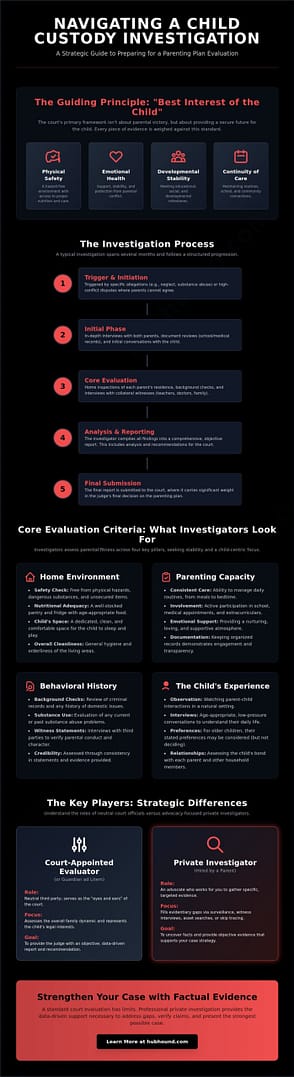
A child custody investigation is a specialized, professional assessment designed to provide the court with an objective view of parental fitness. It goes beyond surface-level observations; it is a forensic deep-dive into your lifestyle, history, and ability to meet your child’s needs. When researching a child custody investigation what to expect, you must understand that the court operates under the “Best Interest of the Child” standard. This standard isn’t about which parent is “better” in a vacuum. It evaluates who can best support the child’s physical safety, emotional health, and developmental stability.
Courts typically trigger these investigations when specific red flags emerge. These often include allegations of neglect, evidence of substance abuse, or high-conflict disputes where parents cannot reach a functional agreement. During this process, you may interact with a court-appointed investigator or a Guardian ad Litem. While an investigator assesses the overall family dynamic, a Guardian ad Litem is specifically tasked with representing the child’s legal interests. Both roles serve as the court’s eyes and ears, filtering subjective parental claims into objective reports.
The Legal Framework for Custody Evaluations
Judges rely heavily on investigative reports to finalize parenting plans. These documents translate complex family dynamics into actionable data. Professional testimony from an evaluator often carries significantly more weight than individual parental claims because it is viewed as neutral and expert-driven. The child custody evaluation process ensures that decisions aren’t based on hearsay but on verified facts. By 2026, standards have shifted to prioritize continuity of care. The court wants to see which parent can maintain the child’s current routines, school connections, and medical consistency with the least amount of disruption.
Timeline: How Long Does the Process Take?
The duration of an investigation varies based on case complexity and the availability of third-party witnesses. You should expect a multi-phase progression. It begins with initial interviews, followed by home inspections and background reviews. If your case involves locating missing witnesses or analyzing complex medical records, the timeline will likely extend. Understanding a child custody investigation what to expect helps you manage the logistical hurdles of this window, which often spans several months from the initial filing to the final report submission. You can handle legal delays professionally by maintaining meticulous records and ensuring your legal team remains responsive to the investigator’s requests.
What Investigators Look For: The Core Evaluation Criteria
A successful outcome depends on your ability to meet objective benchmarks. When analyzing a child custody investigation what to expect, you must focus on the data points evaluators use to measure parental fitness. They don’t look for perfection; they look for stability, safety, and a child-centric environment. The criteria are divided into four primary pillars: environmental safety, parenting capacity, behavioral history, and the child’s own experience.
Evaluating the child’s perspective requires a delicate, specialized approach. Investigators use age-appropriate techniques to understand the child’s daily reality without placing them in the middle of a parental conflict. This often involves observing the child in their natural habitat or conducting low-pressure interviews. If your case involves a court-ordered custody investigation, the evaluator will prioritize the child’s comfort while filtering out any coached responses.
Parenting capacity is measured by your ability to provide consistent care. This includes tracking medical appointments, school attendance, and emotional support. Investigators look for evidence that you are the primary facilitator of the child’s routine. If you aren’t the one handling these tasks, be prepared to explain why and how you remain involved. Documentation is your strongest asset here. Keeping a log of significant events or communication with the other parent demonstrates a high level of engagement and transparency.
Home Environment Inspections
Your physical residence is a primary data source. Investigators inspect high-traffic areas to ensure they are free from hazards. They check the pantry for nutritional adequacy and the medicine cabinet for properly secured prescriptions. A “lived-in” home with scattered toys is rarely a concern. However, an “unsafe” home with exposed wiring, accessible chemicals, or inadequate sleeping arrangements will trigger a negative report. Ensure your yard is secure and that all safety gear, such as smoke detectors and window guards, is fully operational.
Background and Lifestyle Screening
The investigation extends far beyond your front door. Evaluators conduct a comprehensive background screening to verify your claims regarding employment, criminal history, and financial stability. This process often includes a review of social media activity. Posts that suggest high-risk behavior or disparage the other parent can be used as evidence of poor judgment. Additionally, investigators scrutinize third-party influences, such as new romantic partners or frequent houseguests, to determine their impact on the child’s environment.
Strategic preparation helps you identify potential vulnerabilities before the investigator does. If you need to verify the backgrounds of individuals entering your home, utilizing professional surveillance operations can provide the clarity required to protect your child’s interests.
Court-Appointed vs. Private Investigators: Strategic Differences
Understanding the distinction between court-appointed evaluators and private investigators is vital for your legal strategy. A court-ordered evaluator, sometimes referred to as a Friend of the Court, operates as a neutral third party. Their primary function is to report findings directly to the judge. While they provide a necessary baseline, they’re often constrained by high caseloads and limited resources. They typically rely on scheduled interviews and home visits, which can sometimes fail to capture the daily reality of a child’s environment or the true behavior of a parent when they aren’t being watched.
Hiring a private investigator allows you to address specific evidentiary gaps that a neutral evaluator might miss. When considering a child custody investigation what to expect, you should view a private firm as an extension of your legal team. They focus on uncovering documented misconduct, such as substance abuse, neglect, or violations of current parenting agreements. This data-driven approach transforms subjective concerns into “court-ready” evidence. By working in synergy with your attorney, a professional investigative agency ensures that every claim is backed by objective proof rather than emotional testimony.
The Power of Professional Surveillance
Static testimony often pales in comparison to visual documentation. Utilizing advanced surveillance techniques allows you to document cohabitation or neglect with forensic precision. Video evidence is significantly more persuasive than “he-said, she-said” arguments because it provides an unfiltered view of the facts. However, these operations must remain within strict legal boundaries. Professional investigators understand exactly what can and cannot be recorded in public versus private spaces, ensuring that the gathered evidence remains admissible during your child custody investigation what to expect.
Witness Interviews and Statements
Character witnesses are a cornerstone of any custody case, but their value depends entirely on their perceived neutrality. Family members are often dismissed as biased by the court. Identifying and vetting third-party witnesses, such as teachers, coaches, or neighbors, provides the judge with a more reliable perspective. Professional witness interviews and statements can reveal critical inconsistencies in a co-parent’s narrative. These interviews are conducted with a focus on extracting factual observations that support your case while maintaining the integrity of the legal process. Vetting these individuals early prevents surprises during cross-examination and strengthens your overall position.
Preparation Strategy: 5 Steps to Handle an Investigation
Success in a custody case is rarely accidental. It’s the result of rigorous preparation and a commitment to transparency. When analyzing a child custody investigation what to expect, you must shift your focus from the emotional weight of the dispute to the technical requirements of the evaluation. Preparation reduces friction and ensures the investigator receives a clear, undistorted view of your parenting capabilities. Follow these five essential steps to establish a solid foundation for your case.
- Audit your digital footprint: Review all social media platforms. Remove or archive posts that could be misinterpreted as high-risk behavior or evidence of parental alienation.
- Centralize documentation: Gather at least 12 months of school records, medical logs, and extracurricular participation data. Organized files demonstrate a high level of engagement.
- Standardize the home environment: Prioritize safety and age-appropriate amenities. Ensure the child’s space is functional, secure, and clearly defined to show a stable living arrangement.
- Practice emotional regulation: Maintain a professional, cooperative demeanor during all interactions. Treat the investigation as a formal assessment rather than a personal confrontation.
- Coordinate with legal counsel: Finalize your strategy before the first interview. Ensure your attorney has reviewed your evidence and identifies any potential gaps in your narrative.
Interview Conduct: Dos and Don’ts
Your interactions with the evaluator serve as a direct sample of your judgment. You should never use the interview to disparage the other parent. Instead, focus on your child’s developmental needs and how you uniquely meet them. If asked about past mistakes, answer with honesty and emphasize the corrective actions you’ve taken. This demonstrates accountability and growth, which are highly valued in the 2026 legal framework. Maintain a focus on the future rather than re-litigating past grievances during your child custody investigation what to expect.
Documenting Your Parenting Time
Consistency in documentation is your most effective defense against false claims. Keep a detailed, objective calendar of all visitations, including pick-up and drop-off times. Log your daily routines, such as homework help, meal preparation, and bedtime rituals. This data-driven approach provides the court with a concrete roadmap of your involvement. To ensure your records are exhaustive and court-ready, you may benefit from professional civil litigation support to help organize and validate your evidence before it’s submitted to the evaluator.
Leveraging Professional Support for Your Custody Case
A court-appointed evaluator provides a necessary baseline, but they often lack the bandwidth for a forensic audit of a high-conflict family dynamic. Taking control of the narrative requires more than just being a good parent; it requires verifiable data that survives cross-examination. When you analyze a child custody investigation what to expect, you must recognize where the court’s resources end and where professional investigative support begins. A private firm identifies the critical gaps in standard reports, ensuring that the judge sees the full scope of the child’s daily reality.
Professional firms utilize advanced tools like skip tracing for locating missing witnesses or identifying hidden assets. These resources are essential when a co-parent attempts to obscure their true living situation or financial standing. By gathering evidence that meets strict legal standards, you move from a position of anxiety to one of informed action. This transition allows your legal team to build a strategy based on documented facts rather than defensive reactions.
Why Objective Evidence Matters
The primary risk in a contested case is relying on a standard report that misses nuanced misconduct. Court-appointed evaluators are frequently overworked and may only spend a few hours on your case. A private investigative firm provides the depth of research a government agency cannot match. In many contested cases, professional surveillance has shifted the outcome by documenting patterns of neglect or substance abuse that were carefully hidden during scheduled home visits. This level of detail provides the court with a clear, unfiltered view of the child’s environment, making it difficult for the opposition to rely on coached testimony or false claims.
Next Steps: Evaluating Your Investigative Needs
Determine the scope of your requirements early in the process. Ask yourself if your case involves specific allegations that require visual proof or if you need a deep background check on individuals entering the child’s home. Once you identify these needs, integrate the findings into your attorney’s broader strategy. Professional evidence is most effective when it is used to corroborate your claims and highlight inconsistencies in the other parent’s story. If you are ready to secure the objective data needed for your case, Contact HubHound for a professional consultation on your custody matter.
Taking Control of Your Custody Outcome
Successfully managing a child custody investigation what to expect involves shifting from emotional defense to professional preparation. You’ve learned that courts prioritize objective stability over subjective claims. By organizing documentation, optimizing your home environment, and understanding the strategic use of private surveillance, you establish a narrative built on facts. A neutral evaluation provides a baseline; however, specialized investigative support ensures that no critical detail is misrepresented or overlooked during the process.
HubHound offers the expertise needed to validate your parenting fitness and document risks to your child’s well-being. Our licensed investigators bring over 30 years of experience to every case, specializing in court-ready surveillance and evidence gathering. We provide comprehensive nationwide background screening capabilities to ensure every individual in your child’s life meets strict safety standards. This data-driven approach moves your case beyond hearsay and into the territory of verifiable proof.
Secure your parental rights with professional investigative support.
You don’t have to navigate this complex legal landscape alone. With the right data and a clear strategy, you can confidently advocate for your child’s future and secure the best possible outcome for your family.
Frequently Asked Questions
How much does a child custody investigation typically cost?
Costs vary based on the complexity of the family dynamic and the depth of the assessment. Court-appointed evaluations typically range from $2,500 to $10,000. A comprehensive parenting plan evaluation often carries a flat fee near $8,400, while specialized forensic psychological testing can add between $2,500 and $7,500 to the total. These fees are separate from any private investigative services you might retain independently.
Can I refuse to allow a custody investigator into my home?
You have the right to refuse entry, but doing so usually results in severe legal consequences. A refusal is often interpreted by the court as a sign that you’re hiding an unsafe environment or lack the ability to cooperate. If the inspection is court-ordered, failing to provide access can lead to a contempt charge or a recommendation that negatively impacts your parenting time.
Will the investigator talk to my child alone?
Yes, private interviews are a standard part of the process to ensure the child can speak without parental pressure. Investigators use age-appropriate techniques to observe the child’s comfort level and check for signs of coaching. These sessions help the evaluator understand the child’s perspective on their daily routine and emotional bonds in a neutral setting.
What happens if the investigator finds a red flag in my background?
A red flag requires context rather than immediate disqualification. Investigators look for patterns of behavior rather than isolated past mistakes. If a background check reveals a criminal record or history of instability, you must demonstrate the corrective actions you’ve taken. Proactive transparency and evidence of current stability are your best tools for addressing these concerns effectively.
How much weight does the investigator’s report carry in court?
The investigator’s report carries significant weight because it serves as the judge’s primary source of objective data. Judges often adopt the report’s recommendations because they’re based on professional observations rather than parental hearsay. Understanding a child custody investigation what to expect helps you realize that this document often dictates the final parenting plan and custody schedule.
Can a private investigator follow my ex-spouse during their parenting time?
Yes, licensed investigators can perform surveillance in public spaces to document neglect, substance abuse, or violations of the current court order. This evidence is highly persuasive when it captures behaviors that a parent might hide during a scheduled evaluation. All surveillance must be conducted within legal boundaries to ensure the gathered evidence is admissible during your child custody investigation what to expect.
How do I know if the investigator is being biased?
Bias is usually visible when an investigator ignores documented evidence or fails to interview neutral third-party witnesses you’ve provided. If the final report relies heavily on the other parent’s claims without verification, it may be procedurally flawed. You should work with your attorney to highlight these gaps or request a secondary, independent evaluation to ensure a fair outcome.
What should I do if the other parent is lying to the investigator?
Don’t get drawn into a “he-said, she-said” argument; instead, provide the investigator with objective proof that contradicts the lies. Use school attendance records, medical logs, and communication journals to establish the facts. When you provide data-driven evidence, the other parent’s dishonesty becomes a matter of record, which significantly damages their credibility with the evaluator and the judge.

Article by
Joel R. Manley | President | Hubhound Investigations | OR PI-ID#: 90432 | 111 SW Fifth Avenue, Suite 3150 Portland, Oregon 97204 | 971-442-8170
Joel is licensed as a private investigator in Oregon and Tennessee. Joel started his career in 1987 serving as a Military Police Officer and Military Police Investigator.
After ending his military tour of duty, Joel became a civilian Police Officer and Deputy Sheriff. Joel took his strong background in Hostage Negotiations, Mediation and Conflict Resolution, with him to patrol some of the highest crime areas in SE Portland.
Joel was awarded Deputy of the Year for his efforts and for drastically reducing the crime rate in the area he patrolled. As a Deputy Sheriff, Joel assisted in leading a Neighborhood Livability Program that was nationally recognized for having the most innovative and progressive approach to policing.
In 2018, Joel retired as a Deputy Sheriff and founded Hubhound Investigations. Joel played an integral role in Hubhound Investigations receiving an A+ Accredited Business rating from the Better Business Bureau (BBB).
In his off time, Joel enjoys spending time with his wife, adult children and Hubhound’s Happiness Ambassador, Nya. Joel also enjoys Scuba Diving and Kayaking.
Disclaimer
DISCLAIMER: This article is provided for general informational and educational purposes only. It is not intended to constitute legal advice, professional investigative advice, or instruction to engage in any unlawful activity. Laws governing private investigations, surveillance, recording, tracking, access to information, evidence collection, privacy, trespass, licensing, and related investigative activities vary by jurisdiction and are subject to change.
Any investigative techniques, tactics, procedures, scenarios, or legal proceedings discussed in this article are presented for informational purposes and should not be interpreted as authorization or encouragement to use a particular method. Private investigators and members of the public are responsible for understanding and complying with all applicable federal, state, and local laws, licensing requirements, court rules, and professional standards.
The circumstances of every investigation and legal matter are different. Information contained in this article should not be relied upon as a substitute for advice from a qualified attorney or other appropriate licensed professional regarding a specific situation. No attorney-client, investigator-client, or other professional relationship is created by reading or using this information.