
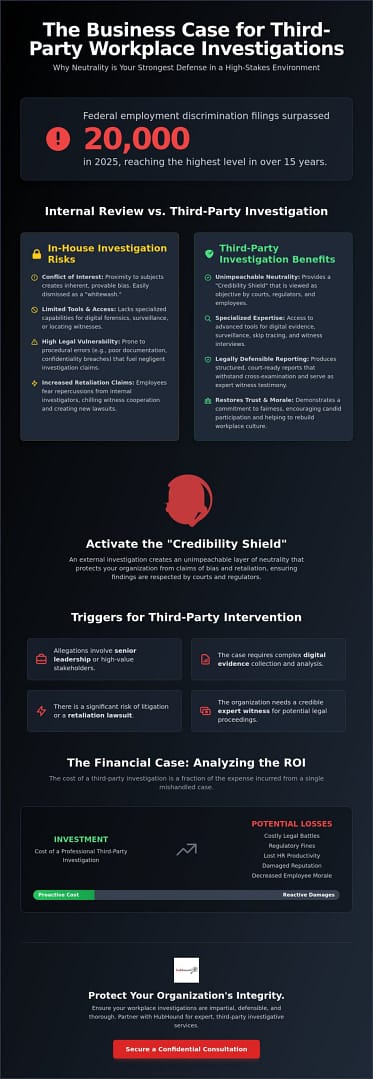
Federal employment discrimination filings surpassed 20,000 in 2025, reaching the highest level in over 15 years. This surge in litigation puts immense pressure on internal teams to handle sensitive complaints with absolute precision. You likely recognize the fear of a botched investigation leading to a costly, multi-year legal battle. Building a strong business case for third-party workplace investigations requires acknowledging that internal neutrality is often difficult to prove to outside regulators. Internal conflicts and a lack of specialized digital evidence tools can quickly compromise a case.
This article explains why external investigative expertise is the most cost-effective way to mitigate corporate risk and protect organizational integrity. You’ll discover how to produce a defensible report that stands up in court while protecting your leadership from retaliation claims. We provide the expert advice necessary to navigate new AI disclosure requirements and shifting EEOC enforcement guidelines. Follow this roadmap to select the right investigative partners and restore your workplace culture through objective, professional discovery.
Key Takeaways
- Leverage a “credibility shield” to eliminate claims of internal bias and protect your organization from costly retaliation lawsuits.
- Strengthen your business case for third-party workplace investigations by analyzing the ROI of external expertise against the high price of procedural errors and lost HR productivity.
- Access specialized tools such as surveillance and skip tracing to verify misconduct and locate critical witnesses that internal departments cannot reach.
- Implement a structured protocol with specific triggers to transition sensitive cases from internal review to a defensible, professional investigation.
The Strategic Necessity of Neutrality in Workplace Investigations
Neutrality isn’t just a corporate preference; it’s a strategic defense mechanism. When an organization faces allegations of harassment or fraud, the investigator’s perceived independence determines the weight of the final report. This “Credibility Shield” protects the company by ensuring that findings are viewed as objective by courts, regulators, and employees alike. Without this shield, even the most thorough internal review can be dismissed as a “whitewash” designed to protect the brand rather than find the truth. The business case for third-party workplace investigations rests on this foundation of unimpeachable impartiality.
In 2026, organizational integrity is measured by how a company handles its most difficult moments. An external expert provides a layer of separation that internal HR departments simply cannot achieve. This separation is essential for preventing retaliation lawsuits, which often stem from the belief that the investigator was “protecting their own.” By outsourcing the process, you demonstrate a commitment to the facts over corporate optics.
The Conflict of Interest Trap
Internal HR teams often operate within a web of “invisible” relationships. They share coffee with the managers they might need to investigate. They report to the executives whose conduct is under scrutiny. This proximity creates an inherent conflict of interest that plaintiffs’ attorneys exploit. If you’re investigating senior leadership or high-value stakeholders internally, you’re handing the opposition a weapon. Perceived bias is just as damaging in a courtroom as actual bias. A judge doesn’t need to prove you were partial; they only need to see that a reasonable person would doubt your objectivity. Using an external partner eliminates this vulnerability entirely.
Building Trust Through External Objectivity
Employees often hesitate to participate in internal reporting of misconduct because they fear the very people tasked with the investigation. An external expert changes this dynamic. The psychological barrier drops when a witness knows the investigator has no stake in their daily career path. This objectivity is vital for workplace investigations aimed at restoring morale after a crisis. The business case for third-party workplace investigations is clear: external experts uncover the “full story” that internal teams might miss due to fear of repercussions. By removing the threat of retaliation, you ensure that high-quality evidence reaches the surface. This transparency serves as a primary driver of retention and performance.
Mitigating Risk: Preventing Improper Investigation Consequences
Botched investigations don’t just fail to solve problems; they create new, expensive liabilities. When an internal team mishandles a complaint, they often inadvertently provide the plaintiff with a roadmap for a “negligent investigation” claim. The business case for third-party workplace investigations is built on avoiding these procedural traps that turn simple HR matters into federal lawsuits. Professional investigators prioritize the collection of witness interviews & statements that are structured to withstand cross-examination in a court of law.
A robust business case for third-party workplace investigations includes the strategic use of investigators as expert witnesses. In 2026, with the EEOC rescinding previous harassment guidance, companies must rely on underlying federal law and rigorous internal standards. A third-party report provides the necessary “Standard of Proof” that internal reviews often lack. Judges and juries typically view external reports as more credible because they are produced by a disinterested party with no stake in the outcome.
Common Procedural Failures of In-House Teams
In-house teams frequently struggle with the technical requirements of a defensible case. These failures often include:
- Inconsistent documentation: A single missing date or a biased comment in an HR file can ruin a defense.
- Confidentiality breaches: When internal probes leak into the company “rumor mill,” the organization faces additional claims of defamation or harassment.
- Digital evidence mishandling: Metadata matters in 2026. If you can’t prove an email or digital log wasn’t tampered with, it’s useless in court.
Documentation is the death knell of a defensible case. If an HR manager takes informal notes that are later lost or destroyed, it creates an “adverse inference.” This allows a jury to assume the missing information was harmful to the company. Professional investigators use standardized, secure systems to ensure every piece of evidence is preserved from the moment of discovery.
Legal Defensibility and the Burden of Proof
Legal defensibility relies on the quality of the investigative process. Third-party reports carry significant weight because they come from a source without internal “invisible” relationships. This objectivity often helps defense counsel secure a summary judgment, ending a case before it reaches an expensive trial. Understanding when a third-party investigator is the smart move is critical for risk managers who want to avoid the “sham investigation” label.
These experts don’t just write reports; they serve as expert witnesses who can articulate the specific standard of care used during the probe. This professional oversight shields the company from claims that the process was biased or incomplete. To ensure your process remains defensible, evaluate your current protocol for workplace misconduct investigations and identify triggers for external intervention.
The Financial Case: Analyzing the ROI of External Expertise
Financial decision-makers often view investigative fees as a sunk cost rather than a strategic investment. However, the business case for third-party workplace investigations becomes undeniable when weighed against the alternative: a multi-year legal battle. Employment lawsuits that go to trial often take nearly three years to resolve. Even successful defenses through motions can take around two years. During this time, legal fees and settlement costs can easily exceed six figures. Engaging a professional corporate investigation firm serves as a proactive hedge against these catastrophic financial risks.
Beyond legal fees, professional investigations can influence your bottom line through Employment Practices Liability Insurance (EPLI). Insurers prioritize organizations that demonstrate a rigorous, objective response to misconduct. By establishing a track record of third-party oversight, businesses can often negotiate more favorable premiums or lower deductibles. This proactive stance signals to underwriters that the company is a lower risk entity, translating directly into annual savings. Preventing a single “serial misconduct” case from escalating can save an organization millions in both direct legal costs and long-term cultural damage.
Direct vs. Indirect Costs of Internal Probes
Internal investigations carry significant hidden drains on management time. The average annual salary for a Workplace Investigator in the United States is approximately $75,325, but your senior HR directors likely earn significantly more. When top-tier HR talent is tied up in a months-long probe, they aren’t focusing on recruitment, training, or strategic growth. This opportunity cost is compounded by the impact on employee turnover. Crises that linger due to slow or biased internal processing often result in the loss of high-performing staff who no longer trust the environment. Investigative ROI is the ratio of potential liability and productivity losses avoided relative to the professional service fee.
Safeguarding Brand Reputation and Market Value
A leaked internal memo or a botched misconduct review can trigger a public relations crisis that erodes market value overnight. Transparent, third-party resolutions maintain stakeholder confidence by proving the organization values accountability over secrecy. This level of transparency is also a core component of corporate due diligence. Thorough investigations prevent partnership failures by identifying cultural toxicity before it results in a public scandal. Investing in external expertise ensures that the root causes of workplace issues are addressed, preventing the recurrence of expensive systemic failures and protecting your brand’s standing in a competitive national market.
Specialized Capabilities: What HR Teams Cannot Do
Internal HR departments excel at policy management and employee relations. However, they aren’t equipped for high-stakes field work or technical data recovery. The business case for third-party workplace investigations hinges on these specialized skill sets that exist outside the standard HR toolkit. Professional investigators bring tools for surveillance, digital forensics, and deep-web discovery that internal teams simply don’t possess. These capabilities are essential when a case moves beyond office walls or involves complex digital footprints.
In 2026, the complexity of evidence has scaled alongside technology. Investigations now frequently involve examining the role of algorithms in employment decisions or recovering data from encrypted messaging apps. A professional investigator maintains the specialized hardware and software necessary to preserve the chain of custody for digital evidence. This ensures that if a case moves to litigation, your data is defensible and hasn’t been compromised by well-meaning but untrained internal staff.
Surveillance and Fact-Finding Beyond the Office
Field work requires a specific legal and tactical approach that HR personnel aren’t trained to handle. Verifying FMLA abuse or workers’ compensation fraud often requires surveillance techniques that are both discreet and legally compliant. Professionals understand the strict boundaries of privacy laws, ensuring all video and photographic evidence is court-admissible. They track activity in public spaces without crossing into harassment territory. This level of precision prevents the organization from facing counter-suits for privacy violations while providing the hard evidence needed to terminate for cause. It’s about getting the facts without creating new liabilities.
Advanced Background and Locate Investigations
Standard HR software checks often scrape surface-level data from limited databases. Professional investigators go deeper, identifying “red flag” patterns such as undisclosed litigation history or hidden assets that suggest a conflict of interest. When a critical witness leaves the company, internal teams often lose the trail. Utilizing skip tracing allows investigators to locate former employees or witnesses who are essential for a complete report. These specialists are also trained in behavioral analysis, conducting witness interviews that uncover nuances an untrained manager might overlook. This depth of discovery is a primary component of the business case for third-party workplace investigations, as it ensures no stone is left unturned before a final decision is made.
If your current internal resources lack the technical tools to recover deleted communications or the field experience to conduct surveillance, your organization is at risk. Protect your interests by integrating professional expertise into your workplace misconduct investigations today.
Implementing a Third-Party Investigative Protocol
A reactive approach to misconduct allegations often leads to procedural errors. Establishing a clear, pre-defined protocol ensures your organization moves from internal review to external expertise seamlessly. The business case for third-party workplace investigations is strongest when the transition is proactive rather than a last-minute scramble to contain a crisis. A formal protocol defines the triggers for external involvement, protecting the integrity of the evidence and the reputation of the company.
Defining the scope of work is essential for maintaining efficiency and controlling costs. Clearly articulate the specific questions the investigator needs to answer. This prevents “scope creep” and ensures the final report addresses the core issues affecting organizational integrity. Selecting the right partner requires a rigorous assessment of their licensing, industry experience, and technical specialization. Prioritize firms that understand the evolving 2026 legal landscape, particularly regarding AI disclosure and shifting EEOC standards.
Creating the Transition Framework
Follow these three steps to identify when an internal probe must move to a neutral third party:
- Step 1: Identify severity and liability. Assess whether the allegation involves senior leadership, systemic discrimination, or potential criminal activity. High-stakes claims require the “credibility shield” discussed in earlier sections.
- Step 2: Assess internal conflicts. Determine if the HR team has personal or reporting relationships with the parties involved. If neutrality is even slightly compromised, external handling is required.
- Step 3: Engage a licensed investigator early. Secure a professional before digital evidence is lost or witness memories fade. Prompt action demonstrates the organization’s commitment to a thorough and impartial review.
Collaborating with External Experts
Once you engage an expert, provide them with the necessary access to personnel and digital logs while maintaining attorney-client privilege. This collaboration ensures the investigator can uncover the full story without internal interference. After receiving the final report, your leadership team must integrate the findings into a clear decision-making process. Use the expert’s recommendations to address root causes and update internal policies to prevent recurrence. This objective resolution is the final piece of a successful business case for third-party workplace investigations.
Consult with HubHound to secure your next workplace investigation and ensure your organization remains protected, compliant, and defensible.
Protecting Organizational Integrity and Future Growth
Managing workplace misconduct requires more than just policy adherence; it demands a defensible and objective process. By utilizing external experts, your organization gains a “credibility shield” that internal teams cannot replicate. This impartiality is essential for securing summary judgments and avoiding the multi-year legal battles that often follow botched internal reviews. Accessing specialized capabilities like digital forensics and surveillance ensures that every fact is uncovered and every witness is located.
The business case for third-party workplace investigations rests on the ability to mitigate corporate risk while preserving the trust of your workforce. Professional oversight turns a potential crisis into a manageable event, protecting your brand reputation and market value. HubHound provides licensed investigators with over 30 years of industry experience to guide you through these complex scenarios. Our team delivers comprehensive reports designed for legal defensibility and includes specialists in surveillance, skip tracing, and digital forensics. Secure your organization with HubHound’s expert investigative services. You can build a culture of accountability that supports sustainable growth and long-term stability.
Frequently Asked Questions
Why is a third-party investigation better than an internal HR investigation?
Third-party investigations provide a level of impartiality that internal teams cannot achieve. External experts aren’t influenced by internal office politics or reporting structures. This neutrality is the core of the business case for third-party workplace investigations, as it prevents plaintiffs from claiming the results were biased or pre-determined to favor the company.
When should a company hire an outside investigator for workplace misconduct?
Hire an outside investigator when allegations involve senior executives, systemic misconduct, or specialized technical evidence. If your internal team lacks the tools for digital forensics or surveillance, external support is necessary. Organizations should also move to external handling when the potential legal liability exceeds the cost of a professional review.
How much does a third-party workplace investigation typically cost?
Industry data from early 2026 indicates that law firm investigations typically range from $25,000 to over $100,000. Independent HR investigators often charge between $8,000 and $28,000. Understanding these industry price ranges is a critical step in building the business case for third-party workplace investigations within your budget. These costs vary based on the complexity of the case and the hourly rates of the professionals involved.
Can an internal investigation be used against a company in court?
Yes, an internal investigation is often the primary target for plaintiff attorneys in employment litigation. If the process was inconsistent or documentation was poor, it can be used to prove “negligent investigation.” This often leads to the organization losing its ability to secure a summary judgment, resulting in an expensive trial.
What are the risks of not using a neutral investigator for harassment claims?
The primary risk is a surge in retaliation claims and heightened federal scrutiny. Federal employment discrimination filings reached a 15-year high in 2025. Without a neutral investigator, you risk the EEOC or a jury viewing your process as a “sham.” This perception can turn a single harassment claim into a massive financial and reputational liability.
How long does a typical third-party workplace investigation take to complete?
A typical third-party investigation can take anywhere from three weeks to several months. The timeline depends on the number of witnesses, the volume of digital evidence, and the complexity of the allegations. While professional probes take time, they are significantly faster than the three years it often takes to resolve a lawsuit in court.
Is the report from a third-party investigator confidential?
Investigative reports are generally treated as confidential business records, but they aren’t always shielded from discovery. If a company uses the investigation as a defense in court, the report usually becomes discoverable. Professional investigators structure their reports to be court-ready, ensuring that even if disclosed, the findings remain defensible and objective.
What qualifications should I look for in a workplace investigator?
Look for a licensed investigator with a proven track record in civil litigation support and corporate misconduct. Essential qualifications include expertise in witness interviews, surveillance operations, and digital forensics. Selecting a firm with decades of industry experience ensures they have the nuance required to handle sensitive stakeholder interviews without compromising the case.

Article by
Joel R. Manley | President | Hubhound Investigations | OR PI-ID#: 90432 | 111 SW Fifth Avenue, Suite 3150 Portland, Oregon 97204 | 971-442-8170
Joel is licensed as a private investigator in Oregon and Tennessee. Joel started his career in 1987 serving as a Military Police Officer and Military Police Investigator.
After ending his military tour of duty, Joel became a civilian Police Officer and Deputy Sheriff. Joel took his strong background in Hostage Negotiations, Mediation and Conflict Resolution, with him to patrol some of the highest crime areas in SE Portland.
Joel was awarded Deputy of the Year for his efforts and for drastically reducing the crime rate in the area he patrolled. As a Deputy Sheriff, Joel assisted in leading a Neighborhood Livability Program that was nationally recognized for having the most innovative and progressive approach to policing.
In 2018, Joel retired as a Deputy Sheriff and founded Hubhound Investigations. Joel played an integral role in Hubhound Investigations receiving an A+ Accredited Business rating from the Better Business Bureau (BBB).
In his off time, Joel enjoys spending time with his wife, adult children and Hubhound’s Happiness Ambassador, Nya. Joel also enjoys Scuba Diving and Kayaking.
Disclaimer
DISCLAIMER: This article is provided for general informational and educational purposes only. It is not intended to constitute legal advice, professional investigative advice, or instruction to engage in any unlawful activity. Laws governing private investigations, surveillance, recording, tracking, access to information, evidence collection, privacy, trespass, licensing, and related investigative activities vary by jurisdiction and are subject to change.
Any investigative techniques, tactics, procedures, scenarios, or legal proceedings discussed in this article are presented for informational purposes and should not be interpreted as authorization or encouragement to use a particular method. Private investigators and members of the public are responsible for understanding and complying with all applicable federal, state, and local laws, licensing requirements, court rules, and professional standards.
The circumstances of every investigation and legal matter are different. Information contained in this article should not be relied upon as a substitute for advice from a qualified attorney or other appropriate licensed professional regarding a specific situation. No attorney-client, investigator-client, or other professional relationship is created by reading or using this information.