
The most compelling piece of evidence in your investigative file is completely worthless if you cannot prove its origin to a skeptical judge. You’ve likely spent weeks on surveillance and witness interviews, yet the fear of seeing your findings thrown out on a technicality remains a constant professional pressure. Mastering the standards for admissible evidence for civil litigation is what separates a successful recovery from a dismissed claim. It’s not just about what you find; it’s about how you document the discovery process from the very first second.
We understand that navigating the Federal Rules of Evidence can feel like a moving target, especially with the 2026 updates to hearsay frameworks and digital authentication standards. This guide provides a clear framework to help you master these complex legal requirements and ensure your investigative findings hold up under intense scrutiny. You’ll learn how to maintain an unbreakable chain of custody, properly document electronically stored information, and apply the rigorous standards of Rule 702 to your expert observations. This article gives you the technical confidence to build a legal strategy that transforms raw data into undeniable proof.
Key Takeaways
- Grasp the essential standards of relevance and materiality defined by the Federal Rules of Evidence to ensure your findings are court-ready.
- Establish an airtight chain of custody to protect the integrity of every document and digital file you collect during an investigation.
- Master the process of identifying admissible evidence for civil litigation to prevent your most critical findings from being suppressed on a technicality.
- Avoid the “Fruit of the Poisonous Tree” trap by ensuring all investigative techniques comply with strict legal privacy standards.
- Evaluate how professional investigators provide the neutral third-party credibility and expert documentation necessary for complex civil cases.
Understanding Admissible Evidence in Civil Litigation
Admissible evidence represents the specific subset of information that a trier of fact is legally permitted to consider during a trial. Whether the trier of fact is a judge in a bench trial or a jury in a standard civil proceeding, they rely on this filtered data to determine the outcome of a case. Without official admissibility, your most groundbreaking investigative discovery remains invisible to the court. Admissible Evidence must pass through a series of legal filters designed to ensure fairness, reliability, and efficiency in the judicial process.
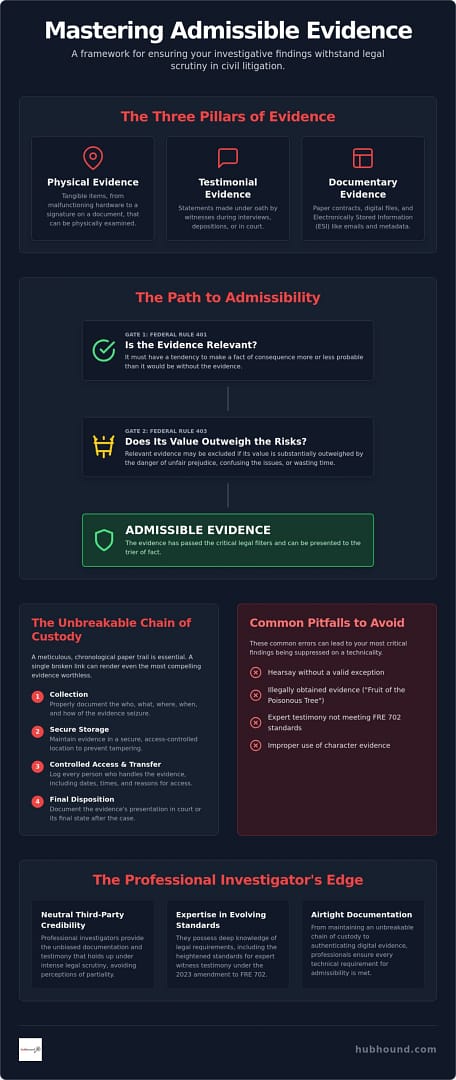
Professional investigators categorize findings into three primary groups. Physical evidence involves tangible items, such as a malfunctioning piece of hardware or a physical signature on a document. In complex industrial projects, you can find out more about Heavy Civil and Trenchless Infrastructure Contracting to see how technical assets and infrastructure data are managed for legal and operational clarity. Testimonial evidence consists of statements made under oath, often gathered through formal witness interviews. Documentary evidence includes everything from paper contracts to electronically stored information (ESI) like emails and metadata. Securing admissible evidence for civil litigation requires a precise understanding of how these categories are scrutinized by the court. Professional investigators must anticipate challenges to admissibility long before a case reaches the courtroom.
The Threshold of Relevance
Federal Rule 401 establishes the baseline for all evidence: relevance. To be relevant, a piece of information must have a tendency to make a fact more or less probable than it would be without that evidence. The fact must also be of consequence in determining the action. Direct evidence proves a fact immediately, such as a surveillance video showing an individual entering a restricted area. Circumstantial evidence requires the trier of fact to make a logical inference, such as using badge swipe logs to suggest an employee was in the building at a specific time. In a business dispute, a signed non-disclosure agreement is relevant; an employee’s unrelated personal hobby is not.
Admissible vs. Inadmissible: The Basic Distinction
The general legal standard dictates that all relevant evidence is admissible unless a specific rule, statute, or constitutional provision excludes it. However, relevance alone does not guarantee entry into the record. Under Federal Rule 403, judges may exclude relevant evidence if its use creates unfair prejudice, confuses the issues, or results in a needless waste of court time. Probative value is the measure of how strongly a piece of evidence proves a specific point in a civil trial. If the risk of misleading the jury outweighs this value, the evidence is deemed inadmissible. Reliable investigative work focuses on maximizing probative value while minimizing technical grounds for exclusion.
The Primary Rules Governing Evidence Admissibility
The Federal Rules of Evidence (FRE) serve as the definitive gold standard for any legal professional. These rules dictate the boundaries of what information can enter the record, ensuring that trials remain focused on facts rather than speculation. While many states maintain their own specific codes, the trend toward alignment with the FRE continues to grow. Understanding the legal definition of admissible evidence requires a deep dive into these regulations, as they provide the framework for every objection and ruling in a civil courtroom. For investigators, these rules are the blueprint for a successful collection strategy.
Character evidence remains a sensitive area in civil proceedings. Unlike criminal trials where a defendant’s past may be scrutinized under specific conditions, civil litigation generally prohibits using a person’s character to prove they acted in accordance with that trait on a specific occasion. Additionally, the 2023 amendment to FRE 702 has heightened the requirements for expert witness testimony. Judges now act as strict gatekeepers, requiring that an expert’s methodology be both reliable and correctly applied to the facts. This makes the selection of highly credentialed investigators and specialists more critical than ever. If you need to bolster your case with professional findings, utilizing expert civil litigation support ensures your data meets these evolving standards.
The Hearsay Rule and Its Exceptions
Hearsay is defined as an out-of-court statement offered to prove the truth of the matter asserted. It is generally inadmissible because the person who made the statement cannot be cross-examined in front of the trier of fact. However, investigators often rely on key exceptions to secure admissible evidence for civil litigation. Business records, for example, are admissible if they were made at or near the time of the event by someone with knowledge. Excited utterances and statements against interest also provide pathways for including critical witness comments that would otherwise be excluded. A new amendment to FRE Rule 801, effective December 1, 2026, will further expand the framework for prior statements made under oath, offering more flexibility for trial strategy.
Balancing Probative Value against Unfair Prejudice
Rule 403 grants judges the authority to exclude relevant evidence if its probative value is substantially outweighed by the danger of unfair prejudice. This balancing test prevents the introduction of inflammatory information that might trigger an emotional rather than logical response from a jury. Judges also use this rule to limit cumulative evidence. If three witnesses have already established a fact, a fourth witness saying the same thing may be excluded as a waste of time. To evaluate if your evidence is at risk, consider this checklist:
- Does the evidence provoke an emotional bias against a party?
- Will the evidence confuse the jury regarding the primary issues?
- Is the information repetitive of facts already established in the record?
- Does the time required to present the evidence outweigh its actual utility?
Maintaining the Chain of Custody and Investigative Integrity
Chain of custody is the chronological documentation that records the sequence of custody, control, transfer, and analysis of physical or electronic evidence. It serves as a verifiable paper trail that proves a piece of evidence is exactly what you claim it is. Any unaccounted gap in this timeline creates an opportunity for opposing counsel to argue that the item was tampered with, altered, or contaminated. Under the Federal Rules of Evidence, maintaining this integrity is the only way to ensure your findings remain admissible evidence for civil litigation. If the court cannot verify the item’s history, the evidence is often suppressed before it ever reaches the jury.
The investigator often serves as the primary authenticating witness for specialized evidence like surveillance footage or recovered assets. You must be prepared to testify about how the evidence was collected, where it was stored, and who had access to it at every stage. For physical items, best practices include using tamper-evident packaging and maintaining a strictly controlled storage environment. Transporting evidence requires similar rigor; every handoff must be signed, dated, and logged immediately. This meticulous approach eliminates the “choice paralysis” legal teams face when deciding which evidence is reliable enough to present in court.
Documentation and Authentication
Bulletproof records start with detailed investigative logs that capture the “who, what, when, and where” of every discovery. Modern litigation support relies heavily on precise time-stamping and metadata to validate the timing of events. These logs provide the foundation for your testimony and act as a shield against claims of investigative bias or error. When handling internal corporate matters, these protocols are even more vital. You can explore how these standards apply to corporate environments in our guide to Workplace Investigations, which details the methodology for maintaining organizational integrity during a probe.
Digital Evidence and Data Recovery
Admitting emails, text messages, and social media posts requires more than just a simple printout. While a screenshot might capture the visual data, it often fails to provide the necessary metadata to prove the message’s origin or timing. Professional investigators use forensic collection tools to create “digital fingerprints” known as hashes. A hash is a unique alphanumeric string generated from the data itself. If even a single character in a document is changed, the hash will no longer match the original. This mathematical proof is the gold standard for admitting digital admissible evidence for civil litigation. It provides undeniable evidence that the data has not been altered since the moment of collection.
Common Pitfalls That Render Evidence Inadmissible
The most damaging blow to a legal strategy isn’t a lack of facts; it’s the exclusion of those facts due to procedural negligence. Securing admissible evidence for civil litigation requires strict adherence to privacy laws and ethical standards from the first day of the assignment. The most common error involves illegal collection methods, such as unauthorized wiretapping or trespassing on private property. While the “Fruit of the Poisonous Tree” doctrine is a cornerstone of criminal law, civil courts often apply similar exclusionary principles or impose heavy sanctions when evidence is obtained through tortious conduct. If the method of discovery is flawed, the discovery itself is often tainted beyond repair.
Privileged communications create another significant barrier to admissibility. Information shared between attorneys and clients or between spouses is generally protected from disclosure by law. Attempting to introduce this material into the record often leads to immediate suppression and potential ethical violations for the legal team involved. Additionally, unauthenticated documents, those lacking a clear origin or a verifiable history, are frequently rejected by the court. Without a witness to testify to a document’s creation or a forensic trail to prove its validity, the trier of fact has no reliable basis to consider the information. To ensure your case remains on solid ground, hire professional civil litigation support to manage your evidence collection and authentication processes.
Procedural Errors in Collection
Improper surveillance techniques can quickly transform a valuable lead into a massive legal liability. If an investigator violates a reasonable expectation of privacy, the resulting footage or data is likely inadmissible. Spoliation, or the intentional destruction or alteration of evidence, is equally fatal. Courts may issue “adverse inference” instructions, telling the jury to assume the destroyed evidence was harmful to the party that deleted it. This frequently occurs when clients attempt “Self-Help” investigations, gathering data without professional oversight and inadvertently breaking the chain of custody or violating privacy statutes.
Character Evidence and Prior Acts
Courts generally exclude character evidence used to prove a person acted “in character” during a specific event. However, Federal Rule 404b allows for the introduction of prior acts if they are used to prove something other than character, such as motive or intent. There is a distinct legal difference between a general character trait and a “habit,” which is a regular, nearly automatic response to a specific repeated situation. The Motive, Opportunity, Intent (MOI) framework provides a specific structure for admitting prior acts to show a defendant had the specialized knowledge or a particular reason to commit an act. Using this framework helps investigators identify admissible evidence for civil litigation that would otherwise be dismissed as irrelevant character assassination.
Leveraging Professional Investigative Support for Civil Cases
Professional investigators serve as essential neutral third parties in the legal process. When a party attempts to gather their own data, opposing counsel often argues that the results are tainted by bias or self-interest. An independent investigator provides a layer of separation that bolsters the credibility of your findings. In high-stakes disputes, the specialized skills of Criminal Defense Investigators are invaluable. They understand the highest levels of scrutiny and apply those same rigorous standards to civil matters. This expertise ensures that every piece of admissible evidence for civil litigation is collected with the assumption it will be challenged by a seasoned litigator.
While a simple witness statement provides a starting point, a sworn affidavit carries significantly more weight in a courtroom. An affidavit is a written statement confirmed by oath or affirmation, making it a powerful tool during pre-trial motions and summary judgment phases. For businesses, partnering with Corporate Investigation Firms allows for comprehensive due diligence that protects organizational interests while maintaining a court-ready record. This professional oversight is a primary driver of cost efficiency, as it prevents the expensive mistake of relying on evidence that a judge will eventually exclude.
Surveillance and Court-Ready Reporting
A professional investigative report is a meticulously structured document designed for the trier of fact. It includes detailed logs, clear descriptions of the subjects, and a precise timeline of events. Video evidence must be prepared with the court in mind, ensuring it is unedited and accompanied by a clear chain of custody. When you present this footage, the investigator acts as the authenticating witness, testifying to the equipment used and the conditions of the observation. This testimony is vital for overcoming authentication hurdles that often sideline amateur recordings. With expert witness hourly rates averaging $465 in 2026, investing in a professional who can defend their methodology is a strategic necessity.
Professional Witness Interviews
Securing reliable testimony requires speed and specific technique. Memories fade quickly, making it necessary to interview witnesses as soon as possible after an event. Professional investigators use non-suggestive questioning to ensure statements are accurate, defensible, and free from leading narratives. Handling hostile or reluctant witnesses requires a specialized approach to extract facts without the appearance of coercion. In many cases, the most critical testimony comes from individuals who are difficult to reach. Utilizing strategies for finding missing adults ensures that key witnesses are located and their statements are secured before the trial begins. This proactive approach is the final step in building a complete file of admissible evidence for civil litigation.
Strengthening Your Litigation Strategy with Expert Discovery
The success of any civil case depends entirely on the integrity of the data presented in court. We have examined how the Federal Rules of Evidence dictate every phase of the collection process, from maintaining an airtight chain of custody to navigating complex hearsay exceptions. Securing admissible evidence for civil litigation isn’t just about finding the truth; it’s about proving that truth through forensic methods that survive the scrutiny of a judge. By prioritizing professional authentication and avoiding common procedural errors, you ensure that your most critical findings remain in the record.
HubHound provides the specialized expertise necessary to transform raw investigative findings into undeniable proof. Our licensed and bonded investigators bring over three decades of experience to your team, offering comprehensive surveillance and witness interview capabilities that meet the highest standards of reliability. Secure court-ready evidence with HubHound’s professional investigative services to ensure your findings hold up in any courtroom. With a dedicated investigative partner, you can approach your next trial with absolute confidence in your legal strategy.
Frequently Asked Questions
What makes evidence inadmissible in a civil case?
Evidence is inadmissible if it is irrelevant, prejudicial, or gathered through illegal means. Common grounds for exclusion include hearsay violations, breaches of privilege, or failing to establish a proper chain of custody. Judges apply Federal Rule 403 to exclude data that risks confusing the jury or wasting court time. Ensuring all findings meet the standards for admissible evidence for civil litigation is the primary responsibility of your investigative team.
Can I use a recorded phone conversation as evidence in court?
Admissibility depends on the recording laws of the jurisdiction where the call occurred. Federal law and many states follow one-party consent rules, but several states require all-party consent for a recording to be legal. If you record a conversation without the necessary consent, the evidence is typically suppressed. It can also lead to civil liability or criminal charges for the person who made the recording.
Is hearsay ever allowed in civil litigation?
Hearsay is admissible if it falls under specific exceptions defined in the Federal Rules of Evidence. Common exceptions include business records, excited utterances, and statements made for medical diagnosis. These exceptions allow the court to consider out-of-court statements that possess a high degree of inherent reliability. Recent amendments to Rule 801 further clarify how prior statements made under oath can be used as substantive evidence during a trial.
How do you prove the authenticity of digital evidence like text messages?
Authenticating digital evidence requires proving the data hasn’t been altered since its creation. A simple screenshot is rarely enough for a judge. Professional investigators use forensic tools to capture metadata and generate hash values to secure admissible evidence for civil litigation. These hash values act as unique digital fingerprints. They verify the integrity of the message and the identity of the sender, ensuring the findings hold up under cross-examination.
What is the “Chain of Custody” and why does it matter for my case?
The chain of custody is a chronological log documenting every person who handled a piece of evidence. It starts at the moment of collection and continues until the item is presented in court. This record is vital because any gap allows the opposition to claim the evidence was tampered with or contaminated. A complete log provides the court with the necessary assurance that the evidence is authentic and unchanged.
Can a private investigator testify in court about their findings?
Licensed investigators frequently testify as fact witnesses to authenticate surveillance footage or witness statements they personally collected. They may also qualify as expert witnesses if their testimony relies on specialized technical knowledge or methodology. Their primary role in court is to provide the foundational testimony that allows their investigative findings to be admitted. This testimony bridges the gap between raw data and admissible proof.
What is the difference between direct and circumstantial evidence?
Direct evidence proves a fact immediately without requiring an inference, such as a surveillance video or a signed document. Circumstantial evidence requires the jury to make a logical leap to reach a conclusion. For example, showing a subject’s search history might be used to infer their intent. Both types are valid in civil litigation, and a case often relies on a combination of both to build a complete narrative.
What happens if the other party destroys evidence (spoliation)?
If a party intentionally destroys evidence, the court may impose sanctions for spoliation. One common sanction is an adverse inference instruction. This tells the jury to assume the missing evidence would have been unfavorable to the party that destroyed it. In severe cases, the judge might even issue a default judgment or dismiss the claim entirely to maintain the integrity of the judicial process.

Article by
Joel R. Manley | President | Hubhound Investigations | OR PI-ID#: 90432 | 111 SW Fifth Avenue, Suite 3150 Portland, Oregon 97204 | 971-442-8170
Joel is licensed as a private investigator in Oregon and Tennessee. Joel started his career in 1987 serving as a Military Police Officer and Military Police Investigator.
After ending his military tour of duty, Joel became a civilian Police Officer and Deputy Sheriff. Joel took his strong background in Hostage Negotiations, Mediation and Conflict Resolution, with him to patrol some of the highest crime areas in SE Portland.
Joel was awarded Deputy of the Year for his efforts and for drastically reducing the crime rate in the area he patrolled. As a Deputy Sheriff, Joel assisted in leading a Neighborhood Livability Program that was nationally recognized for having the most innovative and progressive approach to policing.
In 2018, Joel retired as a Deputy Sheriff and founded Hubhound Investigations. Joel played an integral role in Hubhound Investigations receiving an A+ Accredited Business rating from the Better Business Bureau (BBB).
In his off time, Joel enjoys spending time with his wife, adult children and Hubhound’s Happiness Ambassador, Nya. Joel also enjoys Scuba Diving and Kayaking.
Disclaimer
DISCLAIMER: This article is provided for general informational and educational purposes only. It is not intended to constitute legal advice, professional investigative advice, or instruction to engage in any unlawful activity. Laws governing private investigations, surveillance, recording, tracking, access to information, evidence collection, privacy, trespass, licensing, and related investigative activities vary by jurisdiction and are subject to change.
Any investigative techniques, tactics, procedures, scenarios, or legal proceedings discussed in this article are presented for informational purposes and should not be interpreted as authorization or encouragement to use a particular method. Private investigators and members of the public are responsible for understanding and complying with all applicable federal, state, and local laws, licensing requirements, court rules, and professional standards.
The circumstances of every investigation and legal matter are different. Information contained in this article should not be relied upon as a substitute for advice from a qualified attorney or other appropriate licensed professional regarding a specific situation. No attorney-client, investigator-client, or other professional relationship is created by reading or using this information.