
Wage garnishment volume has surged by 20.8% in early 2026, making the race to recover owed funds more competitive than ever. You likely feel the frustration of hitting dead ends on social media or chasing debtors who jump between jobs to avoid their obligations. Finding a person’s place of employment for garnishment is no longer a simple database hit. It’s a technical process that requires a balance of speed and strict adherence to evolving privacy laws. One mistake in your search can result in a voided order or a legal setback.
We recognize that traditional search methods often fail when you’re dealing with evasive individuals. This guide promises to share the high-level investigative strategies used by experts to locate current employment and ensure the successful service of garnishment papers. You’ll learn about the shift toward AI-driven skip tracing and the rigorous verification protocols needed to secure a reliable source of income for recovery. We’ll move you past the choice paralysis of digital tools and into a streamlined, professional recovery workflow that prioritizes accuracy and results.
Key Takeaways
- Understand why winning a court judgment is only half the battle and how to bridge the gap between a legal order and actual fund recovery.
- Discover the high-level investigative strategies used for finding a person’s place of employment for garnishment through credit header data and specialized databases.
- Assess the limitations of social media searches and learn why professional skip tracing offers a more reliable path than DIY research.
- Identify the essential seed data required for a successful search, including why the Social Security Number remains the most critical identifier.
- Learn how to leverage professional investigative services to streamline the transition from locating an employer to the successful service of garnishment papers.
The Mechanics of Wage Garnishment and the Employment Search Challenge
Wage garnishment is a powerful post-judgment enforcement tool that allows a creditor to collect unpaid debts directly from a debtor’s paycheck. This legal process of wage garnishment requires a court order that directs a third party, usually an employer, to withhold a specific portion of the debtor’s earnings. While winning a lawsuit is a significant milestone, it’s often only the first step in a complex recovery journey. Many creditors face the “Locate Gap,” where they hold a valid judgment but lack the critical information needed to execute it. Without a verified income source, your judgment remains an uncollected piece of paper.
The employer, legally referred to as the garnishee, serves as a vital link in the legal chain. Once served, they’re responsible for calculating the correct withholding and remitting those funds to the court or creditor. However, finding a person’s place of employment for garnishment has become increasingly difficult. In 2026, the volume of wage garnishments increased by 20.8% year-over-year, yet the workforce is more mobile than ever. Employment data has a short shelf life; a debtor might change jobs or transition into the gig economy before your paperwork is even processed. Accurate, real-time data is essential to avoid “wrong party” service, which wastes time and legal fees.
Understanding the Legal Framework of Wage Deductions
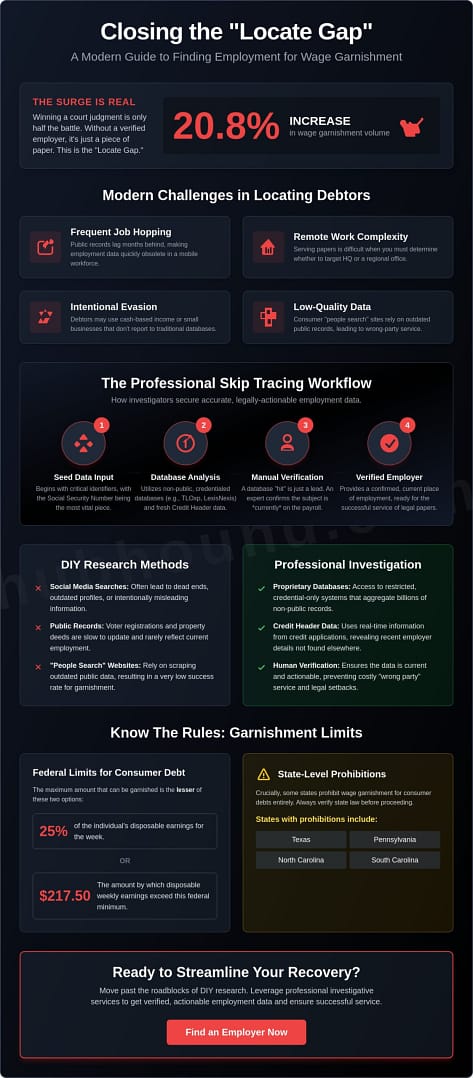
Federal law sets strict limits on how much can be taken from a person’s paycheck. For consumer debt, the maximum garnishment is generally the lesser of 25% of disposable earnings or the amount by which weekly pay exceeds $217.50. It’s vital to remember that some states, including Texas, Pennsylvania, North Carolina, and South Carolina, prohibit wage garnishment for consumer debts entirely. You must have a valid court order before you begin your search. The “current” status of employment is legally critical; you cannot serve a garnishment order to a company where the debtor no longer works. Ensuring the individual is currently on the payroll is the only way to guarantee a successful service.
Common Roadblocks in Locating Debtors at Work
Modern employment trends create significant hurdles for debt recovery. Frequent job hopping is common, and public records often lag months behind actual employment changes. Remote work adds another layer of complexity. You must identify whether to serve the corporate headquarters or a specific regional office, as serving a home office address is rarely effective for legal compliance. Some debtors also practice intentional evasion, moving between cash-based income streams or small businesses that don’t report to traditional databases. Overcoming these obstacles requires a professional approach to skip tracing that goes beyond basic internet searches.
Professional Skip Tracing: How Investigators Locate Current Employers
Professional skip tracing is the systematic process of tracking down a debtor’s current location or income source. In the context of debt recovery, it focuses specifically on finding a person’s place of employment for garnishment. Unlike basic searches, professional skip tracing utilizes “Credit Header” data. This information comes from credit applications and is updated much faster than traditional public records like voter registrations or property deeds. While public records might show where someone lived years ago, credit headers often reveal where they applied for a loan or a new apartment last month, frequently including current employer details.
Investigators rely on proprietary databases such as TLOxp or LexisNexis. These platforms aren’t accessible to the general public and require rigorous credentialing. They aggregate billions of records from non-public sources, including utility bills and cellular service applications. Once a potential employer is identified, the search enters the verification phase. It’s critical to confirm the debtor is currently on the payroll before attempting service. A “hit” in a database is just a lead; it requires human verification to ensure the data is actionable. For those who need a reliable result without the learning curve of these systems, skip tracing investigations provide a direct path to verified employment data.
Proprietary Databases and Non-Public Information
Consumer-grade “people search” sites often fail because they rely on scraped web data and outdated phone directories. Professional investigators bypass these limitations by accessing utility records and credit-originated employment fields. They also leverage professional networks and verification services that track payroll data in real-time. This level of access ensures that the information is current and compliant with the Fair Credit Reporting Act (FCRA), protecting you from legal liabilities during the recovery process. Focus on high-quality data sources to minimize the risk of serving an outdated employer.
Identifying 1099 Contractors and the Self-Employed
Finding income for independent contractors requires a different methodology. Investigators track business licenses, professional certifications, and trade names (DBAs). If a debtor is a licensed electrician or a certified nurse, their active status with a licensing board can lead directly to their current contract or practice. Analyzing asset searches is also an effective way to identify business ownership or hidden income streams that standard payroll searches might miss. These strategies ensure that even self-employed individuals cannot easily hide their financial footprints.
Evaluating Methods: DIY Research vs. Professional Employment Locates
DIY is often the first instinct for creditors. It feels cost-effective to browse social media platforms or public directories. However, finding a person’s place of employment for garnishment through these channels is fraught with inaccuracies. Profiles are frequently outdated, aspirational, or intentionally misleading. Professional locates provide a verified income source that stands up to judicial scrutiny. This saves time and prevents the wasted legal fees associated with serving a defunct employer. When you rely on unverified data, you risk the court rejecting your filing, forcing you to restart the entire legal process from scratch.
Choosing professional services is primarily driven by efficiency. A creditor might spend 20 hours chasing a lead that an investigator can debunk in 20 minutes. Professional reports are structured for immediate use in court, providing the exact legal entity name and registered agent for service of process. This level of detail is necessary because serving the wrong corporate branch can result in an immediate dismissal. In cases where a debtor is particularly evasive or works for a family business, investigators may use surveillance techniques to confirm the individual actually enters the workplace. Physical verification provides the undeniable proof required for high-stakes recovery operations.
The Pitfalls of Social Media Investigations
Social media footprints are often mirages. A LinkedIn profile showing a current role might be two years out of date. Debtors who know they owe money often tighten their privacy settings or stop posting altogether. Perhaps the greatest risk is alerting the debtor. Many platforms notify users when their profile is viewed, giving the debtor a head start to quit their job or hide their income before you can serve the papers.
Legal Boundaries and the Fair Debt Collection Practices Act (FDCPA)
Legal boundaries are often crossed during amateur investigations. Pretexting, or using a false identity to gather information, is illegal under various federal statutes. Licensed investigators operate with “permissible purpose,” which is essential when finding a person’s place of employment for garnishment. Crossing these lines can lead to harassment claims or the dismissal of your garnishment order. Relying on professional civil litigation support ensures your search remains compliant with the FDCPA and other privacy regulations.
Pre-Search Checklist: Information Required for a Successful Locate
Successful debt recovery depends entirely on the quality of your seed data. Think of your initial information as the foundation for the entire investigation. If the foundation is weak, the process of finding a person’s place of employment for garnishment will likely fail. High-level skip tracing isn’t magic; it’s the logical processing of verified data points. Before you engage a professional or attempt a search, you must aggregate every known detail about the debtor. Fragmented data leads to false positives, which can result in serving the wrong employer and potentially incurring legal penalties.
The Social Security Number (SSN) remains the “Golden Key” in employment locates. It’s the only unique identifier that connects an individual to payroll systems and tax reporting. While you can search using a name and date of birth, an SSN ensures you’re tracking the correct person, especially when dealing with common names. You should also gather all known aliases, including maiden names or professional nicknames. A debtor might use a middle name as their primary identifier at work while their legal name remains on the court judgment. Use this structured list to audit your current files:
- Full legal name and any known aliases
- Date of birth and Social Security Number
- Last known residential address and length of residency
- Last known employer and approximate dates of employment
- Active professional license numbers or certifications
Essential Personal Identifiers for the Search
Database accuracy relies on overlapping identifiers. A full name and date of birth are standard, but adding previous residential addresses allows investigators to track the debtor’s geographic movement. This historical tracking often reveals a pattern of employment in specific industries or sectors. Don’t overlook professional license numbers. Individuals in fields like nursing, real estate, or commercial driving must maintain active registrations. These records are frequently updated and often provide a direct link to a current workplace or a registered business address.
Secondary Leads: Vehicle and Professional Data
If primary identifiers are scarce, look for secondary leads like vehicle registration or “tag” data. License plate recognition systems can identify where a vehicle is frequently parked during business hours, providing a strong indicator of a workplace location. Industry-specific patterns, such as union memberships or specialized trade associations, also offer valuable clues for investigators. For high-net-worth debtors who may hide income behind complex business structures, utilizing corporate due diligence is essential to uncover hidden affiliations. If you’re ready to move from data collection to active recovery, start your skip tracing investigation today.
Strategic Litigation Support: Leveraging Professional Investigative Services
Professional investigation is a strategic investment that bridges the gap between a court judgment and actual recovery. While data collection is the first step, the execution phase is where professional expertise becomes indispensable. Finding a person’s place of employment for garnishment requires more than just identifying a company; it requires a discreet verification call. Professional investigators use neutral, non-alarming inquiries to confirm an individual’s active status on the payroll. This ensures the debtor remains unaware of the impending action, preventing them from quitting or requesting an off-books payment arrangement before the writ is served.
The final deliverable from a professional search is a verified report that’s ready for legal use. This document includes the exact legal entity name of the employer and the correct physical address for the registered agent. Having this precise data is mandatory for the clerk of court to issue a valid writ of garnishment. Without it, you’ll likely face a non-service return, which resets your timeline and increases your legal costs. Accuracy at this stage is what separates successful debt recovery from endless litigation cycles.
Integrating Locates with Process Service
The timing of process service is critical for maximizing your recovery. Serving a garnishment order at the beginning of a pay cycle ensures that the maximum allowable amount is captured before other deductions occur. For large corporations, you must serve the registered agent rather than a local manager to ensure legal compliance. Professional investigators often use witness interviews to confirm a debtor’s physical presence at a specific job site. This is especially useful when a debtor works for a firm with multiple regional locations. This coordination ensures that the paperwork reaches the right hands at the right time.
The ROI of Professional Debt Recovery Support
Think of the return on investment when hiring professional support. The cost of a locate investigation is small compared to the value of a multi-year judgment. Professional support reduces the rate of service failures and court delays that often plague DIY attempts. It also helps maintain organizational integrity by ensuring that all recovery efforts are handled within legal boundaries. For companies dealing with internal issues or compliance risks, workplace investigations provide a broader view of organizational health. Finding a person’s place of employment for garnishment through professional channels is the most reliable way to turn a legal victory into a financial reality.
Contact HubHound for professional locate investigations to secure your recovery today.
Streamline Your Path to Judgment Enforcement
Winning a court judgment is a significant legal victory, but actual recovery requires bridging the gap between an order and a verified income source. Success depends on aggregating high-quality seed data and leveraging proprietary databases that far exceed the capabilities of consumer-grade search sites. Finding a person’s place of employment for garnishment is a technical hurdle that requires precise coordination between investigation and litigation. By utilizing professional verification protocols, you ensure that your recovery efforts remain compliant while avoiding the risk of tipping off the debtor before service is complete.
HubHound provides the specialized expertise necessary to navigate these complex recovery landscapes. With over 30 years of experience and access to non-public investigative data, our team delivers the verified employer details required for immediate court action. We prioritize accuracy and efficiency to save you time and legal fees. Secure Your Debt Recovery with HubHound’s Locate Services and move your judgment from a paper victory to a financial reality. You’ve already done the hard work of winning in court; now it’s time to finalize the recovery you deserve.
Frequently Asked Questions
Can I legally call a person’s friends to find where they work?
No, calling a debtor’s friends to gather employment details is highly risky. Under the Fair Debt Collection Practices Act (FDCPA), you’re strictly limited in how you contact third parties. You may only contact them to obtain “location information,” and you cannot disclose that the individual owes a debt. Repeated calls or pressuring friends for workplace details can lead to harassment claims and legal liability for your organization.
What happens if I serve a garnishment order to the wrong employer?
Serving the wrong party results in a “non-service” return or a formal response from the company stating the individual isn’t on their payroll. This error wastes significant time and legal filing fees. It also alerts the debtor to your recovery efforts, potentially giving them time to hide assets. Finding a person’s place of employment for garnishment accurately the first time is essential to avoid restarting the entire legal process.
How long does it typically take a private investigator to find an employer?
Most professional employment locates are completed within three to seven business days. While database hits can happen instantly, the verification phase takes longer. Investigators must confirm the individual is currently active to ensure your writ of garnishment is actionable. Complex cases involving individuals who work in the gig economy or move frequently may require additional time for physical verification.
Can you garnish the wages of someone who is self-employed or a 1099 contractor?
Yes, but the process differs from traditional wage withholding. Instead of a standard wage garnishment, you’ll typically use a non-earnings garnishment or a third-party levy. This requires identifying the specific clients or companies that owe money to the contractor. Once served, those clients must divert the payments intended for the contractor to the creditor instead.
Is it possible to find an employer using only a person’s name and phone number?
It’s possible, but the success rate is significantly lower without additional identifiers. A phone number can lead to a billing address, which then helps investigators access credit header data. However, finding a person’s place of employment for garnishment is most reliable when you provide a Social Security Number or Date of Birth. These “Golden Keys” prevent false positives and ensure you’re tracking the correct individual.
What information do I need to provide to a skip tracer for an employment search?
Gather the debtor’s full legal name, last known residential address, and Date of Birth. The most critical piece of information is the Social Security Number, as it’s the primary identifier used in payroll and tax reporting systems. Providing a last known employer or a list of professional licenses also helps investigators narrow the search and verify current status faster.
Does the debtor get notified when a professional search is conducted?
No, professional investigative searches are designed to be discreet. Licensed investigators use non-public databases and neutral verification methods that don’t alert the debtor to the inquiry. This “stealth” approach is vital for successful recovery. It ensures the individual doesn’t have the opportunity to quit their job or request “under the table” payments before the legal papers are served.
What are the federal limits on how much can be garnished from a paycheck?
Federal law generally limits garnishment for consumer debt to the lesser of 25% of disposable earnings or the amount by which weekly pay exceeds $217.50. If an individual’s weekly disposable earnings are $217.50 or less, their wages cannot be garnished at all. Different limits apply to federal student loans, which are capped at 15%, and child support, which can reach up to 60% in some cases.

Article by
Joel R. Manley | President | Hubhound Investigations | OR PI-ID#: 90432 | 111 SW Fifth Avenue, Suite 3150 Portland, Oregon 97204 | 971-442-8170
Joel is licensed as a private investigator in Oregon and Tennessee. Joel started his career in 1987 serving as a Military Police Officer and Military Police Investigator.
After ending his military tour of duty, Joel became a civilian Police Officer and Deputy Sheriff. Joel took his strong background in Hostage Negotiations, Mediation and Conflict Resolution, with him to patrol some of the highest crime areas in SE Portland.
Joel was awarded Deputy of the Year for his efforts and for drastically reducing the crime rate in the area he patrolled. As a Deputy Sheriff, Joel assisted in leading a Neighborhood Livability Program that was nationally recognized for having the most innovative and progressive approach to policing.
In 2018, Joel retired as a Deputy Sheriff and founded Hubhound Investigations. Joel played an integral role in Hubhound Investigations receiving an A+ Accredited Business rating from the Better Business Bureau (BBB).
In his off time, Joel enjoys spending time with his wife, adult children and Hubhound’s Happiness Ambassador, Nya. Joel also enjoys Scuba Diving and Kayaking.
Disclaimer
DISCLAIMER: This article is provided for general informational and educational purposes only. It is not intended to constitute legal advice, professional investigative advice, or instruction to engage in any unlawful activity. Laws governing private investigations, surveillance, recording, tracking, access to information, evidence collection, privacy, trespass, licensing, and related investigative activities vary by jurisdiction and are subject to change.
Any investigative techniques, tactics, procedures, scenarios, or legal proceedings discussed in this article are presented for informational purposes and should not be interpreted as authorization or encouragement to use a particular method. Private investigators and members of the public are responsible for understanding and complying with all applicable federal, state, and local laws, licensing requirements, court rules, and professional standards.
The circumstances of every investigation and legal matter are different. Information contained in this article should not be relied upon as a substitute for advice from a qualified attorney or other appropriate licensed professional regarding a specific situation. No attorney-client, investigator-client, or other professional relationship is created by reading or using this information.