
What if your multi-million dollar asset is being treated like a basic studio apartment by your current vetting process? You already know that luxury rentals demand a higher standard of care, yet many landlords still rely on basic, automated background checks. For a property with custom builds and expensive finishes, a standard report isn’t enough to catch a “professional tenant” who knows how to exploit legal loopholes. Effective tenant screening for high-end properties requires a shift from simple data-scraping to professional investigative due diligence.
We agree that protecting your investment and the privacy of your exclusive community is your top priority. With national eviction rates hitting 3.6 million annually, the stakes for high-value assets have never been higher. You’ll learn why 65% of property managers are turning to AI, but more importantly, why human-led investigative screening is the only way to achieve total peace of mind. This guide explores the essential steps to mitigate litigation risks and ensure your next tenant is as reputable as the property they inhabit.
Key Takeaways
- Understand why basic credit scores and automated reports are insufficient for protecting multi-million dollar assets against professional scammers.
- Identify the specific financial indicators and asset searches required for effective tenant screening for high-end properties.
- Evaluate the critical differences between 2-minute automated platforms and the deep-dive accuracy of professional investigative databases.
- Implement a standardized, institutional-grade screening workflow that filters out immediate disqualifiers before conducting deep-dive verification.
- Reduce the risk of costly evictions and litigation by leveraging professional surveillance and digital due diligence techniques.
Why Standard Tenant Screening Fails High-End Property Owners
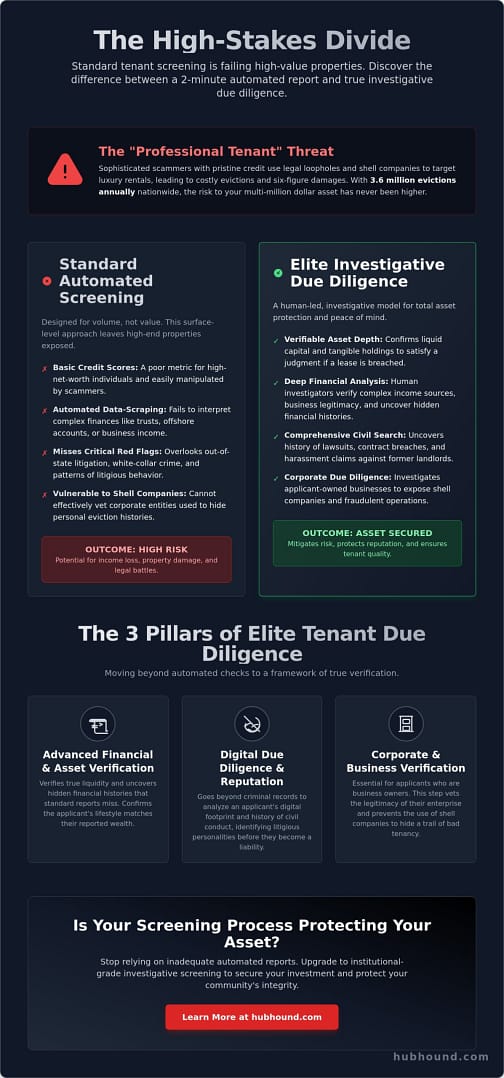
Standard background checks are designed for volume, not value. Most automated platforms provide a surface-level glance at credit scores and criminal databases, which works for mid-market rentals but fails significantly when applied to multi-million dollar assets. For high-net-worth individuals, a credit score is often a poor metric of actual financial health or character. Wealthy applicants frequently have complex income streams, offshore accounts, or trust-based assets that standard algorithms can’t parse. Conversely, sophisticated “professional tenants” often maintain pristine credit scores specifically to bypass these automated filters.
The financial stakes are too high to rely on a two-minute report. When a tenant stops paying rent on a luxury estate, the loss isn’t just the monthly income. It includes the cost of specialized legal counsel, the potential for six-figure property damage to custom finishes, and the degradation of the property’s reputation within an exclusive community. Automated criminal databases frequently miss out-of-state litigation or white-collar crimes that haven’t resulted in a felony conviction. Effective tenant screening for high-end properties requires looking past the digital summary to find the red flags that software misses.
The Professional Tenant Threat
Luxury listings are prime targets for sophisticated scammers who understand the legal loopholes of the tenant screening process. These individuals often use shell companies to sign leases, effectively shielding their personal history from a standard background check. If an applicant is a business owner, you must look deeper than a personal bank statement. Utilizing corporate due diligence is essential to verify the legitimacy of their business interests and ensure they aren’t using a corporate entity to hide a trail of past evictions or civil judgments.
Asset Protection vs. Simple Rent Collection
Managing a high-end rental isn’t just about collecting a check; it’s about asset preservation. A bad tenant in an exclusive neighborhood can cause irreparable harm to your relationship with other residents and community associations. Standard screening treats every applicant as a data point. Investigative due diligence treats every applicant as a potential business partner. Moving to an investigative model ensures you identify litigious personalities and high-risk behaviors before they enter your property. This level of tenant screening for high-end properties is the only way to safeguard your investment against the modern “professional tenant.”
The Pillars of Elite Tenant Due Diligence
Elite screening doesn’t happen in seconds. It requires a manual, investigative approach that verifies the substance behind the wealth. For properties where monthly rents rival annual salaries, a simple credit check is merely an entry requirement, not a final validation. True tenant screening for high-end properties focuses on three core areas: verifiable asset depth, professional reputation, and a clean history of civil conduct. This investigative framework moves beyond what an applicant provides on paper to uncover the reality of their financial and social standing.
Advanced Financial and Asset Verification
Wealthy applicants often present complex financial profiles involving trusts, offshore entities, and diversified holdings. Standard payroll verification tools cannot interpret these structures. Investigators use professional skip tracing techniques to uncover hidden financial histories and verify the legitimacy of income sources that don’t appear on a standard W-2. This process includes performing detailed asset searches to confirm that the applicant’s lifestyle matches their reported liquidity. Comprehensive asset verification serves as the only definitive method to confirm that a tenant possesses the liquid capital or tangible holdings necessary to satisfy a legal judgment if a lease breach occurs.
Civil Litigation and Reputation Screening
Criminal records only tell half the story. A “professional tenant” may have a spotless criminal record but a long history of civil litigation, including contract breaches or harassment suits against former landlords. While landlords must comply with the Fair Credit Reporting Act (FCRA) when using consumer data, high-end vetting requires looking far beyond a credit file. Professional investigators conduct discreet inquiries into an applicant’s professional standing and social reputation within exclusive circles to mitigate the risk of “lifestyle friction.” This includes manual reference checks with previous high-end property managers to ensure the applicant respects quiet enjoyment and community standards. Owners seeking this level of scrutiny often transition to professional investigative screening to move beyond the limitations of automated data.
Reputation management is critical in luxury environments where one disruptive resident can damage the property’s standing. By searching for non-criminal legal disputes and conducting thorough interviews, you protect the residents’ privacy and security. This proactive stance ensures that your tenant is not just financially capable, but also a reputable addition to the community. Effective tenant screening for high-end properties prioritizes this level of nuance over the speed-focused metrics of automated platforms.
Automated Platforms vs. Investigative Agencies: Which is Right for You?
Choosing between an automated platform and a professional investigative agency depends entirely on the level of risk you are willing to accept. Most automated tools rely on high-speed data scraping from public records and credit bureaus. While efficient for high-volume, lower-rent units, these tools often miss the nuanced financial entanglements common among high-net-worth applicants. Professional tenant screening for high-end properties utilizes proprietary investigative databases and manual verification processes that provide a level of detail software simply cannot replicate.
The primary trade-off is speed versus accuracy. Automated services promise results in under two minutes, which sounds attractive until you realize that speed often leads to missed red flags. A thorough investigation typically takes 48 hours. This window allows an investigator to verify employment through direct contact, cross-reference civil litigation records that haven’t been indexed by scrapers, and identify inconsistencies in an applicant’s history. When protecting a multi-million dollar asset, 48 hours of diligence is a small price to pay for the security of your investment.
Compliance is another critical factor. Navigating federal and state tenant screening laws requires more than a software checkmark. Investigators ensure that every data point gathered adheres to the Fair Credit Reporting Act (FCRA) while digging deeper into non-consumer data that automated tools ignore. This human-led approach identifies sophisticated identity fraud or “layered” histories that algorithms are programmed to overlook.
When Software is Sufficient (And When It Isn’t)
Software is often sufficient for short-term, lower-value leases where the cost of a “bad” tenant is manageable. However, luxury rentals face the “False Positive” problem, where automated systems approve applicants who look good on paper but have a history of litigious behavior in other jurisdictions. High-end landlords need a licensed investigator to interpret these high-stakes decisions. If the lease term is long or the property features custom, high-value builds, the limitations of automation become a liability.
Cost vs. Value in High-End Screening
The ROI of professional screening is clear when you analyze the cost of failure. Avoiding a single $50,000 eviction process or six-figure property damage claim pays for decades of investigative services. A professional report also serves as a robust piece of evidence in your legal defense if a dispute arises. The investigative approach functions as a proactive insurance policy that identifies risks before they jeopardize the asset’s long-term value. Investing in tenant screening for high-end properties ensures that your vetting process matches the prestige of the asset itself.
How to Implement an Institutional-Grade Screening Process
Institutional-grade vetting requires a structured, multi-tier workflow. You can’t rely on the same forms used for entry-level apartments. Your initial intake must capture comprehensive details, including corporate affiliations, professional associations, and verified asset locations. This data provides the foundation for deeper inquiry. Follow this five-step protocol to ensure your tenant screening for high-end properties meets the highest standards of due diligence.
- Step 1: Standardize the application. Update your forms to capture deep-dive data points. Require disclosure of shell companies, trusts, or business entities that the applicant intends to use for rent payments.
- Step 2: Run baseline filters. Use automated reports to identify immediate disqualifiers like recent evictions or major credit defaults. This saves time by filtering out unsuitable candidates before investing in a full investigation.
- Step 3: Engage a professional investigator. Once you have your “Final Three” candidates, move beyond software. A licensed investigator will verify the substance behind the application, searching for civil litigation and lifestyle risks that algorithms miss.
- Step 4: Conduct manual verification. Speak directly with previous high-end property managers. Don’t settle for email templates. Verbal interviews often reveal nuances about a tenant’s behavior and respect for property that aren’t recorded in written documents.
- Step 5: Review the final dossier. Analyze the complete investigative summary before signing any legal documents. Ensure every “yellow flag” has been addressed and clarified.
Setting Your Screening Criteria
Establish clear, legally compliant thresholds for your applicants before the process begins. Applying workplace investigations methodology to your vetting process helps maintain organizational integrity and ensures you remain consistent. Consistency is your best defense against fair housing discrimination claims. Define your requirements for liquidity, professional standing, and conduct history in writing to ensure every applicant is measured against the same rigorous benchmark.
The Final Dossier Review
A professional investigative summary is more than a list of data. It’s an evaluative report that highlights inconsistencies. Look for “yellow flags” such as gaps in residential history or income sources that can’t be traced to a verifiable business or employer. These often require further clarification through a final video or in-person interview. This face-to-face interaction allows you to gauge character and professionalism in a way no report can. Protect your multi-million dollar assets by requesting a professional Landlord/Tenant screening investigation for your next luxury listing.
Strategic Risk Mitigation with HubHound’s Screening Services
HubHound leverages over three decades of investigative experience to protect high-value residential assets. While standard platforms scrape public data, our team performs targeted investigations that uncover the true profile of an applicant. We combine surveillance techniques with deep digital due diligence to ensure no detail is overlooked. This dual approach is essential for tenant screening for high-end properties, where the cost of a single mistake can reach six figures in property damage and legal fees. We provide the clarity required to move forward with confidence.
Confidentiality and compliance are the cornerstones of our service. Our investigators maintain strict adherence to the Fair Credit Reporting Act (FCRA) while delivering the deep-dive insights that luxury estate managers require. We understand that your reputation and the privacy of your residents are paramount. By choosing a professional investigative partner, you ensure that your vetting process is as sophisticated as the property itself. Our customized screening packages are designed to scale with your portfolio, providing consistent protection across all your high-end listings.
The HubHound Difference: Human Intelligence
Our licensed investigators understand that data without context is a liability. Algorithms can’t detect the subtle inconsistencies in a high-net-worth applicant’s lifestyle or identify a professional scammer’s refined tactics. We’ve identified risks in the past that software ignored, such as layered corporate structures used to hide previous litigation. Because we maintain a nationwide reach, we track histories across state lines. This ensures that an applicant’s past conduct is verified regardless of where they previously resided. Human intelligence allows us to spot “yellow flags” that automated systems are simply not programmed to see.
Getting Started with Professional Vetting
Integrating our services into your existing management workflow is a seamless process. We don’t offer generic, one-size-fits-all reports. Instead, our team consults with you to build a custom risk profile tailored to the specific vulnerabilities of your property. We look at the unique features of your asset, from custom interior builds to community security requirements, and adjust our investigative depth accordingly. This proactive strategy identifies potential friction before a lease is ever signed. Tenant screening for high-end properties requires an expert eye and a commitment to thoroughness. Protect your investment with HubHound’s expert tenant screening today.
Secure the Future of Your Luxury Portfolio
High-end property management requires a departure from the “instant results” mindset of automated software. Protecting your investment means looking past credit scores to verify actual asset liquidity and professional reputation. By implementing a tiered workflow that prioritizes human-led investigation, you filter out sophisticated risks that standard algorithms miss. This level of tenant screening for high-end properties isn’t just a precaution; it’s a strategic necessity for asset preservation and community security.
HubHound provides specialized high-stakes due diligence conducted by licensed investigators with over 30 years of experience. Our FCRA-compliant nationwide screening ensures your vetting process remains legally robust while delivering the deep-dive insights automated tools ignore. We help you move from basic screening to comprehensive investigative due diligence, reducing the risk of litigation and property damage. Secure your high-end property with HubHound’s professional screening services.
Investing in professional-grade vetting ensures your tenant matches the prestige of your asset. You’ve done the work to build a multi-million dollar portfolio, whether it consists of residential estates or recreational hunting land for sale Wisconsin. Now, take the necessary steps to protect it with total peace of mind.
Frequently Asked Questions
What makes tenant screening for high-end properties different from standard rentals?
High-end screening shifts from automated data scraping to manual investigative due diligence. Standard rentals focus on credit scores and basic criminal checks. Luxury screening evaluates complex financial structures, trust-based assets, and civil litigation history to protect multi-million dollar investments. This approach identifies risks that software algorithms are not programmed to detect.
Does a high credit score guarantee a good tenant for a luxury property?
A high credit score is merely a baseline and can be misleading in the luxury market. Professional scammers often maintain excellent credit specifically to bypass automated filters. Effective tenant screening for high-end properties looks beyond scores to verify the source of wealth and the applicant’s history of civil conduct, ensuring they are a reputable fit for the community.
How long does a professional investigative tenant screening take?
A thorough investigation typically requires 48 hours to complete. This timeframe allows licensed investigators to conduct manual reference checks, verify employment directly, and search proprietary databases. Speed often comes at the expense of accuracy. Taking two days for a deep-dive report is a small investment compared to the months required for a high-stakes eviction.
Is it legal to conduct a deep-dive background check on a potential tenant?
Yes, it is legal provided you comply with the Fair Credit Reporting Act (FCRA) and obtain written consent from the applicant. You must ensure your screening criteria are applied consistently to avoid discrimination claims. Professional investigators help maintain this compliance while digging into non-consumer data that automated tools typically ignore.
What are the red flags of a “professional tenant” in the high-end market?
Common red flags include using shell companies for lease agreements, unexplained gaps in residential history, and a record of civil lawsuits against former landlords. These individuals often present pristine financial documents that don’t match their actual asset liquidity. Vigilance and manual verification are required to spot these sophisticated inconsistencies before they become a liability.
How much does professional investigative tenant screening cost?
Costs vary based on the depth of the investigation and the complexity of the applicant’s financial profile. While basic automated packages are inexpensive, investigative agencies typically charge based on the specific due diligence required for the asset. You should consult with an investigative firm to determine a scope of work that matches your property’s risk level.
Can I screen a tenant who is moving from another country?
Yes, investigative agencies have the resources to conduct international background checks and verify foreign assets. This process involves searching international criminal databases and verifying professional standing in the applicant’s home country. While this requires more time than domestic screening, it is essential for high-value cross-border leases to ensure the applicant’s reputation is verified.
What is the role of asset verification in tenant screening?
Asset verification confirms that an applicant has the liquid capital or tangible holdings to satisfy a legal judgment if a lease breach occurs. It moves beyond simple income verification to ensure the tenant is judgment-ready. This is a critical component of tenant screening for high-end properties where the potential for financial loss from property damage or unpaid rent is significant.

Article by
Joel R. Manley | President | Hubhound Investigations | OR PI-ID#: 90432 | 111 SW Fifth Avenue, Suite 3150 Portland, Oregon 97204 | 971-442-8170
Joel is licensed as a private investigator in Oregon and Tennessee. Joel started his career in 1987 serving as a Military Police Officer and Military Police Investigator.
After ending his military tour of duty, Joel became a civilian Police Officer and Deputy Sheriff. Joel took his strong background in Hostage Negotiations, Mediation and Conflict Resolution, with him to patrol some of the highest crime areas in SE Portland.
Joel was awarded Deputy of the Year for his efforts and for drastically reducing the crime rate in the area he patrolled. As a Deputy Sheriff, Joel assisted in leading a Neighborhood Livability Program that was nationally recognized for having the most innovative and progressive approach to policing.
In 2018, Joel retired as a Deputy Sheriff and founded Hubhound Investigations. Joel played an integral role in Hubhound Investigations receiving an A+ Accredited Business rating from the Better Business Bureau (BBB).
In his off time, Joel enjoys spending time with his wife, adult children and Hubhound’s Happiness Ambassador, Nya. Joel also enjoys Scuba Diving and Kayaking.
Disclaimer
DISCLAIMER: This article is provided for general informational and educational purposes only. It is not intended to constitute legal advice, professional investigative advice, or instruction to engage in any unlawful activity. Laws governing private investigations, surveillance, recording, tracking, access to information, evidence collection, privacy, trespass, licensing, and related investigative activities vary by jurisdiction and are subject to change.
Any investigative techniques, tactics, procedures, scenarios, or legal proceedings discussed in this article are presented for informational purposes and should not be interpreted as authorization or encouragement to use a particular method. Private investigators and members of the public are responsible for understanding and complying with all applicable federal, state, and local laws, licensing requirements, court rules, and professional standards.
The circumstances of every investigation and legal matter are different. Information contained in this article should not be relied upon as a substitute for advice from a qualified attorney or other appropriate licensed professional regarding a specific situation. No attorney-client, investigator-client, or other professional relationship is created by reading or using this information.