
Financial transparency in a high-conflict split isn’t a courtesy; it’s an investigative outcome that you must actively pursue. If you suspect your spouse is manipulating the books or funneling cash into digital wallets, your intuition is likely backed by reality. Finding hidden assets during a contentious divorce requires looking far beyond standard bank statements to uncover the sophisticated ways wealth is moved in 2026. You probably feel that standard legal discovery won’t reveal the full truth, especially when one partner has historically controlled all financial access points.
This guide provides the technical roadmap you need to bridge the gap between what’s reported and what’s actually spent. You’ll learn how professional investigative techniques, such as analyzing the $19,000 annual gift tax exclusion limits or tracing peer-to-peer payment apps, ensure an equitable financial settlement. We’ll examine the specific methods used to identify concealed wealth and provide the evidence necessary to protect your long-term security. This overview explores the intersection of forensic analysis and civil litigation support to help you secure a comprehensive list of all marital assets and gain total peace of mind.
Key Takeaways
- Identify the behavioral red flags of financial “scorched earth” tactics, such as sudden secrecy or uncharacteristic spending patterns that signal asset diversion.
- Understand why standard legal discovery often fails and how an investigative “boots on the ground” approach targets assets that subpoenas might overlook.
- Master the methodology for finding hidden assets during a contentious divorce by establishing a spending baseline through professional lifestyle analysis.
- Leverage advanced skip tracing and surveillance to locate undisclosed property holdings and hidden bank branches across the country.
- Evaluate the strategic value of civil litigation support to ensure your final settlement reflects the true scope of marital wealth.
The Reality of Financial Deception in High-Conflict Divorces
Hidden assets are any form of community property intentionally omitted from sworn financial affidavits. In a legal context, these documents are supposed to be transparent records of everything a couple owns. However, the friction of a split often motivates one party to engage in financial “scorched earth” tactics. This behavior is usually driven by a desire to reduce the pool of divisible property or to exert control over a spouse who has historically been less involved in the household finances. Finding hidden assets during a contentious divorce requires a shift from passive observation to active investigation.
The legal obligation of full disclosure isn’t a suggestion. It’s a mandatory requirement. Courts rely on the principles of equitable distribution to ensure a fair split of marital wealth. When one spouse decides to bypass these rules, they introduce significant risk into the proceedings. A professional investigator serves as a neutral party in these scenarios. Their goal isn’t to take sides but to establish an objective financial truth through rigorous data analysis and field operations.
Why High-Asset Cases Are High-Risk
Complexity often provides a convenient mask for deception. High-net-worth individuals frequently manage diversified portfolios, offshore accounts, and private business interests that are difficult to track without specialized expertise. If one spouse has maintained primary control over the marital estate, they have the infrastructure to move money into less visible vehicles before the divorce is even filed. Statistics from various industry reports suggest that financial infidelity is a common precursor to high-conflict litigation. Managing these risks involves looking past the surface-level reports to see where the money actually flows.
The Consequences of Concealing Wealth
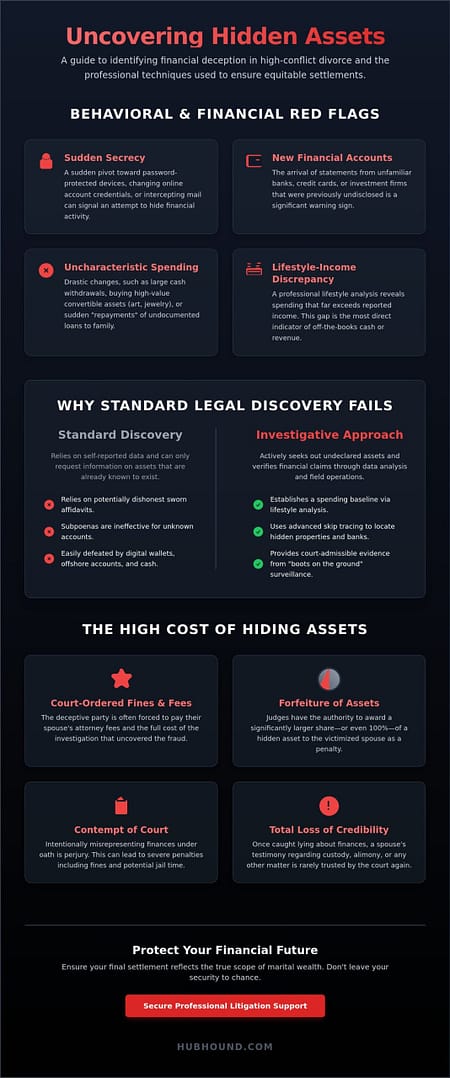
Concealing wealth isn’t just a tactical move; it’s a legal gamble with severe repercussions. If a court discovers that a spouse has been dishonest, the penalties can be devastating. These often include:
- Court-ordered fines and legal fees: The deceptive party may be forced to pay their spouse’s attorney fees and investigative costs.
- Loss of asset share: Judges have the authority to award a larger percentage of the remaining assets to the victim of the deception.
- Contempt of court: Misrepresenting finances under oath can lead to criminal charges or jail time.
- Credibility damage: Once a spouse is caught lying about money, their testimony regarding custody or alimony is rarely trusted by the court.
Finding hidden assets during a contentious divorce protects the integrity of the settlement. It ensures that the final decree is based on reality rather than a curated version of the truth. By utilizing professional civil litigation support, you can identify these discrepancies before they become permanent financial losses.
Common Red Flags and Tactics Used to Conceal Wealth
Deception often leaves a behavioral trail before it leaves a paper one. When one spouse begins a process of financial decoupling in secret, certain patterns emerge. You’ll likely notice a sudden pivot toward password-protected devices, the arrival of new credit card statements from unfamiliar banks, or a drastic change in household spending habits. Finding hidden assets during a contentious divorce starts with identifying these early warnings before the legal discovery process even begins.
One of the most effective investigative tools is the lifestyle-income gap analysis. This technique compares a spouse’s reported income against their actual standard of living. If your spouse claims a salary of $150,000 but maintains a lifestyle requiring $400,000 in annual expenditures, a discrepancy exists. This gap often points toward off-shore accounts or undisclosed business revenue. Additionally, infidelity investigations frequently reveal hidden financial transfers. Money spent on travel, luxury gifts, or separate residences for a third party represents marital wealth that should be accounted for in the final settlement.
Business-Based Asset Hiding
Business owners have unique opportunities to obfuscate wealth through corporate structures. A common tactic involves the creation of “phantom employees.” By adding non-existent workers to the payroll, a spouse can siphon marital funds into accounts they control. Others might intentionally delay lucrative contracts or year-end bonuses until after the divorce decree is signed. We also see the manipulation of business valuations through “pre-paid” future expenses. By paying for next year’s inventory or rent today, they artificially lower the current value of the company. Conducting thorough corporate due diligence is essential to uncovering these balance sheet manipulations.
Personal Property and “Off-the-Books” Assets
Not all wealth stays in a bank account. High-value collectibles like art, jewelry, and cryptocurrency are popular for finding hidden assets during a contentious divorce because they lack a traditional paper trail. Digital assets are especially problematic in 2026, often requiring specialized forensic tracing to identify wallets that aren’t disclosed on financial affidavits.
Another frequent strategy is the “gift” tactic. A spouse might transfer large sums to friends or family for “safekeeping” under the guise of the 2026 annual gift tax exclusion of $19,000 per recipient. They may even invent “old debts” to justify these transfers, claiming they’re simply paying back a loan from a decade ago. These co-conspirators often hold the cash until the divorce is finalized, at which point the money is returned. Identifying these fraudulent transfers requires a deep dive into historical bank records and witness interviews to verify the legitimacy of any alleged debts.
Why Legal Discovery Often Fails to Uncover Hidden Assets
Legal discovery relies on the assumption that both parties will eventually comply with court mandates. In high-conflict scenarios, this assumption is often a strategic error. Finding hidden assets during a contentious divorce requires more than just filing motions and waiting for a response. While your attorney handles the “paper trail,” an investigator provides the “boots on the ground” necessary to verify the accuracy of that trail. Standard discovery is reactive; it only examines what has been disclosed or what can be easily found through known financial institutions.
Subpoenas are precise tools, but they have a significant limitation: you must know which bank or entity to target. If a spouse has moved funds into an undisclosed shell company or a domestic account under a different tax ID, a general subpoena won’t find it. Similarly, depositions are only as effective as the honesty of the witness. A spouse willing to hide millions is often willing to risk a perjury charge. Without external evidence to contradict their testimony, their word remains the primary record. A corporate investigation firm identifies these hidden entities, allowing your legal team to issue targeted subpoenas that actually produce results.
The Limitation of Financial Affidavits
Financial affidavits are essentially “honor system” documents during the initial phase of a divorce. Lawyers are skilled at interpreting the law, but they often lack the technical tools or time required for a deep-dive forensic analysis. This creates a gap between legal disclosure and actual transparency. If the data on the affidavit isn’t rigorously verified against external realities, the settlement will be based on a fiction. Finding hidden assets during a contentious divorce means closing this gap by auditing the claims against real-world financial activity.
The Power of Surveillance in Financial Cases
Surveillance operations provide the physical evidence that paper records often miss. When a spouse claims a business is insolvent but continues to attend high-level meetings at luxury resorts, the narrative crumbles. Surveillance tracks unrecorded business interactions, the use of undisclosed luxury vehicles, and the delivery of high-value goods to secret locations. These observations provide the “probable cause” your attorney needs to justify broader legal inquiries. It turns suspicion into documented fact, ensuring that “off-the-books” assets are brought back into the marital pool for valuation.
Step-by-Step: How Investigators Trace Undisclosed Financial Interests
The investigative process moves from the known to the unknown. It begins by establishing a comprehensive lifestyle analysis to create a baseline of actual spending. By reconstructing financial habits over the last three to five years, investigators can calculate exactly how much income is required to sustain your spouse’s standard of living. When this figure exceeds their reported earnings on tax returns, it provides the first concrete evidence of undisclosed wealth. Finding hidden assets during a contentious divorce relies on this mathematical foundation to prove that the money exists, even if the accounts haven’t been named yet.
Once the baseline is set, investigators utilize advanced skip tracing techniques to locate unknown property holdings or bank branches. This isn’t limited to local searches. A professional deep-dive covers all jurisdictions for titled assets, including aircraft, watercraft, and commercial real estate that may be held under anonymous LLCs. We also analyze business cash flow for irregularities. This involves looking for personal expense laundering where vacations, luxury goods, or “consulting fees” to co-conspirators are buried within corporate ledgers. If you suspect your spouse is using a business as a personal piggy bank, secure professional skip tracing services to track the movement of those funds.
The Role of Digital Forensics
Modern concealment often leaves a digital footprint. Investigators recover deleted emails, text messages, and browser histories that reveal the coordination of asset transfers. Metadata in supposedly “lost” spreadsheets can prove the existence of hidden files or the date a document was tampered with. In 2026, this also includes tracking cryptocurrency wallet addresses. While blockchain technology offers some anonymity, the entry and exit points at exchanges usually leave a trail that can be traced back to marital funds. Analyzing these digital breadcrumbs is a critical step in finding hidden assets during a contentious divorce.
Locating Tangible Assets
Not all wealth is liquid. Investigators identify safe deposit boxes through a combination of surveillance and witness interviews. We search for out-of-state or international real estate through specialized databases that aggregate global property records. This process often reveals “hidden in plain sight” assets such as luxury vehicles, heavy equipment, or high-value art collections that were never disclosed. All findings are synthesized into a court-ready report. This document provides your legal team with the exact data points needed for a rigorous cross-examination, ensuring that no stone is left unturned in the pursuit of an equitable settlement.
Securing Your Future with Professional Asset Discovery Services
Finding hidden assets during a contentious divorce isn’t a solitary task. It’s a specialized function that integrates directly into your broader legal strategy. While your attorney builds the legal framework, the investigator provides the raw data that makes the case winnable. This partnership ensures that every claim made in court is backed by verified evidence. Consider the return on investment. The cost of a professional search is typically a fraction of the total wealth recovered. When millions in marital assets are at stake, the price of an investigation is an essential expenditure to protect your financial future.
Timing is critical. Starting an asset search early prevents the spouse from further dissipating funds or obscuring the trail. Once a divorce filing is public, the incentive to hide money increases. Acting before or immediately after the filing allows the investigator to capture data before it’s deleted or moved into complex offshore structures. Transitioning from suspicion to actionable evidence requires a systematic approach that turns your intuition into a court-ready narrative.
Selecting the Right Investigative Partner
Don’t rely on consumer-grade background check software. These tools use outdated databases that lack the depth required for finding hidden assets during a contentious divorce. You need a partner with deep experience in workplace investigations and corporate due diligence. These skills are transferable; an expert who understands how corporations hide liabilities knows exactly where a spouse might hide wealth. Ensure your chosen firm holds the proper licensure and has a documented track record of providing court-admissible evidence. In high-stakes litigation, the methodology behind the discovery is just as important as the discovery itself.
Next Steps: From Consultation to Courtroom
Moving from suspicion to actionable evidence starts with a secure consultation. Provide your investigator with all known financial documents, including any past tax returns or business ledgers you’ve managed to secure. This information serves as the launchpad for the investigation. Once the search is complete, the findings are synthesized into a formal report. Your legal team then introduces this report into the discovery process, using the specific data points to demand further disclosure or to impeach the spouse’s testimony during a deposition.
Efficiency and discretion are the hallmarks of a successful recovery. By choosing a partner who understands the nuances of the 2026 financial landscape, you ensure that your settlement is based on the full scope of your marital estate. Contact HubHound to begin your confidential asset discovery investigation today.
Take Control of Your Financial Recovery
Achieving an equitable distribution of wealth requires moving beyond the honor system of financial affidavits. Finding hidden assets during a contentious divorce is a technical challenge that demands a combination of digital forensics and physical surveillance. By establishing a clear baseline of spending and utilizing advanced skip tracing, you can identify undisclosed property and accounts that standard legal discovery often misses. This process transforms suspicion into court-admissible evidence, ensuring your future security isn’t compromised by deception. Relying on incomplete data during a high-conflict split puts your long-term stability at risk.
Our team brings specialized expertise in civil litigation support to every case. As licensed investigators with over 30 years of experience, we utilize advanced surveillance and skip tracing capabilities to track down concealed interests nationwide. We provide the objective truth that lawyers need to secure a fair settlement. Don’t leave your financial settlement to chance or wait for a spouse to voluntarily disclose the truth. Secure your financial future; contact HubHound for an expert asset search investigation.
You deserve a settlement based on the full reality of your marital estate. Taking the first step toward professional discovery provides the clarity and peace of mind needed to move forward with confidence.
Frequently Asked Questions
Is it illegal to hide assets during a divorce?
Hiding assets is a form of fraud and often constitutes perjury when financial affidavits are signed under oath. Courts require full disclosure to ensure an equitable split of marital property. If a judge discovers intentional concealment, the offending spouse may face severe sanctions, including fines, loss of their share of the asset, or even jail time for contempt of court.
Can a private investigator find offshore bank accounts?
Investigators use international database searches and trace financial transfers to identify offshore interests. For 2026, any aggregate foreign account value over $10,000 must be reported via FBAR filings, which creates a detectable paper trail. Tracing wire transfers or analyzing tax returns for foreign tax credits helps identify these accounts when finding hidden assets during a contentious divorce.
How much does an asset search investigation typically cost?
The total investment for an asset search depends on the complexity of the marital estate and the depth of the investigation required. Factors such as business ownership, international holdings, and the level of digital forensics needed will influence the final scope. You should consult with a professional provider to determine a strategy that aligns with the potential value of the recovered wealth.
What happens if I find hidden assets after the divorce is finalized?
You can petition the court to reopen the case or set aside the judgment if you discover undisclosed assets after the decree is signed. Courts generally take a dim view of financial fraud and may award you a larger portion of the newly discovered property as a penalty. Investigative reports provide the essential evidence needed for these post-decree motions to be successful.
Can my spouse hide money in a child’s bank account?
Spouses frequently use custodial accounts or UTMA/UGMA accounts to park marital funds under a child’s name. While these accounts are intended for the child’s benefit, a spike in deposits during finding hidden assets during a contentious divorce is a major red flag. Investigators review deposit histories to determine if these funds were moved specifically to avoid division in the divorce settlement.
How do I prove my spouse is getting paid “under the table”?
Proving off-the-books income requires a lifestyle analysis that compares documented earnings against actual expenditures. If your spouse’s daily spending on luxury goods, travel, or bills exceeds their reported salary, the discrepancy serves as evidence of unearned income. Surveillance operations also document physical cash transactions or unrecorded work activity to validate these financial claims.
Will the court make my spouse pay for the investigator fees?
Judges often order the deceptive spouse to reimburse investigative fees if the search successfully uncovers intentionally hidden assets. This is particularly common in high-conflict cases where one party’s bad faith necessitated the extra expense. You should discuss the likelihood of fee shifting with your legal counsel based on the strength of the evidence uncovered during the investigation.
Can an investigator look at my spouse’s business records?
Investigators access public filings, corporate registrations, and UCC filings to identify business interests and assets. While private internal ledgers often require a subpoena, an investigator can use skip tracing and surveillance to identify inconsistencies that justify a legal demand for those records. This process ensures that corporate structures aren’t used as a shield for personal wealth.

Article by
Joel R. Manley | President | Hubhound Investigations | OR PI-ID#: 90432 | 111 SW Fifth Avenue, Suite 3150 Portland, Oregon 97204 | 971-442-8170
Joel is licensed as a private investigator in Oregon and Tennessee. Joel started his career in 1987 serving as a Military Police Officer and Military Police Investigator.
After ending his military tour of duty, Joel became a civilian Police Officer and Deputy Sheriff. Joel took his strong background in Hostage Negotiations, Mediation and Conflict Resolution, with him to patrol some of the highest crime areas in SE Portland.
Joel was awarded Deputy of the Year for his efforts and for drastically reducing the crime rate in the area he patrolled. As a Deputy Sheriff, Joel assisted in leading a Neighborhood Livability Program that was nationally recognized for having the most innovative and progressive approach to policing.
In 2018, Joel retired as a Deputy Sheriff and founded Hubhound Investigations. Joel played an integral role in Hubhound Investigations receiving an A+ Accredited Business rating from the Better Business Bureau (BBB).
In his off time, Joel enjoys spending time with his wife, adult children and Hubhound’s Happiness Ambassador, Nya. Joel also enjoys Scuba Diving and Kayaking.
Disclaimer
DISCLAIMER: This article is provided for general informational and educational purposes only. It is not intended to constitute legal advice, professional investigative advice, or instruction to engage in any unlawful activity. Laws governing private investigations, surveillance, recording, tracking, access to information, evidence collection, privacy, trespass, licensing, and related investigative activities vary by jurisdiction and are subject to change.
Any investigative techniques, tactics, procedures, scenarios, or legal proceedings discussed in this article are presented for informational purposes and should not be interpreted as authorization or encouragement to use a particular method. Private investigators and members of the public are responsible for understanding and complying with all applicable federal, state, and local laws, licensing requirements, court rules, and professional standards.
The circumstances of every investigation and legal matter are different. Information contained in this article should not be relied upon as a substitute for advice from a qualified attorney or other appropriate licensed professional regarding a specific situation. No attorney-client, investigator-client, or other professional relationship is created by reading or using this information.