
Would you trust a $19 automated database to protect your organization from a million-dollar negligent hiring lawsuit? Many business managers feel the pressure to streamline costs, especially as AI-generated resumes and credential fraud reach record levels in 2026. However, the risks of using cheap online background checks often create more problems than they solve. You want a hiring process that’s efficient and reliable, yet you’re likely frustrated by inaccurate reports and the constant fear of missing a critical criminal record. It’s a common challenge to balance speed with the rigorous assessment required for true security.
This guide explains why low-cost automated tools frequently fail and how these gaps expose your organization to significant legal and operational liabilities. You’ll gain a clear understanding of the difference between “people search” aggregators and professional investigative services. We’ll outline a framework for evaluating screening partners and show you how to protect your business through source-verified data. By the end, you’ll have the tools to reduce your legal liability and ensure your background checks meet the highest standards of accuracy and FCRA compliance.
Key Takeaways
- Identify why “instant” results from automated data scrapers often yield outdated information that compromises your hiring integrity.
- Navigate the legal risks of using cheap online background checks by understanding strict FCRA requirements for adverse hiring decisions.
- Distinguish between unreliable aggregated databases and “source of truth” records to ensure your screening data is accurate and actionable.
- Learn how human-led investigations uncover behavioral red flags and complex criminal histories that AI and algorithms consistently fail to detect.
- Transition from basic database searches to a comprehensive risk mitigation strategy that utilizes professional investigative expertise.
The Allure and Hidden Reality of Instant Online Background Checks
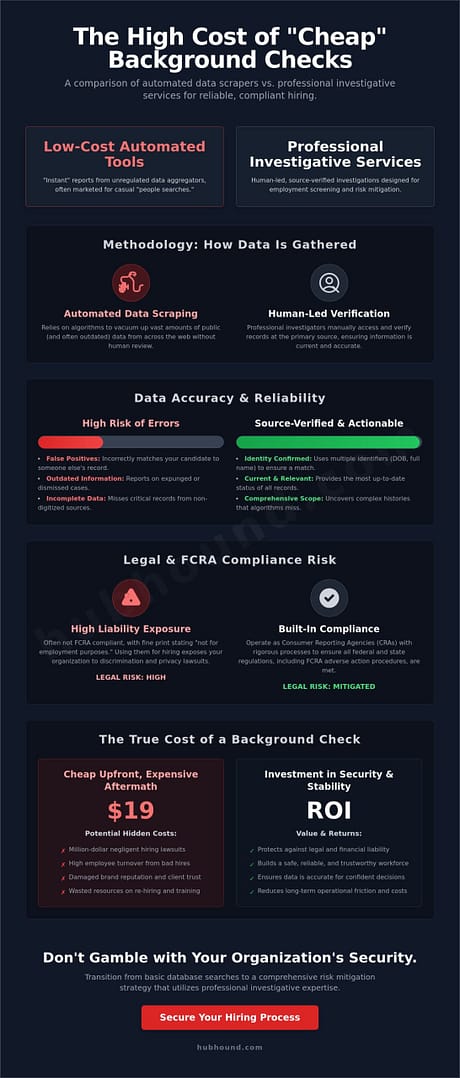
Most “cheap online background checks” are essentially automated search engines rather than investigative tools. They don’t investigate; they aggregate. These platforms rely on unregulated data scrapers that vacuum up public records, social media snippets, and outdated phone directories from across the web. While they promise immediate results, this speed is a structural weakness. True accuracy requires time to verify records at the primary source. Most consumer-facing search engines prioritize data volume because their business model depends on selling monthly subscriptions, not ensuring your company’s safety. When you choose immediacy over verification, you’re gambling with your organization’s security.
The Distinction Between Data Scrapers and Professional Agencies
Automated scrapers pull from cached records that might be months or years old. Unlike a professional agency, these platforms lack human oversight. No investigator reviews the report to see if a “John Smith” with a felony record is actually your specific “John Smith.” This lack of verification is why these services include fine print stating they are “not for employment purposes.” If you use them for hiring, you’re misusing a tool designed for finding old classmates, not for professional screening. A comprehensive understanding of what a background check includes reveals that true due diligence involves verifying current data against primary sources. Professional investigators manually cross-reference identifiers like full names and dates of birth to ensure the record belongs to the right individual. Automated scrapers often fail this basic matching test, leading to reports filled with irrelevant or incorrect data.
Why “Free” or “Cheap” Often Costs More in the Long Run
The upfront savings of a low-cost report vanish when you factor in the financial impact of a bad hire. High turnover and the resource drain of correcting inaccurate applicant data can cripple a small management team. Relying on these tools creates a false sense of security in the context of risk management. You believe you’ve performed due diligence, but you’ve actually left the door open to liability. The risks of using cheap online background checks become apparent the moment a missed criminal record turns into a workplace incident. Professional pre-employment background checks prevent these failures by prioritizing data integrity over sheer speed. Correcting a hiring mistake is always more expensive than performing a thorough investigation from the start. Focus on quality to avoid the operational friction and legal exposure caused by unreliable data.
The Legal Trap: FCRA Non-Compliance and Employer Liability
The Fair Credit Reporting Act (FCRA) isn’t a suggestion; it’s the federal standard for consumer reporting that governs how you evaluate potential hires. When you use any third-party report to make a hiring decision, you’re acting as an employer under this law. One of the primary risks of using cheap online background checks is that many of these providers aren’t consumer reporting agencies (CRAs) and don’t follow the FCRA compliance requirements. If you reject a candidate based on unverified data from a non-compliant source, you leave your company vulnerable to discrimination and privacy claims. Professional firms ensure every report meets these rigorous federal and state regulatory standards before you see the results.
Unverified data often leads to “disparate impact” lawsuits. This occurs when a neutral hiring policy unintentionally discriminates against protected groups due to systemic data errors. Relying on database-only results frequently produces false positives or identifies the wrong individual entirely. The FTC previously reported that one in five consumers had verified errors on their credit reports. In 2026, the maximum allowable charge for a consumer to obtain their file from a CRA is $16.00, an increase that reflects the growing complexity of data management. If you make a decision based on an error from a “people search” site, you’ve violated federal law. Professional investigators mitigate this by manually verifying every record at the source.
Navigating Adverse Action Procedures
Federal law requires you to allow candidates to dispute inaccurate information through a specific multi-step process. This is known as adverse action. Cheap sites fail to provide the necessary dispute mechanisms or notices required by law. They deliver a raw data dump and leave the compliance burden entirely on your shoulders. Professional screening supports workplace investigations by ensuring the data used for personnel decisions is accurate and legally defensible. You must provide a pre-adverse action notice, a copy of the report, and a summary of rights before taking any negative action. Skipping these steps is the fastest way to trigger a regulatory audit.
Protecting the Organization from Litigation
The financial impact of class-action lawsuits regarding improper screening can be devastating for a growing company. You can’t claim you didn’t know the law as a valid defense in court. Establishing a “Reasonable Care” defense requires showing that you performed professional due diligence using verified sources. A corporate investigation firm provides this layer of protection by confirming high-stakes data through primary sources. Understanding the risks of using cheap online background checks is the first step in moving toward a more secure model. If you need to verify a candidate’s history with certainty, our pre-employment background checks provide the rigorous assessment required to protect your business interests.
Data Integrity Issues: Why Databases Are Not a “Source of Truth”
Relying on a national criminal database is like looking at a photograph of a room from three years ago and assuming nothing has moved. These databases are not live feeds; they are static collections of digital files purchased from various jurisdictions at different intervals. Understanding the risks of using cheap online background checks requires a deep dive into how data is actually stored and retrieved. There is no single, centralized repository that contains every criminal record in the United States. Instead, the landscape is a patchwork quilt of thousands of individual county courts, state repositories, and federal agencies that don’t always communicate with each other. When an automated tool “scrapes” this data, it often misses the most recent updates, such as dismissed charges or amended sentences.
The Consumer Financial Protection Bureau has specifically addressed the problem of inaccurate background check reports, noting that sloppy data practices can lead to significant harm for both candidates and employers. Automated systems frequently prioritize speed over verification, leading to reports that are incomplete or flat-out wrong. If a database hasn’t been updated since a record was expunged, that “cheap” check will still show a conviction that no longer legally exists. This creates a massive liability for your company. You need data that is verified at the source, not just aggregated from a secondary vendor.
The Limitations of National Criminal Databases
Many local jurisdictions do not report their records to national databases in real-time; some may only update their digital exports once or twice a year. This lag creates a dangerous window where a candidate could have a recent violent felony that simply doesn’t appear in an “instant” search. There are significant gaps between federal, state, and county reporting requirements that automated tools cannot bridge. Direct manual county-level searches remain the industry standard for accuracy because they access the original source of truth where the record was created. Without this direct verification, you’re essentially making hiring decisions based on a game of digital telephone.
Identity Mismatches and the “Common Name” Problem
Automated systems often rely on “Name-Only” matching, which is a recipe for disaster in a country with millions of shared surnames. If your applicant is named Robert Smith, an algorithm might pull records for every Robert Smith in the database regardless of their physical description or middle name. Professional investigators mitigate this by verifying the Date of Birth (DOB) and other unique identifiers at the source. Furthermore, outdated online scrapers often fail to remove expunged or sealed records. This results in your team seeing information that is legally off-limits, which can trigger a lawsuit even if you don’t use the information to make a hiring decision. Accuracy requires a human eye to filter out the noise and confirm the identity of the subject.
Beyond the Algorithm: What Professional Investigators Find
Algorithms excel at processing structured data but fail completely at interpreting human nuances. One of the primary risks of using cheap online background checks is the total absence of human intelligence (HUMINT). An automated system identifies a match; an investigator identifies a pattern. While a database might miss a series of civil lawsuits or quietly settled workplace disputes, a professional eye spots the red flags that suggest a risk to your company culture. High-level executive due diligence often requires more than a digital footprint. It demands advanced surveillance techniques to verify a subject’s current activities and professional associations. This level of scrutiny ensures that your most critical hires are vetted with the same rigor used in high-stakes litigation.
Investigators also utilize skip tracing to locate records that have been intentionally obscured or moved. If a candidate has lived in multiple jurisdictions to hide a criminal history, skip tracing allows an investigator to track down those hidden files by identifying previous residences through non-public data points. This proactive search for information is what separates a curated investigation from a simple data dump. It’s about finding the information that isn’t sitting on the surface of a search engine. When data is intentionally buried, an algorithm will simply report that nothing was found. An investigator knows where to dig deeper.
The Nuance of Social Media and Open Source Intelligence (OSINT)
AI-based social media scraping frequently produces false positives by flagging content without context. A professional investigator uses OSINT to evaluate a candidate’s public profile while maintaining strict ethical and legal boundaries. We don’t just look for keywords; we look for behavioral indicators that could impact organizational safety. This human-led approach provides the context necessary to distinguish between a temporary lapse in judgment and a genuine character flaw. It protects the candidate from unfair bias while protecting the employer from genuine threats. Automated tools often miss deleted content or alias accounts that a trained investigator can uncover through manual cross-referencing.
Verifying Credentials and Professional History
Resume padding is a persistent issue in 2026, and automated systems are easily fooled by fabricated job titles or exaggerated employment dates. Direct witness interviews and statement verification are the only ways to confirm a candidate’s actual performance and reason for leaving. These are the same rigorous methods used by criminal defense investigators to find the truth in complex legal cases. By applying these investigative standards to your hiring process, you move beyond “checking a box” and into true risk management. You gain a complete picture of the individual rather than a fragmented digital summary.
If you need to verify an applicant’s history with absolute certainty, our pre-employment background checks provide the human-led oversight that algorithms lack.
Building a Robust Risk Mitigation Strategy with HubHound
Effective risk management requires moving beyond the “checkbox” mentality that defines most automated services. While you’ve learned about the risks of using cheap online background checks, the solution lies in a structural shift toward professional investigative partnerships. HubHound integrates advanced screening technology with the rigorous standards of a licensed agency. This ensures that every report isn’t just a data export; it’s a verified asset for your decision-making process. We customize screening protocols based on your specific industry requirements and the sensitivity of each role. Scrutiny levels must match the potential impact of the hire.
Our approach links standard screening to broader Corporate Due Diligence. By treating each check as a focused investigation, we bridge the gap between simple verification and comprehensive risk mitigation. This proactive stance protects your organization from the hidden liabilities discussed in previous sections. Transitioning from an automated tool to a professional partnership is a streamlined process that prioritizes your time and your company’s security. You stop being a consumer of raw data and start being a partner in organizational integrity.
The Value of a Licensed Investigative Partner
Licensed investigators provide a level of accountability that automated data brokers can’t match. When you partner with a professional firm, your reports are prepared to be court-ready in the event of future litigation. This is critical for Civil Litigation Support and maintaining high standards of evidence. You gain a single point of contact who understands the nuances of your technical landscape. This expert curator does the heavy lifting of research. This ensures your team isn’t bogged down by the choice paralysis of reviewing unverified or conflicting data.
Next Steps for Strengthening Your Screening Process
Start by conducting a thorough audit of your current background check providers. Identify the “blind spots” where automated systems might be missing recent records or failing to verify credentials at the source. Evaluate whether your current reports meet the high standards of Pre-Employment Background Checks required for your 2026 hiring goals. If your current process relies on “instant” results, you’re likely exposed to the data integrity issues we’ve outlined. It’s time to close those gaps with source-verified intelligence.
Contact HubHound to discuss a tailored strategy for professional screening. Whether your needs involve corporate vetting or more specialized services like finding missing adults or assets, we provide the specialized authority you need to grow safely. Stop guessing and start verifying with a partner that values transparency and niche expertise. We help you identify high-quality resources and evaluate the top-tier partners your business deserves.
Secure Your Organization with Verified Intelligence
Relying on automated data scrapers exposes your business to significant legal and operational vulnerabilities. You’ve seen how the risks of using cheap online background checks stem from outdated databases and a lack of human oversight. Verify every hire. Moving forward, prioritize source-verified data and strict adherence to federal standards. True risk mitigation requires a shift from passive data collection to active, professional investigation. This approach ensures your hiring decisions are based on the most accurate, current information available.
Protect your organization by partnering with a team that values precision and transparency. HubHound offers FCRA-compliant reporting and comprehensive due diligence that goes beyond simple database scrapes. Our licensed investigators bring over three decades of industry experience to every assessment. By choosing a professional investigative partner, you eliminate the choice paralysis of unreliable data and secure your company’s future. Protect your organization with professional-grade background screening from HubHound. We’re ready to help you build a safer, more reliable workplace with confidence.
Frequently Asked Questions
Is it legal to use “people search” sites for employee background checks?
Using “people search” sites for employment screening is generally illegal under the Fair Credit Reporting Act (FCRA) if the site isn’t a designated consumer reporting agency. Most of these platforms explicitly state in their fine print that they aren’t for hiring or tenant screening. You risk federal lawsuits and regulatory penalties by ignoring these warnings. Always verify that your provider is a licensed agency that follows federal guidelines.
What is the difference between an “instant” check and a professional background report?
The primary difference lies in the verification of the data source. An “instant” check simply scrapes aggregated, static databases that are often months or years out of date. A professional report involves manual verification at the primary source, such as county court records or direct employer contact. This human review ensures that the information belongs to your specific candidate and not someone with a similar name.
How often are online background checks inaccurate?
Online background checks are frequently inaccurate because they rely on secondary data sources that lack real-time updates. The Consumer Financial Protection Bureau has noted significant issues with inaccurate background check reports across the industry. One of the major risks of using cheap online background checks is that they may show records that have been expunged or miss recent convictions entirely. This leads to a false sense of security.
What happens if I hire someone based on a faulty background check?
Hiring based on faulty data exposes your organization to negligent hiring lawsuits and significant operational disruptions. If an employee with a missed criminal history causes harm, your company can be held liable for failing to perform professional due diligence. Beyond the legal fees, you face the high costs of turnover and damage to your brand reputation. Professional screening serves as a critical layer of insurance against these liabilities.
Can a cheap background check miss a recent criminal conviction?
Yes, a cheap check can easily miss a recent conviction because most national databases don’t update in real-time. Many local jurisdictions only report digital records to national aggregators once or twice a year. If a candidate was convicted last month, an automated tool will likely return a “clear” report. Professional investigators solve this by conducting direct, manual searches at the county level where the applicant has lived.
Why do professional background checks take longer than instant online ones?
Professional checks take longer because they prioritize accuracy and source verification over sheer speed. While an algorithm can pull a cached file in seconds, an investigator must wait for court clerks to process requests or for former employers to return calls. This extra time ensures that the data you receive is court-ready and legally defensible. Rushing the process often results in missing critical red flags that an automated system ignores.
Are online background checks FCRA compliant?
Most low-cost online background checks aren’t FCRA compliant. They don’t provide the necessary dispute mechanisms for candidates or the required notices for employers. Using a non-compliant service for adverse hiring decisions is a direct violation of federal law. To protect your business, you must use a provider that guarantees compliance with the Fair Credit Reporting Act and state-specific privacy regulations. Don’t gamble with unregulated data scrapers.
What should I look for when choosing a professional investigative firm for screening?
Look for a firm that employs licensed investigators and maintains a rigorous validation process. You should evaluate their ability to perform human-led due diligence rather than just providing automated data dumps. Check if they offer comprehensive services like workplace misconduct investigations or corporate due diligence. A reliable partner should be transparent about their data sources and offer a single point of contact for complex cases to ensure total accountability.

Article by
Joel R. Manley | President | Hubhound Investigations | OR PI-ID#: 90432 | 111 SW Fifth Avenue, Suite 3150 Portland, Oregon 97204 | 971-442-8170
Joel is licensed as a private investigator in Oregon and Tennessee. Joel started his career in 1987 serving as a Military Police Officer and Military Police Investigator.
After ending his military tour of duty, Joel became a civilian Police Officer and Deputy Sheriff. Joel took his strong background in Hostage Negotiations, Mediation and Conflict Resolution, with him to patrol some of the highest crime areas in SE Portland.
Joel was awarded Deputy of the Year for his efforts and for drastically reducing the crime rate in the area he patrolled. As a Deputy Sheriff, Joel assisted in leading a Neighborhood Livability Program that was nationally recognized for having the most innovative and progressive approach to policing.
In 2018, Joel retired as a Deputy Sheriff and founded Hubhound Investigations. Joel played an integral role in Hubhound Investigations receiving an A+ Accredited Business rating from the Better Business Bureau (BBB).
In his off time, Joel enjoys spending time with his wife, adult children and Hubhound’s Happiness Ambassador, Nya. Joel also enjoys Scuba Diving and Kayaking.
Disclaimer
DISCLAIMER: This article is provided for general informational and educational purposes only. It is not intended to constitute legal advice, professional investigative advice, or instruction to engage in any unlawful activity. Laws governing private investigations, surveillance, recording, tracking, access to information, evidence collection, privacy, trespass, licensing, and related investigative activities vary by jurisdiction and are subject to change.
Any investigative techniques, tactics, procedures, scenarios, or legal proceedings discussed in this article are presented for informational purposes and should not be interpreted as authorization or encouragement to use a particular method. Private investigators and members of the public are responsible for understanding and complying with all applicable federal, state, and local laws, licensing requirements, court rules, and professional standards.
The circumstances of every investigation and legal matter are different. Information contained in this article should not be relied upon as a substitute for advice from a qualified attorney or other appropriate licensed professional regarding a specific situation. No attorney-client, investigator-client, or other professional relationship is created by reading or using this information.