
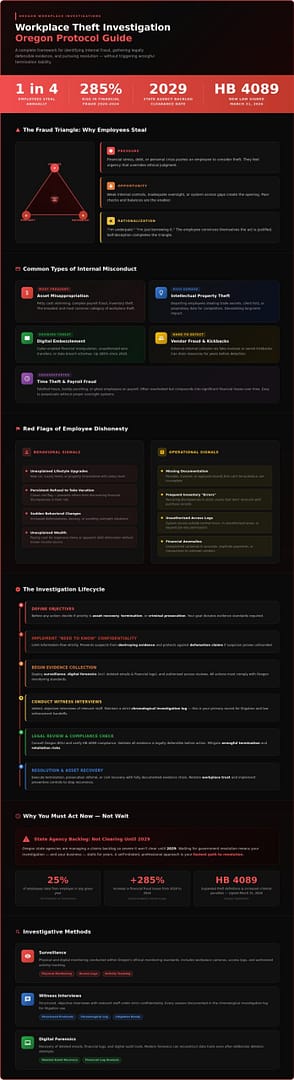
One out of every four employees steals from their employer in a given year, according to a US Chamber of Commerce report. This data confirms that internal loss isn’t just a possibility; it’s a persistent threat to your operational integrity. When you suspect a breach of trust, the challenge lies in gathering proof without triggering a wrongful termination lawsuit. Executing a workplace theft investigation Oregon protocols require means prioritizing procedural accuracy over emotional reaction to ensure your evidence remains legally defensible.
You likely believe that a thorough investigation should result in both asset recovery and a clear legal path forward. With some state agencies currently facing claim backlogs that won’t clear until 2029, taking control of your internal discovery process is essential for immediate resolution. This guide helps you master the protocols for identifying theft while maintaining strict compliance. We’ll preview the essential steps for surveillance, witness interviews, and evidence collection that stand up during litigation. By following these hand-picked strategies, you can resolve misconduct efficiently and restore the workplace trust your company requires.
Key Takeaways
- Define the scope of internal fraud by identifying the psychological triggers of opportunity and rationalization that drive employee misconduct.
- Implement a strict confidentiality protocol to protect the integrity of your evidence from initial discovery through final resolution.
- Utilize modern surveillance and digital forensics to track down deleted emails and financial logs while maintaining ethical monitoring standards.
- Master the vetted protocols of a workplace theft investigation Oregon professionals use to ensure legal compliance and mitigate retaliation risks.
- Leverage specialized investigative experts to streamline the discovery process and optimize your organization’s asset protection strategy.
Understanding the Scope of Workplace Theft and Internal Fraud
Workplace theft is a multifaceted threat that evolves faster than most internal security protocols. While many managers focus on physical inventory, modern fraud often takes the form of digital embezzlement, data breaches, or time theft. To effectively manage a workplace theft investigation Oregon standards suggest, you must first understand the legal Elements of Theft and how they apply to the corporate ecosystem. Internal fraud isn’t just a loss of assets; it’s a breach of organizational integrity that can destabilize an entire company culture.
The psychological profile of internal fraud is often defined by the “Fraud Triangle,” which consists of opportunity, pressure, and rationalization. An employee might face financial pressure and find an opportunity through weak internal controls. They then rationalize the act by telling themselves they’re underpaid or “borrowing” the funds. Data from the US Chamber of Commerce indicates that 25% of employees steal from their employer in a given year. Because of this high frequency, early detection through corporate due diligence is the only viable mitigation strategy to prevent long-term revenue loss.
The economic impact of these crimes has accelerated significantly. Financial fraud losses increased by 285% between 2020 and 2024, reflecting a broader trend of sophisticated cyber-enabled crime. On March 31, 2026, new legislative measures like HB 4089 were signed into law to expand the definition of theft of services and increase criminal penalties. These shifts make it essential for businesses to maintain updated investigative protocols to ensure they can recover assets and pursue prosecution when necessary.
Common Types of Internal Misconduct
Asset misappropriation remains the most frequent form of workplace theft, involving everything from petty cash skimming to complex payroll fraud. Intellectual property theft is equally devastating, as departing employees may attempt to take trade secrets or curated client lists to competitors. Additionally, vendor fraud and kickback schemes involve external-internal collusion that can drain resources for years if not identified through a vetted workplace misconduct investigation.
The Red Flags of Employee Dishonesty
Identifying the warning signs of theft requires a mix of behavioral observation and operational analysis. Behavioral changes, such as unexplained wealth, sudden lifestyle upgrades, or a persistent refusal to take vacations, often signal that an employee is hiding illicit activity. Refusing time off is a classic red flag because it prevents others from stepping into their role and discovering financial discrepancies. Operational anomalies like missing documentation, frequent inventory “errors,” or unauthorized access logs should trigger immediate vetting. When these signs emerge, moving from passive observation to a professional investigation is critical to protecting your bottom line.
The Investigation Lifecycle: From Initial Suspicion to Resolution
Success in a workplace theft investigation Oregon protocols demand depends on a structured, objective-driven lifecycle. Before you begin the discovery process, you must establish a clear endgame. Decide if your priority is the recovery of assets, immediate termination, or criminal prosecution. This decision dictates the level of evidence required and the legal standards you must meet. Throughout this lifecycle, maintain a strict “need to know” confidentiality protocol. Limiting the flow of information prevents the suspect from destroying evidence and protects your organization from defamation claims if the suspicion proves unfounded.
Every action taken during the hunt must be recorded in a chronological log. This vetted document serves as the primary record for future litigation or law enforcement handoffs. If you encounter complexities involving labor laws or wage disputes, consulting resources like Oregon BOLI Investigations can provide clarity on regulatory boundaries. However, remember that state agencies are currently managing a massive backlog that may not clear until 2029. This delay makes a self-initiated, professional approach your fastest path to resolution. To ensure your process remains unbiased, consider partnering with vetted investigative specialists who can provide a neutral third-party perspective.
Step 1: The Preliminary Assessment
Don’t rush into a full-scale operation based on a single anonymous tip. Evaluate the credibility of the discovery by cross-referencing it with existing data, such as inventory logs or financial transactions. Determine if the investigation should stay internal or if the potential conflict of interest requires an outside firm. Defining a precise scope at this stage is vital. It prevents “scope creep” and ensures you don’t overreach into employee privacy areas that could trigger a legal backlash.
Step 2: Evidence Preservation and Collection
Once you confirm the suspicion is reasonable, secure all physical assets and digital footprints immediately. This includes mirroring hard drives, saving surveillance footage, and locking down financial access. You must maintain a meticulous log of who handled each piece of evidence and when. The chain of custody is the backbone of any legal proceeding. Without it, even the most damning evidence can be ruled inadmissible in court or during a wrongful termination hearing.
Step 3: Strategic Interviewing and Interrogation
Understand the critical difference between a witness interview and a subject interrogation. Witness interviews are exploratory and designed to gather facts from coworkers or supervisors. Interrogations are more direct and focused on the suspect. Utilizing neutral investigators during this phase minimizes the risk of perceived bias or coercion. Properly documented statements, ideally recorded or signed by the individual, provide the litigation support necessary to finalize the case and move toward asset recovery.
Investigative Methods: Surveillance, Interviews, and Digital Forensics
Modern asset protection requires more than just a gut feeling or a grainy CCTV clip. To achieve the resolution promised in a workplace theft investigation Oregon protocols provide, you must deploy a curated mix of physical surveillance and digital forensics. This integrated approach transforms vague suspicions into a data-driven narrative that holds up during termination or prosecution. By leveraging these technical tools, you can verify alibis, track down missing assets, and identify the exact moment a breach occurred. Specialized investigative methods ensure that every piece of evidence is vetted for quality and compatibility with legal standards.
The Role of Surveillance in Corporate Integrity
Surveillance serves as the eyes of your investigation, providing irrefutable visual evidence of misconduct. Stationary surveillance works best for monitoring internal stockrooms or point-of-sale systems, while mobile surveillance is essential for tracking off-site misconduct or verifying delivery routes. It’s vital to stay within ethical monitoring boundaries by focusing only on common workplace areas and avoiding private zones. Following investigation best practices ensures your surveillance remains legally admissible and doesn’t violate privacy expectations. These techniques provide the objective proof needed to confront a subject with confidence.
Harnessing Digital Forensics for Financial Theft
Digital forensics is often the missing link in modern corporate investigations. When an employee attempts to cover their tracks by deleting emails or altering financial logs, forensic specialists can recover that data. Analyzing metadata allows you to prove intent by showing when a file was accessed, modified, or transferred to an external drive. This level of detail is crucial for uncovering embezzlement or intellectual property theft that physical cameras might miss. Integrating digital evidence with physical surveillance creates a complete picture of the misconduct, leaving little room for denial.
Sometimes the discovery of theft happens after an employee has already resigned or vanished. In these cases, skip tracing and locate investigations become indispensable tools for your team. These methods allow you to track down former associates or employees involved in the scheme to serve process or conduct witness interviews. Combining skip tracing with digital footprints ensures that leaving the company doesn’t mean escaping the consequences of the theft. Maintaining these high standards during a workplace theft investigation Oregon requires ensures that your findings are court-ready and your assets are protected. Use these methods to systematically debunk false narratives and restore the operational integrity of your business.
Legal Compliance and Mitigating Retaliation Risks
Legal compliance is the shield that protects your discovery process from becoming a corporate liability. When executing the protocols of a workplace theft investigation Oregon requires, you must navigate the Fair Credit Reporting Act (FCRA) if your inquiry involves third-party background checks. Failing to adhere to these federal standards can lead to severe penalties that dwarf the cost of the original theft. Establishing “reasonable suspicion” before launching an inquiry is the only way to avoid “wrongful investigation” or defamation claims. You must base every step on documented, factual anomalies rather than personal intuition or office rumors.
Internal investigations often fail because they lack the appearance of objectivity. If a supervisor with a history of conflict leads the hunt, the results are easily challenged in court. External investigators mitigate this risk by providing a buffer of neutrality that protects the company from bias claims. They ensure that the search and seizure of digital or physical property remains within the legal limits of a corporate environment. Maintaining this distance is essential for a resolution that sticks. To protect your interests, partner with a vetted investigative firm that understands the nuances of modern compliance.
Protecting the Organization from Retaliation Lawsuits
Retaliation claims are the most common counter-move by employees under investigation. To prevent this, ensure your process strictly follows established HR policies and is applied consistently across the organization. Managing the accused employee’s status requires a delicate balance; placing them on paid administrative leave often provides the necessary space to gather evidence without triggering a constructive discharge claim. In 2026, workplace neutrality is defined as the absence of personal or professional bias, achieved through the use of an independent third party who has no stake in the final outcome of the inquiry. This standard ensures that your findings are seen as objective by both judges and labor boards.
Vetting Your Investigative Partner
Selecting the right partner is a critical decision that requires more than a surface-level search. Check for proper state licensing and prioritize firms with multi-decade industry experience in the corporate ecosystem. A high-quality firm must understand the distinction between civil litigation support and criminal prosecution requirements. They should offer comprehensive services, including professional witness interviews and statements that are formatted for court use. By choosing a partner that has already been vetted for quality and reliability, you reduce the cognitive load on your executive team and ensure a more efficient path to asset recovery. This specialized expertise transforms a stressful situation into a manageable, professional process.
Partnering with Professional Investigative Firms for Organizational Integrity
Partnering with a specialized firm transforms a chaotic internal crisis into a streamlined, objective process. A curated investigative approach saves time and significantly reduces the cognitive load for executives who must balance daily operations with the stress of internal fraud. By delegating the discovery process to a vetted partner, you ensure that every element of your workplace theft investigation Oregon requirements is handled with professional neutrality. This specialized expertise is essential for maintaining organizational integrity while managing the complex legal landscape of 2026. Experts handle the heavy lifting of research, allowing you to focus on growth and recovery.
Moving from discovery to action requires a clear, decisive plan that adheres to legal standards. For executives seeking a deeper understanding of these professional protocols, our pillar on workplace investigations offers comprehensive insights. These resources help you transition from initial suspicion to a legally defensible resolution without the risk of procedural errors. High-quality documentation and professional oversight are the keys to ensuring that your findings stand up under the scrutiny of civil or criminal litigation.
The Value of Expert Surveillance and Skip Tracing
Professional surveillance operations provide the irrefutable visual evidence needed to confirm or debunk alibis during an inquiry. These operations use advanced technology to monitor common workplace areas and off-site activities while strictly respecting privacy boundaries. When a suspect vanishes or attempts to hide assets, skip tracing becomes an indispensable tool for recovery. These methods allow investigators to track individuals across state lines, ensuring that former employees are held accountable for their actions. This level of persistence is what separates a standard inquiry from a successful asset recovery mission. Professional surveillance ensures you don’t rely on hearsay or circumstantial evidence during a termination hearing.
Securing Your Business with HubHound
The HubHound advantage lies in our role as a trusted curator within the investigative ecosystem. We connect you with vetted professionals who bring over 30 years of industry experience to every case. Our network offers comprehensive support, ranging from pre-employment background checks to witness interviews and statements. This multi-layered approach ensures that your organization is protected against both current threats and future vulnerabilities. By choosing a corporate investigation firm through our hand-picked selections, you gain a partner that understands the nuances of corporate due diligence.
Don’t let the choice paralysis of selecting an agency stall your investigation. Our goal is to provide the expert filter you need to make quick, informed decisions. Initiate your professional theft investigation today to stop the drain on your resources and restore the culture of trust your business requires. With state agency backlogs projected to last until 2029, a private, professional response is your most reliable path to a swift and court-ready resolution. This proactive approach ensures your assets are protected and your legal risks are minimized through every stage of the process.
Securing Your Operational Integrity
Protecting your company assets requires more than just reactive measures. You must integrate physical surveillance with advanced digital forensics to transform vague suspicions into court-ready evidence. Maintaining procedural neutrality and following vetted documentation standards are the only ways to mitigate the risk of retaliation lawsuits. By prioritizing these professional protocols, you ensure that your discovery process remains legally defensible and operationally efficient. Executing a workplace theft investigation Oregon protocols demand ensures that you stay ahead of sophisticated internal threats in the 2026 landscape. This disciplined approach minimizes cognitive load for your leadership team while maximizing the chances of full asset recovery.
Don’t let internal misconduct compromise your business growth. Our licensed investigators bring over 30 years of industry experience to every case, offering specialized corporate due diligence and litigation support. We provide the expert filter you need to manage complex surveillance and digital forensics with ease. Secure your assets with a vetted workplace theft investigation from HubHound today. Taking proactive steps now restores the workplace trust and operational stability your organization needs to thrive. You have the tools to protect your bottom line; it’s time to put them into action.
Frequently Asked Questions
Is it legal to investigate an employee for theft without their knowledge?
You can legally investigate an employee without their knowledge if the inquiry focuses on work-related misconduct and occurs in areas where they have no reasonable expectation of privacy. Surreptitious monitoring must comply with federal wiretapping laws and internal company policies. A workplace theft investigation Oregon protocols suggest often requires a balance between gathering evidence and respecting privacy to ensure the findings remain admissible in future litigation or termination hearings.
How long does a typical workplace theft investigation take to complete?
A standard investigation typically spans 14 to 45 days. The duration depends on the volume of digital forensics required and the complexity of the theft scheme. Simple asset misappropriation might be resolved in two weeks, whereas complex embezzlement involving vendor kickbacks or data breaches often requires more time to analyze logs and conduct witness interviews. Efficiency is key to minimizing operational downtime during this discovery phase.
Can an employer search an employee’s desk or locker during a theft investigation?
Employers can search desks or lockers if they’ve established a clear policy stating these areas are company property and subject to inspection. Without such a policy, employees may claim a reasonable expectation of privacy. To mitigate risk, always have a witness present during the search and document every item found. This ensures the chain of custody remains intact for any potential criminal prosecution or civil litigation support.
What happens if an investigation is inconclusive but suspicion remains?
If proof is insufficient, you should maintain a “need to know” confidentiality protocol and increase monitoring without taking adverse action. Retaliating based on suspicion alone can lead to wrongful termination claims. Use this time to refine your internal controls and corporate due diligence. A professional firm can help you identify gaps in your evidence collection that might’ve led to the inconclusive result, ensuring your assets stay protected.
Should I involve the police immediately when I suspect workplace theft?
Involving the police immediately isn’t always the best strategy. Law enforcement often requires a high threshold of evidence before they can act, and some state agencies currently face a backlog that won’t clear until 2029. Conducting a private, professional investigation first allows you to hand over a curated, court-ready file. This increases the likelihood that a prosecutor will take the case and prioritize your financial recovery.
How much does a professional workplace theft investigation cost?
Professional rates for investigators typically range from $75 to $200 per hour. Surveillance operations specifically often start at $95 per hour for a single investigator. These costs vary based on whether you require specialized digital forensics or skip tracing to locate individuals across state lines. Investing in a vetted firm ensures you receive high-quality evidence that justifies the expenditure through asset recovery and reduced legal liability for your business.
What is the most effective way to recover stolen company assets?
A civil compromise is often the fastest way to recover losses. Under statutes like ORS Chapter 164, theft classifications range from Class C misdemeanors to Class B felonies depending on the value of the property. If an employer pursues a civil settlement, the employee may avoid criminal charges in exchange for full restitution. This method bypasses the lengthy court system and provides immediate financial restoration for the organization.
Can I fire an employee immediately upon discovery of theft?
While many employees are “at-will,” firing someone immediately without a vetted investigation is risky. If the theft isn’t proven, you face potential lawsuits for wrongful termination or defamation. It’s safer to place the individual on administrative leave while you finalize the workplace theft investigation Oregon protocols require. This professional approach provides the evidence needed to terminate “for cause” and defend your decision in any future labor board hearing.

Article by
Joel R. Manley | President | Hubhound Investigations | OR PI-ID#: 90432 | 111 SW Fifth Avenue, Suite 3150 Portland, Oregon 97204 | 971-442-8170
Joel is licensed as a private investigator in Oregon and Tennessee. Joel started his career in 1987 serving as a Military Police Officer and Military Police Investigator.
After ending his military tour of duty, Joel became a civilian Police Officer and Deputy Sheriff. Joel took his strong background in Hostage Negotiations, Mediation and Conflict Resolution, with him to patrol some of the highest crime areas in SE Portland.
Joel was awarded Deputy of the Year for his efforts and for drastically reducing the crime rate in the area he patrolled. As a Deputy Sheriff, Joel assisted in leading a Neighborhood Livability Program that was nationally recognized for having the most innovative and progressive approach to policing.
In 2018, Joel retired as a Deputy Sheriff and founded Hubhound Investigations. Joel played an integral role in Hubhound Investigations receiving an A+ Accredited Business rating from the Better Business Bureau (BBB).
In his off time, Joel enjoys spending time with his wife, adult children and Hubhound’s Happiness Ambassador, Nya. Joel also enjoys Scuba Diving and Kayaking.
Disclaimer
DISCLAIMER: This article is provided for general informational and educational purposes only. It is not intended to constitute legal advice, professional investigative advice, or instruction to engage in any unlawful activity. Laws governing private investigations, surveillance, recording, tracking, access to information, evidence collection, privacy, trespass, licensing, and related investigative activities vary by jurisdiction and are subject to change.
Any investigative techniques, tactics, procedures, scenarios, or legal proceedings discussed in this article are presented for informational purposes and should not be interpreted as authorization or encouragement to use a particular method. Private investigators and members of the public are responsible for understanding and complying with all applicable federal, state, and local laws, licensing requirements, court rules, and professional standards.
The circumstances of every investigation and legal matter are different. Information contained in this article should not be relied upon as a substitute for advice from a qualified attorney or other appropriate licensed professional regarding a specific situation. No attorney-client, investigator-client, or other professional relationship is created by reading or using this information.