
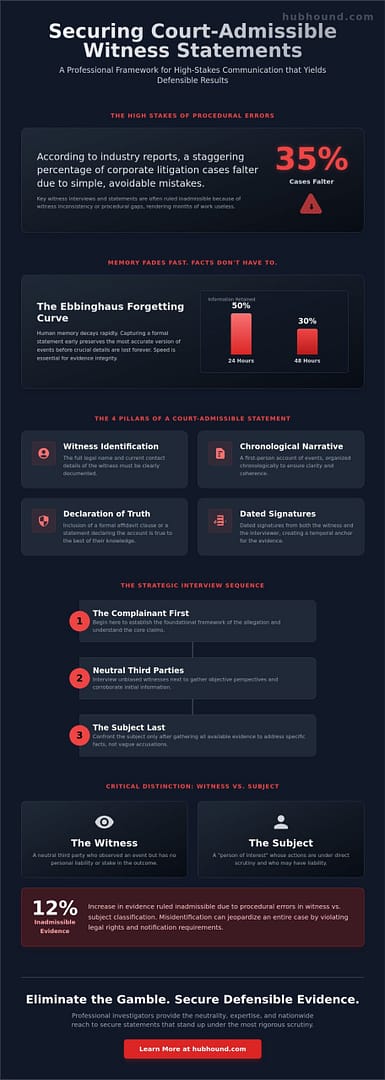
A single procedural error during an initial conversation can render months of investigative work entirely useless in a court of law. According to a 2022 industry report, 35% of corporate litigation cases falter because of witness inconsistency or procedural gaps. It’s a harsh reality for legal teams when critical witness interviews & statements are ruled inadmissible because of a simple technicality. You likely understand the frustration of managing reluctant individuals or watching a key witness change their story weeks after a recorded conversation.
We agree that securing reliable evidence shouldn’t feel like a gamble. This guide provides the exact methodology professional investigators use to identify, interview, and secure court-admissible statements from witnesses. You’ll gain a clear framework for high-stakes communication that yields signed, defensible results. We’ll examine the step-by-step process of vetting sources and optimizing your documentation to ensure your evidence stands up under the most rigorous scrutiny, increasing your chances of winning by providing a vetted path to discovery.
Key Takeaways
- Learn the fundamental differences between informal chats and professional investigative statements to protect the integrity of your evidence.
- Discover the strategic importance of interview sequencing and how a vetted “interview list” prevents critical information gaps.
- Implement the “Funnel Technique” during witness interviews & statements to transition smoothly from broad observations to specific, actionable facts.
- Professionalize your documentation process by organizing accounts chronologically to ensure statements remain clear and court-admissible.
- Understand why utilizing neutral third-party investigators is essential for eliminating bias and locating hard-to-find witnesses nationwide.
Understanding Witness Interviews & Statements
A witness interview is a highly structured conversation. It isn’t a casual chat or a friendly catch-up. Instead, it’s a tactical tool designed to extract precise, factual information regarding a specific event. Effective witness interviews & statements serve as the primary architecture for both criminal defense and civil litigation. They provide the raw data needed to build a case. Speed is essential here. Data from the Ebbinghaus Forgetting Curve indicates that humans forget roughly 50% of new information within 24 hours, and up to 70% within 48 hours. Capturing a formal Witness statement early ensures that the most accurate version of events is preserved before cognitive decay sets in.
Neutrality remains the most critical element of this process. An investigator must act as a curator of facts rather than an advocate for a specific outcome. If a statement feels coerced or influenced by leading questions, it’ll lose all credibility under cross-examination. Professionals prioritize objective questioning to ensure the evidence remains untainted. This disciplined approach eliminates the choice paralysis legal teams face when dealing with conflicting accounts. They don’t want opinions; they need verified observations.
The Legal Weight of a Formal Statement
A formal statement functions as a temporal anchor. It freezes a witness’s memory at a specific point in time, preventing the natural evolution of a story that often occurs during long legal battles. This document is vital for “impeaching a witness” if their testimony shifts during a trial. By presenting the original signed document, counsel can demonstrate inconsistencies to a jury. To be considered court-admissible, a statement must contain specific components:
- The full legal name and contact details of the witness.
- A chronological narrative written in the first person.
- A declaration of truth or a formal affidavit clause.
- A dated signature from the witness and the interviewer.
Witness vs. Subject: Knowing the Difference
Distinguishing between a witness and a subject is a foundational requirement for any investigator. A witness is a neutral third party. They observed the event but have no personal liability or stake in the outcome. A subject, or “person of interest,” is someone whose actions are under direct scrutiny. Misidentifying these roles can jeopardize an entire case. If a subject is treated as a mere witness, they may not receive the necessary legal warnings required by law. This error often leads to the suppression of evidence. A 2022 review of appellate cases showed that procedural errors in witness classification contributed to a 12% increase in evidence being ruled inadmissible. Proper identification ensures that all parties’ rights are respected while maintaining the investigation’s integrity.
Strategic Preparation: Before the Interview Begins
Effective witness interviews & statements don’t happen by accident. They require a rigorous planning phase that begins with a dynamic interview list. This document is never static; it evolves as new names surface during the discovery process. A professional investigator categorizes witnesses into tiers based on their proximity to the event and potential for bias. Identifying these biases through pre-interview background checks is critical. If a witness has a documented history of conflict with the subject, you need to know this before they sit down. This foresight allows you to weigh their testimony accurately against 100% objective data points.
The sequence of your meetings determines the success of the entire investigation. Always interview the complainant first to establish the framework of the allegation. Follow this with neutral third parties who provide an unbiased perspective. Save the subject of the investigation for last. This strategic order ensures you’ve gathered all available evidence and can confront the subject with specific facts rather than vague accusations. For the meeting itself, choose a neutral, non-intimidating location. Avoid high-pressure environments like executive boardrooms or official stations, as these often trigger defensive responses that shut down communication.
The Investigative File and Document Review
You must master the existing evidence before asking your first question. Reviewing time logs, emails, and physical evidence creates a factual perimeter. You can use these documents to verify or challenge witness claims in real-time. For instance, if a witness claims they weren’t present on October 14, 2023, but badge-swipe data proves otherwise, you can address the discrepancy immediately. This level of preparation is a hallmark of a criminal defense investigator who must protect rights in high-stakes environments. Referencing the DOJ Guide to Eyewitness Evidence helps maintain a standard of excellence that withstands legal scrutiny.
Developing an Interview Outline
Rigid scripts are an investigator’s enemy because they prevent natural follow-up questions. Instead, build a flexible topical outline. This ensures you cover every “must-answer” question required for your legal theory without sounding robotic. Prepare specific prompts for common roadblocks like “I don’t remember” or “I wasn’t there.” By having secondary questions ready, you can gently probe their memory using sensory details or chronological markers. If you’re looking for expert help to manage these workflows, you can find vetted agencies that specialize in complex investigative support. This preparation transforms a simple conversation into a powerful tool for discovery.
Interview Techniques for Eliciting Accurate Information
Gathering high-quality witness interviews & statements requires more than just a list of questions. It demands a structured methodology designed to minimize bias and maximize recall. Use the Funnel Technique to guide the conversation. This method starts with broad, open-ended prompts that allow the witness to provide a narrative account without interruption. As the interview progresses, you narrow the focus to specific details to clarify the timeline and identify key actors.
The power of open-ended questions is a foundational tool for any investigator. They force the witness to retrieve information from long-term memory rather than simply agreeing with your premises. Focus on these prompts:
- Who was present at the scene?
- What happened immediately before the event?
- Where were you standing when you first noticed the incident?
- When did you first perceive a problem?
- How did the parties react after the contact occurred?
Building rapport is a functional necessity, not a social nicety. Research indicates that a witness who feels a sense of professional trust provides 25% more relevant details than one who feels defensive. Practice active listening by following the 80/20 rule; the witness should speak for 80% of the session. Use silence strategically. A five-second pause often encourages a witness to share additional details they previously overlooked. If you’re dealing with a reluctant witness, explain the objective value of their perspective to the investigation. Transparency reduces suspicion and fosters cooperation without the need for high-pressure tactics.
Avoiding Leading Questions
Leading questions contain the answer within the prompt, which effectively contaminates the evidence. They destroy the credibility of any statement in a legal or professional review. A 1974 study by Elizabeth Loftus demonstrated that using the word “smashed” instead of “hit” caused witnesses to estimate vehicle speeds 9 miles per hour higher than they actually were. This suggestibility creates false memories that the witness eventually believes are real. Differentiate between clean and contaminated styles. A clean question asks, “What color was the car?” A contaminated question asks, “Was the car red?” Stick to neutral phrasing to ensure the resulting witness interviews & statements hold up under scrutiny.
Managing Hostile or Biased Witnesses
Hostility often presents through non-verbal cues like crossed arms, avoided eye contact, or short, clipped responses. Maintain professional composure and don’t take the bait if a witness becomes argumentative. If a witness is uncooperative, pivot the conversation back to objective, verifiable facts. Document their demeanor and non-verbal behavior in your notes; this provides essential context for the final report. When dealing with bias, acknowledge the witness’s viewpoint but keep the questioning focused on the chronological sequence of events to extract usable data. This disciplined approach ensures the integrity of the information remains the top priority.
Documenting the Statement: From Verbal to Admissible
Capturing witness interviews & statements requires precision. A vague summary won’t suffice in a legal setting. You must choose a format that balances speed with durability. Handwritten statements are useful for immediate capture at a scene, but they often suffer from legibility issues. Transitioning these to a typed format later requires the witness to re-verify the transcribed text. Digital recordings offer the highest fidelity, capturing 100% of the verbal exchange, including pauses and emotional tone. Standardized formats for witness interviews & statements reduce the risk of procedural errors that could disqualify evidence during a trial.
The body of the statement should follow a strict chronological order. Start with the witness’s presence at the location and move through the events minute by minute. This granularity prevents witnesses from glossing over details that might seem minor but prove critical later. Research indicates that 92% of investigators find chronological accounts easier to verify against secondary evidence like surveillance footage or GPS logs. This structure helps identify gaps in the narrative before the interview concludes.
Every document must include a formal attestation. This language confirms the witness provides the account voluntarily and truthfully. Don’t skip the review phase. Allow the witness to read every line slowly. They must initial the bottom of every page and any corrections made to the text. If they strike through a sentence, they need to initial that specific change. This prevents future claims of document tampering or misquoted segments during a deposition.
The Role of Digital Evidence
Digital files require rigorous handling to remain admissible. Store recordings on write-once media or secure cloud servers with immutable audit logs. Utilizing digital forensics & data recovery experts helps authenticate the time, date, and location of the recording. If a witness asks to go off-the-record, document the exact time the recording stopped and restarted. This transparency protects the investigator’s credibility if the recording is challenged.
Finalizing the Signed Statement
The final signature should include language stating the facts are true under penalty of perjury. This legal standard transforms a casual account into a powerful piece of evidence. Many firms leverage civil litigation support to manage the complex logistics of document finalization and storage. Always maintain a physical chain of custody for original documents. A single break in this record can lead to evidence being excluded. Store originals in tamper-evident envelopes and log every individual who handles the file.
Why Professional Investigators are Essential for Credible Statements
Professional investigators provide the third-party neutrality required to maintain the integrity of witness interviews & statements. When internal legal teams or HR departments conduct these interviews themselves, they often face accusations of bias or leading the witness. This perceived conflict of interest can render a statement useless during a trial or arbitration. Specialized investigators act as objective finders of fact, ensuring the evidence remains untainted by internal company politics or legal strategy.
Locating witnesses is a primary challenge in modern litigation. Data from the US Census Bureau indicates that approximately 12.6% of the population moves annually. Professional investigators utilize advanced skip tracing tools and proprietary databases to track down individuals who have relocated or are intentionally avoiding contact. When standard search methods fail, knowing how to locate missing person data using professional investigative frameworks becomes a critical capability for securing testimony before deadlines expire. This technical expertise ensures that critical testimony isn’t lost simply because a witness changed their address.
Investigators also serve as foundational witnesses in court. They can testify regarding the specific conditions under which a statement was gathered, confirming that no coercion or improper influence occurred. This testimony establishes the necessary chain of custody for the information. Additionally, they ensure total compliance with federal and state privacy laws. For instance, they manage the complexities of one-party versus two-party consent recording laws, protecting your organization from potential legal liability or the exclusion of evidence.
- Expertise: Access to non-public databases for rapid witness location.
- Objectivity: Elimination of internal bias claims.
- Compliance: Strict adherence to the Fair Credit Reporting Act (FCRA) and privacy mandates.
- Reliability: Professional documentation that stands up to cross-examination.
Avoiding Claims of Intimidation
Allegations of witness tampering or intimidation can dismantle a legal case instantly. Professional investigators follow strict ethical boundaries to prevent these claims. They use standardized interview techniques that prioritize open-ended questions and factual recording. By following a consistent, documented procedure, they protect the integrity of the entire legal process. This methodical approach ensures that the witness’s words are their own, free from the pressure often felt when speaking directly to a corporate employer or an opposing attorney.
The HubHound Approach to Witness Statements
HubHound acts as your expert filter in the investigative ecosystem. We provide access to a curated network of vetted professionals who specialize in high-stakes evidence gathering. Our focus is on quality and compatibility, matching your specific case needs with investigators who deliver court-ready documentation and efficient turnaround times. We eliminate the choice paralysis of finding reliable help by hand-picking talent with proven track records. You can Contact HubHound for professional investigative support to optimize your discovery process and secure the credible evidence your case requires.
Strengthen Your Case with Professional Evidence
Expertly handled witness interviews & statements serve as the backbone of any successful investigation. Success depends on meticulous preparation and the use of specialized techniques that ensure verbal accounts become admissible records. You can’t leave these critical interactions to chance when the integrity of your evidence is on the line. Professional investigators bring decades of industry experience to every case, ensuring that every statement is gathered with the highest level of precision and discretion.
HubHound simplifies your search by providing a vetted and verified investigative ecosystem. Our network consists of licensed professionals who specialize in discreet surveillance and interview operations. We’ve already done the heavy lifting to curate a selection of experts who prioritize transparency and efficiency. This approach removes the choice paralysis often associated with finding reliable investigative support, allowing you to focus on your core objectives while experts handle the fieldwork.
Take the next step toward building a solid foundation for your legal or corporate strategy today.
Frequently Asked Questions
What is the difference between an interview and an interrogation?
An interview focuses on gathering information from a cooperative party, while an interrogation is a structured process designed to obtain an admission or confession from a suspect. During an interview, the investigator uses open-ended questions to build a chronological timeline. In contrast, interrogations often follow the Reid Technique, a model used by law enforcement since 1948 to handle resistant subjects through direct confrontation and narrow questioning.
Can a witness refuse to provide a signed statement?
A witness can legally refuse to sign a statement unless they’re under a specific court order or a subpoena. While voluntary cooperation is the goal for most witness interviews & statements, you can’t force a private citizen to put their signature on a document. If a witness declines, you should document their verbal account and note the refusal in your final investigative report to maintain a clear evidentiary trail.
Are recorded witness statements better than written ones?
Recorded statements are generally superior because they capture the witness’s exact tone, pauses, and inflection. Digital audio files eliminate the risk of an investigator misinterpreting a witness’s words during the transcription process. Research indicates that 70% of communication is non-verbal or tonal, making a high-quality recording a more reliable piece of evidence than a summarized written document that lacks emotional context and nuance.
What makes a witness statement inadmissible in court?
A statement becomes inadmissible if it’s based on hearsay, obtained through coercion, or lacks a proper foundation of personal knowledge. Under Federal Rule of Evidence 602, a witness must have first-hand experience of the events they describe. If the investigator used leading questions or failed to provide a proper warning during a custodial situation, a judge will likely strike the evidence from the record during pre-trial motions.
How do you handle a witness who wants to remain anonymous?
Treat anonymous witnesses as confidential sources by assigning them a unique numerical identifier in your files. You must explain the limits of confidentiality, as their identity might be disclosed if the case goes to trial under the Sixth Amendment’s Confrontation Clause. Maintain a separate, secure log that links their identity to their statement to ensure the integrity of the witness interviews & statements process while protecting their privacy.
Should I provide a copy of the statement to the witness immediately?
You should provide a copy of the statement to the witness within 24 hours to ensure transparency and accuracy. This practice allows the witness to review the text for errors and sign off on its veracity while the details are fresh in their mind. Providing a copy also builds trust, which is essential for maintaining a professional relationship if you need to contact the individual for follow-up questions later.
Can a witness change their statement after signing it?
A witness can change their statement by providing a supplemental addendum rather than altering the original document. You shouldn’t delete or overwrite the first version, as this creates a chain of custody issue for the evidence. Instead, document the changes in a new dated entry. This preserves the original record while accounting for the 20% of cases where memory recall improves after the initial stress of an event subsides.
What should I do if a witness contradicts physical evidence?
When a witness contradicts physical evidence, you must re-interview them to explore the discrepancy without being accusatory. Present the physical findings, such as 4K surveillance footage or forensic data, and ask the witness to help you understand the gap. Human memory is fallible, and 75% of overturned convictions involve some form of witness misidentification, so you must always prioritize hard data over subjective recollections during your analysis.

Article by
Joel R. Manley | President | Hubhound Investigations | OR PI-ID#: 90432 | 111 SW Fifth Avenue, Suite 3150 Portland, Oregon 97204 | 971-442-8170
Joel is licensed as a private investigator in Oregon and Tennessee. Joel started his career in 1987 serving as a Military Police Officer and Military Police Investigator.
After ending his military tour of duty, Joel became a civilian Police Officer and Deputy Sheriff. Joel took his strong background in Hostage Negotiations, Mediation and Conflict Resolution, with him to patrol some of the highest crime areas in SE Portland.
Joel was awarded Deputy of the Year for his efforts and for drastically reducing the crime rate in the area he patrolled. As a Deputy Sheriff, Joel assisted in leading a Neighborhood Livability Program that was nationally recognized for having the most innovative and progressive approach to policing.
In 2018, Joel retired as a Deputy Sheriff and founded Hubhound Investigations. Joel played an integral role in Hubhound Investigations receiving an A+ Accredited Business rating from the Better Business Bureau (BBB).
In his off time, Joel enjoys spending time with his wife, adult children and Hubhound’s Happiness Ambassador, Nya. Joel also enjoys Scuba Diving and Kayaking.
Disclaimer
DISCLAIMER: This article is provided for general informational and educational purposes only. It is not intended to constitute legal advice, professional investigative advice, or instruction to engage in any unlawful activity. Laws governing private investigations, surveillance, recording, tracking, access to information, evidence collection, privacy, trespass, licensing, and related investigative activities vary by jurisdiction and are subject to change.
Any investigative techniques, tactics, procedures, scenarios, or legal proceedings discussed in this article are presented for informational purposes and should not be interpreted as authorization or encouragement to use a particular method. Private investigators and members of the public are responsible for understanding and complying with all applicable federal, state, and local laws, licensing requirements, court rules, and professional standards.
The circumstances of every investigation and legal matter are different. Information contained in this article should not be relied upon as a substitute for advice from a qualified attorney or other appropriate licensed professional regarding a specific situation. No attorney-client, investigator-client, or other professional relationship is created by reading or using this information.