
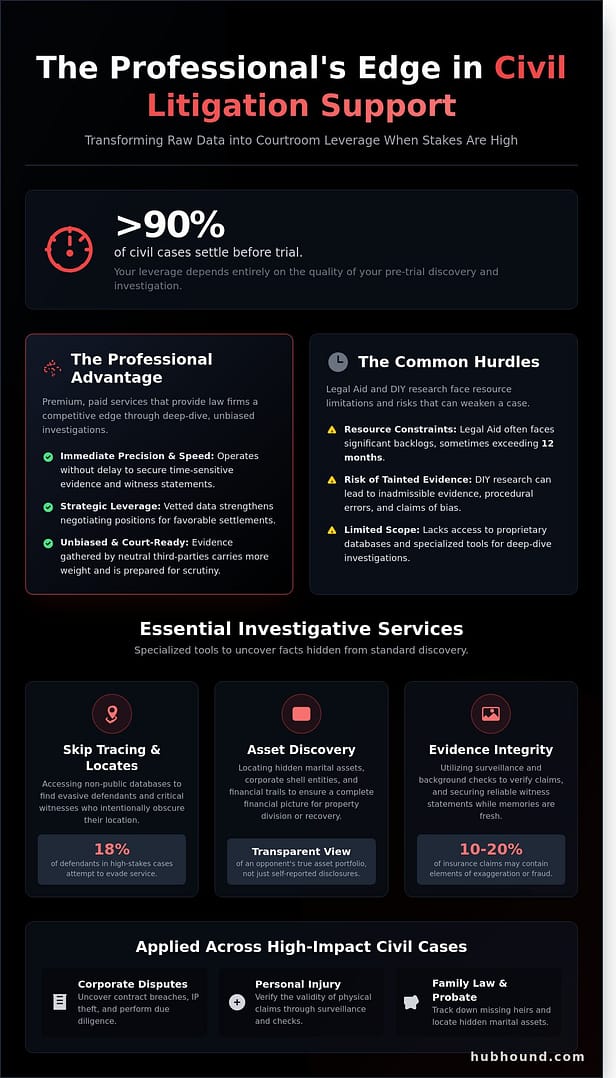
A lawsuit isn’t won in the courtroom; it’s won during the weeks of investigation that precede the first hearing. According to the American Bar Association, more than 90% of civil cases settle before ever reaching a jury, which means your leverage depends entirely on the quality of your discovery. You understand the pressure of building a case when key witnesses go missing or an opposing party hides their financial trail. These gaps in information don’t just cause anxiety; they weaken your position at the negotiating table and leave you vulnerable during high-stakes disputes.
Professional civil litigation support acts as an expert filter, turning raw data into the vetted evidence you need to secure a favorable outcome. This guide shows you how specialized investigative techniques locate evasive defendants and provide a transparent view of an opponent’s true asset portfolio. You’ll learn how to transform fragmented information into court-ready documentation that withstands rigorous scrutiny. We’ll explore the strategic advantages of using hand-picked investigative tools to ensure your process service is handled with precision and your evidence remains beyond reproach.
Key Takeaways
- Understand how professional investigative frameworks provide a strategic advantage in high-stakes disputes, moving far beyond the scope of basic legal aid.
- Leverage specialized tools like skip tracing to locate evasive defendants and critical witnesses with professional precision and speed.
- Protect your case from the risk of tainted evidence by utilizing professional civil litigation support instead of relying on unreliable DIY research.
- Learn to integrate investigative support early in the litigation lifecycle to define and secure the essential elements of proof required for victory.
- Identify the specific criteria for selecting a vetted investigative partner with deep expertise in legal procedure and court-ready evidence handling.
What is Professional Civil Litigation Support?
Professional civil litigation support functions as the tactical framework for non-criminal legal disputes. It involves the systematic identification, collection, and analysis of information required to build a persuasive legal argument. This process isn’t merely administrative. It’s a specialized investigative discipline that bridges the gap between an attorney’s legal theory and the hard facts needed to prove it in court.
There’s a vital distinction between Civil Legal Aid and professional civil litigation support. Legal aid refers to pro-bono services provided to individuals who can’t afford legal representation. In contrast, professional litigation support is a premium, paid service utilized by law firms and corporations to gain a competitive edge. It focuses on deep-dive investigations, asset recovery, and witness vetting that go far beyond the scope of basic legal assistance.
Modern law firms outsource field investigations to maintain a necessary layer of neutrality. When an external specialist gathers data, the evidence often carries more weight because it lacks the appearance of internal bias. The core objective is clear. Investigators work to turn raw intelligence into admissible evidence. This ensures that every data point, from a digital footprint to a physical surveillance log, aligns with the requirements of the court.
The Professional Advantage Over Legal Aid
High-stakes litigation requires dedicated resource allocation that non-profit organizations simply can’t provide. While legal aid offices often face backlogs exceeding 12 months, professional firms operate with immediate precision. Speed is critical when securing witness statements or preserving digital evidence before it’s deleted. Expertly gathered evidence also changes the math for settlement negotiations. Since 90 percent of civil cases settle before trial, having vetted investigative data provides the leverage needed to force a favorable resolution without the cost of a full court proceeding.
Common Civil Case Categories
Professional investigators apply their skills across several high-impact areas to ensure transparency and accountability:
- Corporate disputes: Experts verify business entities, perform due diligence on potential partners, and uncover evidence of contract breaches or intellectual property theft.
- Personal injury: Firms use surveillance and background checks to verify the validity of physical claims. Industry reports suggest that 10 percent to 20 percent of insurance claims contain elements of exaggeration or fraud.
- Family law and probate: During discovery, investigators locate hidden marital assets and track down missing heirs. This ensures that the division of property is based on a complete financial picture rather than self-reported disclosures.
By utilizing civil litigation support, legal teams move from a reactive posture to a proactive strategy. They don’t just wait for discovery documents; they go out and find the facts that define the case outcome.
Essential Investigative Services for Civil Cases
Modern civil litigation support requires a curated set of investigative tools designed to uncover facts that remain hidden during standard discovery. It’s not enough to rely on voluntary disclosures. Legal teams now utilize proprietary databases that aggregate trillions of data points to identify assets or locate elusive parties. This proactive approach allows attorneys to build a case founded on verified data rather than assumptions. Successful litigation depends on the precision of your initial intelligence gathering. When you optimize your investigative phase, you reduce the risk of procedural delays that can stall a case for months.
- Skip Tracing: Accessing non-public records to find evasive defendants and witnesses.
- Professional Process Service: Delivering legal documents according to national standards to avoid jurisdictional challenges.
- Witness Statements: Securing reliable, recorded accounts while memories are fresh and untainted.
Skip Tracing and Locate Investigations
Skip tracing goes beyond a basic search engine query. Professional investigators access non-public databases to track individuals who intentionally obscure their location. Industry reports from 2023 indicate that approximately 18% of civil defendants in high-stakes litigation attempt to evade service of process. Expert skip tracing ensures these parties are found and served. This process is vital for establishing the burden of proof. It helps you secure the presence of key witnesses who might otherwise be unreachable. When you need to locate missing person data for corporate litigation or legal service, professional frameworks that utilize non-public databases and verified field intelligence are essential for securing court-admissible results. If you need to find vetted agencies to handle these complex searches, prioritize those with deep technical expertise and access to high-tier data integrations.
Surveillance and Evidence Gathering
Surveillance provides the visual proof that testimony alone can’t offer. Professional teams use high-definition optics and discreet techniques to document activities relevant to civil claims. Digital forensics & data recovery also plays a critical role in modern civil litigation support. Tools like Cellebrite allow experts to recover deleted communications from mobile devices. These “smoking gun” messages often change the trajectory of a lawsuit. Every piece of gathered evidence must maintain a strict chain of custody. This keeps the data admissible in court and prevents procedural dismissals.
Securing statements early is equally important for a reliable case file. Research on the Ebbinghaus Forgetting Curve shows that people forget about 70% of specific details within 24 hours of an event. Professional witness interviews & statements capture the truth before it fades or becomes influenced by external narratives. By locking in these accounts before the formal discovery phase, you gain a significant strategic advantage during depositions. This level of preparation ensures that your evidence is both comprehensive and bulletproof when it reaches the courtroom.
Professional Evidence vs. DIY Research
A common misconception in modern legal battles is that a quick social media search or a Google deep-dive qualifies as sufficient discovery. It doesn’t. Relying on DIY research creates a significant liability for any legal team. While a private citizen can browse public profiles, they lack the legal authority and technical tools to verify the integrity of the data. Professional civil litigation support ensures that every piece of information is gathered through vetted, legal channels that stand up to scrutiny.
DIY mistakes often lead to “tainted” evidence. If an untrained individual accesses a private account or scrapes data in violation of terms of service, that evidence might be barred from court. Under the principles of digital forensics, even a simple screenshot can be challenged if the metadata isn’t preserved. Licensed investigators utilize proprietary databases like TLOxp or Tracers. These platforms provide access to non-public records that 92% of the general population cannot legally view. This professional barrier protects the case from “fruit of the poisonous tree” challenges where illegally obtained facts invalidate the entire argument.
The investigator’s role as a third-party witness is a critical asset. If a paralegal or client finds a key piece of evidence, they risk becoming a witness in their own case, which creates a conflict of interest. A professional investigator provides neutral, expert testimony to validate findings. They offer a clear chain of custody that proves where the evidence came from and how it was handled from the moment of discovery.
Admissibility and Courtroom Standards
Federal Rule of Evidence 901 requires that all evidence be authenticated before it’s presented to a judge. DIY research rarely meets this high bar because it lacks the technical documentation needed to prove the data hasn’t been altered. Professional firms provide comprehensive reports that serve as foundational testimony. This documentation prevents opposing counsel from successfully filing motions to suppress based on hearsay or lack of authenticity. By following strict collection protocols, investigators ensure that digital and physical facts remain admissible throughout the entire trial process.
Cost-Benefit Analysis of Litigation Support
Investing in civil litigation support is a strategic move for risk mitigation. Data from the American Bar Association shows that roughly 95% of civil cases settle before reaching a jury. High-quality evidence gathered in the early stages of a dispute directly influences these settlement figures. A targeted $5,000 investigation can uncover facts that protect a multi-million dollar claim from dismissal. Specialized firms also offer extreme efficiency, often delivering deep-dive background checks within 48 hours. This speed allows lead counsel to make informed decisions faster than relying on junior staff who lack specialized skip-tracing or forensic training.
Building a Strategic Litigation Support Plan
A winning legal strategy requires more than just a deep understanding of the law. It demands a curated approach to evidence gathering that begins the moment a file is opened. Integrating professional civil litigation support at the earliest stages of the litigation lifecycle prevents tactical blind spots. Legal counsel and investigators must collaborate to define the “Essential Elements of Proof” for every claim. This collaboration ensures that surveillance, asset searches, and witness locates are not just fishing expeditions. They become targeted strikes designed to meet specific legal burdens. Managing the information flow between the field and the law office is the final piece of the puzzle. Efficiency is the priority. You need a system where field intelligence translates into legal leverage without delay.
Step 1: Initial Case Assessment
Effective planning starts with an audit of existing filings to identify narrative gaps. A 2023 industry analysis highlighted that 68% of civil cases involve missed evidentiary opportunities due to delayed investigations. We look for these missing links by reviewing pleadings and identifying key entities that require deep-dive background screening. This phase also determines the legal standing for technical operations like data recovery or covert surveillance. Vetting these hurdles early protects the integrity of the final evidence package. It ensures that every piece of data collected is admissible and relevant to the specific legal hurdles at hand. Don’t wait for the discovery deadline to realize your witness list is incomplete.
Setting clear objectives is the next priority. Whether the goal is locating a former employee or uncovering hidden corporate assets, the mission must have a defined scope. This prevents scope creep and keeps costs predictable. A vetted investigation plan focuses on three core pillars:
- Identity Verification: Ensuring all parties and witnesses are exactly who they claim to be.
- Asset Mapping: Identifying tangible and intangible property that could satisfy a future judgment.
- Behavioral Patterns: Using surveillance to confirm or refute claims of physical injury or professional misconduct.
Step 2: Execution and Continuous Reporting
Active field operations thrive on real-time data. Legal teams need immediate updates to make informed decisions during depositions or settlement talks. If skip tracing identifies a new lead, the strategy shifts instantly to capitalize on the discovery. This dynamic feedback loop ensures that the civil litigation support plan remains relevant as the case evolves. It eliminates the lag time between the discovery of a fact and its application in court. The process culminates in a comprehensive evidence package. This hand-picked collection of facts and findings is ready for discovery and trial prep. It saves the legal team hours of manual sorting and verification.
Build a more resilient case by connecting with vetted litigation experts who specialize in high-stakes discovery and field operations.
Selecting a Vetted Litigation Support Partner
Choosing an investigative partner requires more than a simple search for local providers. Effective civil litigation support demands a firm that integrates deep legal knowledge with advanced technological capabilities. High-stakes cases often hinge on the admissibility of evidence. Therefore, you must prioritize firms that employ investigators with a rigorous background in legal procedure. These professionals understand the nuances of chain of custody and the specific requirements for service of process. A partner who lacks this foundation risks having critical evidence suppressed, which can dismantle a legal strategy instantly.
A nationwide perspective is a mandatory requirement in a mobile society. According to U.S. Census Bureau data from 2023, approximately 25.6 million people moved within the previous year. This mobility makes skip tracing a complex task that often spans multiple state lines. A partner with a broad reach can track subjects across jurisdictions without losing momentum. You need a team that maintains strict ethical standards and adheres to the Fair Debt Collection Practices Act (FDCPA) and the Gramm-Leach-Bliley Act. This compliance protects your firm from secondary liability and ensures that every piece of data gathered is legally sound.
- Experience: Look for firms with a minimum of 20 years in the field to ensure they’ve handled diverse case types.
- Licensing: Verify that the firm holds active licenses in all relevant jurisdictions.
- Technology: Ensure they utilize proprietary databases and digital forensics tools that go beyond public record searches.
The HubHound Philosophy: Vetted and Verified
HubHound functions as a specialized expert filter for your investigative needs. We eliminate the choice paralysis often felt by legal professionals by providing a curated selection of top-tier investigators. Our “Hound” approach focuses on tracking down the truth through a combination of modern technology and 30 years of industry experience. We don’t just provide a list of names; we offer an ecosystem of vetted professionals who understand high-stakes litigation. Legal teams trust our hand-picked services because we prioritize quality and compatibility over sheer volume.
Getting Started with Professional Support
Initiating a case review is a streamlined process designed for efficiency. Contact a lead investigator to discuss the specific parameters of your case. To jumpstart a skip trace or surveillance operation, provide the subject’s full name, last known address, and any known social media handles. This data allows our team to begin the discovery process immediately, saving you valuable billable hours. Partner with HubHound for expert civil litigation support to gain the strategic edge your clients expect. Our focus on transparency and niche expertise makes us an indispensable ally for growth-focused law firms.
Elevate Your Legal Strategy with Specialized Intelligence
Winning a legal battle requires more than just legal theory; it demands verifiable facts and high-quality civil litigation support. DIY research often fails under cross-examination because it lacks the chain of custody and professional rigor required by the court. Licensed investigators provide the specialized expertise needed to uncover hidden assets or conduct field surveillance with precision. A strategic support plan transforms raw data into court-ready evidence packages provided for every engagement, ensuring they withstand scrutiny during trial. HubHound connects you with professionals who bring over 30 years of industry experience to your case. These experts handle complex corporate due diligence and active field operations, ensuring your strategy remains robust and reliable. You don’t have to navigate the complexities of evidence gathering alone when you can rely on vetted experts who understand the nuances of the discovery process. Secure your case with HubHound’s professional litigation support to gain the clarity you need. Accurate data ensures your legal team remains prepared for any outcome.
Frequently Asked Questions
What exactly is included in civil litigation support?
Professional civil litigation support includes a curated suite of services like skip tracing, witness interviews, asset searches, and digital forensics. These vetted services provide the factual foundation needed to build a winning case. Investigators also handle surveillance and background checks to verify claims. By integrating these specialized tools, legal teams can focus on strategy while experts gather the hard evidence.
How much does professional litigation support typically cost?
Costs vary based on the scope of the case and the required expertise. Industry reports from platforms like Thumbtack show that private investigators typically charge between $50 and $150 per hour. Complex cases involving digital forensics & data recovery or long-term surveillance require higher budgets. Most firms provide a detailed fee schedule after an initial consultation to ensure transparency and help you manage costs effectively.
Is evidence gathered by a private investigator admissible in civil court?
Yes, evidence gathered by a licensed investigator is generally admissible if it’s obtained through legal means. This includes photographs, video surveillance, and signed witness statements. According to the Federal Rules of Evidence, specifically Rule 901, evidence must be authenticated to be admitted. Professional investigators maintain a strict chain of custody to ensure every piece of data stands up to judicial scrutiny during the trial.
Can an investigator help with process serving for an evasive person?
Investigators specialize in locating and serving individuals who actively avoid legal notice. They use advanced skip tracing technology and surveillance to identify a subject’s current location in real time. While a standard process server might make 3 attempts before stopping, an investigator uses deep-dive data to find the best window for service. This proactive approach ensures legal proceedings move forward without unnecessary delays.
What is the difference between skip tracing and a basic background check?
Skip tracing is a targeted search to find a person’s current location, whereas a background check focuses on their history. Skip tracing utilizes non-public databases and utility records to track movement. In contrast, a background check examines criminal records, employment history, and financial standing. Investigators often explore Credit Reports as part of this process to uncover liabilities or verify a subject’s fiscal claims. Both are medical and essential components of civil litigation support when you’re preparing for a trial or a deposition.
How long does a typical civil investigation take from start to finish?
Most preliminary investigations conclude within 7 to 14 days. However, complex litigation involving deep-dive asset searches or witness locating can extend to 30 days or more. Timeline variables include the subject’s cooperation and the volume of records that need to be analyzed. Efficient firms provide weekly status reports to keep the legal team informed of every discovery and development.
Why should I hire an investigator instead of having a paralegal do the research?
Investigators possess specialized field skills and access to proprietary databases that paralegals typically don’t have. While a paralegal handles document management, an investigator conducts physical surveillance and difficult interviews. This division of labor optimizes the legal team’s efficiency. Professional investigators are also trained in specific evidence collection techniques that minimize the risk of evidence being suppressed in court.
Do you provide litigation support for family law cases like divorce or custody?
Yes, litigation support is frequently utilized in family law to uncover hidden assets or document lifestyle choices. In 2023, approximately 20 percent of private investigation requests nationwide were related to domestic or family law matters. Investigators provide objective, third-party evidence that’s crucial for custody hearings. This vetted data helps the court make informed decisions based on verified facts rather than hearsay.

Article by
Joel R. Manley | President | Hubhound Investigations | OR PI-ID#: 90432 | 111 SW Fifth Avenue, Suite 3150 Portland, Oregon 97204 | 971-442-8170
Joel is licensed as a private investigator in Oregon and Tennessee. Joel started his career in 1987 serving as a Military Police Officer and Military Police Investigator.
After ending his military tour of duty, Joel became a civilian Police Officer and Deputy Sheriff. Joel took his strong background in Hostage Negotiations, Mediation and Conflict Resolution, with him to patrol some of the highest crime areas in SE Portland.
Joel was awarded Deputy of the Year for his efforts and for drastically reducing the crime rate in the area he patrolled. As a Deputy Sheriff, Joel assisted in leading a Neighborhood Livability Program that was nationally recognized for having the most innovative and progressive approach to policing.
In 2018, Joel retired as a Deputy Sheriff and founded Hubhound Investigations. Joel played an integral role in Hubhound Investigations receiving an A+ Accredited Business rating from the Better Business Bureau (BBB).
In his off time, Joel enjoys spending time with his wife, adult children and Hubhound’s Happiness Ambassador, Nya. Joel also enjoys Scuba Diving and Kayaking.
Disclaimer
DISCLAIMER: This article is provided for general informational and educational purposes only. It is not intended to constitute legal advice, professional investigative advice, or instruction to engage in any unlawful activity. Laws governing private investigations, surveillance, recording, tracking, access to information, evidence collection, privacy, trespass, licensing, and related investigative activities vary by jurisdiction and are subject to change.
Any investigative techniques, tactics, procedures, scenarios, or legal proceedings discussed in this article are presented for informational purposes and should not be interpreted as authorization or encouragement to use a particular method. Private investigators and members of the public are responsible for understanding and complying with all applicable federal, state, and local laws, licensing requirements, court rules, and professional standards.
The circumstances of every investigation and legal matter are different. Information contained in this article should not be relied upon as a substitute for advice from a qualified attorney or other appropriate licensed professional regarding a specific situation. No attorney-client, investigator-client, or other professional relationship is created by reading or using this information.