
Your rental property is a high-value asset, yet an unvetted guest who never leaves can turn it into a significant liability overnight. Managing this risk requires more than just a firm conversation; it requires a strategic investigative approach. Knowing what to do when a tenant has unauthorized occupants is essential for protecting your property from excessive wear and tear and avoiding the trap of a wrongful eviction claim. You likely understand the frustration of seeing your lease terms ignored while you shoulder the liability for individuals you never screened. These concerns are justified, especially as modern legal standards in 2026 increase the penalties for landlords who fail to follow precise, documented protocols.
This guide helps you navigate the complexities of unauthorized residency with professional confidence. You’ll learn how to legally identify and document these individuals while building a bulletproof case for lease violations. We provide a clear guest to occupant transition framework designed to resolve these disputes efficiently. By following this structured process, you can secure your property and achieve a resolution without the expense of a lengthy court battle. It’s time to move from uncertainty to a documented, legal solution that respects your time and your investment.
Key Takeaways
- Establish clear boundaries by learning the specific legal markers that transform a temporary guest into a permanent resident under your lease agreement.
- Master the investigative techniques, such as surveillance and skip tracing, required to gather court-ready evidence of residency violations.
- Discover exactly what to do when a tenant has unauthorized occupants to ensure you follow formal notice procedures and avoid costly litigation.
- Protect your long-term ROI by implementing rigorous tenant screening protocols that identify potential risks before they move into your property.
Understanding Unauthorized Occupancy and the Risks to Your Investment
An unauthorized occupant is any individual residing in a rental unit without your explicit, written approval. Unlike a legal tenant, these individuals haven’t signed the lease agreement and haven’t undergone your professional screening process. While standard Landlord-Tenant Law provides a framework for managing legitimate residents, “ghost tenants” operate outside these protections. This creates a high-risk environment for your property. Knowing what to do when a tenant has unauthorized occupants begins with a clear understanding of your legal standing and the potential for long-term financial loss.
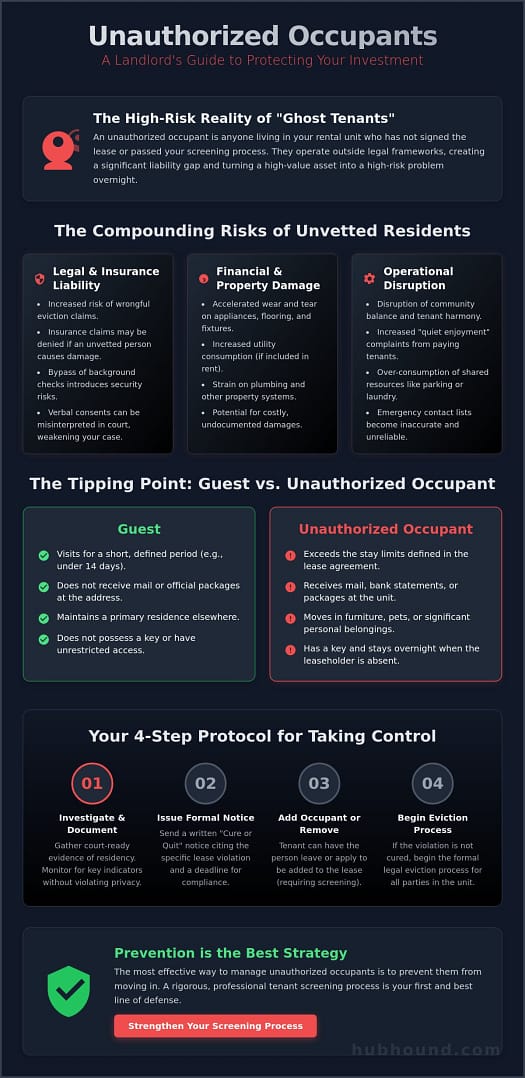
The distinction between a “guest” and a “permanent resident” is often a matter of duration and intent. A guest visits for a short period, typically defined in the lease as no more than 14 consecutive days. A permanent resident, however, establishes a domicile by moving in personal belongings, receiving mail at the address, or staying beyond the agreed-upon limits. Never rely on informal handshake agreements or verbal permissions. These casual arrangements often backfire during litigation; a court may interpret your silence or verbal consent as a waiver of your right to enforce lease occupancy limits.
The Legal Liability of “Ghost” Tenants
Unvetted individuals represent a significant security gap. Because they bypass your standard background check protocols, you’ve no insight into their criminal history or past evictions. This lack of transparency increases the risk of illegal activity occurring on-site. Insurance companies often base their coverage on the number of vetted occupants. If a major liability event occurs, such as a fire or injury, and an unauthorized resident is found to be the cause, your carrier may deny the claim. This leaves you personally liable for damages that should’ve been covered by your policy.
Financial and Operational Impacts
Unauthorized occupancy accelerates property depreciation. You’ll notice increased wear and tear on flooring, cabinetry, and expensive appliances that weren’t intended for high-density use. Plumbing systems often face strain beyond their designed capacity, leading to frequent maintenance calls. Beyond the physical structure, “ghost” tenants disrupt the community balance. They consume shared resources like parking spaces and laundry facilities, often leading to “quiet enjoyment” complaints from your paying tenants. This friction can drive away high-quality residents who value the security of a professionally managed building. Without a clear record of who is living in your unit, your emergency safety protocols and contact lists become essentially useless during a crisis.
Distinguishing Long-Term Guests from Permanent Residents
The line between a social visitor and a legal resident is often defined by the concept of “exclusive possession.” If an individual has a key, stays overnight when the leaseholder isn’t present, or moves in furniture, they’ve likely crossed the threshold into residency. Your lease agreement must be the primary tool for defining these boundaries. Professional contracts typically cap guest stays at 14 days within any six-month period. Once a person exceeds this limit, they’re no longer a guest; they’re an unauthorized occupant.
Identify the red flags early to protect your investment. When you suspect a breach, your first priority is determining what to do when a tenant has unauthorized occupants based on documented facts. If you fail to act, you may inadvertently grant the occupant legal rights that require you to follow a formal legal eviction process, even if they never signed a contract. Proactive enforcement prevents a guest from gaining the status of a “tenant at sufferance,” which complicates your ability to regain control of the unit.
The “Residency Indicators” Checklist
Look for concrete evidence that proves a shift in residency status. These indicators serve as the foundation for any legal action or lease violation notices you may issue. Monitor the property for these specific markers:
- Mail and Packages: Consistent delivery of mail, bank statements, or subscription packages in the individual’s name to your property address.
- Personal Property: The presence of significant furniture items, large electronics, or pets that were not authorized in the original lease agreement.
- Access Control: Evidence that the individual possesses a physical key, a keyless entry code, or a dedicated parking permit provided by the tenant.
Guest Policies: Setting Clear Boundaries
Draft guest policies that are enforceable and leave no room for interpretation. Specify the exact number of overnight stays permitted per month or year. Use a rolling calendar to calculate these limits; this prevents tenants from attempting to reset the clock at the start of a new month. Clearly state that any individual staying beyond these limits must undergo your standard landlord/tenant screening process and be formally added to the lease. This ensures every adult on the premises is vetted and remains legally accountable for the property’s condition.
Investigative Strategies to Gather Court-Ready Evidence
Amateur observations aren’t enough to sustain a legal challenge. To understand what to do when a tenant has unauthorized occupants, you must move beyond suspicion and toward rigorous data collection. Courts require concrete proof that an individual has established residency rather than just visiting. Relying on neighbor gossip or blurry smartphone photos often leads to dismissed claims or, worse, accusations of tenant harassment. Professional Advanced Surveillance Techniques provide the neutral, third-party documentation needed to prove a lease violation without bias.
Supporting evidence can also be found in operational data. Monitor utility bills for sudden, unexplained spikes in water or electricity usage that don’t align with the number of authorized tenants. Trash inspections may reveal discarded mail or packaging addressed to the unauthorized individual at your property. When combined with a professional guide to dealing with unauthorized occupants, these data points create a comprehensive narrative of residency that is difficult for a tenant to refute in a formal hearing.
Surveillance and Pattern Documentation
Professional investigators focus on documenting “life patterns” to establish residency. This typically involves a 72-hour observation period to track the frequency of entry and exit. Investigators record when the individual arrives at night and departs in the morning, especially if they possess their own key or entry code. This time-stamped video and photo evidence is essential for proving the person isn’t just a guest. It’s critical to ensure these operations remain legal; professional surveillance focuses on public view and avoids illegal stalking or privacy violations that could jeopardize your case.
Skip Tracing and Identity Verification
Skip tracing is a powerful tool for identifying an occupant’s true primary address. By utilizing specialized databases, you can determine if the individual has registered for utilities, car insurance, or voting at your rental property. If their “paper trail” leads directly to your unit while they claim to live elsewhere, you have a clear case of unauthorized occupancy. You can also use these investigative strategies to check for a criminal history. Identifying a high-risk individual on your property allows you to prioritize the safety of other residents and strengthens your justification for immediate formal action.
Taking Formal Action: Notices and Legal Compliance
Once your investigation confirms a breach of contract, you must pivot from observation to enforcement. Knowing exactly what to do when a tenant has unauthorized occupants requires disciplined adherence to a legal timeline. Your lease is the primary blueprint for this process. Review the occupancy clause to confirm the specific language regarding “permanent residents” versus “guests.” Most professional agreements explicitly state that any stay exceeding a specific duration requires a formal application. If the tenant’s bypassed this requirement, they’ve initiated a material breach of the lease terms.
Follow a structured sequence to ensure your actions remain defensible in court. First, issue a formal notice. Second, schedule a property inspection with the required 24 or 48-hour notice to document the physical presence of unauthorized individuals. Third, record the tenant’s response. If they claim the individual’s “just visiting,” counter this defense with the time-stamped surveillance and skip tracing data you gathered previously. If the occupant remains after the notice period expires, you must transition to formal eviction proceedings to regain exclusive possession of your unit.
The “Cure or Quit” Notice
A “Notice to Cure or Quit” is the standard instrument for resolving occupancy violations. To be valid, this document must include the specific names of the unauthorized occupants (if known), the dates the violation was observed, and the specific lease clause being violated. You must serve this notice through a legally recognized method, such as professional process service, to prove the tenant received it. Typically, the tenant has a window of three to ten days to “cure” the violation by having the occupant move out or by submitting an application for them to be added to the lease. If they fail to act, the notice “quits,” allowing you to file for eviction.
Navigating Fair Housing and Discrimination Risks
Consistency is your best defense against discrimination claims. You must enforce occupancy limits uniformly across your entire portfolio. If you only target certain units for “ghost” tenants, you open yourself to Fair Housing litigation. Document every step of your process to prove that your actions are based on lease violations rather than the protected status of the occupants. Never engage in “self-help” evictions. Changing locks, removing belongings, or terminating utilities are illegal actions that can result in massive statutory penalties. Stick to the legal process to ensure your resolution is both permanent and protected from countersuits.
Prevention: Strengthening Your Tenant Screening Process
Preventing unauthorized occupancy is significantly more cost-effective than removing an unvetted resident. While the previous sections detailed investigative and legal responses, the most efficient strategy for what to do when a tenant has unauthorized occupants is to ensure they never gain access to the property. This requires a shift from passive data collection to active due diligence. Every adult applicant must undergo a rigorous vetting process that extends beyond simple credit scoring. By establishing high barriers to entry, you filter out applicants who view lease agreements as mere suggestions rather than binding legal contracts.
Regular property inspections serve as a secondary layer of defense. Scheduling legal, pre-announced walk-throughs establishes a consistent presence that deters tenants from attempting to move in “ghost” residents. These visits allow you to verify that the occupants match the names on the lease and that the property’s condition aligns with your standards. This proactive approach signals to your tenants that you’re an attentive manager who prioritizes lease compliance. Partnering with a Corporate Investigation Firm ensures your due diligence protocols meet the highest professional standards in 2026.
Advanced Screening Protocols
Relying on automated credit checks is a common mistake for modern property owners. These tools often miss the nuances of high-risk behavior patterns. A professional Landlord/Tenant screening process involves deep-dive verification of previous landlord references to identify past occupancy issues or “professional tenants” who specialize in bypassing lease limits. You must verify the actual identity of reference sources to ensure they aren’t just friends or family members posing as former property managers. This selective filtering process identifies individuals who have a history of moving in unauthorized guests or subletting units without permission. High-quality screening is an investment in your property’s stability and long-term profitability.
The Role of Professional Investigation in Property Management
HubHound provides the specialized expertise needed to manage complex occupancy disputes. We support landlords with both pre-lease vetting and mid-lease investigations when red flags emerge. Having a licensed investigator on call allows you to address suspicious activity with quiet confidence and clear evidence. This professional oversight alleviates the stress of choice paralysis when you’re forced to decide between ignoring a violation or pursuing legal action. Our team handles the heavy lifting of research, ensuring your property remains a secure, high-performing asset. We provide the clarity you need to make informed decisions and protect your portfolio from unvetted liabilities.
Securing Your Rental Assets Through Professional Oversight
Protecting your property from unauthorized residents is a matter of consistent enforcement and technical due diligence. You’ve learned to identify the legal markers of residency and the importance of documenting life patterns through neutral, third-party observation. Knowing what to do when a tenant has unauthorized occupants allows you to act decisively, moving from suspicion to a legally defensible resolution. By prioritizing rigorous screening and formal notice protocols, you eliminate the liability of unvetted individuals and safeguard your long-term ROI.
Don’t let residency disputes compromise your investment or lead to costly litigation. HubHound provides the specialized expertise required to navigate these challenges with quiet confidence. We offer comprehensive nationwide screening services and deliver court-ready evidence and documentation. Our team consists of licensed investigators with over 30 years of experience who understand the nuances of property protection and civil compliance.
Take proactive control of your rental portfolio today. With the right investigative partner, you can ensure your property remains secure, compliant, and profitable for years to come.
Frequently Asked Questions
Can I evict a tenant for having a long-term guest?
Yes, you can evict if the guest’s stay violates the specific occupancy limits defined in your lease agreement. Most professional agreements treat unauthorized occupants as a material breach of contract. You’ll need to follow the legal process by first issuing a “Notice to Cure or Quit.” This gives the tenant a formal opportunity to remove the individual before you file a case in court to regain possession.
How long can a guest stay before they are considered a tenant?
The specific timeframe is typically defined in your lease agreement, often set at 14 consecutive days or 30 days total within a year. Beyond these limits, guests may gain legal residency rights that make removal difficult. Establishing a clear duration in your original contract is the most effective way to determine what to do when a tenant has unauthorized occupants before the situation escalates into a legal battle.
Is it legal to use surveillance to prove an unauthorized occupant is living there?
Yes, it is legal provided the surveillance is conducted in public areas where there is no reasonable expectation of privacy. Professional investigators focus on capturing individuals entering and exiting the property from the street or common areas. You shouldn’t record inside the unit or through windows, as this could lead to harassment claims. Documenting consistent overnight stays from a public vantage point is a standard investigative practice.
What evidence do I need to win an unauthorized occupant eviction case?
Winning an eviction case requires a combination of physical and digital documentation to prove residency. This includes time-stamped video of the individual’s daily patterns and photos of their vehicle parked overnight. Skip tracing reports that show the individual has registered utilities at your address are also vital. Knowing what to do when a tenant has unauthorized occupants means gathering evidence that leaves no room for denial in court.
Can I charge extra rent for an unauthorized occupant instead of evicting?
You can technically negotiate a lease amendment to include the additional person, but this is often a high-risk strategy. Accepting additional rent for an unvetted individual essentially grants them legal status without a background check. It’s better to require the occupant to pass your standard screening process before adding them to the lease officially. This ensures you don’t inherit a liability that compromises your insurance coverage.
Does accepting rent from a tenant who has an unauthorized occupant waive my right to evict?
It’s possible that accepting rent could waive your rights in the eyes of a judge. If you accept a payment while knowing an unauthorized person is living there, the court may rule that you’ve “waived” your right to enforce the occupancy limit. Always issue a formal notice of violation before accepting the next rent payment. This simple step preserves your legal standing and prevents the tenant from claiming your consent.
What if the unauthorized occupant is a family member or partner?
Lease agreements apply equally to all individuals, regardless of their relationship to the tenant. Family members and partners must still be screened and listed on the lease if they meet the residency criteria. Failing to enforce this consistently across your portfolio can lead to liability issues and potential fair housing complications. It’s essential to treat every adult resident as a legal party to the contract to ensure full accountability.
How do I handle a tenant who denies the occupant is living there?
Handle a denial by presenting objective, third-party evidence rather than engaging in a verbal dispute. Present your documented surveillance logs, skip tracing results, and inspection findings directly to the tenant. When a tenant realizes you have professional-grade proof of the violation, they’re much more likely to comply with a notice without a court battle. It’s about maintaining a professional distance while relying on verified facts to drive the resolution.

Article by
Joel R. Manley | President | Hubhound Investigations | OR PI-ID#: 90432 | 111 SW Fifth Avenue, Suite 3150 Portland, Oregon 97204 | 971-442-8170
Joel is licensed as a private investigator in Oregon and Tennessee. Joel started his career in 1987 serving as a Military Police Officer and Military Police Investigator.
After ending his military tour of duty, Joel became a civilian Police Officer and Deputy Sheriff. Joel took his strong background in Hostage Negotiations, Mediation and Conflict Resolution, with him to patrol some of the highest crime areas in SE Portland.
Joel was awarded Deputy of the Year for his efforts and for drastically reducing the crime rate in the area he patrolled. As a Deputy Sheriff, Joel assisted in leading a Neighborhood Livability Program that was nationally recognized for having the most innovative and progressive approach to policing.
In 2018, Joel retired as a Deputy Sheriff and founded Hubhound Investigations. Joel played an integral role in Hubhound Investigations receiving an A+ Accredited Business rating from the Better Business Bureau (BBB).
In his off time, Joel enjoys spending time with his wife, adult children and Hubhound’s Happiness Ambassador, Nya. Joel also enjoys Scuba Diving and Kayaking.
Disclaimer
DISCLAIMER: This article is provided for general informational and educational purposes only. It is not intended to constitute legal advice, professional investigative advice, or instruction to engage in any unlawful activity. Laws governing private investigations, surveillance, recording, tracking, access to information, evidence collection, privacy, trespass, licensing, and related investigative activities vary by jurisdiction and are subject to change.
Any investigative techniques, tactics, procedures, scenarios, or legal proceedings discussed in this article are presented for informational purposes and should not be interpreted as authorization or encouragement to use a particular method. Private investigators and members of the public are responsible for understanding and complying with all applicable federal, state, and local laws, licensing requirements, court rules, and professional standards.
The circumstances of every investigation and legal matter are different. Information contained in this article should not be relied upon as a substitute for advice from a qualified attorney or other appropriate licensed professional regarding a specific situation. No attorney-client, investigator-client, or other professional relationship is created by reading or using this information.