
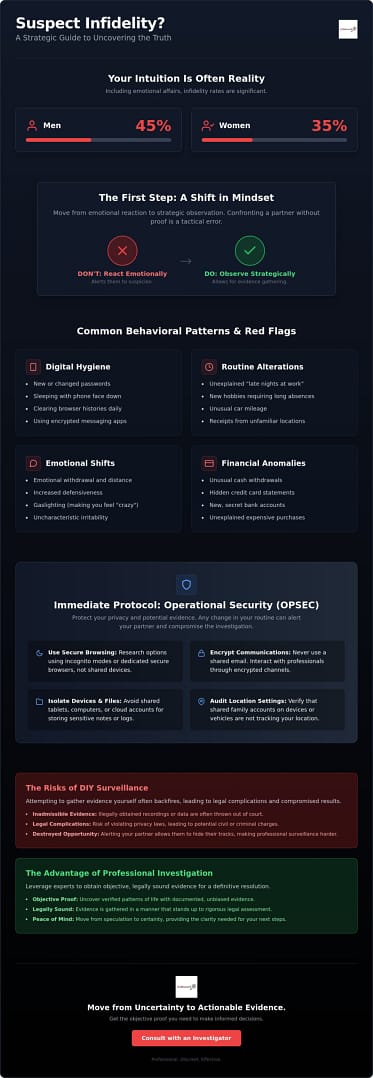
According to the American Association for Marriage and Family Therapy, infidelity rates rise to 45% for men and 35% for women when emotional affairs are included. These figures confirm that your intuition is likely grounded in reality, even if you currently feel gaslit or uncertain. Deciding what to do if you suspect your partner is cheating is a high-stakes process that requires a shift from emotional reaction to strategic observation. You’re likely worried about the legal boundaries of privacy or the potential impact on future divorce proceedings.
It’s natural to feel overwhelmed by the complexity of modern digital footprints and the anxiety of an unknown future. You deserve objective proof and the emotional peace of mind that comes with knowing the truth. This article provides the precise, legally sound steps to move from suspicion to clarity using professional investigative standards. We’ll outline how to identify high-quality evidence, protect your own digital privacy, and ensure you have the necessary documentation for any potential legal transitions.
Key Takeaways
- Establish operational security immediately to protect your privacy while transitioning from emotional suspicion to a structured investigative framework.
- Discover what to do if you suspect your partner is cheating by identifying specific behavior shifts that warrant a professional infidelity investigation.
- Avoid the common pitfalls of DIY surveillance that often result in inadmissible evidence or legal complications during divorce and custody proceedings.
- Leverage professional surveillance operations to uncover objective patterns of life and verified proof that stands up to rigorous legal assessment.
- Move toward a definitive resolution by integrating professional investigative reports into your broader legal and personal strategy.
Validating Your Instincts: The First Steps of a Targeted Investigation
An infidelity investigation is a professional process of verifying or disproving marital misconduct through systematic evidence gathering. When you’re deciding what to do if you suspect your partner is cheating, your first step must be a shift from emotional distress to objective data collection. A “gut feeling” is rarely a random occurrence. It’s often your subconscious recognizing subtle deviations from a long-established baseline of behavior. However, you must distinguish between temporary, stress-related irritability and systemic patterns of deception. While work pressure might cause a spouse to be quiet, it doesn’t typically lead to encrypted messaging apps or hidden bank accounts. When defining infidelity, researchers look at breaches of trust that violate core relationship expectations. Professionally, we look for the physical and digital manifestations of those breaches.
Common Behavioral Patterns and Red Flags
Deception leaves a trail. You’re looking for specific indicators that suggest a secondary life is being maintained. These red flags often manifest in four primary areas:
- Digital Hygiene: This includes setting new passwords, sleeping with a phone face down, or clearing browser histories daily.
- Routine Alterations: Look for unexplained “late nights at the office” or new hobbies that require long periods of absence without a clear output.
- Emotional Shifts: Withdrawal is common, often paired with defensiveness or gaslighting, where your partner makes you feel “crazy” for asking basic questions.
- Financial Anomalies: Watch for cash withdrawals that don’t match typical spending habits or hidden credit card statements.
Trusting Your Intuition Without Acting Prematurely
Confronting a partner without evidence is a tactical error. It alerts them to your suspicion, allowing them to delete messages, scrub call logs, and move their activities further underground. If you want to know what to do if you suspect your partner is cheating, the most effective strategy is to maintain a “business as usual” demeanor. This approach keeps the subject at ease while you discreetly document “soft evidence” like car mileage, receipts from unfamiliar locations, or unusual ATM withdrawals. Infidelity surveillance is a neutral fact-finding mission that utilizes professional observation to confirm or disprove suspicions of misconduct. Transition to professional verification once these patterns become too consistent to ignore. This move ensures that your next steps are based on documented reality rather than speculation.
Immediate Protocol: Protecting Your Privacy and Potential Evidence
Securing your own digital footprint is the first defensive measure when addressing marital suspicion. In the professional world, we refer to this as Operational Security, or OPSEC. If your partner is engaging in deception, they’re likely hyper-aware of your behavior. Any sudden change in your routine, like searching for legal advice on a shared computer, can alert them to your suspicions. This “tipping of your hand” often causes the subject to destroy evidence or modify their behavior, making future surveillance significantly more difficult. Consulting an investigator early serves as a protective measure to ensure your legal interests remain intact before any evidence is purged. Stay under the radar.
Maintaining Operational Security (OPSEC)
OPSEC isn’t just for corporate environments; it’s essential for anyone navigating the complexities of what to do if you suspect your partner is cheating. To maintain a strategic advantage, follow these protocols:
- Use Secure Browsing: Only research investigative services or legal options using incognito modes or dedicated secure browsers.
- Encrypt Communications: Ensure your interactions with professionals are through encrypted channels. Never use a shared email address.
- Isolate Devices: Avoid using family tablets or shared cloud accounts for sensitive notes or evidence logs.
- Audit Location Settings: Many modern vehicles and devices share locations across family accounts. Verify your own settings to ensure you aren’t being tracked while meeting with advisors.
Avoiding the Pitfalls of Immediate Confrontation
The impulse to confront a partner immediately after noticing signs of infidelity is strong, but often counterproductive. Accusations without documented proof typically result in “temporary behavior modification.” The cheater doesn’t stop the activity; they simply become more sophisticated at hiding it. This makes it much harder for a professional to track their “patterns of life” during later stages. By remaining quiet, you retain the psychological upper hand and allow the truth to reveal itself through uninhibited actions. Professional investigators provide the clarity confrontation cannot, delivering objective reports that are far more effective than an emotional argument.
Modern surveillance techniques require professional handling to remain within legal boundaries and ensure evidence is admissible. If you find yourself stuck in a cycle of doubt, initiating a formal infidelity investigation can provide the verified answers you need to move forward with confidence.
The Risks of DIY Surveillance vs. Professional Investigative Standards
Knowing what to do if you suspect your partner is cheating involves understanding where your rights as a spouse end and legal liabilities begin. The gap between a spouse’s curiosity and a licensed investigator’s authority is wide. DIY surveillance frequently crosses into illegal territory, creating liabilities that can destroy a legal case before it even begins. While you may feel justified in your search for the truth, the law does not grant spouses special permissions to bypass privacy protections. Engaging in amateur “tailing” or stalking-like behavior also carries significant physical risks, potentially escalating a sensitive situation into a dangerous confrontation.
While recognizing the signs of a cheating partner is a necessary starting point, acting on those signs without a legal framework is a significant risk. Using a platform like HubHound helps you identify professional investigators who operate within strict legal standards. This ensures your search for clarity doesn’t result in a legal catastrophe or personal harm.
Understanding Privacy Laws and Illegal Monitoring
Spyware and GPS trackers are common tools in DIY attempts, but their use without professional oversight is a legal minefield. Most jurisdictions have strict laws regarding electronic tracking and wiretapping. If you install software on a device you don’t own or place a tracker on a vehicle without proper authorization, you risk criminal charges. Trespassing on private property to capture photos also violates established “expectation of privacy” rules. These actions often lead to counter-suits that shift the focus from your partner’s misconduct to your own illegal evidence gathering. Illegal actions can even lead to a judge dismissing your evidence entirely.
Why Professional Evidence Holds Weight
Professional evidence is valuable because it follows a strict chain of custody. This process ensures that digital and physical evidence is handled in a way that prevents tampering or contamination. Licensed investigators serve as neutral, third-party witnesses whose testimony carries weight in civil litigation and divorce cases. They are trained to operate in public spaces where no expectation of privacy exists, ensuring every captured moment is legally sound. Consider the difference between a grainy, handheld cell phone photo and professional, time-stamped surveillance footage. High-definition evidence provided by an expert is far more difficult to dispute during a deposition or trial. This level of quality provides the legal protection you need for potential custody or asset proceedings.
Strategic Evidence Gathering: How Professional Investigations Work
Professional investigation is a structured methodology that moves from initial intake to a final, verified report. When you’re determining what to do if you suspect your partner is cheating, you must transition from passive worry to active, strategic evidence gathering. Investigators begin by establishing a subject’s “patterns of life.” This involves documenting their daily routines to identify deviations that predict clandestine meetings. By understanding where a subject usually goes and who they interact with, professionals can deploy resources at the precise moments when misconduct is most likely to occur. This level of workplace investigations rigor ensures that every finding is backed by a clear chain of events rather than isolated incidents.
High-tech equipment plays a critical role in maintaining discretion while securing documentation. Long-range lenses, night-vision optics, and specialized vehicle-mounted cameras allow investigators to capture clear imagery from distances that prevent detection. This technical advantage is combined with skip tracing and comprehensive background checks to identify the “third party” involved. Uncovering the identity of an associate provides a more complete picture of the situation, allowing your legal counsel to evaluate potential impacts on marital assets or future litigation. Due diligence in a personal relationship is the process of conducting a thorough, objective assessment to verify facts and mitigate emotional or financial risk.
The Role of Discreet Physical Surveillance
Effective surveillance operations often involve multiple vehicles and coordinated teams to remain undetected. This “leapfrog” technique prevents a subject from noticing a single car following them over long distances or through complex traffic. Investigators prioritize documenting interactions in public spaces to establish a preponderance of evidence. This legal standard refers to evidence that makes a claim more likely to be true than not. The output of this effort is time-stamped, high-definition video that provides undeniable proof of infidelity, leaving no room for the gaslighting or denials common in DIY confrontations.
Leveraging Background Checks and Digital Footprints
Beyond physical observation, professionals utilize proprietary databases to examine digital footprints. This process identifies hidden social media profiles, secondary communication channels, or “burner” accounts that are invisible to standard search engines. Asset searches are also vital. They can reveal hidden spending on travel, gifts, or second residences that may constitute a dissipation of marital assets. By combining physical surveillance with digital discovery, an investigator provides a 360-degree view of the subject’s activities. If you are ready to move from suspicion to documented fact, you can find a licensed investigator to begin a formal case assessment today.
Executing a Resolution: Moving from Uncertainty to Actionable Evidence
The conclusion of a professional investigation marks the end of ambiguity. When you’re determining what to do if you suspect your partner is cheating, the ultimate goal is a resolution backed by objective data. Once the surveillance operations are complete, you’ll receive a comprehensive investigative report. This document is a strategic asset. You should review it immediately with your legal counsel to determine its weight in potential divorce or custody proceedings. Transitioning from the active investigation phase to the legal or reconciliation phase requires a clear head and a factual foundation. Having the truth in hand eliminates the anxiety of being gaslit and allows you to make life-altering decisions with total confidence.
To navigate the emotional aftermath of these findings, many people turn to professional counseling; you can visit Martin Hogg (Private Practice Success) to see how therapists and counsellors use specialized coaching and accredited CPD training to maintain the highest standards of care in their private practices.
Evaluating Your Investigative Options
Selecting a partner for an infidelity investigation requires a focus on professional standards and niche expertise. Vet potential firms based on their adherence to national standards and their experience with civil litigation support. A reputable agency provides full transparency regarding their hourly rates and the frequency of surveillance reporting. You shouldn’t feel left in the dark about the progress of your case. Additionally, ensure the firm utilizes robust confidentiality agreements. Protecting your privacy and the integrity of the evidence is paramount during such a sensitive transition. Look for investigators who treat your time and resources with the same respect they would a corporate client.
How a Professional Agency Provides Clarity
The psychological shift from suspecting to knowing is a powerful catalyst for personal growth. It ends the cycle of self-doubt that often accompanies marital suspicion. Beyond emotional relief, professional reports offer tangible advantages during negotiations. You can use verified evidence of misconduct to negotiate more favorable terms in a settlement, especially if marital assets were diverted to support an affair. A thorough, expert-led investigation provides the peace of mind that comes from knowing the facts are documented and authenticated. This clarity is the first step toward a future built on reality rather than deception, allowing you to eventually discover Redhead Dates or other niche communities to find a partner who truly aligns with your life.
Don’t let uncertainty dictate your future or compromise your legal standing. If you’re ready to move from suspicion to documented proof, consult with HubHound’s expert investigators for a confidential assessment of your situation.
Securing Your Future with Professional Clarity
Moving from suspicion to certainty requires a disciplined approach that prioritizes your legal and emotional well-being. You’ve learned that maintaining operational security is your first line of defense, preventing a deceptive partner from further hiding their trail or destroying evidence. By choosing professional verification over risky DIY tactics, you ensure that every piece of evidence gathered is admissible in potential court proceedings. This strategic shift from emotional reaction to objective observation is the most effective way to handle what to do if you suspect your partner is cheating.
HubHound connects you with licensed investigators who bring over three decades of experience to every case. You’ll receive court-ready evidence and professional reporting that adheres to strict national confidentiality standards. Don’t let doubt compromise your long-term stability or legal rights. You can contact HubHound for a confidential consultation on your case to begin the process of reclaiming your peace of mind. You deserve the truth, and you don’t have to find it alone. Taking this step ensures you move forward with the strength of verified facts behind you.
Frequently Asked Questions
Is it legal to track my partner’s car if I suspect them of cheating?
Tracking a vehicle without legal authorization or ownership is generally illegal and can result in criminal charges. Most states regulate GPS use strictly; unauthorized tracking often falls under stalking or harassment statutes. Professional investigators understand these boundaries and use surveillance operations to gather evidence legally. This ensures that any proof obtained remains admissible in court and doesn’t expose you to potential counter-suits or civil legal liabilities during your proceedings.
How much does a professional infidelity investigation typically cost?
Investigation costs depend on the scope of surveillance and the specific resources required for your case. Most professional firms operate on an hourly basis, with additional fees for specialized reports or background checks. Because every situation is unique, you should request a confidential consultation to receive an accurate assessment. This transparency allows you to manage your budget while securing the high-quality evidence needed for a legal or personal resolution.
Can I use text messages or emails I found as evidence in a divorce?
Text messages and emails are admissible in divorce proceedings provided they can be authenticated and were obtained legally. Courts require proof that the digital evidence hasn’t been altered, often necessitating metadata or expert verification. If you accessed an account without permission, a judge might exclude that evidence. Professional investigators handle digital discovery with a strict chain of custody to ensure your proof stands up to rigorous legal scrutiny.
What happens during a professional surveillance operation?
During surveillance, licensed professionals use discreet vehicles and long-range lenses to monitor a subject’s movements in public. They focus on identifying “patterns of life” to determine when and where clandestine meetings occur. The goal is to capture high-definition, time-stamped video of interactions that confirm or disprove misconduct. This objective documentation provides a factual basis for your next steps, removing the need for speculation or emotional arguments during a difficult time.
How long does a typical infidelity investigation take to complete?
The duration of an investigation depends on the subject’s current activity level and how frequently they deviate from their normal routine. While some cases provide clarity within forty-eight hours, more complex scenarios involving travel or erratic schedules may take several weeks. Investigators aim for efficiency by using strategic planning to target high-probability windows. This targeted approach ensures you receive actionable evidence without unnecessary delays or extended surveillance costs.
Should I confront my partner before I hire a private investigator?
You shouldn’t confront your partner before securing professional evidence. Confrontation warns the subject, causing them to hide their activities more effectively or delete incriminating digital footprints. This “tipping of your hand” makes it significantly harder for an investigator to document authentic behavior later. If you’re unsure what to do if you suspect your partner is cheating, stay quiet and maintain your normal household routine while professionals gather the truth.
Will my partner find out that I have hired an investigator?
Licensed investigators use specialized techniques and equipment specifically designed to prevent detection by the subject. If you follow strict operational security protocols at home, such as using private browsers and encrypted communication, the risk of your partner finding out is extremely low. Professionals are trained to blend into the environment and maintain a safe distance. Their primary objective is to remain a neutral, invisible observer throughout the entire investigative process.
What if the investigator finds no evidence of cheating?
An investigation that finds no evidence of misconduct provides essential clarity and can often disprove false suspicions. If a professional finds no signs of an affair after thorough surveillance, it suggests the behavior shifts you noticed may stem from other stressors. This outcome is just as valuable as a positive finding because it allows you to address relationship issues from a position of fact. It’s a critical component of deciding what to do if you suspect your partner is cheating.

Article by
Joel R. Manley | President | Hubhound Investigations | OR PI-ID#: 90432 | 111 SW Fifth Avenue, Suite 3150 Portland, Oregon 97204 | 971-442-8170
Joel is licensed as a private investigator in Oregon and Tennessee. Joel started his career in 1987 serving as a Military Police Officer and Military Police Investigator.
After ending his military tour of duty, Joel became a civilian Police Officer and Deputy Sheriff. Joel took his strong background in Hostage Negotiations, Mediation and Conflict Resolution, with him to patrol some of the highest crime areas in SE Portland.
Joel was awarded Deputy of the Year for his efforts and for drastically reducing the crime rate in the area he patrolled. As a Deputy Sheriff, Joel assisted in leading a Neighborhood Livability Program that was nationally recognized for having the most innovative and progressive approach to policing.
In 2018, Joel retired as a Deputy Sheriff and founded Hubhound Investigations. Joel played an integral role in Hubhound Investigations receiving an A+ Accredited Business rating from the Better Business Bureau (BBB).
In his off time, Joel enjoys spending time with his wife, adult children and Hubhound’s Happiness Ambassador, Nya. Joel also enjoys Scuba Diving and Kayaking.
Disclaimer
DISCLAIMER: This article is provided for general informational and educational purposes only. It is not intended to constitute legal advice, professional investigative advice, or instruction to engage in any unlawful activity. Laws governing private investigations, surveillance, recording, tracking, access to information, evidence collection, privacy, trespass, licensing, and related investigative activities vary by jurisdiction and are subject to change.
Any investigative techniques, tactics, procedures, scenarios, or legal proceedings discussed in this article are presented for informational purposes and should not be interpreted as authorization or encouragement to use a particular method. Private investigators and members of the public are responsible for understanding and complying with all applicable federal, state, and local laws, licensing requirements, court rules, and professional standards.
The circumstances of every investigation and legal matter are different. Information contained in this article should not be relied upon as a substitute for advice from a qualified attorney or other appropriate licensed professional regarding a specific situation. No attorney-client, investigator-client, or other professional relationship is created by reading or using this information.