
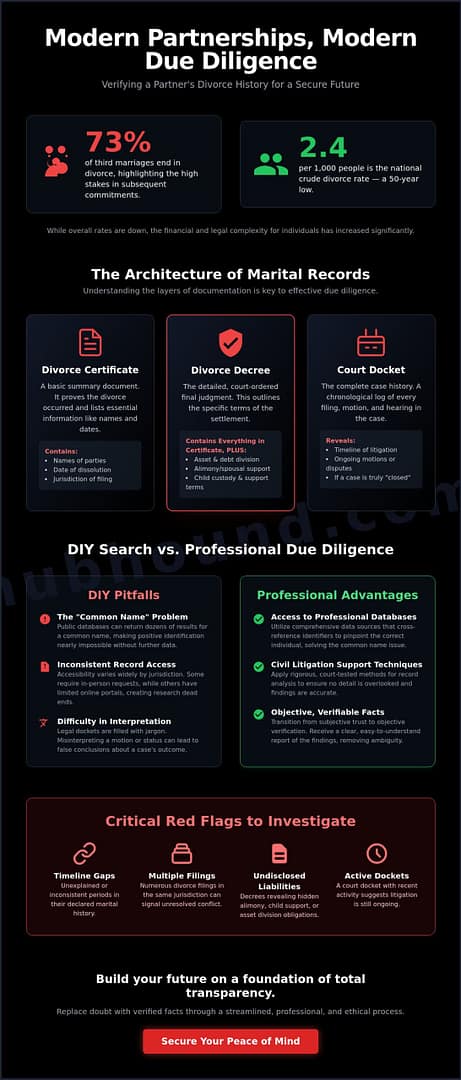
As of 2026, approximately 73% of third marriages in the United States end in divorce. While the national crude divorce rate has reached a 50 year low of 2.4 per 1,000 people, the stakes for high value personal commitments remain exceptionally high. It’s natural to feel a sense of anxiety when a partner’s past seems inconsistent or opaque. You deserve total transparency before merging your life or finances with another person, but the task of verifying a potential partner’s divorce history often feels like an invasive or confusing hurdle.
This guide provides a professional standard for conducting personal due diligence to protect your interests. You’ll learn how to validate marital claims while navigating recent legislative shifts that have restricted public access to sensitive records across various jurisdictions. We’ll preview the rigorous assessment methods used in civil litigation support to uncover hidden legal histories, ensuring you can replace doubt with verified facts through a streamlined and ethical process.
Key Takeaways
- Distinguish between summary certificates and full legal decrees to understand the depth of financial and custodial data available in public records.
- Master the process of verifying a potential partner’s divorce history by leveraging professional databases that resolve the “common name” identification problem.
- Identify critical red flags, such as unresolved timeline gaps or multiple filings in a single jurisdiction, that may indicate hidden legal liabilities or undisclosed assets.
- Apply rigorous civil litigation support techniques to transition from subjective trust to objective verification for high-stakes personal and financial commitments.
- Learn how to interpret complex court dockets and present findings constructively to ensure your future partnership is built on a foundation of total transparency.
The Importance of Verifying Divorce History in Modern Partnerships
In 2026, the landscape of personal commitment has shifted toward a model of radical transparency. With the median age for first marriages reaching an all-time high of 30.8 for men and 28.4 for women, individuals are entering partnerships with more extensive financial and legal histories than ever before. This delay in marriage often means more complex previous relationships, making verifying a potential partner’s divorce history a standard component of modern due diligence. It isn’t about a lack of trust; it’s about establishing a verified foundation for a shared future. Treating personal commitments with the same rigor as corporate due diligence ensures that both parties are protected from the start.
The legal framework surrounding Divorce in the United States is intricate and varies significantly across different jurisdictions. While the overall crude divorce rate has hit a 50 year low of 2.4 per 1,000 people, the complexity of these filings has increased. High asset divisions, ongoing litigation, and evolving privacy laws mean that a simple verbal confirmation is rarely sufficient for high stakes decisions. Validating marital claims helps you avoid the “common name” identification errors that often plague DIY searches, providing a clear view of any existing legal obligations that could impact your joint assets or tax filings.
Protecting Your Financial and Legal Integrity
Undisclosed liabilities from a previous marriage can jeopardize your financial health. Alimony payments and child support obligations directly affect debt to income ratios, which can complicate everything from mortgage approvals to investment strategies. More critically, an incomplete or improperly filed divorce can technically invalidate a secondary marriage. Utilizing civil litigation support to review court dockets ensures that a previous union was fully dissolved. This level of verification identifies “multiple filings” or unresolved motions that might indicate ongoing legal friction or hidden financial claims. It’s a necessary step to mitigate the risk of entering a partnership that is legally compromised from day one.
The Psychology of Verification
Moving past the stigma of “snooping” requires a shift to a safety first mindset. Professional verification preserves the relationship by replacing nagging doubts with objective facts. When you approach verifying a potential partner’s divorce history as a professional standard, you remove the emotional volatility of the discovery process. It creates an ethical framework where transparency is prioritized over assumptions. By doing the heavy lifting of research early, you allow the relationship to grow without the shadow of undisclosed legal baggage. This proactive approach doesn’t just protect your bank account; it provides the ultimate peace of mind for your emotional well being.
Understanding the Architecture of Marital and Divorce Records
Effective due diligence starts with understanding that documentation exists in layers. When you’re verifying a potential partner’s divorce history, you’ll encounter three primary record types: certificates, decrees, and dockets. A divorce certificate serves as a basic summary. It’s often used for administrative purposes like name changes or applying for a new marriage license. However, a Divorce Decree is the court-ordered document outlining the final terms of a dissolution. While the certificate proves the event happened, the decree details the legal judgment. For those looking for the full narrative, the court docket provides a chronological log of every filing, hearing, and motion within the case. Jurisdictional differences mean that accessibility varies. Some regions provide robust online portals, while others still rely on antiquated paper filing systems.
The case for checking his background before merging lives is rooted in financial and personal safety. Understanding these record layers allows you to see the difference between a “paper” divorce and a truly finalized legal separation. If you find a docket with recent activity, it suggests the litigation is active. This can mean unresolved custody battles or ongoing asset disputes that may impact your future. Identifying whether a case is closed or ongoing is a critical step in risk mitigation.
Public vs. Private Records: What is Accessible?
Most basic case information is standard public record. This includes the names of the parties, the filing date, and the final judgment date. However, courts often seal specific sensitive information to protect privacy. Financial affidavits, social security numbers, or detailed child custody schedules are frequently restricted. As of 2026, there’s a growing legislative trend toward restricting public access to the sensitive personal and financial information contained in these files. If a record is fully sealed, you’ll need a court order or the consent of a party to access the details. Knowing what is legally available helps you set realistic expectations for your search.
Digital vs. Physical Archives
When verifying a potential partner’s divorce history, relying solely on “instant” digital tools can lead to significant gaps in your due diligence process. These databases rely on scraped data that may not update in real time. For historical accuracy, the Clerk of Court remains the definitive source. Physical archives often contain the nuanced details that digital summaries omit. If you require a high level of certainty, utilizing civil litigation support to perform a targeted search at the local courthouse is the most reliable method. This ensures you aren’t relying on outdated or incomplete digital snapshots that might miss recent or complex filings.
DIY Record Searches vs. Professional Investigative Due Diligence
Attempting to handle the process of verifying a potential partner’s divorce history through automated consumer tools often yields fragmented or inaccurate results. These platforms aggregate data from public social profiles and outdated court indexes, creating a high risk of “false positives.” If your subject has a common name, an automated algorithm might associate them with a divorce filing from a different individual in a different jurisdiction. Professionals mitigate this by cross-referencing secondary identifiers, such as previous addresses and date of birth records, to ensure identity matches with absolute certainty. This filtering process is what separates a casual search from a professional standard of due diligence.
Legal compliance is a critical differentiator that DIY methods ignore. As of 2026, a growing number of jurisdictions have passed legislation to restrict public inspection of divorce records to protect personal information. Attempting to bypass these privacy protections through improper data collection can expose you to significant legal liability. Professional investigators operate within these evolving legal frameworks, ensuring that any information gathered is obtained ethically. This ensures the data remains admissible if it’s ever required for civil litigation support or other formal proceedings.
The Limitations of Consumer Background Check Sites
Consumer sites sell convenience at the expense of accuracy. They rely on “scraped” data that often fails to reflect recent filings or motions to seal records. These reports lack human oversight, meaning they can’t interpret the nuance of a “dismissed” case versus a “finalized” decree. High-tier corporate investigation firms provide a much higher tier of accuracy by utilizing a selective filtering process. They do the heavy lifting of research to ensure that the final report is both current and contextually accurate, saving you from making decisions based on incomplete snapshots.
The Value of a Licensed Private Investigator
A licensed investigator provides access to non-public proprietary databases and advanced skip-tracing tools that the general public cannot access. They can perform physical courthouse audits to retrieve un-digitized records or “gray divorce” filings that may be missing from digital archives. Beyond paper trails, investigators can use surveillance techniques to verify if a partner’s current living situation actually aligns with their legal claims. This multi-layered approach is the only reliable way to achieve total transparency when verifying a potential partner’s divorce history.
Identifying Red Flags and Inconsistencies in Marital History
Securing a copy of a record is only the first step in a professional due diligence process. The true value lies in the rigorous assessment of the narrative within those documents. When verifying a potential partner’s divorce history, you must look beyond the finality of the decree to identify patterns of behavior or undisclosed legal friction. Discrepancies between a partner’s verbal account and the official court docket often point to deeper issues that could impact your financial or personal security. Identifying these red flags early allows you to make informed decisions before significant commitments are made.
Common red flags found during a professional review include:
- Multiple Filings: Repeatedly filing for divorce and subsequently dismissing the case in the same jurisdiction often indicates high volatility or unresolved conflict.
- Missing Records: If a partner claims a divorce was finalized in a specific region but no record exists, it suggests either a fabrication or a failure to properly dissolve the union.
- Hidden Litigation: Divorce dockets often contain references to secondary legal actions, such as active restraining orders or domestic litigation, that are not immediately visible in a basic background check.
- Active Liens: Unresolved financial judgments or liens resulting from a settlement can follow an individual into a new partnership, creating shared liability.
Analyzing the Timeline of Dissolution
Inconsistencies in the timeline of a previous marriage are often the most telling indicators of a lack of transparency. Compare the stated separation date with the actual filing date recorded by the court. A significant gap or a “perpetually pending” status that spans several years suggests that the individual may not be legally free to remarry. Cross-referencing social media claims with legal filing dates can reveal if a partner was presenting themselves as “single” while still actively engaged in litigation. This level of scrutiny ensures that the narrative you’ve been given aligns with the documented reality.
Hidden Legal and Financial Entanglements
High-conflict cases often result in records being “sealed for cause,” which should trigger a more intensive investigation. While the specific details may be restricted, the existence of a sealed record during a period of claimed transparency is a significant data point. If your personal partnership also involves shared business interests, moving from a basic check to a workplace investigation may be necessary to protect your professional assets. This ensures that any undisclosed judgments or custodial disputes don’t bleed into your commercial operations. To ensure you have a complete and accurate picture of these risks, you should evaluate professional due diligence services that specialize in complex record retrieval and interpretation.
Securing Your Future Through Rigorous Verification
Achieving total transparency in a relationship requires moving beyond verbal assurances. Professional verification is the ultimate peace of mind for those entering high stakes personal commitments. By verifying a potential partner’s divorce history through authoritative channels, you replace uncertainty with a verified legal narrative. This process isn’t a sign of distrust; it’s a professional standard of due diligence. It ensures that your financial and emotional investments are built on a foundation of documented facts rather than curated claims. Choosing a specialized guide to handle this research allows you to maintain the integrity of your relationship while securing your personal interests.
Presenting your findings to a partner requires a constructive approach. If inconsistencies arise, frame the conversation around the shared goal of long term security. Explain that verifying a potential partner’s divorce history is a standard practice for protecting joint assets and ensuring legal compatibility. HubHound acts as your specialized expert curator in these moments, providing the niche expertise required to interpret complex court dockets. Our role is to do the heavy lifting of research, allowing you to focus on the health of your partnership with the confidence that no hidden legal liabilities remain undisclosed.
Discretion and Confidentiality
A primary concern for many individuals is the risk of alerting their partner to the search. Professional investigative firms prioritize discretion to ensure the subject is never aware of the inquiry. HubHound utilizes a selective filtering process to access records without leaving a digital footprint that could disrupt your daily life. We maintain rigorous data security protocols to handle sensitive findings with the highest level of professional care. This makes HubHound a trusted ally for civil litigation support and infidelity investigations, where confidentiality is the cornerstone of the process.
Actionable Next Steps
Initiating a professional verification is a streamlined process designed for the busy professional. To begin, you’ll need to provide basic identifiers such as the subject’s full name, approximate dates of previous marriages, and known past residences. This information allows our team to conduct a targeted search across multiple jurisdictions, bypassing the limitations of automated data scraping. You can contact HubHound for a confidential assessment of your situation to determine the most effective investigative plan. Whether you require corporate due diligence or a simple validation of marital claims, our goal is to deliver clarity through a reliable and efficient discovery process.
Establishing Total Transparency in Your Next Chapter
Protecting your personal and financial interests requires moving beyond verbal claims and incomplete digital snapshots. You’ve seen how the architecture of legal records varies and why a standard divorce certificate often lacks the depth needed for true risk mitigation. Professional verification resolves the identification errors common in DIY searches and identifies hidden legal entanglements that automated tools consistently miss. The process of verifying a potential partner’s divorce history is a vital step in modern due diligence; it ensures that your shared future is built on a foundation of verified facts.
Don’t leave your security to chance or outdated web scrapers. HubHound utilizes licensed investigators with over three decades of experience to conduct exhaustive searches through proprietary professional databases. We maintain strict confidentiality and data security protocols to ensure your inquiry remains completely private. Contact HubHound for a discreet and professional verification of any marital history to gain the clarity you deserve. Take control of your future with the confidence that comes from expert validation.
Frequently Asked Questions
Can I legally look up someone’s divorce records without their permission?
Yes, divorce records are generally considered public information throughout the United States. You don’t need the subject’s consent to access these documents through court clerks or public databases. However, legislative shifts in 2026 have begun to restrict public inspection of certain proceedings to protect personal privacy. While the existence of the divorce is typically public, the specific financial or custodial details may be restricted depending on the specific jurisdiction’s privacy laws.
How long does it take to professionally verify a divorce history?
A professional verification typically takes between three and seven business days to complete. While automated digital searches offer instant results, they often lack the depth required for high-stakes due diligence. A comprehensive investigation involves manual courthouse audits and the cross-referencing of proprietary databases to ensure accuracy. This timeline allows for the retrieval of un-digitized records and the resolution of any identity conflicts that may arise during the search.
What happens if a divorce record is sealed by the court?
If a record is sealed, the general public cannot access the specific terms of the decree or the underlying filings. A judge must be convinced that a compelling reason for privacy outweighs the public interest in transparency before granting a motion to seal. In these cases, a professional investigator can still confirm the existence of the case and identify related civil litigation or public dockets that remain accessible. This helps you understand the context of the filing even when primary documents are restricted.
Is a divorce certificate the same thing as a final divorce decree?
No, these are two distinct legal documents with different levels of detail. A divorce certificate is a summary document used primarily for administrative purposes like name changes. It only confirms that a divorce occurred. A final divorce decree is the judge’s signed order that outlines the specific legal judgment, including asset division and ongoing obligations. For the purpose of verifying a potential partner’s divorce history, the decree is the more valuable resource for risk mitigation.
How do I find out if someone is still legally married in another state?
You must conduct a search in every jurisdiction where the individual has established residency. Because there’s no single national database for marriages, professionals use skip tracing and locate investigations to identify a subject’s residential history first. Once these locations are identified, researchers query the specific county or state-level archives. This ensures that a perpetually pending divorce in a previous location doesn’t invalidate your current or future legal standing.
Can a private investigator find records that don’t show up on Google?
Yes, investigators access proprietary databases and physical archives that search engines cannot index. Google only surfaces a small fraction of digitized court records and often misses recent filings or historical paper archives. Professionals perform direct courthouse audits to retrieve documents that haven’t been uploaded to public portals. This specialized access is critical for uncovering records or complex litigation that automated consumer tools frequently overlook.
What information do I need to start a divorce record search?
You should provide the individual’s full legal name, date of birth, and a list of previous residential addresses. Having the name of the former spouse or the approximate year of the filing can also significantly accelerate the search process. These identifiers allow investigators to filter out false positives and ensure the records retrieved belong to the correct person. This precision is essential for verifying a potential partner’s divorce history without alerting the subject to the inquiry.
Is it possible for someone to hide a marriage or divorce entirely?
It’s difficult to hide a legal dissolution entirely, but it can be obscured by filing in remote jurisdictions or through name changes. If a record was never digitized or the court system has a significant backlog, it might not appear in basic background checks. A professional investigation uses multi-layered search strategies to track down these outliers. By analyzing timeline gaps in a person’s history, experts can identify the specific windows where an undisclosed marriage or divorce likely occurred.

Article by
Joel R. Manley | President | Hubhound Investigations | OR PI-ID#: 90432 | 111 SW Fifth Avenue, Suite 3150 Portland, Oregon 97204 | 971-442-8170
Joel is licensed as a private investigator in Oregon and Tennessee. Joel started his career in 1987 serving as a Military Police Officer and Military Police Investigator.
After ending his military tour of duty, Joel became a civilian Police Officer and Deputy Sheriff. Joel took his strong background in Hostage Negotiations, Mediation and Conflict Resolution, with him to patrol some of the highest crime areas in SE Portland.
Joel was awarded Deputy of the Year for his efforts and for drastically reducing the crime rate in the area he patrolled. As a Deputy Sheriff, Joel assisted in leading a Neighborhood Livability Program that was nationally recognized for having the most innovative and progressive approach to policing.
In 2018, Joel retired as a Deputy Sheriff and founded Hubhound Investigations. Joel played an integral role in Hubhound Investigations receiving an A+ Accredited Business rating from the Better Business Bureau (BBB).
In his off time, Joel enjoys spending time with his wife, adult children and Hubhound’s Happiness Ambassador, Nya. Joel also enjoys Scuba Diving and Kayaking.
Disclaimer
DISCLAIMER: This article is provided for general informational and educational purposes only. It is not intended to constitute legal advice, professional investigative advice, or instruction to engage in any unlawful activity. Laws governing private investigations, surveillance, recording, tracking, access to information, evidence collection, privacy, trespass, licensing, and related investigative activities vary by jurisdiction and are subject to change.
Any investigative techniques, tactics, procedures, scenarios, or legal proceedings discussed in this article are presented for informational purposes and should not be interpreted as authorization or encouragement to use a particular method. Private investigators and members of the public are responsible for understanding and complying with all applicable federal, state, and local laws, licensing requirements, court rules, and professional standards.
The circumstances of every investigation and legal matter are different. Information contained in this article should not be relied upon as a substitute for advice from a qualified attorney or other appropriate licensed professional regarding a specific situation. No attorney-client, investigator-client, or other professional relationship is created by reading or using this information.