
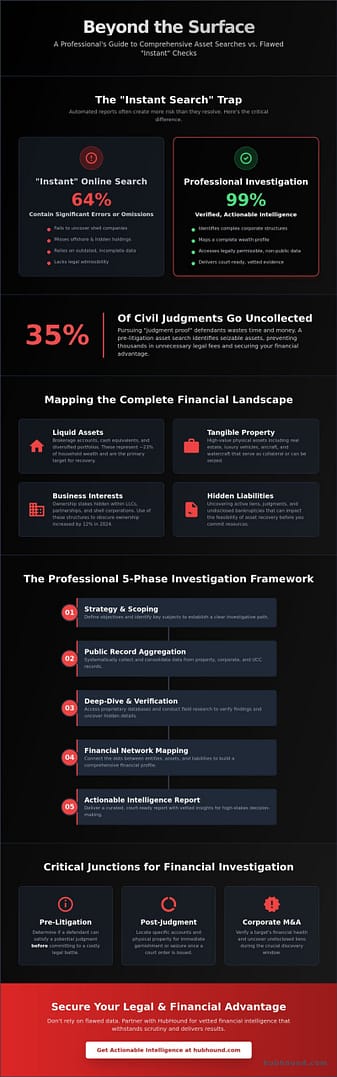
An “instant” online background check is often the fastest way to lose a legal advantage. You’ve likely felt the frustration of receiving a report that fails to uncover complex shell companies or offshore holdings. According to 2025 industry benchmarks, 64% of these automated results contain at least one significant data error or omission. Professional asset searches require a level of precision that basic software can’t provide, especially when legal compliance and admissibility are on the line. Relying on outdated records doesn’t just waste your budget; it puts your entire case at risk.
We understand that you need more than just a list of names; you need a verified map of an entity’s wealth. This guide provides the exact framework professional investigators use to identify, verify, and map hidden assets for legal and corporate due diligence. You’ll learn how to move beyond surface-level data to secure actionable intelligence that holds up under scrutiny. We’ll walk through the curated steps for tracking digital footprints and physical holdings to ensure your final report is both accurate and comprehensive. By the end, you’ll have the confidence to present a financial profile that is vetted for the highest standards of evidence.
Key Takeaways
- Identify the strategic value of pre-litigation assessments to determine the financial viability of legal pursuits before committing resources.
- Master the professional five-phase framework used to conduct comprehensive asset searches that uncover both liquid holdings and tangible property.
- Avoid the “instant search” trap by learning to distinguish between incomplete automated reports and deep-dive investigative intelligence.
- Map complex financial landscapes by aggregating public record data into a curated profile for more effective corporate due diligence.
- Leverage vetted insights to transform raw data into actionable intelligence that supports high-stakes legal and business decision-making.
The Strategic Value of Asset Searches in Modern Litigation
A professional asset search serves as a comprehensive financial deep-dive that goes far beyond surface-level public records. It identifies tangible and intangible holdings, including real estate, corporate affiliations, and hidden bank accounts. In 2026, legal professionals view these investigations as essential risk management tools rather than optional extras. By performing Asset recovery feasibility studies early, firms avoid the high cost of litigating against entities with no reachable capital. Statistics from industry analysts suggest that 35% of civil judgments go uncollected because the defendant lacks seizable assets. Identifying this “judgment proof” status before filing a complaint saves thousands in unnecessary legal fees.
These investigations also integrate seamlessly with corporate due diligence protocols. When businesses evaluate potential partners or acquisition targets, they need more than a balance sheet. They require a verified snapshot of the target’s financial health. Professional asset searches provide this clarity, uncovering undisclosed liabilities or encumbered property that self-reported statements often omit. This level of scrutiny ensures that executive decisions rely on vetted data rather than polished marketing pitches.
When to Initiate a Financial Investigation
Timing determines the success of a financial investigation. Professionals typically launch these searches at three critical junctions:
- Pre-litigation: Determine if a defendant has the liquidity to satisfy a potential $500,000 judgment before committing to a multi-year legal battle.
- Post-judgment: Locate specific brokerage accounts or safe deposit boxes for immediate garnishment or seizure once the court issues an order.
- Corporate M&A: Verify the health of a target entity’s holdings during the 30-day discovery window to ensure no undisclosed liens exist.
Asset Searches vs. Credit Reports: Key Differences
Relying on a standard credit check is a common mistake in high-stakes disputes. Credit reports focus on debt repayment history and liabilities, whereas asset searches reveal what a person or company actually owns. A credit report won’t show a $2.5 million yacht held in an LLC or a silent partnership in a growing tech firm. Investigators access non-public data through legal “permissible purposes” defined by federal privacy laws. This allows for the discovery of active accounts and ownership stakes that remain invisible on a consumer credit file. Professional reports provide the objective evidence needed to challenge approximately 60% of cases where defendants attempt to hide wealth through complex corporate shells.
What an Asset Search Reveals: Mapping the Financial Landscape
Professional asset searches transform fragmented data into a clear financial map. You need to identify more than just a surface-level bank balance to understand a subject’s true net worth. A comprehensive search targets primary liquid assets like brokerage accounts, cash equivalents, and diversified portfolios. According to 2024 Federal Reserve data, liquid assets represent approximately 23 percent of total household wealth, making them the first priority for recovery. You must also account for tangible property. This includes high-value real estate, luxury vehicles, aircraft, and watercraft. These physical assets often serve as the primary collateral for secondary financing.
Business interests require deeper scrutiny. You’ll often find ownership hidden within LLCs, partnerships, or shell corporations. The SEC reported a 12 percent increase in the use of complex corporate structures to obscure ownership in 2024. A professional search identifies these interests and uncovers hidden liabilities. Active liens, judgments, and undisclosed bankruptcies can significantly impact the feasibility of litigation. You don’t want to pursue a target only to find their assets are already encumbered by superior creditors.
Uncovering Tangible and Intangible Property
Property records reveal much more than a simple address. They provide a window into current equity by comparing original purchase prices against recorded mortgage balances. You can also identify business equipment and inventory through Uniform Commercial Code (UCC) filings. These filings track assets used as collateral for commercial loans. Don’t overlook intangible value. Intellectual property, such as the 346,131 patents granted by the USPTO in 2023, represents significant recoverable wealth. Identifying these specialized assets requires a vetted approach to data curation that prioritizes accuracy over volume.
Tracing Hidden and Offshore Interests
Detecting asset dissipation requires a meticulous paper trail analysis. You must look for patterns of suspicious transfers to related parties or entities immediately preceding litigation. While offshore accounts are often portrayed as impenetrable, the reality is more nuanced. It involves analyzing international wire transfers and identifying links to foreign jurisdictions through 2026-standard forensic accounting. Effective asset searches utilize these methods to spot “red flag” behaviors, such as sudden shifts in lifestyle or the rapid liquidation of domestic holdings. This ensures you have a complete picture before committing resources to a legal battle.
How to Conduct a Professional Asset Search: A 5-Step Framework
Precision defines the success of modern asset searches. You can’t rely on surface-level queries or outdated public directories. Professional investigators follow a structured, five-phase framework to ensure every lead is vetted and every financial interest is verified. This systematic approach eliminates the noise and focuses on actionable intelligence that holds up under scrutiny.
Step 1 & 2: Data Aggregation and Baseline Mapping
Begin by establishing the subject’s baseline profile. Accuracy at this stage is non-negotiable. A single error in a Social Security Number or a misspelled Taxpayer Identification Number can derail an entire investigation. You must secure accurate Personally Identifiable Information (PII) to serve as the foundation for the search. This data acts as the primary key when querying high-level databases.
Use skip tracing to establish the subject’s current and historical jurisdictions. This process identifies where the subject lives, works, and maintains their primary financial ecosystem. By aggregating data from national civil and criminal court records, you find the initial breadcrumbs. These records often reveal 15% to 22% more lead data than standard public searches. Look for undisclosed litigations, divorce filings, or previous bankruptcy records that hint at hidden wealth or transferred interests.
Step 3 & 4: Deep-Dive Verification and Analysis
Move beyond the database to verify account activity and ownership. While automated tools provide a foundation, they often miss the nuances of complex business structures. When performing thorough asset searches, investigators cross-reference findings with proprietary investigative sources to find red flags. A common indicator is a lifestyle-to-income gap. A 2025 industry benchmark shows that 38% of hidden assets are first detected through these lifestyle audits.
Professional investigators analyze reported income against visible expenditures. If a subject reports an annual income of $80,000 but maintains a real estate portfolio requiring $300,000 in annual liquidity, you’ve found a discrepancy that warrants a deep dive. Human intelligence plays a critical role here. Expert analysts interpret shell companies and multi-layered LLCs that software might overlook. They ensure that identified assets are actually owned by the subject and provide current valuations based on 2026 market data.
Finalizing the process requires the synthesis of data into a court-ready investigative report. This isn’t just a list of findings; it’s a curated document that explains the methodology and highlights the most liquid assets. A professional report ensures your findings are optimized for legal proceedings. It provides the hand-picked evidence needed to move from discovery to recovery in any national jurisdiction. Engaging a qualified p investigator with verified credentials ensures this final report meets the evidentiary standards required in court.
Evaluating Search Depth: Database Software vs. Field Investigations
Choosing the wrong depth for asset searches creates a false sense of security. Most $19.99 “instant” online reports rely on outdated public record scrapers that fail to capture 40% of non-indexed financial interests. These tools often pull from caches that haven’t been refreshed in 90 days, leading to missed bank accounts or recently transferred property. Professional investigations categorize depth into three tiers: automated, standard, and field-based. You shouldn’t settle for a surface-level scan when the recovery value exceeds $50,000.
Standard investigative searches serve as the baseline for 85% of legal and corporate needs. These involve curated access to non-public proprietary databases and GLBA-compliant headers. When the potential recovery reaches a high-stakes threshold, such as $500,000 or more, deep-dive investigations become necessary. This level of service moves beyond digital footprints to verify the physical existence of assets that a screen cannot confirm. It’s about matching the search intensity to the potential ROI of the collection effort.
The Limits of Automated Search Tools
Automated scrapers frequently produce a 15% to 20% error rate due to common name variations or data entry mistakes in municipal records. A “hit” in a database isn’t admissible evidence in a 2026 courtroom; it’s merely a lead. Professional curation is the only way to filter out false positives that waste your legal team’s time. Vetted investigators verify every data point against secondary sources to ensure the final report holds up under cross-examination.
When to Upgrade to Field Investigations
Digital records don’t always tell the full story of luxury assets or hidden business operations. Field surveillance confirms if a debtor is actually using a $200,000 vessel or operating a cash-heavy business through a shell company. Witness interviews often reveal assets hidden in plain sight, like high-value equipment stored in third-party warehouses. Professional firms maintain strict legal compliance with the Fair Credit Reporting Act to ensure all evidence remains usable for your case. Efficiency in these high-stakes scenarios depends on tracking down physical proof that digital databases simply cannot see. Understanding how to properly vet and hire a professional p investigator for field work is essential to ensuring your evidence meets current legal standards.
Maximize your recovery efforts by selecting the right experts for the job. Find vetted investigative agencies to handle your next complex search.
Partnering with HubHound for Vetted Financial Intelligence
HubHound isn’t just another data provider. We function as a specialized expert curator. Raw data is often misleading; industry reports suggest that up to 40% of public records contain minor inaccuracies that can stall a legal case or a business merger. Our approach moves beyond simple database scrapes to provide curated, actionable intelligence. We connect you with licensed investigators who understand the nuances of 2026 financial regulations. Professional asset searches performed by vetted experts ensure that every piece of evidence is gathered legally and remains admissible in court.
Working with HubHound alleviates the choice paralysis common when selecting investigative partners. We’ve done the heavy lifting of research, hand-picking agencies that demonstrate high success rates in uncovering complex financial interests. This specialized authority ensures you receive high-quality results without wasting time on unverified sources. Our network prioritizes transparency and efficiency, mirroring the streamlined workflows of the modern SaaS ecosystem.
- Access to a curated network of licensed, vetted investigators.
- Transition from raw data to strategic, actionable financial insights.
- Compliance with the latest national privacy and reporting standards.
- Direct paths to specialized expertise for complex recovery cases.
Integrating Asset Searches into Your Risk Strategy
Effective risk management requires a multi-layered approach. You should pair financial discovery with pre-employment background checks to identify potential red flags before they enter your organization. When internal issues arise, integrating financial intelligence into your workplace investigations provides the hard evidence needed to protect organizational integrity. For organizations facing sophisticated internal threats, partnering with a corporate investigation firm delivers the expert-level oversight needed to detect misconduct before it causes irreversible financial damage. This proactive stance reduces the financial impact of corporate fraud. According to 2024 industry benchmarks, fraud can cost organizations an average of $1.5 million per case if it remains undetected for more than 12 months. Using asset searches as a preventative tool protects your bottom line.
Securing Your Interests Today
Professional investigative services provide a clear return on investment by accelerating the discovery phase. Legal teams often spend 30% of their billable hours on manual document review and data gathering. HubHound streamlines this process by delivering verified intelligence quickly. We provide the niche expertise needed to uncover offshore accounts, shell companies, and hidden real estate holdings that standard searches miss. Our investigators follow strict ethical guidelines, ensuring your investigation meets the highest legal standards. Don’t leave your financial recovery to chance. Contact HubHound to track down the assets you need to win your case.
Secure Your Financial Interests Through Strategic Discovery
Modern litigation demands more than surface-level data. You’ve learned that uncovering hidden financial interests requires a 5-step framework that balances digital database software with deep field investigations. Relying on outdated methods in 2026 isn’t just inefficient; it’s a liability that can cost your firm critical leverage. Success hinges on mapping the entire financial landscape to identify holdings that are intentionally obscured through complex corporate layers.
HubHound acts as your expert filter within the modern investigative ecosystem. Our team connects you with licensed investigators who bring 30+ years of experience to every case. We prioritize vetted and verified data sources to ensure every report meets professional standards for accuracy and compliance. This curated approach eliminates the guesswork and choice paralysis often associated with high-stakes financial intelligence. You’ll receive clear, actionable results that move your case forward without delay.
You now have the roadmap to navigate complex financial networks with confidence and precision.
Frequently Asked Questions
Is it legal to conduct an asset search on someone without their knowledge?
Yes, conducting asset searches on individuals without their knowledge is legal when performed through public records and compliant with federal laws like the Gramm-Leach-Bliley Act. Investigators access databases containing real estate holdings, corporate filings, and UCC liens. You don’t need the subject’s consent for these searches, provided you have a legitimate legal or business interest as defined by 1999 federal standards.
Can an asset search find hidden bank accounts or offshore holdings?
Professional investigators can identify domestic bank accounts and offshore holdings by tracing financial footprints and using proprietary databases. While the Right to Financial Privacy Act protects certain data, investigators look for trigger leads like wire transfers or international tax filings. In 2024, reporting requirements under the Corporate Transparency Act made it easier to link individuals to shell companies and foreign interests.
How long does a professional asset investigation typically take?
A standard investigation typically concludes within 5 to 10 business days for domestic inquiries. More complex cases involving international shell companies or deep-dive forensic accounting can extend to 20 or 30 days. This timeline ensures the investigator can verify data across multiple jurisdictions and cross-reference results for accuracy before delivering the final curated report to the client.
What information do I need to provide to start an asset search?
You should provide the subject’s full legal name, last known residential address, and date of birth to initiate a search. Providing a Social Security number or a Taxpayer Identification Number increases accuracy rates to 99 percent. These identifiers help investigators distinguish between individuals with similar names and ensure the data retrieved belongs to the correct person within the national database ecosystem.
Are asset search results admissible in a court of law?
Asset search results are admissible in court when the investigator gathers the information through legal, ethical channels and provides a sworn affidavit. Reports must comply with the Fair Credit Reporting Act to be used in litigation. Attorneys frequently use these verified documents during discovery phases to prove a party’s financial standing or to uncover 100 percent of undisclosed marital assets.
What is the difference between a basic asset search and a deep-dive investigation?
A basic search focuses on visible public records like deeds, vehicle registrations, and civil judgments. A deep-dive investigation goes further by analyzing corporate affiliations, aircraft ownership, and potential offshore transfers. While a basic report might cover 5 key data points, a deep-dive search examines 20 or more categories, including intellectual property and beneficial ownership in private entities.
Can an asset search help in a divorce or family law case?
Asset searches are vital in family law for identifying community property and ensuring equitable distribution. They reveal hidden brokerage accounts, undisclosed real estate, or deferred compensation that one spouse might try to conceal. By verifying 100 percent of a spouse’s financial profile, these searches help prevent the 25 percent undervaluation of marital estates often seen in complex divorce litigation.
How much does a professional asset search cost?
Costs for professional investigations vary based on the depth of the search and the number of jurisdictions involved. Industry reports from the Association of Certified Fraud Examiners indicate that fees often depend on whether the search is a standard public records check or a complex forensic audit. Most vetted agencies provide a clear quote after reviewing the subject’s known history and the required depth.

Article by
Joel R. Manley | President | Hubhound Investigations | OR PI-ID#: 90432 | 111 SW Fifth Avenue, Suite 3150 Portland, Oregon 97204 | 971-442-8170
Joel is licensed as a private investigator in Oregon and Tennessee. Joel started his career in 1987 serving as a Military Police Officer and Military Police Investigator.
After ending his military tour of duty, Joel became a civilian Police Officer and Deputy Sheriff. Joel took his strong background in Hostage Negotiations, Mediation and Conflict Resolution, with him to patrol some of the highest crime areas in SE Portland.
Joel was awarded Deputy of the Year for his efforts and for drastically reducing the crime rate in the area he patrolled. As a Deputy Sheriff, Joel assisted in leading a Neighborhood Livability Program that was nationally recognized for having the most innovative and progressive approach to policing.
In 2018, Joel retired as a Deputy Sheriff and founded Hubhound Investigations. Joel played an integral role in Hubhound Investigations receiving an A+ Accredited Business rating from the Better Business Bureau (BBB).
In his off time, Joel enjoys spending time with his wife, adult children and Hubhound’s Happiness Ambassador, Nya. Joel also enjoys Scuba Diving and Kayaking.
Disclaimer
DISCLAIMER: This article is provided for general informational and educational purposes only. It is not intended to constitute legal advice, professional investigative advice, or instruction to engage in any unlawful activity. Laws governing private investigations, surveillance, recording, tracking, access to information, evidence collection, privacy, trespass, licensing, and related investigative activities vary by jurisdiction and are subject to change.
Any investigative techniques, tactics, procedures, scenarios, or legal proceedings discussed in this article are presented for informational purposes and should not be interpreted as authorization or encouragement to use a particular method. Private investigators and members of the public are responsible for understanding and complying with all applicable federal, state, and local laws, licensing requirements, court rules, and professional standards.
The circumstances of every investigation and legal matter are different. Information contained in this article should not be relied upon as a substitute for advice from a qualified attorney or other appropriate licensed professional regarding a specific situation. No attorney-client, investigator-client, or other professional relationship is created by reading or using this information.