
Fifty-eight percent of organizations encountered hiring fraud in the last year, yet many still rely on speed over substance. You likely appreciate the efficiency of digital screening tools to keep your onboarding process moving. However, the inherent problems with instant online criminal record checks often create a dangerous illusion of security rather than providing actual protection. It’s frustrating to receive a “no records found” result for a candidate with a known history, or to face the threat of a negligent hiring lawsuit because of incomplete data.
This guide explains why “instant” background reports frequently fail and how to safeguard your organization with accurate, compliant data. We’ll examine five critical risks currently facing the industry in 2026 and provide a framework for a more reliable screening process. You’ll discover how to manage evolving federal regulations and maintain workplace safety without sacrificing the efficiency your business requires. By moving beyond automated snapshots, you can ensure your data is both rigorous and legally sound.
Key Takeaways
- Identify why automated database scrapes prioritize speed over depth, often leaving critical gaps in a candidate’s history.
- Understand the “disposition gap” and why seeing an arrest without a final court outcome is a major technical failure of automated systems.
- Evaluate the legal liabilities and problems with instant online criminal record checks that don’t adhere to federal FCRA compliance standards.
- Learn to spot specific red flags in background reports, including missing jurisdictions and inconsistent identifiers that signal unreliable data.
- Explore how human-led investigative layers provide the verification necessary for workplace safety and peace of mind.
The Illusion of Instant Certainty: Why Speed Kills Accuracy
Instant online criminal record checks are essentially automated database scrapes. They function by pulling information from vast, pre-collected repositories rather than conducting a live investigation. For busy hiring managers, the promise of a result in seconds is incredibly seductive. It fits perfectly into a high-volume recruitment cycle. However, this convenience often masks significant problems with instant online criminal record checks, primarily because the speed of the algorithm cannot match the reality of how court records are actually maintained and updated.
The core issue lies in the age of the data. Commercial repositories don’t update their records every time a court clerk files a new motion. Instead, they buy bulk data at specific intervals. This creates a dangerous reliance on stale data. If a candidate was cleared of charges or had a record expunged last week, an instant check might still show the original arrest. Conversely, if a serious conviction occurred recently, it might not appear in the commercial database for months. Relying on these snapshots creates a false sense of security that can lead to negligent hiring decisions.
What Happens When You Click “Search”?
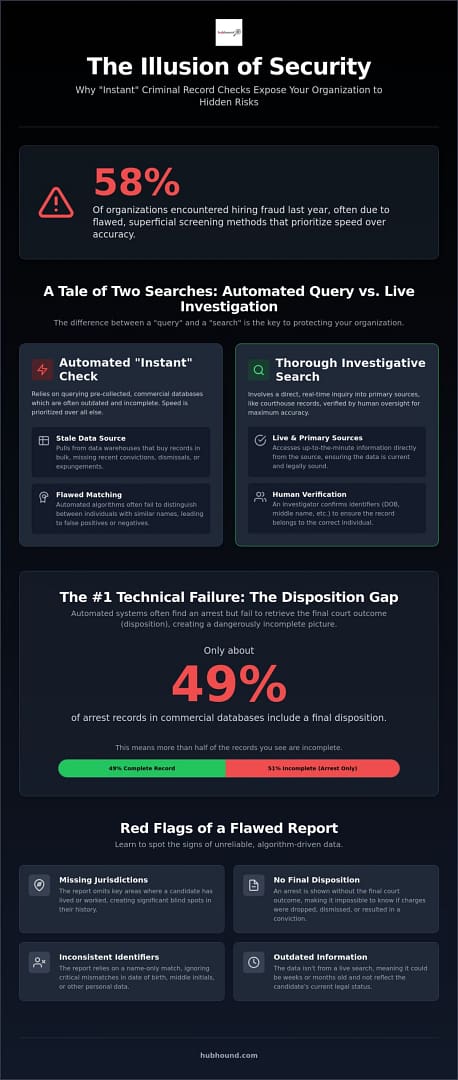
When you initiate an automated check, software aggregates data from secondary and tertiary sources. These are commercial warehouses that buy bulk records from various jurisdictions. These tools rarely access live courthouse terminals in real-time. Instead, they rely on a process to verify information that was collected during the last bulk purchase. This lack of direct access is a primary reason why 58% of organizations encountered hiring fraud last year, according to recent industry data. Without human oversight, automated data matching often fails to distinguish between individuals with similar names. A computer doesn’t pause to double-check a middle initial or a date of birth if the primary name matches a stored record. It simply delivers the data it has, regardless of its current accuracy or relevance.
The Difference Between a Search and a Database Query
It’s vital to distinguish between a database query and a legitimate criminal search. A query only examines the information the provider already purchased. If you’re looking for real-time accuracy, a query is insufficient. A true search involves a direct inquiry into current jurisdiction records, which often requires a digital or physical check of the primary source at the county level. Database mirroring is the technical practice of copying records into private, often un-synced storage, which inevitably leads to a gap between the court’s reality and your background report. Evaluate your current providers to determine if they are performing a live search or simply running a query against an outdated mirror. The difference is the key to protecting your organization from liability and ensuring workplace safety.
The Disposition Gap: The #1 Technical Failure of Automated Checks
A disposition represents the final legal resolution of a criminal charge, such as a conviction, dismissal, or acquittal. While an arrest record indicates that an interaction with law enforcement occurred, the disposition tells the actual story of the outcome. One of the most significant problems with instant online criminal record checks is their inability to consistently pair these two pieces of data. Automated systems are highly efficient at scraping initial arrest entries, but they often fail to return to the record months or years later to capture the final judgment.
Research indicates a startling disparity in data completeness. Some industry analyses, such as those conducted by Urban.org, suggest that only about 49% of arrest records in national commercial databases include a matching disposition. This means more than half of the records you see in an instant report could be incomplete. Relying on this partial data is not just a technical oversight. It’s a strategic risk that leads to unfair and potentially illegal hiring rejections. If your software flags an arrest but misses the subsequent dismissal, you are making a decision based on a legal non-event; this underscores the importance of the work done by firms like Abogado Penal Temuco, who specialize in the technical defense necessary to secure such outcomes.
Why Outcomes Disappear in Digital Transit
The journey of a court record from a local municipality to a national database is fraught with technical hurdles. Local courts often use antiquated filing systems that don’t sync automatically with commercial aggregators. When a record is expunged or sealed by a judge, the primary court record is updated, but the “mirrored” data in a private database remains unchanged. This technical lag creates a persistent ghost record. The algorithm simply delivers what it bought in the last bulk data purchase, completely unaware that the legal status of the individual has changed. For organizations seeking rigorous pre-employment background checks, verifying the disposition at the source is the only way to avoid these technical pitfalls.
The Legal Danger of “Arrest-Only” Data
Using arrest-only data to disqualify candidates is a high-stakes gamble. Federal regulators have long cautioned that arrest records do not prove criminal conduct. Acting on an arrest without a conviction can lead to claims of disparate impact or defamation. To maintain FCRA Compliance, employers must ensure the information they use is accurate and up to date. Instant software cannot verify if a case was later overturned on appeal or if the charges were dropped due to lack of evidence.
- Review reports for “Pending” statuses that have remained unchanged for years.
- Cross-reference arrest dates with the date the database was last refreshed.
- Require manual verification for any “hit” before taking adverse action.
Protect your organization by demanding the full story, not just the opening chapter of a candidate’s legal history.
The High Cost of Cheap Data: Liability and FCRA Compliance
The Fair Credit Reporting Act (FCRA) remains the gold standard for background screening. This federal law protects consumer privacy and mandates the accuracy of reports used for employment decisions. Many “people search” sites explicitly state in their terms of service that they are not Consumer Reporting Agencies. Using these non-compliant platforms for hiring is a direct violation of federal law. One of the most persistent problems with instant online criminal record checks is that they lack the rigorous data verification required to meet these legal standards.
The financial penalties for non-compliance in 2026 are substantial. General FCRA violations can cost between $100 and $1,000 per instance. For willful violations, punitive damages can reach up to $2,500. For a company hiring at scale, these figures represent a massive financial liability. Recent data shows that 42% of organizations with over 1,000 employees reported at least one compliance error in their background screening process over the last 12 months. Relying on automated database scrapes significantly increases the likelihood of becoming part of that statistic.
A frequent objection from business owners is that professional screening is too expensive compared to “instant” alternatives. However, this is a narrow view of cost. When you compare the price of a verified, human-reviewed report to the potential for a multi-million dollar lawsuit, the “cheap” option becomes the most expensive choice you can make. Speed and low entry prices provide a false sense of economy that disappears the moment a non-compliant report leads to a legal challenge.
Negligent Hiring: A Multi-Million Dollar Risk
Negligent hiring occurs when an employer fails to exercise reasonable care during the recruitment process, leading to harm in the workplace. An incomplete “instant” check often fails the legal “due diligence” test. In a courtroom, using “cheap data” can be framed as evidence that an employer prioritized profit over the safety of their staff and customers. For high-stakes roles or positions involving vulnerable populations, using a licensed investigative agency is a critical defensive measure. It demonstrates a commitment to workplace safety that an algorithm simply cannot provide.
Compliance Pitfalls of Automated Software
The FCRA requires agencies to follow reasonable procedures to assure “maximum possible accuracy.” Instant algorithms often fail this accuracy requirement because they cannot effectively resolve identity conflicts or verify if a record has been updated at the source. These systems are built for volume, not validity. To ensure your organization adheres to professional screening standards, you must implement a process that includes manual oversight. Moving beyond the limitations of automated software is the only way to satisfy federal accuracy mandates and maintain a truly secure hiring environment.
Red Flags: How to Spot a Flawed Background Report
Critical evaluation is the hallmark of a professional hiring process. When reviewing a report, the summary page often hides the most significant problems with instant online criminal record checks. You should start by scrutinizing the “Jurisdictions Searched” section. If a candidate’s resume shows a ten-year career spanning five different counties, but the report only lists two, you’re looking at a massive data gap. Automated tools often skip jurisdictions that don’t offer cheap, bulk digital access. This omission isn’t just a technical glitch; it’s a liability waiting to happen.
Look for inconsistent identifiers within the record details. If a report flags a criminal record but the middle name is missing or the date of birth is slightly off, the algorithm has likely forced a match. This happens frequently with common names where the software prioritizes a “hit” over accuracy. Without biometric verification or manual cross-referencing, these matches are often false positives. Relying on such data can lead to wrongful disqualification and significant legal blowback from candidates who have been wrongly flagged.
The “No Records Found” Trap
An empty report is frequently the biggest red flag of all. It often suggests the system looked in the wrong places or failed to access the necessary files. Many counties across the country still rely on paper records or local terminals that are not indexed by commercial scrapers. While an algorithm returns a “clean” result in seconds, it simply cannot see what isn’t digitized. Professional investigators manually check these non-digital jurisdictions to ensure a candidate’s history is actually clear. A “no results” notification from an instant provider should be viewed as an invitation for further inquiry, not a final clearance.
Verifying Identity Beyond the Name
Matching a Name and Social Security Number is the bare minimum for modern screening, not the final word. To achieve real security, you must verify identity through a candidate’s entire residential history. Professional investigators use skip tracing techniques to uncover previous addresses that a candidate might have omitted from their application. For executive-level hires, performing Corporate Due Diligence ensures that your high-level candidates are vetted with the same rigor as a potential business partner. This level of scrutiny moves beyond basic algorithms to provide a complete picture of a candidate’s professional and legal standing.
If you suspect your current reporting is missing critical data, schedule a comprehensive pre-employment background check audit to identify hidden gaps in your screening process.
Moving Beyond Algorithms: The Investigative Advantage
Algorithms are efficient tools for data sorting, but they lack the critical thinking required for risk management. While software provides speed, the inherent problems with instant online criminal record checks mean they should never be the final step in a professional vetting process. In 2026, where 58% of organizations have encountered hiring fraud, relying solely on automated database hits is a dangerous gamble. Human-led verification acts as the necessary layer of defense, bridging the gap between a digital “snapshot” and a verified legal history.
Professional investigators do more than just query a database. They analyze the results for context and continuity. For example, if a report shows a “no results” status but the candidate has unexplained gaps in their employment history, a human investigator knows to dig deeper into the jurisdictions where the individual actually lived. This proactive approach identifies the 38% of fraud cases that are typically caught during the background check stage. It ensures that your hiring decisions are based on facts, not just the limitations of a software’s scraping capabilities.
The Value of a Licensed Investigator
A licensed investigator accesses records that simply aren’t available to the public internet. Many jurisdictions maintain “non-digital” files or require in-person terminal access to view full case details. By using “boots on the ground” record retrieval, an investigator verifies a record directly at the source with the county clerk. This eliminates the technical lag and stale data issues associated with commercial mirrors. This level of scrutiny is essential for maintaining Workplace Investigations standards and ensuring your organization’s long-term integrity. It moves the process from a passive query to an active search for the truth.
Customized Screening for Your Organization
Every role carries a different level of risk. A professional firm doesn’t use a one-size-fits-all approach. Instead, they tailor the search to the specific candidate’s history and the sensitivity of the position. For executive roles or positions with access to significant assets, this might include witness interviews or surveillance operations to clarify “grey area” records that an algorithm would miss. Customization addresses the problems with instant online criminal record checks by filling the silence left by automated systems. It provides the peace of mind that comes from knowing your workplace safety is backed by rigorous, human-verified data.
Don’t let a flawed algorithm compromise your company’s safety or legal standing. Contact HubHound today for a consultation on professional-grade background checks and ensure your organization is protected by accurate, compliant, and investigative-led data.
Secure Your Future with Verified Intelligence
Relying on automated database scrapes leaves your organization vulnerable to significant gaps in candidate history. You’ve seen how the “disposition gap” and stale data repositories create a false sense of security that often fails the “due diligence” test in a courtroom. Identifying the problems with instant online criminal record checks is the first step toward building a resilient, compliant, and safe workplace. True security requires moving beyond the limitations of an algorithm to embrace a more rigorous, human-led verification process.
Invest in accuracy to protect your company’s reputation and legal standing. You don’t have to navigate these complex regulatory landscapes alone. HubHound provides comprehensive national reach combined with local-level verification to ensure no record is left behind in a non-digital courthouse. Our licensed investigators bring over 30 years of experience to every report, delivering FCRA-compliant results that meet the highest professional standards. Protect your business with verified, professional-grade background checks from HubHound. Taking this step ensures you have the reliable information needed to grow your team with total confidence.
Frequently Asked Questions
Why do instant background checks often show incorrect information?
Instant checks rely on bulk data purchased from court systems months or even years prior. If a record was expunged, sealed, or if a case was dismissed after that bulk purchase, the database won’t reflect the change. These lag times and the lack of real-time verification are the primary problems with instant online criminal record checks. Without a manual search at the source, you’re viewing a stale snapshot of a candidate’s history.
Is it legal to use “people search” websites for hiring employees?
No, it is generally illegal to use standard “people search” or “background lookup” sites for employment decisions. These platforms are not Consumer Reporting Agencies (CRAs) and don’t adhere to the strict accuracy requirements of the Fair Credit Reporting Act (FCRA). Using non-compliant data for hiring exposes your organization to significant federal penalties and lawsuits from wrongly disqualified applicants.
What is the difference between a name-based check and a fingerprint-based check?
Name-based checks utilize alphanumeric data like names and dates of birth to find matches, which can lead to false positives for common names. Fingerprint checks use unique biometric data to link an individual to their specific criminal history. While fingerprinting is highly precise, it only captures records where prints were taken and submitted to a central repository, often missing minor or non-biometric records.
How far back do professional criminal record checks go?
Professional checks typically look back seven to ten years, though this varies based on the role and specific legal requirements. While some convictions remain on a record indefinitely, federal and state regulations often limit what an employer can consider. A licensed investigator ensures your look-back period is appropriate for the position while maintaining compliance with current nationwide privacy standards.
What should I do if a background check report contains an error?
You must follow the federal adverse action process immediately if an error is suspected. Provide the candidate with a copy of the report and a summary of their rights under the FCRA. This allows them to dispute the inaccuracy with the reporting agency before you make a final decision. Never take adverse action based on a disputed report until the investigation is complete.
Can a criminal record check miss a conviction from another state?
Yes, especially if the search is limited to a specific jurisdiction or an incomplete national database. Many counties don’t share their data digitally or participate in national aggregators. Professional searches use skip tracing to identify every jurisdiction where a candidate has lived or worked. This ensures that convictions from other regions are uncovered through direct, local-level verification rather than relying on flawed algorithms.
How long does a professional, non-instant background check typically take?
A professional check usually takes between two and five business days to complete. This timeframe is necessary for investigators to contact county clerks and verify records directly at the source. While this is slower than an automated result, the extra time is vital to avoid the common problems with instant online criminal record checks, such as missing dispositions or identity mismatches.
What are the most common mistakes employers make when reading background reports?
Employers often mistake a simple arrest for a final conviction or fail to notice when a case is still pending. Another frequent error is ignoring the “date of last update,” which indicates how stale the data might be. Failing to cross-reference the jurisdictions searched against the candidate’s actual residential history is also a major oversight. Professional reports provide the necessary context to avoid these critical misinterpretations.

Article by
Joel R. Manley | President | Hubhound Investigations | OR PI-ID#: 90432 | 111 SW Fifth Avenue, Suite 3150 Portland, Oregon 97204 | 971-442-8170
Joel is licensed as a private investigator in Oregon and Tennessee. Joel started his career in 1987 serving as a Military Police Officer and Military Police Investigator.
After ending his military tour of duty, Joel became a civilian Police Officer and Deputy Sheriff. Joel took his strong background in Hostage Negotiations, Mediation and Conflict Resolution, with him to patrol some of the highest crime areas in SE Portland.
Joel was awarded Deputy of the Year for his efforts and for drastically reducing the crime rate in the area he patrolled. As a Deputy Sheriff, Joel assisted in leading a Neighborhood Livability Program that was nationally recognized for having the most innovative and progressive approach to policing.
In 2018, Joel retired as a Deputy Sheriff and founded Hubhound Investigations. Joel played an integral role in Hubhound Investigations receiving an A+ Accredited Business rating from the Better Business Bureau (BBB).
In his off time, Joel enjoys spending time with his wife, adult children and Hubhound’s Happiness Ambassador, Nya. Joel also enjoys Scuba Diving and Kayaking.
Disclaimer
DISCLAIMER: This article is provided for general informational and educational purposes only. It is not intended to constitute legal advice, professional investigative advice, or instruction to engage in any unlawful activity. Laws governing private investigations, surveillance, recording, tracking, access to information, evidence collection, privacy, trespass, licensing, and related investigative activities vary by jurisdiction and are subject to change.
Any investigative techniques, tactics, procedures, scenarios, or legal proceedings discussed in this article are presented for informational purposes and should not be interpreted as authorization or encouragement to use a particular method. Private investigators and members of the public are responsible for understanding and complying with all applicable federal, state, and local laws, licensing requirements, court rules, and professional standards.
The circumstances of every investigation and legal matter are different. Information contained in this article should not be relied upon as a substitute for advice from a qualified attorney or other appropriate licensed professional regarding a specific situation. No attorney-client, investigator-client, or other professional relationship is created by reading or using this information.