
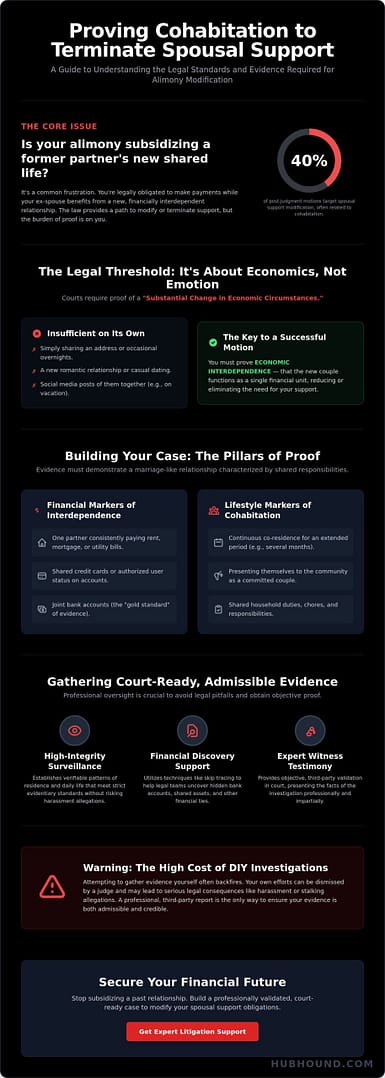
Approximately 40% of post-judgment motions in divorce cases target the modification of spousal support, often involving the process of proving cohabitation to terminate alimony in Oregon. It’s frustrating to realize your income is subsidizing a lifestyle for a former partner who is effectively sharing a life and bank account with someone else. You want to stop the payments, but you’re likely uncertain about what evidence is legally admissible or if your own efforts to gather proof might lead to legal complications.
This guide clarifies the specific legal standards and investigative strategies required to build a case based on economic interdependence rather than just a shared address. We will break down the $167 filing fee for a Motion to Modify Spousal Support and explore how courts evaluate a substantial change in economic circumstances. You’ll learn how to identify shared financial responsibilities and how high-integrity surveillance operations provide the professional validation needed to secure a successful judgment.
Key Takeaways
- Define the “substantial change in circumstances” threshold to determine if a support order is eligible for judicial review.
- Identify specific markers of economic interdependence, such as shared household expenses, when proving cohabitation to terminate alimony in Oregon.
- Deploy professional surveillance and skip tracing to establish a verifiable pattern of residence that meets strict evidentiary standards.
- Avoid the legal pitfalls of DIY investigations by utilizing high-integrity, third-party reports that prevent harassment or stalking allegations.
- Leverage expert witness testimony and professional litigation support to provide the objective validation necessary for a successful court motion.
The Legal Threshold for Modifying or Terminating Spousal Support
The legal foundation for altering a support order rests on the “Substantial Change in Circumstances” rule. This standard requires the paying spouse to demonstrate that a significant, permanent, and unanticipated shift in financial needs or abilities has occurred since the original judgment. In the context of Alimony in the United States, courts generally hold that a new domestic partnership can constitute such a change if it reduces the recipient’s economic dependency. However, the burden of proof lies entirely with the payor. You must provide clear evidence that the recipient’s financial situation has improved due to a new live-in relationship.
When you’re tasked with proving cohabitation to terminate alimony in Oregon, you must understand that the court doesn’t act on suspicion alone. Casual dating, even if frequent, doesn’t meet the legal threshold for modification. Courts look for a marriage-like relationship characterized by shared living expenses and a commingling of daily lives. This distinction is critical; a judge won’t terminate support simply because a recipient is seeing someone new. The relationship must function as an economic unit where the third party contributes to the recipient’s reasonable and necessary expenses.
Understanding the Purpose of Alimony Modifications
Spousal support serves as a financial bridge to help a former spouse reach self-sufficiency. When a recipient enters a stable domestic partnership, that bridge often becomes unnecessary. A new partner’s contribution to rent, utilities, or groceries directly impacts the recipient’s actual financial need. Depending on the evidence, a judge might order a temporary suspension of support or a permanent termination. This decision hinges on whether the economic change is viewed as a lasting shift in the recipient’s lifestyle or a short-term arrangement.
Determining if Your Case Meets the Legal Standard
Before filing a motion, evaluate the specific nature of the suspected cohabitation. A roommate situation for financial convenience is viewed differently than a romantic partnership. Judges assess several factors to determine if the standard for proving cohabitation to terminate alimony in Oregon is met:
- Duration: Has the couple lived together for a continuous period, typically exceeding several months?
- Openness: Does the couple present themselves to the community, neighbors, and family as a committed unit?
- Interdependence: Is there evidence of shared household responsibilities or joint financial commitments?
Identifying these markers early prevents wasted legal fees and unnecessary conflict. If the relationship lacks these qualities, a court is unlikely to find a substantial change in circumstances. Clear, objective data is the only way to satisfy the court’s requirement for a supplemental judgment.
Economic Interdependence: The Key to Proving Cohabitation
Proving cohabitation to terminate alimony in Oregon requires shifting the focus from social media posts to bank statements. While a photo of a former spouse on vacation with a new partner creates an emotional reaction, it rarely satisfies a judge. The legal standard demands proof of economic interdependence. This occurs when two people function as a single financial unit, sharing the burdens and benefits of their combined resources. If a new partner is subsidizing your ex-spouse’s lifestyle, the recipient’s actual financial need has decreased.
Under Oregon Revised Statute 107.135, a court evaluates whether a “substantial change in economic circumstances” has occurred. This isn’t about casual dating. It’s about a domestic partnership that mirrors a marriage. When proving cohabitation to terminate alimony in Oregon, you must look for markers that indicate the couple has merged their daily lives. If you suspect these financial ties exist, utilizing civil litigation support can help uncover the documentation needed for your motion.
Financial Markers of a Domestic Partnership
Identify who is paying the bills. Joint bank accounts are the gold standard of evidence, but they are often hidden. Look for alternative signs of shared finances:
- One partner consistently paying the mortgage, rent, or utilities for the household.
- Shared credit card usage or authorized user status on high-limit accounts.
- Regular, significant financial transfers that function as an allowance or subsidy.
- Payment for major recurring expenses like health insurance or car payments.
Shared Assets and Long-Term Commitments
Economic interdependence also manifests through long-term asset management. These commitments suggest a permanent arrangement rather than a temporary living situation. Joint ownership of vehicle titles or property deeds is a strong indicator of a marriage-like bond. Naming the new partner as a beneficiary on life insurance policies further establishes this intent. Co-signing for personal loans also demonstrates a level of shared risk that typical roommates do not exhibit. Documenting these markers creates a narrative of stability and shared future planning. It provides the court with a concrete reason to modify or terminate existing support obligations.
Investigative Strategies to Gather Court-Ready Evidence
High-stakes litigation requires high-integrity data. Relying on children’s testimony or casual observations is a strategic mistake that often leads to inadmissible evidence. To succeed in proving cohabitation to terminate alimony in Oregon, you must build a case based on verifiable patterns of behavior and documented financial overlap. This process begins with professional surveillance operations and advanced skip tracing to identify the partner’s actual residence history and current lifestyle habits.
While social media “lifestyle” evidence can supplement a case by showing a public commitment, it doesn’t prove residence or shared finances on its own. Courts prioritize evidence that shows a permanent domestic arrangement. In some jurisdictions, investigative techniques like trash pulls can uncover discarded financial documents, utility bills, or correspondence that link the partner to the recipient’s address. These methods provide the objective proof necessary to move a motion forward without relying on hearsay.
Establishing a Pattern of Residence Through Surveillance
Professional surveillance is the most effective way to establish a pattern of residence. A judge needs to see that the partner isn’t just a frequent guest but a co-resident. This requires “overnight” surveillance conducted over several weeks to document the partner’s presence during late-night and early-morning hours. Effective documentation includes video evidence of the partner performing daily domestic routines, such as taking out the trash, retrieving mail, or performing yard work. Most importantly, investigators look for signs of unrestricted access, such as the partner using their own key or garage door opener to enter the home at will.
Utilizing Civil Litigation Support for Discovery
Once a motion is filed, the discovery process allows for a deeper dive into the couple’s private financial lives. Utilizing civil litigation support ensures that your legal team can effectively manage the flow of information. Subpoenas are often issued to bank and utility companies to verify who is actually paying the bills at the residence. Professional investigators also conduct witness interviews with neighbors or landlords to gather statements regarding the couple’s living arrangement. These high-integrity reports serve as the backbone of your motion, providing the court with a clear, undisputed narrative of the recipient’s reduced financial need. This strategic approach is essential when proving cohabitation to terminate alimony in Oregon, as it replaces emotional arguments with cold, hard facts.
Strategic Pitfalls: Why DIY Investigations Often Fail
DIY investigations are fraught with legal and emotional risks. While it’s tempting to follow a former spouse yourself, doing so often jeopardizes the entire case. Judges prioritize evidence that is gathered ethically and legally. If you cross a line, the court may invoke the “Fruit of the Poisonous Tree” doctrine. This legal principle ensures that evidence obtained through illegal acts is excluded from the record. A single unauthorized photo taken while trespassing could result in your most compelling proof being thrown out of court.
When proving cohabitation to terminate alimony in Oregon, your personal involvement can also lead to stalking or harassment allegations. These charges don’t just ruin your chances of modifying support; they can lead to restraining orders or criminal records. Professional investigators act as a necessary buffer. They provide a layer of separation that protects your reputation while securing the data you need. This objective distance is vital for maintaining credibility during a high-stakes hearing.
Legal Boundaries of Private Investigation
Privacy laws are complex and strictly enforced. Unauthorized use of GPS trackers or hidden cameras often constitutes a felony in many jurisdictions. Trespassing on private property to secure a “smoking gun” photograph is a common mistake that renders the evidence useless. A licensed investigator understands these nuances and operates within the bounds of the law. Their reports are viewed as objective, third-party accounts. This carries far more weight in a courtroom than the testimony of an emotionally charged ex-spouse who may be perceived as having an axe to grind.
The Ethical Trap of Involving Children
Using children as informants is one of the most damaging mistakes a payor spouse can make. Courts are highly protective of minors and look unfavorably on parents who involve them in litigation. Pumping a child for details about who stayed over or where a parent slept is often viewed as parental alienation. This behavior can lead a judge to question your motivations, potentially impacting other aspects of your divorce decree. Relying on professional surveillance operations allows you to gather facts without placing children in the middle of a legal battle.
Hearsay from friends or family members is another weak point in DIY cases. These witnesses are naturally biased toward you. Judges know this and frequently dismiss their observations as unreliable or exaggerated. To succeed in proving cohabitation to terminate alimony in Oregon, you need a high-integrity narrative built on independent verification. Professional documentation replaces emotional anecdotes with a chronological record of facts that a judge cannot easily ignore.
Securing Your Financial Future with Professional Oversight
Successful modification of support requires more than just a stack of photos. It demands a structured narrative that a judge can verify. A professional investigative report serves as the foundation for your motion, providing a chronological, unbiased account of cohabitation. Expert witness testimony from the investigator further solidifies this record. They can speak directly to the methods used and the integrity of the data collected, which is vital since nationally, only about 10-15% of spousal support awards are modified annually. Integrating surveillance techniques into your legal strategy transforms suspicion into actionable intelligence. This transition from raw data to court-ready evidence is the most critical phase of your case.
A judge’s primary concern is the reliability of the information presented. A professional report removes the emotional dynamic that plagues many post-divorce proceedings. By providing a third-party, objective account of the living situation, you provide the court with the confidence it needs to modify a final judgment. This professional oversight is often the difference between a dismissed motion and a successful outcome when proving cohabitation to terminate alimony in Oregon.
Building a Comprehensive Evidence Package
A winning case combines multiple streams of data into a single, cohesive package. This includes surveillance logs that prove residence patterns, financial discovery that highlights commingled funds, and authenticated witness statements. Using corporate investigation firm methods allows for a deeper analysis of the new partner’s assets and income. This level of rigor ensures that every piece of evidence is trial-ready and resistant to cross-examination. You must ensure that all surveillance is conducted within legal boundaries to avoid having your evidence suppressed.
Taking Action to Terminate Support
Once the evidence is secured, coordinate with your family law attorney to file the formal motion. A high-quality investigative report often serves a dual purpose. While it’s essential for trial, it’s also a powerful tool for encouraging an out-of-court settlement. When the recipient spouse sees the depth of the evidence against them, they’re often more willing to negotiate a termination or reduction without a lengthy court battle. This saves you time, money, and emotional stress. The goal is to move from uncertainty to a clear resolution that reflects the current economic reality of your former spouse’s life.
If you’re ready to stop making payments to a former spouse who is no longer financially dependent, take the first step today. Contact HubHound for a confidential consultation on your case.
Reclaim Your Financial Independence
Transitioning from financial obligation to independence requires a strategy built on high-integrity data. You’ve seen that the path to a successful modification lies in documenting economic interdependence through objective, third-party verification. By prioritizing professional surveillance over DIY methods, you protect yourself from legal risks and ensure your evidence is actually admissible in a courtroom.
Proving cohabitation to terminate alimony in Oregon is a rigorous process that demands precision. Our licensed investigators bring over 30 years of experience to every case, delivering court-ready evidence and expert witness testimony that stands up to scrutiny. We specialize in discreet surveillance operations that provide the clarity needed to move your motion forward with confidence. Don’t let your resources be misallocated when a solution is within reach. Start your confidential investigation with HubHound today and take the final step toward securing the financial future you’ve earned.
Frequently Asked Questions
How long does a partner have to live with my ex to count as cohabitation?
Courts generally look for a stable, continuous relationship rather than a specific number of days. While casual stays don’t qualify, a period of six to twelve months of shared residency often triggers a review. Research indicates that cohabitation for more than twelve months with documented shared finances typically leads to a 25% to 100% reduction in support payments. Judges prioritize the permanence of the arrangement over a fixed calendar date.
Can I stop paying alimony as soon as I have proof of cohabitation?
No, you must continue making all scheduled payments until a judge signs a supplemental judgment. Ceasing payments prematurely can lead to contempt of court or wage garnishment. You must file a formal motion to modify support and present your evidence during a hearing. Only a court order can legally terminate or reduce your existing obligation, even if the proof of a new domestic partnership is overwhelming.
Is social media enough evidence to prove my ex-spouse is living with someone?
Social media posts are rarely sufficient on their own because they don’t document residency or financial interdependence. While photos of a “domestic life” help establish a relationship, they don’t prove that a partner is contributing to household expenses. Courts require high-integrity evidence like surveillance logs and financial records. Relying solely on digital footprints often results in a motion being dismissed for lack of concrete economic proof.
Will the court terminate alimony if my ex’s new partner doesn’t have a job?
Termination is less likely if the new partner is financially dependent on your ex-spouse. The court’s primary focus is whether the recipient’s financial need has decreased. If the new partner doesn’t contribute income, your ex’s expenses may actually increase. However, if the partner provides non-monetary support that offsets costs, it remains a relevant factor. The court evaluates the total economic impact of the new living arrangement.
What happens if my ex-spouse denies that their partner is living there?
Denials are common in these cases, which makes professional surveillance a necessity for proving cohabitation to terminate alimony in Oregon. Video evidence showing a partner using their own key, retrieving mail, or performing daily maintenance overrides verbal claims. Objective data from a third party provides the court with a factual narrative that is difficult to dispute. This evidence forces the recipient to explain the partner’s constant presence and unrestricted access.
Can a private investigator testify in my alimony modification hearing?
Yes, licensed investigators frequently provide expert witness testimony to authenticate their reports and surveillance footage. Their testimony is viewed as objective and carries significantly more weight than the accounts of friends or family. This professional validation ensures that the evidence was gathered legally and meets the court’s standards. Having an expert present the facts directly to the judge often streamlines the decision-making process.
How much does it typically cost to gather proof of cohabitation?
Costs depend on the complexity of the surveillance and the depth of the financial discovery required. You should account for the $167 filing fee required for a motion to modify support in addition to investigative services. Investing in professional oversight prevents the much higher cost of continuing life-long alimony payments to a self-sufficient ex-spouse. High-quality data ensures your motion has the highest possible chance of success on the first attempt.
What if the new partner keeps a separate ‘legal’ address but stays at the house every night?
Judges look at the actual pattern of residence rather than a “paper” address like a P.O. box or a relative’s house. If surveillance proves the partner is present every night and keeps personal property at the residence, the separate address is usually viewed as a sham. Documenting a consistent daily routine is essential for proving cohabitation to terminate alimony in Oregon. Courts focus on the reality of the domestic arrangement rather than deceptive mailing addresses.

Article by
Joel R. Manley | President | Hubhound Investigations | OR PI-ID#: 90432 | 111 SW Fifth Avenue, Suite 3150 Portland, Oregon 97204 | 971-442-8170
Joel is licensed as a private investigator in Oregon and Tennessee. Joel started his career in 1987 serving as a Military Police Officer and Military Police Investigator.
After ending his military tour of duty, Joel became a civilian Police Officer and Deputy Sheriff. Joel took his strong background in Hostage Negotiations, Mediation and Conflict Resolution, with him to patrol some of the highest crime areas in SE Portland.
Joel was awarded Deputy of the Year for his efforts and for drastically reducing the crime rate in the area he patrolled. As a Deputy Sheriff, Joel assisted in leading a Neighborhood Livability Program that was nationally recognized for having the most innovative and progressive approach to policing.
In 2018, Joel retired as a Deputy Sheriff and founded Hubhound Investigations. Joel played an integral role in Hubhound Investigations receiving an A+ Accredited Business rating from the Better Business Bureau (BBB).
In his off time, Joel enjoys spending time with his wife, adult children and Hubhound’s Happiness Ambassador, Nya. Joel also enjoys Scuba Diving and Kayaking.
Disclaimer
DISCLAIMER: This article is provided for general informational and educational purposes only. It is not intended to constitute legal advice, professional investigative advice, or instruction to engage in any unlawful activity. Laws governing private investigations, surveillance, recording, tracking, access to information, evidence collection, privacy, trespass, licensing, and related investigative activities vary by jurisdiction and are subject to change.
Any investigative techniques, tactics, procedures, scenarios, or legal proceedings discussed in this article are presented for informational purposes and should not be interpreted as authorization or encouragement to use a particular method. Private investigators and members of the public are responsible for understanding and complying with all applicable federal, state, and local laws, licensing requirements, court rules, and professional standards.
The circumstances of every investigation and legal matter are different. Information contained in this article should not be relied upon as a substitute for advice from a qualified attorney or other appropriate licensed professional regarding a specific situation. No attorney-client, investigator-client, or other professional relationship is created by reading or using this information.