
A single inflated vendor contract can quietly siphon away your annual profit margin before you even suspect internal foul play. Investigating kickback schemes in a small business requires more than just a gut feeling. It demands a surgical approach to forensic evidence and a strict adherence to legal boundaries. You likely believe that your team is loyal, yet you recognize that the lack of oversight in procurement often leads to expensive, hidden liabilities.
This guide provides the technical framework to identify red flags, document illicit exchanges, and neutralize threats to your capital. You’ll learn how to secure the evidence necessary for asset recovery or prosecution while avoiding the pitfalls of wrongful termination claims. We will examine the 2026 regulatory landscape, including state commercial bribery laws and federal statutes, alongside modern data analytics for fraud detection and the specific investigative protocols that protect your professional standing and legal interests. By following these validated procedures, you can ensure that your response to internal misconduct is both decisive and legally sound.
Key Takeaways
- Distinguish between commercial bribery and internal kickback schemes to understand how illicit returns on value compromise your procurement process.
- Identify behavioral red flags like the “Lifestyle Gap” and vendor defensiveness to spot potential misconduct before financial losses escalate.
- Establish a professional framework for investigating kickback schemes in a small business by using secure environments and neutral third parties to maintain confidentiality.
- Determine the legal boundaries for deploying surveillance and witness interviews to gather actionable evidence for litigation or asset recovery.
- Translate investigative findings into “For Cause” termination reports that protect your business from wrongful dismissal claims.
What Is a Kickback Scheme? Understanding the Small Business Impact
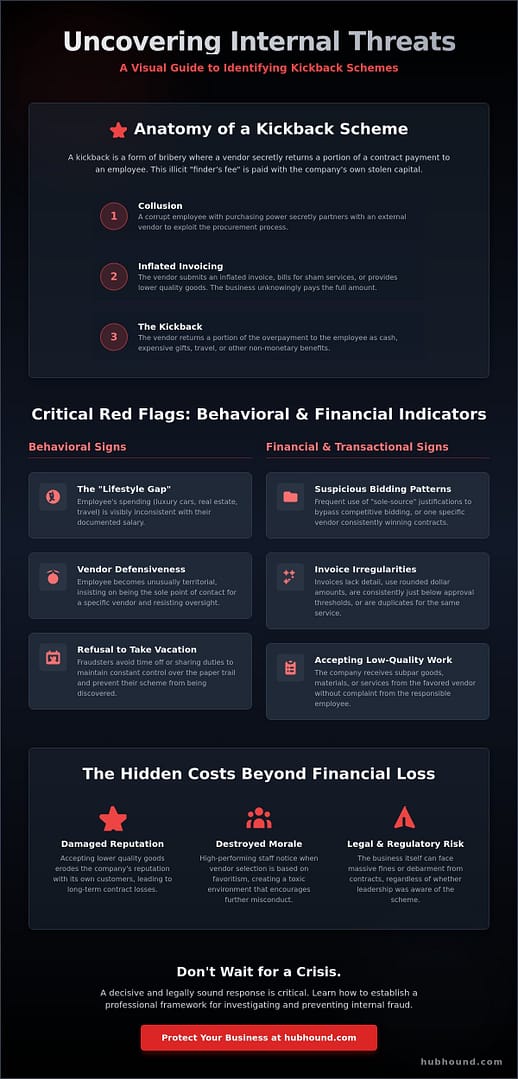
A kickback is a form of negotiated bribery where a portion of a contract sum is returned to an individual as a reward for facilitating a transaction. Unlike traditional bribery, which often involves an upfront payment to influence a future decision, a kickback usually happens after the business has already paid the vendor. This subtle timing makes understanding What Is a Kickback Scheme? a critical priority for owners. It’s essentially a “finder’s fee” paid with the company’s own stolen capital.
The scheme relies on a specific three-party dynamic. You have the corrupt employee who holds purchasing power, the external vendor willing to pay for access, and the victim business that unknowingly subsidizes the illicit payment. Small businesses are disproportionately targeted because they often lack the separation of duties found in larger corporations. When one person manages the vendor relationship, approves the work, and signs the check, the environment is ripe for exploitation.
Common Kickback Variations in Procurement and Sales
Corruption manifests in several ways during procurement. Inflated invoicing is common; the vendor adds a “corruption premium” to the bill, then passes that extra cash back to the employee. Sham consulting fees are another tactic where the business pays for services that were never actually rendered. Non-monetary kickbacks, such as high-end travel, expensive gifts, or debt forgiveness, are increasingly used to bypass traditional financial audits. These methods allow perpetrators to hide their gains outside of standard payroll or banking records.
The Hidden Costs Beyond Financial Loss
The damage extends far beyond the immediate cash drain.
Investigating kickback schemes in a small business
often reveals severe operational degradation. Corrupt employees will accept lower quality goods or delayed timelines just to maintain their illicit revenue stream. This compromise erodes the company’s reputation with its own customers and can lead to long-term contract losses.
Undetected fraud also destroys employee morale. High-performing staff members quickly notice when vendor selection is based on favoritism rather than merit. This creates a toxic environment that encourages further misconduct. Finally, the business entity itself faces legal and regulatory exposure. If a kickback occurs within certain sectors, like government contracting or healthcare, the company could face massive fines or debarment regardless of whether the owner was aware of the scheme. Proactive identification is the only way to mitigate these compounding risks.
Identifying Red Flags: Behavioral and Financial Indicators
Spotting a kickback scheme early prevents catastrophic financial loss. When investigating kickback schemes in a small business, the most visible indicator is often the Lifestyle Gap. If a procurement manager on a modest salary suddenly acquires luxury vehicles or high-end real estate, it warrants closer inspection. This isn’t about judging personal choices; it’s about identifying financial anomalies that don’t align with documented income.
Behavioral shifts are equally telling. Corrupt employees often become unusually defensive or territorial regarding specific vendor relationships. They might insist on handling all communications with a particular supplier, even when it’s outside their standard scope. This gatekeeping is a survival mechanism. It prevents others from noticing the irregularities in the contract terms or service delivery.
Watch for the no-vacation rule. Fraudsters often refuse to take time off or share duties because they need to maintain constant control over the paper trail. If someone else steps in, the scheme might collapse. When conducting workplace misconduct investigations, this lack of redundancy is frequently cited as a primary enabler of long-term fraud. Reliable employees generally welcome the help; those with something to hide rarely do.
Transactional Anomalies to Monitor
Analyze your ledger for emergency or sole-source procurement justifications that bypass standard bidding. These exceptions should be rare. According to the ACFE’s 2026 Report to the Nations, tips remain the most common detection method, often highlighting specific patterns in the data:
- Approval Thresholds: Purchase orders that consistently fall just below limits requiring executive sign-off.
- Invoice Irregularities: Rounded dollar amounts on bills or frequent duplicate billing for the same service period.
- Justification Abuse: Excessive use of sole-source labels for services that are widely available in the open market.
Vendor Relationship Warning Signs
Examine the social dynamic between staff and suppliers. Excessive socializing or gifts that exceed company policy are clear indicators of a compromised boundary. A sudden shift in vendor selection without a clear business rationale often points to a new arrangement. Consider these specific warning signs:
- Data Matches: Vendor addresses or bank accounts that match employee residential data or personal phone numbers.
- Service Quality: Vendors that win contracts despite higher pricing or documented poor performance.
- Exclusivity: Procurement staff who insist on being the sole point of contact for a specific vendor and react poorly to audits.
Successfully investigating kickback schemes in a small business starts with these granular, data-driven comparisons. By identifying these signals early, you can protect your bottom line before the fraud becomes systemic.
The Professional Framework for Investigating Kickback Schemes
Establishing a professional framework is the difference between a successful recovery and a costly lawsuit. When investigating kickback schemes in a small business, you must operate with absolute discretion. Small environments are often tight-knit. A single leak can lead to the destruction of evidence or the intimidation of witnesses. You can’t afford a breach of confidentiality at this stage. It’s vital to keep the circle of knowledge as small as possible.
Create a “Clean Room” for your investigation. This is a restricted environment, either physical or digital, where only authorized decision-makers have access to findings. Utilizing neutral third parties, such as external forensic accountants or specialized investigators, ensures that internal biases don’t cloud the judgment of the case. This objectivity is a core component of workplace investigations designed to maintain organizational integrity. Moving from a vague suspicion to a formal investigative file requires structured evidence that can withstand legal scrutiny. It’s about building a narrative based on facts, not feelings.
Step 1: Discreet Data Collection and Digital Forensics
Begin by securing digital evidence before the suspect becomes aware of the inquiry. Imaging company-issued laptops or mobile devices allows you to preserve a snapshot of the data without alerting the employee. Review internal communications for “side-channel” discussions. Perpetrators often use professional platforms to initiate contact before moving to personal channels. Analyze the metadata on vendor invoices. If the “Author” field in a PDF properties box matches your employee’s name rather than the vendor’s, you’ve found a critical link. These technical markers are difficult for amateurs to scrub and provide high-quality evidence for your file.
Step 2: External Intelligence and Vendor Vetting
The process of investigating kickback schemes in a small business must extend beyond your office walls. Perform deep-dive background checks on suspect vendors to identify potential “Shell Companies.” These entities often lack a physical office. They might have generic names or were formed shortly before the contract began. Use corporate due diligence to map ownership links. You’re looking for shared addresses, common directors, or family ties between the vendor and your staff. Identifying these hidden connections provides the “smoking gun” needed to prove a conflict of interest. This documentation is essential for any subsequent legal action or insurance claim.
Securing Evidence: Surveillance and Witness Interviews
Digital trails provide the foundation, but physical evidence often secures the conviction. When investigating kickback schemes in a small business, you must eventually move beyond the ledger to document the “Value Transfer.” This is the moment where the illicit agreement manifests as a tangible benefit, such as a cash hand-off, a luxury gift, or an off-site meeting. Transitioning from suspicion to court-ready proof requires a blend of tactical observation and structured questioning.
Legality remains your primary constraint during this phase. Monitoring employee activity in public spaces generally doesn’t violate privacy expectations, but recording private conversations or entering residential property can lead to suppressed evidence. You must ensure that every piece of data is gathered through methods that withstand legal challenges. If your evidence is ruled inadmissible, your ability to pursue civil litigation or a “For Cause” termination disappears instantly.
Professional Surveillance Operations offer a high-integrity way to verify meetings between procurement staff and vendor representatives. These operations provide visual confirmation of relationships that the suspect may have denied during initial inquiries. Documenting these interactions in real-time creates a timeline that digital records alone cannot replicate. It transforms circumstantial data into a cohesive narrative of misconduct.
Professional Surveillance Techniques
Covert methods are essential for verifying off-site meetings that occur during business hours or at industry events. You need to document more than just presence; you need to capture the exchange of value. This might include the transfer of envelopes, the use of a vendor-provided vehicle, or the delivery of high-value goods to an employee’s home. Ensure your investigator uses high-resolution equipment that clearly identifies all parties. This visual record prevents the suspect from claiming “mistaken identity” or “coincidental meeting” during later interviews.
The Art of the Witness Interview
Interviews should follow a strategic sequence. Start by debriefing internal whistleblowers and neutral colleagues who may have noticed the red flags mentioned in earlier sections. These individuals often provide the context needed to break the suspect’s defenses. Interviewing former employees is also highly effective; they’re often more willing to speak freely once they’re no longer under the suspect’s direct influence.
The final stage is the “Admission-Seeking” interview with the suspect. Structure your Witness Interviews & Statements to present evidence in a way that makes denial impossible. Use the digital forensics and surveillance logs to lead the suspect into contradictions. A well-documented statement at this stage often leads to a voluntary confession, which significantly simplifies the process of asset recovery and legal prosecution.
Next Steps: Legal Action and Fraud Prevention
The conclusion of the data gathering phase marks the beginning of the resolution phase. Once you’ve finished investigating kickback schemes in a small business, you must transition from an investigator to a decision-maker. Don’t act on impulse. Review your findings with legal counsel before initiating any confrontation. This step is non-negotiable. It ensures your evidence meets the standards required for court and minimizes the risk of a retaliatory “wrongful termination” claim. Legal experts will help you determine if the conduct violates specific statutes, such as state commercial bribery laws or federal anti-kickback regulations verified in 2026.
A comprehensive investigative report is your primary tool for “For Cause” terminations. It provides a clear, factual justification for removing a corrupt employee without triggering severance obligations. Beyond HR actions, consider your reporting obligations. If the financial loss is substantial, notify your insurance provider to file a claim under your employee dishonesty or fidelity bond. Reporting the fraud to law enforcement is also a critical deterrent. It signals to your remaining staff and vendors that you maintain a zero-tolerance policy for corruption. This decisive action protects your professional standing and your bottom line.
Maintaining the Chain of Custody
Professional documentation is your best defense against countersuits. If you can’t prove who handled the evidence and when, it becomes worthless in a legal setting. Store all digital and physical evidence in a secure, audited environment. This includes the original metadata from invoices and the raw logs from surveillance operations. Your investigative report should mirror the standards of a professional corporate investigation firm. It must be objective, chronological, and free of inflammatory language. This level of rigor ensures your business remains protected if the suspect attempts to litigate the termination.
Strengthening Internal Controls
Prevention is more cost-effective than recovery. Transition your procurement process to a “Zero-Trust” model. This means no single individual has the authority to select a vendor, approve the work, and authorize the payment. Investigating kickback schemes in a small business often reveals that a lack of oversight was the primary enabler. Implement these specific controls immediately:
- Dual-Signature Approvals: Require two different managers to sign off on any vendor payment exceeding a specific dollar amount.
- Unannounced Audits: Conduct random, periodic reviews of vendor contracts and pricing to ensure they align with market rates.
- Anonymous Reporting: Create a safe, anonymous channel for employees to report suspicious activity without fear of retaliation.
According to the ACFE’s 2026 report, tips remain the most effective way to catch fraud. By making it easy for staff to speak up, you significantly reduce the lifespan of future schemes and protect the long-term health of your organization.
Protecting Your Bottom Line Through Vigilance
Internal corruption often hides behind the complexity of procurement, but it’s manageable with a precise detection strategy. You now understand that identifying behavioral red flags and monitoring transactional anomalies are the first steps toward recovery. Successfully investigating kickback schemes in a small business requires a transition from internal suspicion to a structured, forensic approach that preserves evidence and limits legal liability. By establishing a clean room environment and utilizing digital forensics, you can protect your assets without tipping off the perpetrator.
Don’t let undetected fraud compromise your organizational integrity. Secure the expertise needed to navigate these high-stakes scenarios with confidence. Secure your business interests with a professional investigation. Our licensed investigators bring over 30 years of experience to every case, providing specialized expertise in workplace misconduct and corporate due diligence. We deliver the confidential, court-ready evidence collection required for successful litigation or “For Cause” terminations. You have the tools to reclaim control of your procurement process and build a more resilient company.
Frequently Asked Questions
What is the most common type of kickback in a small business?
Over-invoicing remains the most frequent method used in commercial settings. A vendor inflates a bill by a specific percentage, then passes that “premium” back to the corrupt employee as cash or gifts. This often occurs in high-volume, low-scrutiny areas like maintenance services or office supplies. Identifying these patterns requires a granular review of market rates versus your actual spend to find the discrepancy.
Can I legally look at an employee’s private emails if I suspect a kickback?
You generally cannot access personal email accounts without a court order or explicit consent. However, you typically have broad rights to monitor company-issued email accounts and devices if your employee handbook includes a clear electronic communications policy. Review your internal privacy disclosures with legal counsel to ensure your data collection doesn’t trigger a privacy violation lawsuit during the process.
How much evidence do I need before confronting a suspect?
You need enough forensic documentation to support a “For Cause” termination or a civil claim. Investigating kickback schemes in a small business requires more than circumstantial evidence like a lifestyle change. Aim for a “smoking gun,” such as a digital trail of side-channel communications, a witness statement, or surveillance footage showing an illicit meeting between the parties involved.
Should I call the police as soon as I suspect a kickback scheme?
No, because prematurely involving law enforcement can compromise your ability to secure evidence. Most police departments require a high threshold of proof before they’ll open a formal case. Conduct a thorough internal investigation first to build a “court-ready” file. This allows you to present a complete narrative to authorities, which significantly increases the likelihood of a successful prosecution.
What is the difference between a kickback and a conflict of interest?
A conflict of interest occurs when an employee has a competing professional or personal interest that could influence their decisions. A kickback is the specific, illicit payment received for acting on that conflict. While a conflict of interest is a significant red flag, it isn’t always criminal. A kickback is a realized act of commercial bribery that carries severe legal consequences for all parties.
How long does a typical kickback investigation take?
Timelines vary based on the complexity of the scheme, but most professional inquiries take between two weeks and three months. This duration allows for discreet digital forensics, vendor background checks, and necessary surveillance. Rushing the process often leads to procedural errors that can disqualify evidence in future civil litigation or criminal proceedings, making a patient approach more effective.
Will insurance cover the losses from an employee kickback scheme?
Coverage depends on whether your commercial policy includes an “Employee Dishonesty” or “Fidelity” rider. Most standard liability policies don’t cover internal fraud or kickback losses by default. Review your specific policy language to see if it covers the “indirect” loss of inflated contract prices. Professional investigative reports are usually required to substantiate these insurance claims and prove the loss occurred.
How can a private investigator help prove a kickback if I have no receipts?
When receipts are absent, investigators rely on behavioral evidence and external intelligence. Investigating kickback schemes in a small business often involves using surveillance to document physical meetings or gift exchanges that aren’t recorded in the ledger. Witness interviews with former employees or competitors can also uncover the verbal agreements that facilitate these hidden financial arrangements, providing the proof needed for action.

Article by
Joel R. Manley | President | Hubhound Investigations | OR PI-ID#: 90432 | 111 SW Fifth Avenue, Suite 3150 Portland, Oregon 97204 | 971-442-8170
Joel is licensed as a private investigator in Oregon and Tennessee. Joel started his career in 1987 serving as a Military Police Officer and Military Police Investigator.
After ending his military tour of duty, Joel became a civilian Police Officer and Deputy Sheriff. Joel took his strong background in Hostage Negotiations, Mediation and Conflict Resolution, with him to patrol some of the highest crime areas in SE Portland.
Joel was awarded Deputy of the Year for his efforts and for drastically reducing the crime rate in the area he patrolled. As a Deputy Sheriff, Joel assisted in leading a Neighborhood Livability Program that was nationally recognized for having the most innovative and progressive approach to policing.
In 2018, Joel retired as a Deputy Sheriff and founded Hubhound Investigations. Joel played an integral role in Hubhound Investigations receiving an A+ Accredited Business rating from the Better Business Bureau (BBB).
In his off time, Joel enjoys spending time with his wife, adult children and Hubhound’s Happiness Ambassador, Nya. Joel also enjoys Scuba Diving and Kayaking.
Disclaimer
DISCLAIMER: This article is provided for general informational and educational purposes only. It is not intended to constitute legal advice, professional investigative advice, or instruction to engage in any unlawful activity. Laws governing private investigations, surveillance, recording, tracking, access to information, evidence collection, privacy, trespass, licensing, and related investigative activities vary by jurisdiction and are subject to change.
Any investigative techniques, tactics, procedures, scenarios, or legal proceedings discussed in this article are presented for informational purposes and should not be interpreted as authorization or encouragement to use a particular method. Private investigators and members of the public are responsible for understanding and complying with all applicable federal, state, and local laws, licensing requirements, court rules, and professional standards.
The circumstances of every investigation and legal matter are different. Information contained in this article should not be relied upon as a substitute for advice from a qualified attorney or other appropriate licensed professional regarding a specific situation. No attorney-client, investigator-client, or other professional relationship is created by reading or using this information.