
An investigation is only as successful as the executive’s ability to act on its results. If your delivery fails, the entire investigation fails. You’ve likely felt the anxiety of presenting complex evidence under tight deadlines, fearing executive pushback or a potential misinterpretation of the facts. This pressure is justified; the 90 day period following an investigation is when most retaliation claims are filed. Mastering how to present investigation findings to management with professionalism and legal defensibility is critical for any growth-focused organization.
This guide provides a clear roadmap for your next presentation meeting to ensure you deliver results with clarity and authority. You’ll learn how to create a defensible written record that serves as the definitive account of your findings. We’ll show you how to secure executive buy-in for corrective actions while navigating a landscape where federal guidance is shifting and state-level standards are increasingly complex. Follow these steps to transform raw evidence into decisive corporate action.
Key Takeaways
- Treat every presentation as a strategic tool to inform leadership, protect the organization, and provide actionable recommendations.
- Master how to present investigation findings to management by leading with an executive summary and structuring data around findings of fact.
- Choose your delivery format based on the severity of the findings to balance corporate transparency with legal defensibility.
- Learn to handle executive pushback and the “denial phase” while maintaining a strictly neutral, fact-based stance during the meeting.
- Understand why third-party investigators provide the level of objectivity and validation required for high-stakes corporate decisions.
The Strategic Role of Presenting Investigation Findings
An investigation report isn’t just a summary of events; it’s a high-stakes business communication tool. When you master how to present investigation findings to management, you aren’t simply reading a list of interviews or evidence logs. You’re delivering a strategic briefing designed for immediate, defensible action. This moment represents the most vulnerable point in the entire investigative lifecycle. If your delivery is weak or the facts are misinterpreted, the organization remains exposed to significant liability. A failed presentation can turn a thorough investigation into a legal nightmare.
The presentation serves three core objectives that every investigator must prioritize. First, it informs leadership by providing a neutral account of verified facts. Second, it protects the company by establishing a clear, written record of the investigation’s integrity. Finally, it recommends a path forward based on the evidence collected. There is a sharp distinction between sharing raw data and briefing for action. Sharing data is passive and often leads to choice paralysis. Briefing for action requires you to synthesize evidence into a narrative that compels management to make difficult decisions. Effective briefings clarify how to present investigation findings to management in a way that minimizes cognitive load while maximizing clarity.
Establishing the Purpose and Scope
Start every briefing by reiterating the original mandate. This prevents “scope creep,” where executives might attempt to pull unrelated personnel issues or historical grievances into the conversation. Connect every finding to specific company policies or established legal standards to provide a clear framework for the discussion. By Structuring Your Findings around the initial allegations, you maintain a neutral, fact-based discussion. This approach ensures the meeting stays focused on the evidence rather than shifting into speculation or personal opinion about the parties involved.
The Importance of Timing and Confidentiality
Identify the “Goldilocks zone” for your delivery. You must present findings promptly to address misconduct, yet you cannot rush the process before every lead is fully exhausted. With the EEOC securing $660 million from employers in fiscal year 2025, the stakes for getting the timing right are immense. Limit information flow to those with a strict need-to-know basis. Whether you’re using a secure digital platform or a physical boardroom, ensure the environment is private and controlled. Maintaining confidentiality isn’t just about professional courtesy; it’s a legal necessity to prevent retaliation claims, which are the most common charges filed after an investigation concludes.
Structuring Your Findings for Executive Clarity
Translating technical investigative jargon into business impact is where many internal reports fail. A phrase like “unauthorized credential sharing” means little to a CEO compared to “a systemic failure in digital security protocols that exposes the company to regulatory fines.” Use visual aids to clarify complex misconduct patterns. Heat maps or flowcharts can demonstrate how a single bad actor influenced multiple departments. This visual synthesis makes the “so what?” factor immediately apparent to decision makers who are focused on the bottom line. For organizations dealing with sensitive internal matters, professional workplace misconduct investigations provide the structured data needed to make these high-stakes calls with confidence.
The Anatomy of a High-Impact Executive Summary
Your summary must lead with a definitive statement. For example: “The investigation confirms that a director-level employee systematically bypassed digital authorization protocols, leading to a documented breach of sensitive personnel data.” This clarity removes ambiguity instantly. Follow this with a bulleted list of “Red Flags” that require immediate attention. Briefly summarize your methodology to establish credibility, showing that you followed a rigorous, repeatable process without getting bogged down in the minutiae of every single witness statement.
Evidence Synthesis and Credibility Assessments
Conflicting testimony is inevitable in high-stakes cases. Your role is not to ignore these contradictions but to weigh them against corroborating evidence. Use a “Finding of Fact” framework to separate what happened from why it happened. This approach relies on Defensible Results that can withstand legal scrutiny if the case moves to litigation. By focusing on physical evidence, digital footprints, and third-party witness statements, you provide management with a reliable foundation for corrective action. This ensures the final decision is based on verified facts rather than internal politics or personal biases.
Choosing the Right Presentation Format: Formal vs. Informal
Selecting the appropriate channel for your findings is a tactical decision. You must evaluate the severity of the misconduct before choosing between a formal written document and a verbal briefing. High-stakes cases involving systemic fraud or regulatory breaches demand a comprehensive written record. Conversely, sensitive personnel issues often benefit from the nuance of an oral presentation. Deciding how to present investigation findings to management requires balancing the need for transparency with the necessity of protecting the organization from unnecessary legal exposure.
The “Email vs. Meeting” debate is a central concern for modern investigators. While email offers speed, it creates a permanent, easily discoverable record that can become a liability if drafted without legal oversight. Meetings allow for immediate clarification and the gauging of executive reactions, which is vital when delivering difficult news. In litigation-heavy environments, standardizing the formal report ensures that the company’s response is consistent and defensible. This consistency is your best defense against the rising tide of recoveries from systemic investigations, which increased by 115% in 2025 according to EEOC data.
When to Use a Formal Written Report
Reserve formal reports for cases where the findings could trigger termination, lawsuits, or regulatory penalties. If you’ve uncovered systemic harassment or a breach of state-level workplace transparency regulations, a written record is essential. This document serves as the official evidence of the company’s due diligence. When preparing an investigation report, ensure it is stored in a secure, centralized environment with restricted access. This protects the integrity of the findings and prevents unauthorized leaks that could lead to retaliation claims, which remain the most common charge filed with federal agencies.
The Strategic Use of Verbal Briefings
Verbal briefings are highly effective for “gray area” misconduct or minor policy infractions. They allow you to share early-stage findings while protecting attorney-client privilege. This format is ideal for discussing sensitive matters that don’t yet require a permanent paper trail. When documenting these sessions, focus on the actions taken rather than verbatim quotes that could be misinterpreted later. Use concise meeting minutes to track the investigative progress without creating “smoking gun” notes that could be used against the company in future disputes. This approach allows for a more fluid dialogue on how to present investigation findings to management without increasing the legal footprint of the investigation.
Navigating the Presentation Meeting: Handling Objections
The investigative presentation is often the most volatile part of the process. While a report provides the facts, the meeting is where those facts face scrutiny from leadership. You must prepare for the “Denial Phase.” This occurs when management, often protective of high performing employees or the company’s reputation, pushes back against uncomfortable findings. Maintaining neutrality is your primary defense. If an executive challenges the investigative process, don’t take it personally. Stick to the methodology and the evidence. Professional investigators understand that the goal isn’t to win an argument, but to facilitate a clear understanding of the risks involved.
Use the “Bridge Technique” to steer the conversation. This involves acknowledging the findings and immediately moving the focus toward remediation. It shifts the energy from assigning blame to solving a business problem. Understanding how to present investigation findings to management effectively means managing these emotional reactions without losing your professional stance. Your goal is to be seen as a source of objective truth rather than an adversary. For high stakes situations where internal bias might be a factor, professional workplace misconduct investigations ensure the evidence is presented with a third party authority that management is less likely to challenge.
Pre-empting Common Executive Questions
Executives will inevitably ask, “How sure are we?” Be ready to discuss the standard of proof used, such as a preponderance of evidence. Another common objection is, “Why didn’t we know about this sooner?” Frame this as a discovery of systemic gaps rather than a failure of oversight. This approach protects the managers in the room while highlighting the need for change. Always have your raw data, such as interview transcripts or digital logs, indexed and ready for deep dive questions. Having this information at your fingertips demonstrates a level of rigor that builds immediate trust.
Leading the Transition to Recommendations
Your presentation should clearly separate factual findings from suggested corrective actions. This distinction preserves your status as a neutral fact finder. Offer a range of options for management to consider:
- Minimal: Basic compliance updates or verbal warnings for minor infractions.
- Moderate: Policy revisions and targeted disciplinary action for involved parties.
- Comprehensive: Structural reorganization, termination, or reporting to regulatory bodies.
Presenting these choices allows management to weigh the business risks accurately. Document the final decision making process meticulously. This record is vital for future accountability and demonstrates that the company took the findings seriously and acted appropriately. By providing a clear roadmap for action, you move from a messenger of bad news to an indispensable ally for growth.
Partnering with Professional Investigators for Defensible Results
Internal investigations often carry an invisible weight: the perception of bias. When leadership receives a report from an internal HR or legal team, there is often a lingering question about whether the findings were softened to protect the company culture or specific individuals. Partnering with professional firms eliminates this hurdle. These experts provide a level of third party neutrality that is impossible to replicate in house. They specialize in generating “court ready” evidence that stands up to the most rigorous external scrutiny. When you are deciding how to present investigation findings to management, having the backing of an independent firm adds a layer of validation that internal teams simply cannot provide.
Professional investigators bring a specialized vocabulary to the boardroom. They use precise, evaluative terminology that appeals to tech-savvy decision-makers. By leveraging witness interviews conducted by seasoned professionals, you bolster management’s confidence in the results. These experts know how to identify algorithmic bias or technical misconduct that internal teams might miss. This level of detail is crucial when dealing with complex corporate due diligence or civil litigation support. Expert investigators ensure that every piece of evidence is collected and stored in a way that maintains a pristine chain of custody.
The Advantage of External Perspective
Internal bias remains the primary threat to investigative credibility. It’s difficult for internal staff to remain objective when they have existing relationships with the subjects of an inquiry. External investigators act as a necessary buffer, especially when delivering “bad news” to upper management. They provide a clear, unfiltered view of the facts without the fear of internal career repercussions. This objectivity is essential when determining how to present investigation findings to management in cases involving high ranking executives. For companies seeking this level of specialized authority, HubHound offers the niche expertise required to navigate these high stakes briefings with quiet confidence.
Moving from Investigation to Resolution
The conclusion of an investigation should mark the beginning of a stronger prevention strategy. Use the insights gained to update your pre employment background check protocols and identify gaps in your corporate due diligence. If an investigation revealed systemic issues, integrating surveillance insights can help prevent future misconduct. For a deeper look at long term strategy, consult our Workplace Investigations guide. This approach ensures your findings lead to meaningful change rather than just a closed file. It demonstrates to management that the investigative process is a value driven investment in organizational health and legal defensibility.
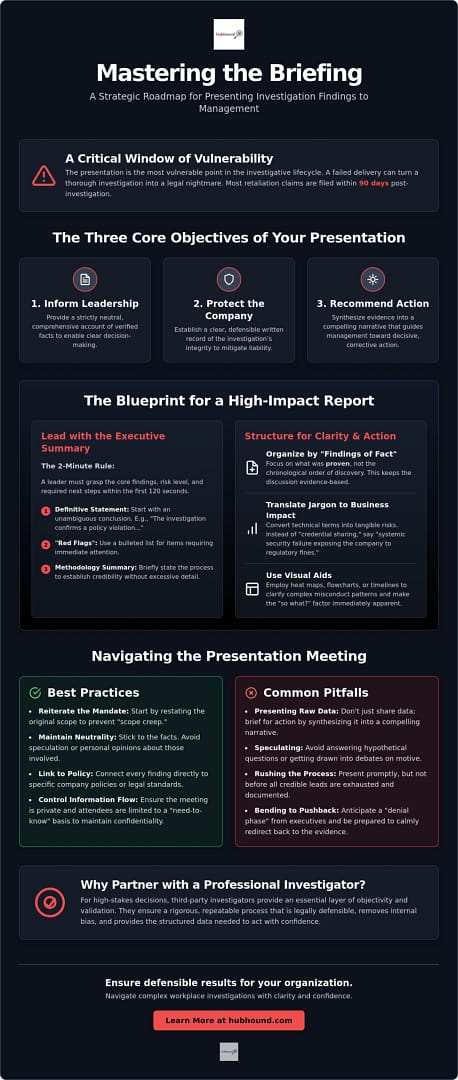
Securing Your Organization Through Defensible Reporting
Delivering investigative results is a high-stakes communication task that requires more than just a list of facts. You’ve learned to prioritize the executive summary and organize your data around findings of fact rather than simple chronology. These methods ensure your briefing is both time-efficient for leadership and legally defensible in court. Mastering how to present investigation findings to management allows you to move past the initial denial phase and focus the conversation on remediation and organizational growth.
When the stakes involve systemic fraud or sensitive misconduct, internal teams often face the threat of perceived bias. HubHound provides the third-party neutrality needed for these critical briefings. Our licensed investigators bring three decades of experience to every case, specializing in court-ready evidence collection and rigorous corporate due diligence. This external validation ensures your findings stand up to the most intense scrutiny from both executives and external regulators.
Contact HubHound for professional workplace investigation services to ensure your next presentation is supported by expert witness interviews and a pristine chain of custody. You now have the roadmap to turn complex evidence into decisive corporate action. Professionalism and clarity will protect your organization and pave the way for a more secure, transparent workplace.
Frequently Asked Questions
What are the most important elements to include in an investigation report for management?
Every report must include the investigation’s scope, methodology, and a clear summary of the findings of fact. These elements provide the necessary context for leadership to evaluate the integrity of the process. Including the specific company policies or legal standards that were reviewed ensures the report remains focused on objective compliance rather than personal grievances. This structure creates a reliable foundation for any future corporate due diligence.
How do you present negative findings about a high-performing employee?
Present negative findings for high-performers by focusing strictly on the evidence and the resulting business risk. High performance doesn’t provide immunity from legal liability or policy violations. Frame the discussion around protecting the organization from systemic risks like harassment or fraud. This approach helps management see the findings as a necessary step for organizational health rather than an attack on a valuable asset.
Should an investigation report include specific recommendations for discipline?
An investigation report should focus on fact-finding rather than specific disciplinary recommendations. The investigator’s role is to determine what happened; management and HR are responsible for determining the appropriate consequences based on company policy. Separating these roles maintains the investigator’s neutrality. This distinction is vital for mastering how to present investigation findings to management without overstepping professional boundaries.
How long should a management briefing for an investigation typically last?
A management briefing should typically last between 30 and 60 minutes. This timeframe is sufficient to cover the executive summary, key findings, and high-priority evidence without losing the audience’s attention. Efficient briefings respect the professional’s time and focus on the most critical risks. If the case involves complex corporate fraud, you may need a follow-up session to dive into specific digital evidence or financial logs.
What is the best way to handle a manager who disagrees with the investigative findings?
Handle disagreement by redirecting the manager to the corroborating evidence and the investigative methodology used during the process. If a manager challenges the results, provide the specific interview transcripts or digital footprints that support the conclusion. Stick to the facts and avoid emotional arguments. Understanding how to present investigation findings to management involves staying calm when findings clash with internal politics or personal loyalties.
Can I use a PowerPoint presentation to deliver investigation findings?
You can use a PowerPoint presentation to visualize complex patterns or data trends for leadership. Visual aids are effective for demonstrating systemic misconduct that is difficult to explain in text alone. However, remember that every slide is a discoverable record in potential litigation. Keep the slides concise and focus on high-level findings while relying on the written report for the granular, defensible details.
How do I ensure the confidentiality of the findings during the presentation?
Ensure confidentiality by limiting the presentation to individuals with a strict need-to-know status. Conduct the meeting in a secure environment and use encrypted digital platforms for any shared documents. Remind all attendees of the company’s non-retaliation policies before you begin. This is especially important during the 90-day period following the investigation when the risk of retaliation claims is statistically at its highest.
What should I do if management refuses to take action on the findings?
If management refuses to act, you must meticulously document that the findings were delivered and acknowledged. This record protects the investigator by proving that leadership was informed of the risks. While the final decision rests with management, your documentation serves as proof of due diligence. In some cases, a lack of action on systemic issues can increase the company’s exposure to significant regulatory fines or legal liability.

Article by
Joel R. Manley | President | Hubhound Investigations | OR PI-ID#: 90432 | 111 SW Fifth Avenue, Suite 3150 Portland, Oregon 97204 | 971-442-8170
Joel is licensed as a private investigator in Oregon and Tennessee. Joel started his career in 1987 serving as a Military Police Officer and Military Police Investigator.
After ending his military tour of duty, Joel became a civilian Police Officer and Deputy Sheriff. Joel took his strong background in Hostage Negotiations, Mediation and Conflict Resolution, with him to patrol some of the highest crime areas in SE Portland.
Joel was awarded Deputy of the Year for his efforts and for drastically reducing the crime rate in the area he patrolled. As a Deputy Sheriff, Joel assisted in leading a Neighborhood Livability Program that was nationally recognized for having the most innovative and progressive approach to policing.
In 2018, Joel retired as a Deputy Sheriff and founded Hubhound Investigations. Joel played an integral role in Hubhound Investigations receiving an A+ Accredited Business rating from the Better Business Bureau (BBB).
In his off time, Joel enjoys spending time with his wife, adult children and Hubhound’s Happiness Ambassador, Nya. Joel also enjoys Scuba Diving and Kayaking.
Disclaimer
DISCLAIMER: This article is provided for general informational and educational purposes only. It is not intended to constitute legal advice, professional investigative advice, or instruction to engage in any unlawful activity. Laws governing private investigations, surveillance, recording, tracking, access to information, evidence collection, privacy, trespass, licensing, and related investigative activities vary by jurisdiction and are subject to change.
Any investigative techniques, tactics, procedures, scenarios, or legal proceedings discussed in this article are presented for informational purposes and should not be interpreted as authorization or encouragement to use a particular method. Private investigators and members of the public are responsible for understanding and complying with all applicable federal, state, and local laws, licensing requirements, court rules, and professional standards.
The circumstances of every investigation and legal matter are different. Information contained in this article should not be relied upon as a substitute for advice from a qualified attorney or other appropriate licensed professional regarding a specific situation. No attorney-client, investigator-client, or other professional relationship is created by reading or using this information.