
What if the standard legal channels aren’t enough to secure the financial support your family depends on? It’s exhausting to face the financial strain of unpaid obligations while waiting for slow government processes to catch up. You likely feel the frustration of knowing the other parent is intentionally evading their responsibilities. If you’re investigating how to locate someone who owes child support Oregon, you’ve likely found that state databases often lack the real-time data needed to find someone who doesn’t want to be found.
This guide explains the professional skip tracing strategies used to track down evaders and bridge the gap when official efforts stall. Use these techniques to identify current places of employment and verified residential addresses to ensure legal papers are served correctly. Evaluate high-quality investigative resources and specialized software that prioritize efficiency and accuracy over broad, outdated records. This approach allows you to move from a state of uncertainty to professional validation, gaining the peace of mind that comes with a verified location and a clear path toward enforcement.
Key Takeaways
- Learn why private investigative firms offer a proactive alternative to the often reactive nature of state-run agencies.
- Discover how to build a detailed Subject Profile that tracks past employers and social circles to find current locations.
- Implement professional skip tracing strategies for how to locate someone who owes child support Oregon to bridge the gap when official channels stall.
- Evaluate the hierarchy of investigative data, moving from public social media footprints to private credit header information.
- Understand the role of surveillance in proving a lifestyle that contradicts reported income during child support hearings.
Understanding Why Individuals Evade Child Support Obligations
Distinguishing between financial hardship and active avoidance is the first step in any recovery effort. While some parents experience genuine job loss or medical emergencies, others systematically restructure their lives to avoid their legal duties. Understanding how to locate someone who owes child support Oregon requires recognizing that state-level enforcement often moves slower than a person who is determined to stay hidden. These individuals frequently exploit gaps in the legal system to remain invisible to administrative agencies.
Willful evasion is a deliberate attempt to circumvent court-ordered financial responsibilities. This behavior often involves more than just a missed payment; it includes changing phone numbers, moving frequently, or even adopting aliases. In the modern economy, the rise of “under the table” work and gig-based platforms has made it easier for people to earn income without triggering standard wage-withholding notifications. This creates a significant hurdle for traditional tracking methods that rely on payroll tax data.
The Limitations of Administrative Tracking
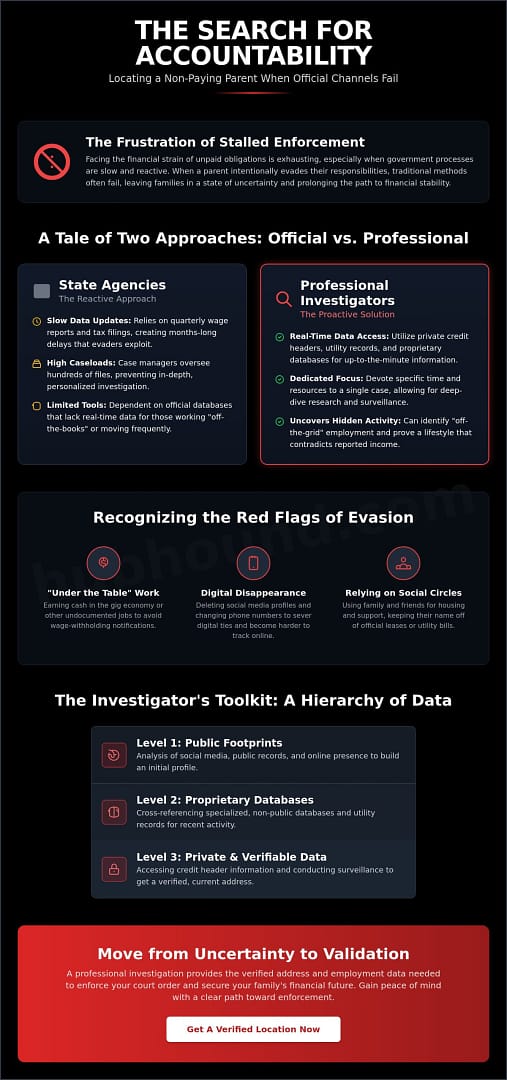
State databases are reactive by design. They rely on reported data from employers and government agencies that may take months to synchronize. This delay creates a window of opportunity for someone to relocate before an address update occurs. Frequent job-hopping further complicates the issue. By the time an agency identifies a place of employment, the individual has already moved to a new role, effectively resetting the tracking clock. Furthermore, self-reported information is often inaccurate, as those evading support may provide false residential details to avoid service of process.
Intentional Evasion vs. Administrative Oversight
Differentiating between a simple clerical error and active concealment requires a critical look at specific red flags. If a parent suddenly deletes their social media presence or cuts ties with mutual acquaintances, they aren’t just moving; they’re disappearing. Family members and social circles often provide the support structure needed for this evasion, offering housing or cash-only employment to keep the individual off the grid. When mail-based inquiries fail to produce results, professional skip tracing becomes the only viable method for uncovering a current location. This process involves a rigorous assessment of digital and physical footprints that standard government searches often overlook. By analyzing utility records, credit headers, and proprietary databases, investigators can identify the precise location of someone who is intentionally hiding.
Identifying these patterns early is essential for long-term success. If you’ve been struggling with how to locate someone who owes child support Oregon, you must evaluate whether the person is simply hard to find or actively hiding. Professional investigative techniques focus on these distinctions, ensuring that the search is tailored to the specific level of evasion present in the case.
Official Resources vs. Professional Investigative Services
State-run child support agencies operate as the primary point of entry for most cases. These organizations manage vast caseloads and rely on standardized administrative processes to find non-custodial parents. While they have access to the Federal Parent Locator Service (FPLS), their approach is inherently reactive. They wait for data to appear in quarterly wage reports or tax filings. If you are researching how to locate someone who owes child support Oregon, you’ll find that government agencies are often limited by high file volumes. A single case manager may oversee hundreds of active files. This prevents them from performing deep-dive research into a single individual’s whereabouts.
Private investigators offer a proactive alternative. They dedicate specific blocks of time to a single subject, allowing for a level of scrutiny that state resources cannot match. While official channels are useful for basic enforcement, they often stall when a parent intentionally goes off the grid. Transitioning to a professional service is a strategic move that prioritizes speed and accuracy over administrative routine.
What State Agencies Do (and Don’t Do)
Official programs use centralized databases to flag new employment or updated addresses. The Oregon Child Support Program and similar state entities utilize the FPLS to cross-reference social security data and unemployment records. However, these tools have limits. Government employees cannot conduct physical surveillance or visit a suspected residence to verify someone is actually living there. The timeline for state-initiated locate requests is often measured in months. This delay allows an evasive parent to relocate again before the system catches up.
The Investigative Advantage of Professional Locate Services
Private investigative firms operate without the constraints of government bureaucracy. They utilize proprietary databases that aggregate real-time data from utility connections, cellular service records, and credit header information. This data is often more current than the quarterly reports used by the government. If you need to understand how to locate someone who owes child support Oregon, professional services provide the necessary agility to track moving targets.
The ability to perform real-world surveillance is a critical differentiator. An investigator can physically confirm a place of employment or a residential address, providing the “boots on the ground” that administrative agencies lack. This level of verification is essential for successful process service. Utilizing HubHound’s locate investigations allows you to gather the validated evidence needed to move forward with legal proceedings. When the standard mail-based inquiries of the state fail, pivoting to a professional service ensures that the search doesn’t stall.
Advanced Skip Tracing: How Professionals Track Down Elusive Individuals
Skip tracing is the professional process of locating an individual’s whereabouts for legal purposes. It is a systematic filtration of data points that leads to a verifiable address or place of employment. While government agencies often stop at social security records, professional investigators use a sophisticated hierarchy of information. This starts with public records and escalates to private credit header data, which provides the most recent billing addresses associated with a subject’s financial activity. If you are trying to understand how to locate someone who owes child support Oregon, you must look beyond basic government databases.
Effective investigations cross-reference multiple sources to ensure accuracy. This includes analyzing utility connections, voter registrations, and professional licenses that require a current physical address. Advanced skip tracing utilizes non-traditional data points like hunting licenses or gym memberships to pinpoint an individual’s routine and geographic preferences. These details create a comprehensive profile that makes it nearly impossible for an individual to remain hidden long-term. By aggregating these disparate pieces of information, investigators build a roadmap to the subject’s current location.
Digital Footprint Analysis
Social media activity often provides the most immediate leads. Even if a subject is careful, their digital footprint can inadvertently reveal a hidden location through metadata or background details in photographs. Analyzing “check-ins” or the specific architecture in a posted image allows investigators to identify neighborhoods or even specific street corners. This type of digital surveillance is legal when conducted within the bounds of public accessibility, providing a cost-effective starting point for many locate investigations. It’s about finding the one slip-up in an otherwise guarded online presence.
Field Investigations and Verification
Data only tells part of the story; physical verification is what confirms residency. Field investigations often involve neighbor interviews or “trash pulls” to gather physical evidence of occupancy. By observing daily travel patterns and workplace arrivals, investigators can verify employment even when a subject is being paid cash or working under a different name. If you are struggling with how to locate someone who owes child support Oregon, these real-world tactics provide the final layer of proof needed for legal service. To understand the complexities of this work, review this Advanced Surveillance Techniques guide for deeper context on field methods. These strategies ensure that once a subject is found, the evidence is strong enough to withstand scrutiny in a courtroom.
Steps to Take When the Other Parent Goes ‘Off the Grid’
When a parent decides to go “off the grid,” they often rely on cash payments and frequent relocation to stay invisible. This level of evasion requires a shift from passive waiting to active intelligence gathering. If you’re researching how to locate someone who owes child support Oregon, the most effective first step is compiling a comprehensive Subject Profile. This document should aggregate every known past address, former employer, and verified phone number. By mapping their history, you can identify patterns in their movement that might predict their current location.
Don’t overlook the value of social circles. Mutual acquaintances and extended family members often possess fragments of information that, when combined, reveal a clearer picture. Documenting known assets like vehicles, professional licenses, or business interests also provides critical leverage. These tangible items are much harder to hide than a person and often lead directly to a physical location. Coordinating this data with legal counsel ensures that every lead you follow results in evidence that is admissible in court.
Gathering Preliminary Intelligence
Construct a detailed timeline of the last known contacts and sightings. This helps identify “anchors,” which are specific people or places the subject is unlikely to abandon regardless of their legal situation. For example, a person may change their name but continue to frequent a specific gym or visit a particular relative. Use public records to search for professional aliases or businesses registered in their name. These records often provide a paper trail that outlasts a temporary residential move.
Preparing for Legal Service of Process
Finding a current address is a major milestone, but it’s only half the battle. You must ensure that the individual is legally notified of the proceedings against them. This is why professional process service is essential once a location is identified. In cases of active evasion, legal service may require multiple attempts or specialized delivery methods to be considered valid by the court. A professional locate report facilitates this work by providing your attorney with the validated data needed to prove the subject’s whereabouts. If you need to move from discovery to action, identify high-quality locate investigations to secure the evidence required for your case. This systematic approach ensures that your efforts to understand how to locate someone who owes child support Oregon result in actual legal accountability.
The Role of Professional Investigation in Legal Accountability
Professional investigative reports transform raw data into actionable evidence for child support hearings. While a locate investigation identifies where a person lives, the subsequent documentation of their activities establishes their financial capacity. If you’ve been researching how to locate someone who owes child support Oregon, remember that a verified address is only the foundation. The real value lies in providing the court with a clear, documented record of the subject’s current lifestyle and employment status. This evidence is critical for countering claims of unemployment or poverty that an evasive parent might present during a modification hearing.
Moving from a successful locate to a successful enforcement action requires a seamless transition from discovery to documentation. Investigative findings are often the catalyst for wage garnishments or asset seizures. By providing a comprehensive report, you empower your legal counsel to move decisively. This synergy ensures that the search for a missing parent leads to a tangible financial result rather than just a confirmed address.
Proving Hidden Income and Assets
Identifying undisclosed employment or side businesses requires specialized techniques that go beyond administrative records. Surveillance operations can document a subject arriving at a workplace daily, even if they aren’t on the official payroll. Similarly, documenting ownership of assets like boats, luxury cars, or recreational vehicles directly challenges “inability to pay” claims. These tangible signs of wealth provide a lifestyle profile that often contradicts reported income. For a deeper look at these methodologies, refer to HubHound’s guide on finding missing adults, which outlines similar locate strategies used in high-stakes cases.
Securing Professional Assistance
Selecting a licensed investigative firm for sensitive family matters requires careful evaluation. Look for a partner that operates with quiet confidence and absolute discretion. The most effective firms demonstrate a synergy between criminal defense investigators and civil locate tasks, applying rigorous standards of evidence to every file. This professional rigor ensures that the information gathered is not only accurate but also defensible in court.
When you’re ready to bridge the gap left by official channels, professional intervention is the next logical step. Evaluate firms based on their niche expertise and their ability to provide clear, actionable reports. To initiate the process and secure the financial support your family deserves, contact HubHound to begin a specialized locate operation. This proactive approach is the most efficient way to resolve questions regarding how to locate someone who owes child support Oregon and ensure long-term legal accountability.
Securing Financial Accountability Through Professional Precision
Securing the financial support your family deserves requires a strategic, data-driven approach that moves faster than those attempting to hide. You’ve seen that while official agencies provide a necessary baseline, they often lack the specialized resources to track individuals who intentionally go off the grid. Professional skip tracing fills this critical gap. It leverages real-time data and field verification to ensure that legal papers are served correctly and lifestyle claims are rigorously validated.
If you’re currently navigating the complexities of how to locate someone who owes child support Oregon, don’t allow administrative delays to stall your progress. HubHound connects you with licensed investigators who bring over three decades of experience to complex skip tracing and surveillance operations. We provide court-ready evidence and professional reporting to ensure your case is built on a foundation of verified facts. Connect with a professional investigator at HubHound to start your locate search today.
Take the next step toward a resolution. You now have the roadmap to move from uncertainty to action, ensuring that legal obligations are met and your family’s future is protected.
Frequently Asked Questions
Can a private investigator find someone if the state agency failed?
Yes, private investigators often succeed where state agencies fail because they operate with fewer administrative constraints. While government workers manage thousands of files, a professional investigator dedicates specific hours to a single case. If you’re investigating how to locate someone who owes child support Oregon, a private firm provides the proactive surveillance and proprietary data access that reactive state systems lack.
Is it legal to hire an investigator to find a parent for child support?
Hiring a licensed investigator is entirely legal for the purpose of locating a parent for child support enforcement. These investigations fall under civil litigation support and process service preparation. Using a professional ensures that all evidence is gathered ethically and stays admissible in court during future hearings.
How much does it cost to locate someone who owes child support?
Costs for locate investigations are determined by the complexity of the subject’s evasion tactics and the depth of research required. Some cases only require database skip tracing, while others involve extensive field surveillance. You should evaluate the specific needs of your case with an investigator to receive an accurate assessment of the required resources.
What information do I need to provide to start a locate investigation?
Start by providing the subject’s full name, date of birth, and any known social security numbers. Information regarding past employers, vehicle descriptions, and social media profiles helps build a more accurate subject profile. When you’re determining how to locate someone who owes child support Oregon, even small details like gym memberships or professional licenses can serve as vital anchors.
How long does professional skip tracing typically take?
Professional skip tracing timelines vary based on the subject’s current level of activity and the age of your last lead. A standard search might conclude in a few business days, while cases involving intentional disappearance may take weeks of surveillance. Most investigators prioritize efficiency to help you move to the legal service phase as quickly as possible.
Can an investigator find someone who is working for cash or ‘under the table’?
Investigators use surveillance and field interviews to identify individuals earning income through cash payments. By documenting daily commutes and physical presence at a job site, professionals prove employment that doesn’t appear in tax records. This lifestyle evidence is essential for challenging a parent’s claim that they have no income to provide support.
What happens once the missing parent is located?
Once a verified location is identified, the next step is typically process service to notify the parent of pending legal actions. This validated address allows your attorney to initiate wage garnishments or asset seizures through the court system. Gaining a current address is the catalyst for turning a stalled case into an active enforcement action.
Can an investigator help if the parent has moved to another state?
Professional investigators utilize nationwide databases to track individuals regardless of where they move across the country. They can follow digital and financial footprints across state lines to find subjects who believe they’ve escaped their obligations by relocating. This nationwide reach is a primary advantage over localized administrative searches that may struggle with jurisdictional boundaries.

Article by
Joel R. Manley | President | Hubhound Investigations | OR PI-ID#: 90432 | 111 SW Fifth Avenue, Suite 3150 Portland, Oregon 97204 | 971-442-8170
Joel is licensed as a private investigator in Oregon and Tennessee. Joel started his career in 1987 serving as a Military Police Officer and Military Police Investigator.
After ending his military tour of duty, Joel became a civilian Police Officer and Deputy Sheriff. Joel took his strong background in Hostage Negotiations, Mediation and Conflict Resolution, with him to patrol some of the highest crime areas in SE Portland.
Joel was awarded Deputy of the Year for his efforts and for drastically reducing the crime rate in the area he patrolled. As a Deputy Sheriff, Joel assisted in leading a Neighborhood Livability Program that was nationally recognized for having the most innovative and progressive approach to policing.
In 2018, Joel retired as a Deputy Sheriff and founded Hubhound Investigations. Joel played an integral role in Hubhound Investigations receiving an A+ Accredited Business rating from the Better Business Bureau (BBB).
In his off time, Joel enjoys spending time with his wife, adult children and Hubhound’s Happiness Ambassador, Nya. Joel also enjoys Scuba Diving and Kayaking.
Disclaimer
DISCLAIMER: This article is provided for general informational and educational purposes only. It is not intended to constitute legal advice, professional investigative advice, or instruction to engage in any unlawful activity. Laws governing private investigations, surveillance, recording, tracking, access to information, evidence collection, privacy, trespass, licensing, and related investigative activities vary by jurisdiction and are subject to change.
Any investigative techniques, tactics, procedures, scenarios, or legal proceedings discussed in this article are presented for informational purposes and should not be interpreted as authorization or encouragement to use a particular method. Private investigators and members of the public are responsible for understanding and complying with all applicable federal, state, and local laws, licensing requirements, court rules, and professional standards.
The circumstances of every investigation and legal matter are different. Information contained in this article should not be relied upon as a substitute for advice from a qualified attorney or other appropriate licensed professional regarding a specific situation. No attorney-client, investigator-client, or other professional relationship is created by reading or using this information.