
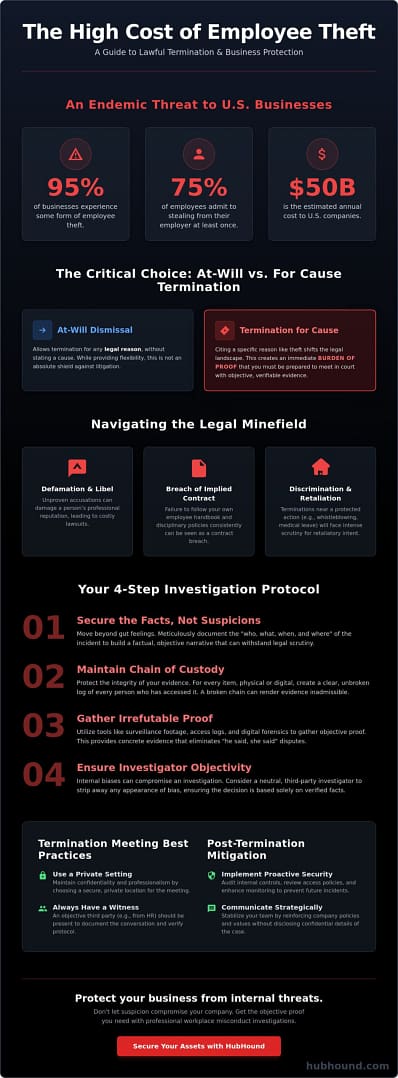
Approximately 95% of U.S. businesses experience some form of employee theft, with 75% of employees admitting to stealing from their employer at least once. This creates a massive financial drain, costing companies an estimated $50 billion annually. When you discover a breach of trust, the urge to act immediately is understandable. You’ve invested significant time and resources into your team, and a violation of that bond feels personal. However, a hasty dismissal can often lead to expensive legal retaliation if the proper protocols aren’t followed. Understanding how to legally fire an employee for theft requires moving beyond suspicion toward a framework of objective proof.
You deserve to lead a team where integrity is the standard. This guide provides the precise investigative and legal steps required to terminate a dishonest employee while shielding your business from litigation. We’ll walk through the process of gathering credible evidence and handling the termination meeting with professional authority. By following this structured approach, you can recover stolen assets and restore the security of your workplace without the fear of legal blowback. Use these insights to navigate the burden of proof and ensure your termination process is both clean and final.
Key Takeaways
- Distinguish between at-will dismissal and termination for cause to avoid the common pitfalls of wrongful termination litigation.
- Follow a rigorous investigative protocol to gather court-admissible evidence and learn how to legally fire an employee for theft while protecting your assets.
- Audit your internal disciplinary policies and transparency protocols to ensure your business remains compliant with current regulatory standards.
- Don’t conduct the termination meeting alone; use a witness and a private setting to maintain professional authority and objective documentation.
- Implement proactive security measures and strategic communication to stabilize your team and prevent future internal theft.
Understanding At-Will Employment and the Burden of Proof
Most jurisdictions operate under the At-will employment doctrine. This legal standard allows you to end an employment relationship at any time for any legal reason. While this provides a layer of protection for business owners, it isn’t an absolute shield against litigation. When you choose to cite a specific reason like theft, you’re effectively moving the dismissal from “at-will” to “for cause.” This transition is significant. It changes the legal landscape from one where no explanation is needed to one where your explanation must be backed by verifiable facts.
Stating a specific cause like theft creates an immediate burden of proof that you must be prepared to meet in a court of law. Knowing how to legally fire an employee for theft requires a shift from suspicion to a framework of objective proof. You need a clear, documented narrative that links the individual to the specific loss. This requires more than just a gut feeling; it requires a chain of evidence that demonstrates the employee violated company policy. Without this foundation, your business remains exposed to claims that the termination was arbitrary or based on personal friction rather than objective misconduct.
The Legal Risks of Stating “Theft” as the Reason
Accusing an employee of a crime like theft carries heavy legal weight. If the allegation is unproven or handled poorly, the former employee may sue for defamation or libel per se. These claims focus on the damage done to the individual’s professional reputation. Even in at-will environments, you’re held to the standards set in your own employee handbook. If your internal policies aren’t followed consistently across the entire organization, a judge may view the termination as a breach of implied contract. Consistency in how you handle misconduct is your strongest defense against these types of legal challenges.
Protected Categories and Retaliation Risks
Every termination must be evaluated through the lens of potential discrimination or retaliation. You must be certain that the decision isn’t a reaction to an employee’s protected status or a recent whistle-blowing activity. If an employee has recently filed a complaint or requested medical leave, a sudden accusation of theft will be scrutinized for retaliatory intent. Utilizing a neutral, third-party resource for Workplace Misconduct Investigations helps strip away the appearance of bias. This objective approach ensures that the decision is based on verified evidence rather than management’s subjective perception. For more specialized resources on business protection, visit HubHound to explore their investigative tools.
The Investigation Phase: Gathering Court-Admissible Evidence
Suspicion is not a substitute for evidence. When an asset goes missing, your first priority is to secure the facts without alerting the suspect. A formal workplace investigation acts as the bridge between an initial report and a defensible termination. This process requires a meticulous approach to documentation, ensuring every detail of the incident is recorded. You must identify the “who, what, when, and where” with absolute precision. While legal nuances vary by region, those determining how to legally fire an employee for theft in Oregon will find that the foundational requirements for evidence remain consistent across most jurisdictions. You need a clear, unshakeable narrative that survives the scrutiny of a courtroom.
Maintaining a strict chain of custody is essential for both physical and digital evidence. If you handle a compromised laptop or a physical inventory log, you must document every person who had access to that item. Proactive surveillance operations can often confirm suspicions by capturing unauthorized activities in real-time. This provides objective proof that eliminates the “he-said, she-said” dynamic that often plagues misconduct cases. Investigating employee theft requires a level of detail that many internal teams aren’t equipped to handle on their own. Without a professional trail, your evidence may be deemed inadmissible, leaving your business vulnerable to litigation.
Internal vs. External Investigations
Deciding between in-house HR and a specialized firm is a matter of objectivity and expertise. Internal teams may have existing biases or relationships with the suspect that compromise the integrity of the report. Utilizing professional workplace investigations ensures a neutral perspective. These experts produce a comprehensive report that serves as your primary legal defense. Keeping the inquiry discreet is vital. If the employee realizes they’re being watched, they may destroy digital logs or intimidate witnesses before you can secure the data. If you need to validate a claim quickly, consider a soft consultation for Corporate Due Diligence to identify the best path forward.
Types of Evidence to Secure
Modern theft often leaves a digital footprint that is difficult to erase. Secure email logs, access card timestamps, and financial transaction records immediately. These data points establish a pattern of behavior that is hard to refute. Physical evidence remains equally important. High-resolution security footage and verified inventory counts provide the visual and mathematical proof needed for a clean dismissal. Professional witness interviews play a critical role in establishing intent. An expert interviewer can often uncover admissions or contradictions that a standard HR meeting would miss. This multi-layered approach ensures your decision to terminate is backed by a mountain of verifiable facts.
Procedural Safeguards to Prevent Wrongful Termination Claims
Once the investigation yields concrete results, you must filter those findings through a procedural framework that minimizes risk. Even with conclusive evidence, the manner in which you execute the dismissal determines whether your business is protected from a wrongful termination claim. When learning how to legally fire an employee for theft in Oregon, you’ll see that procedural fairness is as vital as the evidence itself. You must ensure that the termination isn’t just justified by facts, but also by the consistent application of your company’s internal rules. This requires a final audit of your policies before the meeting takes place.
Start by evaluating the “Fair Investigation” standard. This means the employee was given a reasonable chance to tell their side of the story before the final decision was finalized. You aren’t required to disclose every piece of evidence, but you must demonstrate that the process was impartial. Review your employee handbook to confirm that theft is explicitly listed as a ground for immediate dismissal. If your policy suggests a progressive discipline path, you must document why the severity of this incident warrants a departure from that standard. For specialized validation of your findings, visit HubHound to access expert investigative resources.
Documentation and the Paper Trail
Your investigation file should be a comprehensive record that can withstand the scrutiny of Civil Litigation Support. Include all digital logs, witness statements, and physical evidence reports in a centralized file. When drafting the termination letter, keep it strictly factual. Avoid adjectives that imply malice or intent. Focus on the specific policy that was violated and the evidence that supports the breach. This neutral tone reduces the risk of defamation claims while clearly establishing the reason for the separation.
Final Pay and Benefits Compliance
Compliance doesn’t end with the dismissal. You must adhere to the strict timeline for the final paycheck, which is often due by the end of the next business day. This includes all earned wages and any accrued vacation time mandated by your specific company policy. Don’t make the mistake of withholding pay as a form of “reimbursement” for the stolen items. This is a high-risk legal error that can trigger wage theft penalties far exceeding the value of the stolen goods. Handle asset recovery as a separate legal matter through the appropriate channels.
The Termination Meeting: Best Practices for Employers
The termination meeting represents the final execution of your investigative efforts. It’s the moment where your preparation meets professional reality. To maintain control, you must select a private location that’s free from interruptions and away from the view of other staff members. Timing is equally critical. Many experts suggest conducting these meetings mid-week and at the end of the day to minimize workplace disruption. Executing this meeting correctly is the culmination of your research into how to legally fire an employee for theft in Oregon, requiring a balance of firm authority and strict procedural adherence.
You should never conduct this meeting alone. Always have a second person present, such as an HR representative or a senior manager, to act as a witness. This witness provides an objective account of the conversation, which prevents the dismissed individual from later misrepresenting the interaction in a legal setting. Their role is to observe and take notes, not to lead the discussion. Your goal is to maintain professional neutrality throughout the encounter. If the employee becomes emotional or combative, don’t mirror their energy. Stay focused on the facts you’ve already verified through your investigation.
What to Say (and What Not to Say)
Be direct and concise. State the decision clearly in the first few sentences so there’s no ambiguity. Avoid using the word “thief” or making character judgments. Instead, focus on the specific “violation of company policy” or “breach of the employee handbook.” This phrasing is safer from a legal standpoint and keeps the conversation focused on the act rather than the person. When the employee offers a denial or an “I didn’t do it” defense, don’t engage in a debate. Simply state that a thorough investigation has been completed and the decision is final. For professional support in establishing these facts before the meeting, consult a specialist in Workplace Misconduct Investigations.
Security and Logistics
Asset recovery must happen immediately. Before the meeting concludes, secure all company property, including keys, badges, laptops, and company-issued credit cards. You should also coordinate with your IT department to revoke all digital access and change passwords the moment the meeting begins. This prevents any retaliatory data breaches or unauthorized communications. Once the meeting is over, escort the employee from the premises safely and discreetly. If they have personal belongings at their workstation, it’s often better to pack these items and ship them later or arrange a supervised time for pickup. This ensures the departure is quick and minimizes the risk of a scene in front of the remaining team.
Post-Termination Steps and Mitigating Future Risk
The dismissal is complete, but the organizational risk remains. You must address the systemic failure that allowed the theft to occur. While you’ve followed the protocols for how to legally fire an employee for theft in Oregon, the next step involves securing your operational environment. This transition from reactive termination to proactive prevention is essential for long-term stability. Use this time to evaluate your internal controls and identify where the breach occurred. A clean exit only matters if you’ve closed the door behind the departing individual.
Communication with the remaining team is a delicate balance. You must inform them of the departure without providing specific details of the misconduct. Labeling a former employee as a criminal to the whole office can lead to defamation claims, even if the evidence was clear. Focus on the fact that the individual is no longer with the company and that roles are being reassigned. This maintains professional neutrality while signaling that policy violations have consequences. It’s about restoring workplace integrity without creating new legal liabilities.
Engaging corporate investigation firms to conduct a post-incident audit is a high-value move for growth-focused companies. These experts identify the specific vulnerabilities, such as lack of oversight in financial software or blind spots in physical security, that the former employee exploited. This specialized filtering process turns a crisis into a roadmap for organizational hardening. By auditing these vulnerabilities, you demonstrate a commitment to transparency and rigorous assessment that protects both the business and its honest employees.
Improving Pre-Employment Screening
Most internal theft can be traced back to a failure in the initial hiring phase. Generic screening software often misses nuanced red flags like frequent job hopping or undisclosed gaps in employment. High-quality pre-employment background checks provide the rigorous assessment needed for sensitive roles. Professional investigators verify past employment and criminal history with a level of precision that automated systems cannot match. This expert guidance saves you time and effort by filtering out high-risk candidates before they gain access to your assets.
Ongoing Workplace Monitoring
Transparency is your best deterrent. Implement clear surveillance policies that comply with privacy laws and ensure every employee understands the monitoring protocols. Regular financial and inventory audits should be standard procedure rather than a reaction to a loss. This rhythmic efficiency suggests that the process of finding a solution is built into the company culture. By establishing clear reporting channels, you encourage an environment where integrity is the standard. It makes the brand feel like an indispensable ally for employees who value a secure and honest workplace.
Securing Your Workplace Integrity
Navigating a termination for misconduct requires a shift from emotional reaction to professional validation. You’ve seen that a successful dismissal depends on two critical pillars: a meticulous investigation that secures court-admissible evidence and a termination process that respects procedural compliance. By following these steps, you eliminate the ambiguity that trial lawyers often exploit during wrongful termination claims. A clean exit is the result of rigorous preparation and a commitment to objective truth.
While many managers focus on the immediate hurdle of how to legally fire an employee for theft in Oregon, the most resilient businesses look toward long-term mitigation. This includes strengthening your pre-employment screening and auditing internal vulnerabilities to prevent future breaches. Establishing a culture of integrity is an ongoing process that begins with the right investigative partners.
Protect your business with professional workplace investigations from HubHound. Our team of licensed investigators brings over 30 years of experience to every engagement, providing court-ready evidence documentation and comprehensive corporate due diligence services. You can restore your workplace’s security and focus on growth with the confidence that your assets are protected by expert curators of truth. Take the first step toward a more secure future today.
Frequently Asked Questions
Can I fire an employee for theft if I only have a strong suspicion but no video proof?
You can terminate an employee based on a strong suspicion; however, you must have a “preponderance of evidence” to defend against wrongful termination claims. Video footage is a powerful tool, but it’s not the only way to establish cause. Digital access logs, financial records, and consistent witness statements often provide the necessary proof. If you’re determining how to legally fire an employee for theft in Oregon, ensure your documentation is robust enough to survive legal scrutiny.
How soon must I provide the final paycheck to an employee fired for theft?
If you fire an employee, their final paycheck is typically due by the end of the next business day. This deadline is strict and includes all earned wages and accrued benefits defined in your company policy. Failing to meet this timeline can result in significant penalties and further legal complications. Always have the check ready or processed within 24 hours of the termination meeting to maintain full regulatory compliance with national standards.
Should I call the police before or after I fire the employee?
Most experts recommend involving the police after the termination meeting has concluded. Calling law enforcement before the dismissal can lead to claims of false imprisonment or workplace disruption. If there’s an immediate threat to safety, contact authorities instantly. Otherwise, secure your evidence first, conduct the meeting professionally, and then file a formal report with the police to document the theft for insurance or criminal purposes.
Can an employee sue me for defamation if I tell the rest of the staff they stole?
Yes, an employee can sue for defamation if you broadcast the reason for their departure to the entire staff. To protect your business, limit the disclosure of information to a strictly “need-to-know” basis. Inform the team that the individual is no longer with the company without detailing the misconduct. Focus on the redistribution of duties rather than the specific cause of the exit to avoid libel or slander allegations.
What happens if the employee offers to pay back the money in exchange for keeping their job?
You should generally decline offers to repay stolen assets in exchange for continued employment. Accepting such a deal creates a dangerous precedent and signals that theft is a negotiable offense. It also leaves a known risk within your organization. Instead, treat the termination and the recovery of assets as two separate legal tracks. Use Civil Litigation Support to pursue the return of funds after the professional relationship has been severed.
Is it legal to record a termination meeting without the employee’s consent?
The legality of recording a termination meeting depends on whether your jurisdiction follows “one-party” or “two-party” consent laws. In many areas, recording without consent is illegal and the audio won’t be admissible in court. The safest approach is to have a second HR representative present as a witness. This witness provides an objective account of the meeting, which serves as a reliable alternative to a potentially problematic electronic recording.
Does at-will employment protect me if the employee claims I am discriminating?
At-will employment does not protect you from claims of discrimination or retaliation. While you can fire an employee for “no reason,” you cannot fire them for an illegal reason. If an employee is in a protected category, your burden of proof for the theft must be even more precise. A neutral, third-party investigation is the most effective way to demonstrate that the termination was based solely on misconduct rather than bias or illegal motives.

Article by
Joel R. Manley | President | Hubhound Investigations | OR PI-ID#: 90432 | 111 SW Fifth Avenue, Suite 3150 Portland, Oregon 97204 | 971-442-8170
Joel is licensed as a private investigator in Oregon and Tennessee. Joel started his career in 1987 serving as a Military Police Officer and Military Police Investigator.
After ending his military tour of duty, Joel became a civilian Police Officer and Deputy Sheriff. Joel took his strong background in Hostage Negotiations, Mediation and Conflict Resolution, with him to patrol some of the highest crime areas in SE Portland.
Joel was awarded Deputy of the Year for his efforts and for drastically reducing the crime rate in the area he patrolled. As a Deputy Sheriff, Joel assisted in leading a Neighborhood Livability Program that was nationally recognized for having the most innovative and progressive approach to policing.
In 2018, Joel retired as a Deputy Sheriff and founded Hubhound Investigations. Joel played an integral role in Hubhound Investigations receiving an A+ Accredited Business rating from the Better Business Bureau (BBB).
In his off time, Joel enjoys spending time with his wife, adult children and Hubhound’s Happiness Ambassador, Nya. Joel also enjoys Scuba Diving and Kayaking.
Disclaimer
DISCLAIMER: This article is provided for general informational and educational purposes only. It is not intended to constitute legal advice, professional investigative advice, or instruction to engage in any unlawful activity. Laws governing private investigations, surveillance, recording, tracking, access to information, evidence collection, privacy, trespass, licensing, and related investigative activities vary by jurisdiction and are subject to change.
Any investigative techniques, tactics, procedures, scenarios, or legal proceedings discussed in this article are presented for informational purposes and should not be interpreted as authorization or encouragement to use a particular method. Private investigators and members of the public are responsible for understanding and complying with all applicable federal, state, and local laws, licensing requirements, court rules, and professional standards.
The circumstances of every investigation and legal matter are different. Information contained in this article should not be relied upon as a substitute for advice from a qualified attorney or other appropriate licensed professional regarding a specific situation. No attorney-client, investigator-client, or other professional relationship is created by reading or using this information.