
What if the primary reason your top-tier candidates vanish during the final hiring stages isn’t a competitor’s offer, but a simple misunderstanding of your screening process? It’s a common frustration for hiring managers who feel the pressure of maintaining a secure workplace while trying to avoid the “candidate ghosting” that often occurs during investigative phases. Learning how to explain a background check policy to candidates is no longer just an administrative task; it’s a strategic move to protect your employer brand and ensure compliance with evolving federal standards.
You deserve a recruitment process that feels like a professional bridge rather than a legal hurdle. This guide provides the tools you need to master transparent communication, offering a repeatable script to reduce friction and lower drop-off rates. We’ll explore how to simplify complex Fair Credit Reporting Act (FCRA) requirements and align your messaging with modern “ban-the-box” trends that now impact over 37 states and numerous jurisdictions nationwide. By the end of this article, you’ll have the framework to turn a technical necessity into a competitive advantage for your hiring team.
Key Takeaways
- Master how to explain a background check policy to candidates by positioning the screening process as a tool for mutual security and professional verification.
- Reduce candidate drop-off rates by implementing a “verbal first” disclosure strategy immediately following your conditional job offer.
- Safeguard your organization with standardized guidelines that cover the rigorous verification of employment history, education, and professional credentials.
- Identify why human-led corporate due diligence outperforms software-only solutions when verifying complex backgrounds or high-level professional licenses.
- Follow a structured communication framework to ensure your hiring process remains compliant with federal regulations while maintaining a modern, helpful brand image.
Why Transparency in Background Check Policies Matters
The final stage of the hiring process often creates a psychological disconnect. While your team views a background check as a routine validation step, a candidate might perceive it as an intrusive interrogation. This gap in perception is where many high-quality hires are lost. Mastering how to explain a background check policy to candidates transforms this potential friction point into a moment of brand reinforcement. It shifts the narrative from a “gotcha” moment to a standard procedure that protects the integrity of the entire organization.
Building a culture of integrity starts at the first touchpoint. When you’re upfront about your screening requirements, you signal that your company values safety and professional standards. This transparency eliminates “screening anxiety,” a common phenomenon where candidates worry about minor, irrelevant discrepancies in their history. By providing a clear roadmap of what you verify, you allow the candidate to feel like a partner in the process rather than a subject under investigation. Use this phase to confirm that the screening is simply a tool for corporate due diligence, ensuring every team member meets the same high bar.
Reducing Candidate Friction and Ghosting
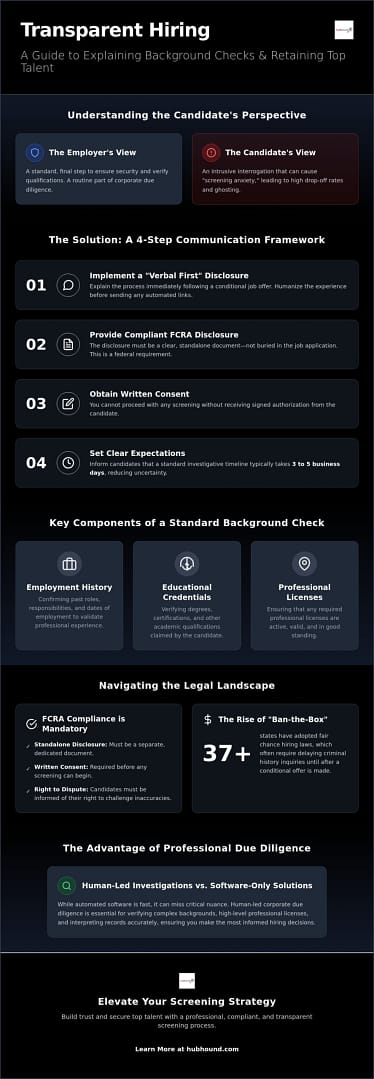
Candidate ghosting often spikes the moment a background check link hits an inbox. This happens when the process feels cold, automated, or unexpected. You can prevent this by using the explanation phase to humanize the experience. Explain that the check is the final bridge to their start date. Set realistic expectations by outlining that a standard investigative timeline usually takes three to five business days. When candidates know what to expect, they’re less likely to drop out or accept a competing offer out of uncertainty. Clear communication at this stage reinforces your company values of respect and efficiency.
The Legal Necessity of Clear Disclosure
Transparency isn’t just a best practice for candidate experience; it’s a federal requirement. Learning how to explain a background check policy to candidates requires a firm grasp of the Fair Credit Reporting Act (FCRA). The Fair Credit Reporting Act (FCRA) is a federal law that establishes the standards for how personal information is collected and used by consumer reporting agencies for employment purposes. You must provide a standalone disclosure document that is separate from the job application. This ensures the candidate fully understands their rights and knows exactly who is conducting the investigation.
- Standalone Disclosure: The notification must be a separate document, not buried in fine print.
- Written Consent: You cannot proceed without a signed authorization from the candidate.
- Right to Dispute: Candidates must know they have the right to challenge any inaccuracies found in the report.
For organizations looking to streamline this process while maintaining rigorous standards, HubHound offers access to expert investigative resources that prioritize both compliance and candidate clarity. Providing this level of detail early helps you navigate the complex legal landscape while keeping your recruitment pipeline moving forward.
Key Components of a Standard Background Check Policy
A background check policy serves as your organization’s blueprint for verification. It’s a standardized set of guidelines that governs how you confirm the accuracy of a candidate’s history. Without a formal policy, your screening process risks becoming inconsistent, which opens the door to both legal liability and candidate confusion. When you’re determining how to explain a background check policy to candidates, you must first define the scope of what you verify. Standard policies typically focus on three pillars: employment history, educational credentials, and professional licenses. This ensures that the person you hire actually possesses the expertise they claimed during the interview.
Criminal record screening requires a delicate balance between workplace safety and fair hiring practices. As of 2026, over 37 states have implemented “ban-the-box” or fair chance hiring laws. These regulations often require you to delay criminal inquiries until after a conditional offer is made. You should also consult the EEOC guidance on background checks to ensure your policy includes individualized assessments. This means evaluating the nature of an offense and its relevance to the specific job rather than applying blanket exclusions.
Effective policies also incorporate role-specific checks. For example, a candidate for a financial role might undergo a credit history check to assess fiscal responsibility. Conversely, a fleet driver requires a rigorous review of their motor vehicle record. Tailoring the check to the job’s actual risks makes the process more defensible and easier to explain to the applicant; similarly, logistics firms often turn to Warenous to ensure their third-party providers meet the necessary operational and security benchmarks.
Verification vs. Investigation
Don’t confuse a basic software sweep with professional due diligence. Automated database hits are often fast, but they can miss critical nuances in a candidate’s background. High-level corporate roles often require a deeper level of workplace investigations to verify complex employment histories or international credentials. Licensed investigators provide a layer of human analysis that software simply can’t replicate, ensuring your data is both accurate and actionable. For specialized roles, consider partnering with experts who provide HubHound pre-employment background checks that go beyond surface-level data.
The Exclusion List: What You Should Not Check
A robust policy also defines what is off-limits. Avoid screening for protected characteristics such as age, religion, or genetic information. Navigating social media is particularly risky; “investigating” a candidate’s private profiles can lead to the accidental discovery of protected data, creating a risk of discriminatory hiring claims. Maintain consistency by applying the same screening criteria to every candidate within a specific role. This uniformity is your best defense against allegations of bias and ensures a fair experience for every applicant in your pipeline.
How to Explain the Policy: The Communication Framework
Timing is the most critical element of your communication strategy. You shouldn’t wait until a candidate receives an automated email from a screening portal to discuss your requirements. Instead, introduce the topic during the verbal offer phase. This proactive approach allows you to frame the process as a standard bridge to their start date rather than a hurdle. When you’re determining how to explain a background check policy to candidates, position yourself as an expert guide. Your goal is to alleviate choice paralysis by clearly outlining what happens next, ensuring the candidate feels supported through the final stages of the hiring journey.
Connecting the check to workplace safety and client trust is essential for brand alignment. Explain that your organization maintains high standards to protect the entire team and the integrity of your professional environment. This isn’t about looking for reasons to disqualify someone; it’s a validation of the trust you’ve already placed in them. Encourage candidates to share any potential “flags” early. This transparency allows you to address discrepancies before they appear on a report, demonstrating a culture of open communication from Day 1. Following the FTC guidance for employers ensures that your explanation remains grounded in federal requirements while maintaining a helpful, professional tone.
The Script: What to Say and How to Say It
Your language should be direct and action-oriented. Use phrases like, “We verify professional credentials to ensure a secure workplace for everyone.” This reinforces that the policy applies to all employees equally. Avoid clinical or accusatory language that might trigger defensiveness. Instead of saying “We need to investigate your criminal past,” try “Our policy includes a standard verification of public records.” Clearly state that a specialized third-party agency handles the data collection. This clarifies that your company isn’t personally scrutinizing their private identifiers, which helps maintain a professional distance during the investigative phase.
Handling Candidate Questions and Concerns
Candidates often ask, “What exactly are you looking for?” Be specific. Tell them you’re verifying employment dates, educational degrees, and relevant criminal records as defined by your role-specific policy. If they raise privacy concerns, explain that their data is handled through encrypted portals and used only for identity verification. Provide a clear path for them to dispute any findings. Let them know that if a report contains inaccuracies, they have a legal right to challenge it directly with the screening agency. For businesses that need to ensure these conversations are backed by high-quality data, HubHound provides the investigative expertise necessary to support a transparent and reliable hiring process.
Step-by-Step Guide to the Background Screening Process
Understanding the technical sequence of screening allows you to guide your new hire with precision. When you’re considering how to explain a background check policy to candidates, you must break the process down into manageable phases. This clarity prevents the candidate from feeling overwhelmed by the investigative machinery. The process begins the moment you extend a conditional offer, moving through a series of legal and logistical checkpoints that ensure every hire meets your organization’s rigorous standards.
- 1. Verbal Disclosure: Introduce the policy during the offer stage to set expectations immediately.
- 2. Written Consent: Provide the required standalone disclosure and authorization form. This document must be separate from the job application to remain compliant.
- 3. Candidate Submission: The candidate enters their personal identifiers, such as Social Security Number and date of birth, into a secure, encrypted portal.
- 4. Professional Investigation: A specialized agency conducts the authorized searches, verifying everything from criminal records to professional credentials.
- 5. Review and Adjudication: HR evaluates the final report against role-specific criteria to determine if the candidate meets the necessary benchmarks.
The Adverse Action Process
Compliance doesn’t end when a report returns a red flag. If you’re considering an adverse hiring decision, you must follow a strict three-step protocol. First, issue a pre-adverse action notice and provide the candidate with a copy of their report along with a summary of their rights. Second, allow a reasonable waiting period, typically five to ten business days, for the candidate to dispute inaccuracies. Finally, if the decision remains unchanged after the review period, issue a final adverse action notice. This structured approach protects your company from legal challenges and ensures every candidate is treated with procedural fairness.
Maintaining Efficiency in the Timeline
Delays in screening can lead to top talent looking elsewhere. Professional agencies like HubHound accelerate the verification process by utilizing direct connections to primary data sources. Common bottlenecks, such as non-responsive previous employers, are bypassed through persistent, multi-channel follow-up strategies that automated software often lacks. Specialized investigative expertise reduces “false positives” in criminal reports by manually verifying that records actually belong to the candidate in question. To ensure your recruitment pipeline stays efficient, partner with a professional screening service that prioritizes both speed and accuracy.
Elevating Your Screening Strategy with Professional Investigators
Relying solely on automated software creates a dangerous blind spot in your hiring process. While digital platforms excel at scanning high-volume databases, they often fail to identify nuanced red flags that a human expert would catch immediately. Transitioning from a simple “checkbox” mentality to a comprehensive risk mitigation strategy is essential for protecting your organizational integrity. When you’re refining how to explain a background check policy to candidates for leadership roles, the conversation changes from basic compliance to mutual due diligence. You aren’t just verifying a Social Security Number; you’re validating the candidate’s professional legacy and ensuring a cultural fit for high-stakes positions.
Licensed investigators provide a level of scrutiny that software cannot replicate. They possess the expertise to navigate complex employment histories, identifying shell companies or falsified credentials that automated systems often overlook. HubHound supports nationwide corporate and legal clients by delivering these rigorous assessments, ensuring that every piece of data is verified at the source. This human-led approach provides you with the quiet confidence needed to make informed decisions, especially when a candidate’s background involves international experience or intricate corporate structures.
Beyond the Standard Check: Corporate Due Diligence
Executive hires and sensitive roles require advanced investigative techniques that go beyond standard criminal and credit sweeps. These high-stakes positions demand a deeper look into professional reputations and potential conflicts of interest. Integrating Corporate Investigation Services into your screening policy ensures you’re protected against sophisticated fraud or reputational risks. Ensure your internal policy explicitly covers the depth of these investigations so candidates understand that the level of scrutiny is proportional to the responsibility of the role. This transparency reinforces your commitment to protecting business interests from the top down.
Partnering for Integrity
HubHound acts as a seamless extension of your HR and legal departments, providing the specialized authority that broader directory sites lack. Our investigators focus on delivering court-ready evidence, which is a critical asset if you ever face workplace misconduct cases or civil litigation. By utilizing a professional firm, you ensure that your screening process remains objective and legally defensible. This partnership allows your team to focus on talent acquisition while we handle the heavy lifting of rigorous validation. For those seeking to enhance their recruitment pipeline with expert-level accuracy, Contact HubHound to streamline your professional background screening and secure your organization’s future today.
Securing Your Hiring Pipeline with Transparent Communication
Mastering the transition from clinical compliance to brand-aligned transparency is the key to retaining top-tier talent. By implementing a “verbal first” communication strategy and utilizing role-specific assessments, you protect your workplace while respecting the candidate’s journey. Refining how to explain a background check policy to candidates ensures your recruitment process remains efficient and compliant with federal standards. It eliminates the friction that leads to ghosting and builds a foundation of trust before Day 1.
To move beyond basic software sweeps and access high-level corporate due diligence, Partner with HubHound for Professional Background Screening. Our licensed investigators bring over 30 years of experience to every search; they provide authoritative, court-ready reporting that supports your legal and HR teams. This level of specialized support allows you to focus on growth while we handle the rigorous validation of your new hires. Elevate your hiring standards today. A secure, transparent process is your most effective tool for long-term organizational integrity.
Frequently Asked Questions
How do I tell a candidate they failed a background check?
Follow the federal adverse action process by first issuing a pre-adverse action notice. This must include a copy of the background report and a Summary of Your Rights under the FCRA. This allows the candidate to dispute any inaccuracies before you make a final hiring decision. Never skip this step, as it protects your organization from legal challenges and ensures procedural fairness.
Can I conduct a background check without a candidate’s consent?
No, you cannot initiate a search without clear, written authorization. Federal law requires you to provide a standalone disclosure document that is separate from the job application. Using a third-party agency without this signed consent is a direct violation of the Fair Credit Reporting Act. Always secure a signature before proceeding with any investigative searches or record verifications.
What is the most important thing to include in a background check policy?
Consistency is the most vital component of a robust policy. You must clearly define the scope of verification for each role to ensure every candidate is treated equally. The most effective way of how to explain a background check policy to candidates is to show that the requirements are standardized and directly related to the responsibilities of the position.
How long should a candidate have to respond to a pre-adverse action notice?
Industry standards typically define a “reasonable” response period as five business days. However, some jurisdictions require up to ten business days for a candidate to review and dispute findings. Check the specific regulations applicable to your workforce to ensure your timeline provides enough opportunity for a thorough response. Rushing this process can lead to compliance risks and brand damage.
Is it legal to check a candidate’s social media as part of the policy?
It is technically legal but carries significant risk of bias claims. Searching social media can expose you to protected information like religion, age, or political affiliation that you cannot use in hiring decisions. If you must include this, use a specialized third-party service. This ensures you only receive job-related data while filtering out protected characteristics that could lead to discrimination lawsuits.
What is the difference between a standard background check and professional due diligence?
Standard checks rely on automated database hits for criminal records and identity verification. Professional due diligence involves human-led investigation into complex professional histories, corporate affiliations, and reputation. This deeper level of scrutiny is essential for executive hires and sensitive roles where software-only solutions might miss critical red flags. It provides a more comprehensive view of organizational risk.
How can I explain a delay in the background check process to a candidate?
Provide a direct explanation about the specific cause of the delay, such as slow court response times or non-responsive previous employers. When you’re determining how to explain a background check policy to candidates during a bottleneck, offer a revised timeline to maintain trust. Transparency prevents the candidate from feeling ignored and reduces the likelihood that they will accept a competing offer out of uncertainty.
Should the background check policy be the same for every role in the company?
No, your policy should be tailored to the specific risks of each role. An accountant may require a credit history check, while a warehouse manager needs a focus on criminal records and equipment certifications. Role-specific screening ensures your process is relevant and defensible. It also makes the explanation easier for the candidate to understand because the checks clearly align with their job duties.

Article by
Joel R. Manley | President | Hubhound Investigations | OR PI-ID#: 90432 | 111 SW Fifth Avenue, Suite 3150 Portland, Oregon 97204 | 971-442-8170
Joel is licensed as a private investigator in Oregon and Tennessee. Joel started his career in 1987 serving as a Military Police Officer and Military Police Investigator.
After ending his military tour of duty, Joel became a civilian Police Officer and Deputy Sheriff. Joel took his strong background in Hostage Negotiations, Mediation and Conflict Resolution, with him to patrol some of the highest crime areas in SE Portland.
Joel was awarded Deputy of the Year for his efforts and for drastically reducing the crime rate in the area he patrolled. As a Deputy Sheriff, Joel assisted in leading a Neighborhood Livability Program that was nationally recognized for having the most innovative and progressive approach to policing.
In 2018, Joel retired as a Deputy Sheriff and founded Hubhound Investigations. Joel played an integral role in Hubhound Investigations receiving an A+ Accredited Business rating from the Better Business Bureau (BBB).
In his off time, Joel enjoys spending time with his wife, adult children and Hubhound’s Happiness Ambassador, Nya. Joel also enjoys Scuba Diving and Kayaking.
Disclaimer
DISCLAIMER: This article is provided for general informational and educational purposes only. It is not intended to constitute legal advice, professional investigative advice, or instruction to engage in any unlawful activity. Laws governing private investigations, surveillance, recording, tracking, access to information, evidence collection, privacy, trespass, licensing, and related investigative activities vary by jurisdiction and are subject to change.
Any investigative techniques, tactics, procedures, scenarios, or legal proceedings discussed in this article are presented for informational purposes and should not be interpreted as authorization or encouragement to use a particular method. Private investigators and members of the public are responsible for understanding and complying with all applicable federal, state, and local laws, licensing requirements, court rules, and professional standards.
The circumstances of every investigation and legal matter are different. Information contained in this article should not be relied upon as a substitute for advice from a qualified attorney or other appropriate licensed professional regarding a specific situation. No attorney-client, investigator-client, or other professional relationship is created by reading or using this information.