
What if the most significant threat to your new venture isn’t a competitor, but the data you chose not to verify? You probably worry that convincing my business partner we need due diligence will be interpreted as a lack of trust; however, that perspective ignores the reality of modern risk. In 2026, the due diligence investigation market has reached $8.82 billion because high-level decision-makers view verification as a standard fiduciary insurance policy. It’s a tool to protect your shared assets rather than a personal interrogation.
It’s a common concern that requesting a background check or financial audit might cause friction or make you appear paranoid. You want to focus on growth while avoiding the anxiety of hidden liabilities or professional fallout. This guide will show you how to reframe due diligence as a professional standard that safeguards both parties. You’ll learn a framework for presenting the idea, gain evidence of the risks involved in skipping these steps, and discover discreet methods for conducting a thorough investigation.
Key Takeaways
- Reframe corporate due diligence from a personal trust issue into a systematic business standard that protects shared assets.
- Learn a professional framework for convincing my business partner we need due diligence by positioning it as a tool for informed decision-making.
- Identify the hidden financial and legal risks, such as undisclosed litigation, that can be mitigated through rigorous professional verification.
- Follow a step-by-step script to discuss investigative needs during neutral periods to maintain partnership harmony and focus on long-term growth.
- Leverage the expertise of licensed investigators to uncover critical data points that standard HR software and automated tools often overlook.
Understanding Due Diligence as a Business Standard, Not a Lack of Trust
Corporate due diligence is the systematic, objective verification of facts, claims, and financial records before entering a formal agreement. When you’re in the process of convincing my business partner we need due diligence, it’s helpful to start with a clear definition. Due diligence isn’t an accusation; it’s a rigorous assessment designed to ensure that the reality of a business deal matches the representations made on paper. It’s a standard investigative process that removes ambiguity from high-stakes decision-making.
Many business leaders rely on intuition, but data suggests that “gut feelings” are a leading cause of partnership litigation. Relying on a personal connection without verifying professional history often leads to undisclosed liabilities. By positioning verification as a standard operating procedure (SOP), you move the conversation away from emotion and toward operational excellence. This approach ensures that every high-value deal is backed by a verifiable paper trail, protecting both partners from shared legal and financial fallout.
The Fiduciary Duty of Business Partners
Partners have a strict legal obligation to act in the best interest of the company. This fiduciary duty requires you to exercise reasonable care when committing company resources or entering into new ventures. Skipping the verification phase can be interpreted as a breach of this duty, potentially exposing you to personal liability if the deal fails due to foreseeable risks. Utilizing professional corporate investigation firms helps fulfill this obligation. These experts provide the objective reports necessary to prove that you’ve performed the required oversight to protect your shareholders and assets.
Reframing Trust in a Professional Context
The High Cost of Skipping Verification: Risks Every Partner Should Know
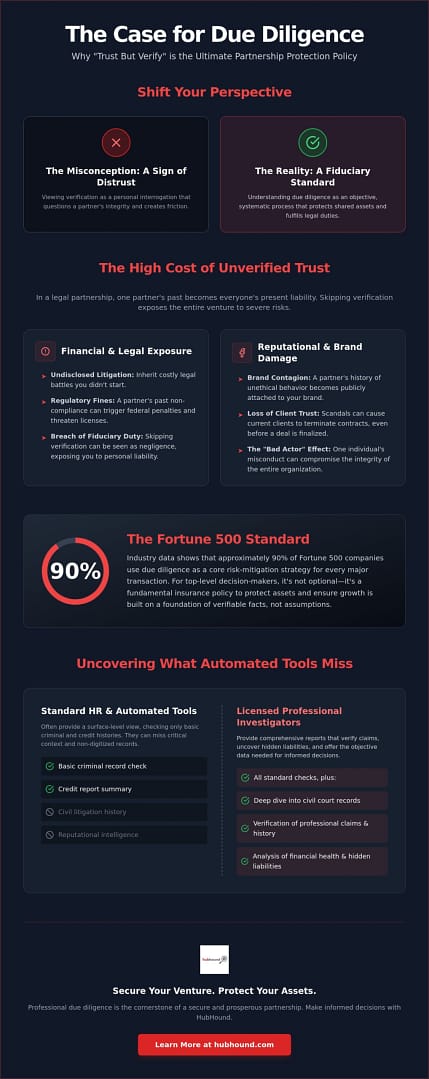
Skipping verification creates a cascade of risks that can dismantle years of hard work. When you’re convincing my business partner we need due diligence, focus on the reality of shared liability. A partner’s past isn’t just their history; in a legal partnership, it becomes your present. Undisclosed litigation or regulatory non-compliance can trigger federal fines that threaten your operational licenses. One individual with a history of misconduct can compromise the entire organization. This “Bad Actor” effect often necessitates internal workplace investigations to root out systemic issues, costing the firm time and capital. These investigations are not just internal HR matters; they’re often the first step in a larger legal defense strategy.
Reputational Damage and Brand Contagion
Your brand’s value is tied to the perceived integrity of its leadership. If a partner has a history of unethical behavior, that reputation attaches to you the moment the partnership is publicized. It’s nearly impossible to “unring the bell” once the market associates your firm with a scandal. Government resources emphasize that you must evaluate a potential buyer or foreign partner with extreme care to avoid these associations. For example, a mid-market merger in 2025 collapsed entirely when a post-announcement discovery revealed a partner’s previous involvement in a fraud settlement. The resulting brand contagion led current clients to terminate contracts before the deal even finalized. This loss of client trust often precedes a total loss of market share.
Financial and Asset Vulnerability
Financial skeletons are rarely found in self-reported balance sheets. Undisclosed liens or significant personal debt can severely limit your company’s ability to secure future business loans. If a partner is under investigation for tax issues, co-mingling your assets with theirs puts your own capital at risk of seizure or freezing. Rigorous asset verification is a prerequisite for any capital-heavy partnership. You need to know if the resources being brought to the table are actually unencumbered. Utilizing professional corporate due diligence ensures you aren’t inheriting another person’s financial crisis. This level of scrutiny protects the company’s borrowing power and long-term solvency. Comprehensive screening identifies these vulnerabilities before they can impact your bottom line.
Reframing the Conversation: Due Diligence as Professional Insurance
Reframing the conversation starts by shifting the perception of investigations from an interrogation to a form of professional insurance. Think of it like a building inspection. You wouldn’t close on a commercial property without verifying the foundation’s integrity. Similarly, you wouldn’t purchase a high-end vehicle without a pre-purchase check. When you’re convincing my business partner we need due diligence, explain that these investigations are “deal-enablers.” They provide the clarity needed to move forward with confidence rather than serving as “deal-killers” or roadblocks. A clean report doesn’t just satisfy curiosity; it solidifies the relationship by removing doubt and establishing a baseline of transparency. Professional investigations provide a “clean bill of health” that simplifies future negotiations with banks, insurance providers, and vendors. Utilizing a neutral, third-party investigative agency like HubHound ensures that the facts are delivered objectively. This removes personal bias from the equation and allows both parties to focus on verified data rather than subjective impressions or personality-based assumptions.
Professional verification acts as a strategic buffer. It allows you to ask the difficult questions through a standardized process rather than a direct confrontation. When a third party handles the data collection, it preserves the interpersonal chemistry necessary for a successful partnership. You aren’t the one digging into their past; the process is simply following a set of objective criteria. Convincing my business partner we need due diligence is much simpler when you emphasize that the agency is the one doing the heavy lifting. This separation of the person from the process is vital for maintaining long-term rapport. It ensures that any “skeletons” are identified by a neutral report rather than discovered during a heated board meeting later. This proactive approach shows you value the partnership enough to protect it from external shocks.
The “Blame the Standard” Strategy
Externalize the decision by framing the investigation as a non-negotiable part of the company’s onboarding checklist. Mention that external stakeholders, such as investors or commercial lenders, will require this data before releasing capital. By making it a standard requirement for all high-value associations, you remove the personal sting from the request. It becomes a routine administrative step rather than a targeted inquiry, positioning you as a diligent steward of company governance.
Emphasizing Mutual Protection
Focus on how this process protects your partner’s investment. An undisclosed liability on either side could bankrupt the shared venture. Framing the investigation as a way to “onboard with confidence” shifts the focus to long-term stability. There is significant psychological relief in knowing that the “worst-case scenario” has been professionally ruled out. This mutual transparency fosters a culture of accountability, ensuring the partnership is built on a foundation of reality.
A Step-by-Step Script for Discussing Investigative Needs with Your Partner
Success in convincing my business partner we need due diligence depends heavily on timing and framing. Avoid raising the subject during the high-pressure final stages of a deal negotiation. Instead, choose a neutral setting where you can discuss operational standards without the distraction of immediate deadlines. Start the conversation with a positive affirmation of the partnership’s potential. By leadings with the value you see in the collaboration, you establish that the request for verification is a strategy for long-term protection rather than a sign of suspicion.
Handling Common Objections
Partners often suggest that a simple web search is sufficient. You must explain the limitations of public search engines compared to professional databases. While a search engine might show recent news, professional investigators access proprietary records, civil litigation history, and undisclosed liens that are not indexed online. If the objection is cost, frame the expense as a fraction of the total deal value. Industry data shows that due diligence typically represents between 0.2% and 4% of the total transaction value; a small price to pay to avoid a catastrophic financial error. Finally, if they worry about optics, clarify that professional firms conduct discreet, non-intrusive inquiries that do not alert third parties or damage professional standing.
The “What If” Framework
Use hypothetical scenarios to highlight the value of certainty. Ask your partner: “What if we find out six months from now that there was a major undisclosed tax lien we could have identified today?” This shift in perspective focuses on the consequences of inaction. Use this sample three-sentence script to initiate the discussion: “I am fully committed to this partnership and want to ensure we build it on the strongest possible foundation. To protect our shared assets, I suggest we follow a standard risk assessment protocol used for all high-value ventures. Let’s engage a professional firm to handle the verification so we can move forward with total confidence.”
Ready to establish a baseline of transparency for your next deal? Secure your partnership by requesting a comprehensive corporate due diligence report today.
How Professional Investigators Streamline the Verification Process
Relying on basic HR software or automated background checks often provides a false sense of security. While these tools identify surface-level criminal records, they lack the depth required for complex corporate partnerships. Licensed investigators go beyond the surface to identify non-indexed civil litigation, undisclosed business interests, and patterns of professional misconduct. When convincing my business partner we need due diligence, highlight that professional expertise is the only way to locate hidden liabilities that automated systems miss. These investigators utilize proprietary databases and field intelligence to verify the legitimacy of stated assets and professional credentials.
Professional investigators operate with a level of precision that standard digital tools cannot replicate. They utilize techniques such as surveillance operations and skip tracing to verify the physical and financial reality of a potential partner’s claims. This deep-dive approach is critical for identifying “ghost assets” or undisclosed legal entanglements that could compromise your firm’s standing. By integrating these specialized services, you transform the verification process from a simple check into a rigorous validation of the entire business ecosystem. This data isn’t just for peace of mind; it’s a foundational record that protects the firm if a partnership later dissolves or faces regulatory scrutiny.
Discretion and Professionalism
Maintaining the integrity of the relationship is a primary concern for business owners. Professional investigative firms conduct inquiries with extreme discretion to ensure the subject remains unaware of the specific screening process. This avoids the awkwardness of a perceived lack of trust or personal paranoia. These firms follow strict ethical standards and legal boundaries, ensuring that all data collected is “court-ready.” If a dispute arises in the future, having a professionally prepared, legally obtained report is an invaluable asset for civil litigation support. It provides an objective baseline of facts that can be used to resolve conflicts without relying on hearsay or memory.
Finalizing the Decision
Once the investigation is complete, present the final report to your partner as a joint tool for strategic planning. Use the data to negotiate better terms, adjust equity splits, or move forward with total confidence. If the report is clean, it validates your decision to partner; if it reveals risks, it gives you the leverage to address them before capital is committed. Convincing my business partner we need due diligence is the first step toward a more secure and transparent future. Contact HubHound for a confidential consultation on your corporate due diligence needs and ensure your assets are protected by expert oversight.
Secure Your Partnership for Long-Term Growth
Professional verification is more than a safety measure; it’s a strategic asset that enables confident decision-making. By reframing the conversation as a fiduciary standard rather than a personal inquiry, you establish a culture of transparency and mutual protection. Convincing my business partner we need due diligence becomes a straightforward task when you focus on the shared goal of safeguarding the company’s future against undisclosed liabilities and reputational risks.
HubHound provides the specialized expertise necessary to uncover the facts that standard software often misses. With over 30 years of industry experience, our licensed investigators offer discreet, nationwide capabilities and deliver comprehensive, court-ready reporting. This level of professional oversight ensures that your business assets remain secure and your legal obligations are fully met. Protect your interests with HubHound’s corporate due diligence services. Building your venture on a foundation of verified data is the most effective way to ensure sustainable success.
Frequently Asked Questions
Is it legal to conduct due diligence on a potential business partner?
It is entirely legal to conduct due diligence, provided the investigation complies with federal and state privacy laws. Most commercial agreements include provisions for this level of scrutiny as part of a standard vetting process. Performing these checks is often considered a fulfillment of your fiduciary duty to protect the company’s interests and assets from foreseeable risks.
How much does professional corporate due diligence typically cost?
The cost of a professional investigation varies based on the depth of the search and the complexity of the entity being reviewed. Factors such as the number of jurisdictions involved, the volume of litigation records, and the necessity of asset verification will influence the final fee. Most firms view this as a necessary operational expense that serves as a hedge against catastrophic financial loss.
Will the other party know that I am conducting a background check on them?
Many investigative techniques utilize public and proprietary records that do not require the subject’s notification. This allows for a discreet assessment of a partner’s professional history and financial standing without causing interpersonal friction. However, specific types of reports regulated by consumer protection laws may require written consent, which professional investigators will handle according to legal standards.
What is the difference between a standard background check and corporate due diligence?
A standard background check typically focuses on criminal history and basic employment verification. Corporate due diligence is a holistic process that includes civil litigation history, asset searches, and reputational analysis. This comprehensive approach is vital when convincing my business partner we need due diligence to ensure all commercial and financial risks are fully transparent before a deal is finalized.
How long does a professional due diligence investigation take?
Most professional investigations are completed within one to three weeks. The specific timeline depends on the complexity of the partner’s corporate structure and the speed of record retrieval from various courts or agencies. High-stakes transactions involving international assets or extensive histories may require additional time to ensure every data point is accurately verified and documented.
What happens if the due diligence report reveals a “red flag”?
Discovering a red flag gives you the opportunity to mitigate risk before it impacts the business. You can use the findings to negotiate more protective contract terms, request specific financial disclosures, or walk away from a potentially damaging deal. Factual data allows you to make these decisions based on objective evidence rather than personal feelings or assumptions.
Can due diligence protect me from my partner’s personal legal issues?
Yes, due diligence identifies personal legal liabilities like tax liens or judgments that could jeopardize the company’s credit or reputation. Uncovering these issues early is a critical component of convincing my business partner we need due diligence for the safety of the venture. This transparency allows you to structure the partnership to insulate the business from a partner’s individual financial or legal burdens.
Do I need my partner’s consent to run a professional investigation on a third party?
You generally don’t need consent to perform an investigation using public records or proprietary investigative databases. Accessing certain protected data, such as credit reports or private financial statements, does require specific legal authorizations. Professional investigative firms ensure that all inquiries are conducted within legal boundaries, maintaining the integrity of the data while protecting your professional standing.

Article by
Joel R. Manley | President | Hubhound Investigations | OR PI-ID#: 90432 | 111 SW Fifth Avenue, Suite 3150 Portland, Oregon 97204 | 971-442-8170
Joel is licensed as a private investigator in Oregon and Tennessee. Joel started his career in 1987 serving as a Military Police Officer and Military Police Investigator.
After ending his military tour of duty, Joel became a civilian Police Officer and Deputy Sheriff. Joel took his strong background in Hostage Negotiations, Mediation and Conflict Resolution, with him to patrol some of the highest crime areas in SE Portland.
Joel was awarded Deputy of the Year for his efforts and for drastically reducing the crime rate in the area he patrolled. As a Deputy Sheriff, Joel assisted in leading a Neighborhood Livability Program that was nationally recognized for having the most innovative and progressive approach to policing.
In 2018, Joel retired as a Deputy Sheriff and founded Hubhound Investigations. Joel played an integral role in Hubhound Investigations receiving an A+ Accredited Business rating from the Better Business Bureau (BBB).
In his off time, Joel enjoys spending time with his wife, adult children and Hubhound’s Happiness Ambassador, Nya. Joel also enjoys Scuba Diving and Kayaking.
Disclaimer
DISCLAIMER: This article is provided for general informational and educational purposes only. It is not intended to constitute legal advice, professional investigative advice, or instruction to engage in any unlawful activity. Laws governing private investigations, surveillance, recording, tracking, access to information, evidence collection, privacy, trespass, licensing, and related investigative activities vary by jurisdiction and are subject to change.
Any investigative techniques, tactics, procedures, scenarios, or legal proceedings discussed in this article are presented for informational purposes and should not be interpreted as authorization or encouragement to use a particular method. Private investigators and members of the public are responsible for understanding and complying with all applicable federal, state, and local laws, licensing requirements, court rules, and professional standards.
The circumstances of every investigation and legal matter are different. Information contained in this article should not be relied upon as a substitute for advice from a qualified attorney or other appropriate licensed professional regarding a specific situation. No attorney-client, investigator-client, or other professional relationship is created by reading or using this information.