
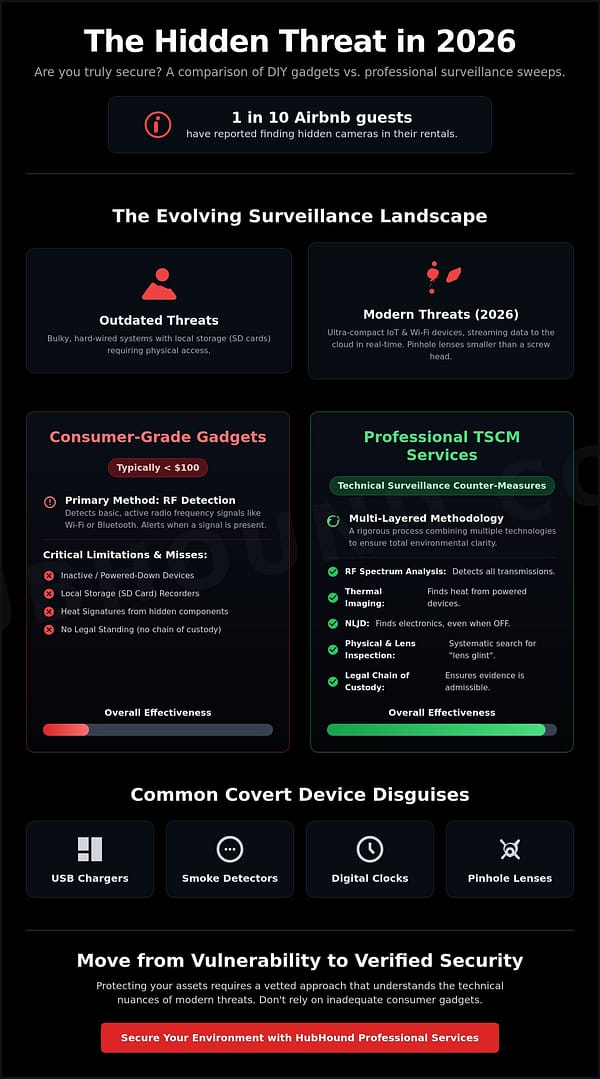
Reports in early 2026 indicate that 1 in 10 Airbnb guests have found hidden cameras in their rental properties; meanwhile, law enforcement agencies reported a 47% increase in surveillance-related criminal complaints between 2020 and 2025. You likely feel that your privacy is a non-negotiable asset, yet the fear of corporate espionage or personal violation remains a valid concern. When standard security measures fail, professional hidden camera investigation services provide the technical expertise needed to reclaim your space and verify your environment is secure.
You deserve to know exactly how investigators identify illicit devices and why a $50 store-bought detector can’t compete with professional-grade RF, infrared, and magnetic field tools. This guide details the specialized detection process and compares current 2026 technology, such as AI-integrated detectors, against entry-level alternatives. You’ll also learn the critical legal steps to take if a device is found, ensuring you move from a state of vulnerability to one of verified security. We’ve curated this technical overview to help you differentiate between basic sweeps and high-level privacy optimization.
Key Takeaways
- Recognize how modern surveillance has shifted from wired systems to ultra-compact IoT and Wi-Fi devices that require specialized detection methods.
- Learn why professional hidden camera investigation services employ a multi-layered approach to identify sophisticated electronic threats beyond simple radio signals.
- Differentiate between low-cost consumer gadgets and professional thermal imaging tools; these specialized devices pinpoint heat signatures from hidden components that RF detectors miss.
- Understand the legal frameworks of privacy protection and the investigator’s role in securing a chain of custody for discovered devices.
- Access a curated roadmap for securing your environment using vetted, high-quality investigative strategies designed for maximum privacy protection.
Understanding the Modern Threat of Illicit Surveillance
Privacy is no longer a passive state; it’s a target. Professional hidden camera investigation services have evolved into a specialized field known as Technical Surveillance Counter-Measures (TSCM). This discipline involves the rigorous detection of electronic “bugs” and illicit surveillance devices that compromise sensitive environments. TSCM is the professional discipline of detecting electronic “bugs” and illicit surveillance. The threat landscape has shifted dramatically since 2020. We’ve moved away from bulky, hard-wired systems toward ultra-compact IoT and Wi-Fi-enabled devices that are nearly impossible to spot with the naked eye.
The motives behind these breaches are diverse but consistently damaging. Corporate espionage remains a primary driver, with competitors seeking proprietary data or trade secrets. Workplace misconduct, such as unauthorized monitoring of staff, also fuels the demand for illicit tech. Additionally, domestic litigation often involves the use of covert recording to gain an edge in legal proceedings. Because these devices are now available for less than $100 on major e-commerce platforms, the barrier to entry for bad actors has vanished. Protecting your assets requires a vetted approach that understands the technical nuances of these modern threats.
The Evolution of Covert Hardware
Miniaturization has redefined what’s possible in covert recording. Pinhole technology allows lenses to be smaller than the head of a screw, making them virtually invisible when embedded in textured surfaces. Modern hardware is hand-picked by bad actors for its ability to blend in. You’ll find these cameras disguised as standard smoke detectors, USB wall chargers, or even digital clocks. The most significant shift in 2026 is the transition from local storage to real-time cloud streaming. An SD card requires physical retrieval; a Wi-Fi-enabled device transmits data instantly to a remote server, making immediate detection a necessity.
Why Privacy Protection is a Nationwide Priority
Illicit surveillance is a nationwide risk that ignores geographic boundaries. The accessibility of high-tech spy gear to non-professionals means that any office or boardroom can be compromised. This trend threatens organizational integrity and the safety of high-level executives. Companies often utilize workplace investigations to identify internal threats before they escalate into full-scale data breaches. Protecting your environment requires a strategy that addresses both the technical and human elements of security. Relying on outdated methods leaves you vulnerable to modern, cloud-integrated threats.
The Technical Process: How Professionals Detect Hidden Threats
Professional hidden camera investigation services utilize a rigorous two-phase methodology to ensure total environmental clarity. This process begins by establishing a sterile environment, which involves deactivating known wireless devices to eliminate background noise. By isolating the area, investigators can detect even the faintest signals from illicit hardware. While many people look for basic methods for detecting hidden cameras, professional sweeps go far beyond simple visual checks. They incorporate thermal imaging to identify heat signatures. Even a miniaturized camera generates a thermal footprint, often appearing several degrees warmer than the surface it’s embedded in.
For more sophisticated threats, such as devices that are powered down or set to record locally, investigators use Non-Linear Junction Detectors (NLJD). This technology emits a signal that reflects off the semiconductor junctions found in all modern electronics. It allows a specialist to find a “bug” hidden deep inside a sofa or behind drywall, even if the device is currently inactive. This multi-layered approach ensures that no piece of hardware remains undetected, regardless of its power state or transmission frequency.
Physical Inspection and Lens Detection
The physical phase is a systematic, inch-by-inch search of the premises. Investigators use optical lens augmenters that emit specific light frequencies to catch the “glint” of a camera lens. This glint is a physical property of the glass used in optics and cannot be hidden by software. Experts focus their search on high-probability zones, including:
- Electrical Infrastructure: Outlets, light switches, and power strips are common power sources for long-term surveillance.
- Structural Elements: Ceiling tiles, HVAC vents, and baseboards are inspected for recent modifications or unusual gaps.
- Everyday Objects: Clocks, mirrors, and decorative items are scrutinized for pinhole apertures or weight imbalances.
Electronic Spectrum Analysis
Electronic spectrum analysis provides a comprehensive map of the invisible data environment. Professionals use wide-band receivers to scan for unauthorized transmissions across a vast range of frequencies. They look for anomalous Wi-Fi signals, suspicious Bluetooth handshakes, and cellular bursts that indicate a camera is “calling home” to a remote server. By applying advanced surveillance techniques, investigators can pinpoint the exact origin of a rogue signal. This technical rigor is vital for maintaining the security of a modern workspace through hidden camera investigation services. You can compare vetted investigative solutions to find the right technical fit for your organization’s specific needs.
RF Detector Limitations: Why Consumer Gadgets Often Fail
Consumer-grade RF detectors are often marketed as a total solution for privacy, but their operational reality is far more limited. These devices typically function on broadband signal detection, meaning they alert the user to any radio frequency energy within a specific range. Because they lack the ability to filter or analyze the source, they are prone to high rates of false positives. A microwave, a Wi-Fi router, or even a smart thermostat can trigger a cheap detector, leading to confusion and wasted time. A basic RF detector cannot differentiate between a legitimate Wi-Fi signal and a spying device.
The most dangerous limitation involves the blind spots inherent in entry-level hardware. Modern illicit surveillance often utilizes burst-transmission technology, where data is compressed and sent in millisecond bursts to avoid detection. A $50 detector will likely miss these signals entirely. Additionally, encrypted or frequency-hopping devices can easily bypass the simple circuitry of consumer gadgets. Professional hidden camera investigation services utilize equipment that captures these anomalies in real-time, ensuring no transmission goes unnoticed. This technical gap is why professional intervention remains the gold standard for privacy protection.
Consumer vs. Professional Grade Equipment
Comparing a $50 Amazon detector to a $20,000 professional spectrum analyzer reveals a massive gap in technical capability. Professional tools offer a vastly wider frequency range and higher sensitivity, allowing specialists to detect low-power signals from across a room rather than having to be within inches of the source. However, the hardware is only half the battle. Vetted investigators possess the training required to interpret complex signal graphs and identify the specific signature of a covert transmitter. Experience allows a professional to distinguish between a neighbor’s Bluetooth speaker and a malicious bug.
The Danger of a False Sense of Security
Relying on a DIY sweep creates a dangerous false sense of security. If a consumer-grade tool fails to beep, a user might assume their environment is clear, potentially leaving sensitive data exposed for months. This is particularly true for passive cameras that record to internal storage without transmitting a signal; these are completely invisible to RF detectors. In high-stakes environments where intellectual property is at risk, partnering with a corporate investigation firm is the only way to ensure a comprehensive sweep. These firms use multi-layered strategies that combine electronic analysis with the physical and thermal inspections mentioned previously to find what cheap gadgets miss.
Legal and Ethical Frameworks for Surveillance Investigations
Finding a device is only half the battle; the other half is ensuring the discovery is handled within strict legal parameters. Hidden camera investigation services must operate under the “reasonable expectation of privacy” standard, a core legal principle applied nationwide. Under the Video Voyeurism Prevention Act of 2004, recording intimate areas without consent is a federal crime. If you find a device in a sensitive area, the situation transitions from a private concern to a potential criminal matter. Hiring a licensed professional ensures that every step taken, from detection to documentation, remains court-admissible. Unlicensed sweeps may compromise your ability to seek legal recourse later.
Navigating the line between security surveillance and illicit spying requires technical and legal nuance. For instance, landlords may monitor common hallways, but placing a camera inside a rental unit without consent is illegal in every state. Similarly, Airbnb’s April 2024 global ban on all indoor cameras has set a new standard for hospitality privacy. A professional investigator understands these distinctions and can identify when a security measure has crossed into a criminal privacy breach. This expertise is vital for maintaining the integrity of your case and ensuring that your response is proportional and legally sound.
Evidence Preservation and Documentation
If a device is identified, do not touch or remove it immediately. Fingerprints and DNA evidence are easily contaminated by well-meaning individuals. A professional investigator maintains a strict chain of custody, documenting the device’s exact location, orientation, and technical state through high-resolution photography and logs. This meticulous reporting is vital for civil litigation support cases where the victim seeks damages for privacy violations. Without a verified chain of custody, a defense attorney can easily argue that the evidence was planted or tampered with.
Reporting to Law Enforcement
Privacy breaches often cross into criminal territory, especially when audio recording is involved. As of late 2025, 11 states require all-party consent for audio, making unauthorized recording a felony in those jurisdictions. An investigator acts as a critical liaison, presenting a vetted evidence package to the authorities that includes technical specifications of the hardware found. This package includes professional witness statements that carry significant weight during grand jury or trial proceedings. If you suspect your privacy has been compromised, you should consult with a vetted investigative expert to ensure your rights are protected through every phase of the recovery process.
Securing Your Environment with HubHound Professional Services
HubHound serves as the specialized expert curator for organizations that prioritize absolute privacy. We eliminate the choice paralysis often felt by business owners by providing access to vetted investigative frameworks and hand-picked technical experts. Our approach to hidden camera investigation services focuses on high-grade technology and legal precision; this ensures your environment remains a secure ecosystem for sensitive operations. A professional, verified sweep offers more than just the removal of hardware. It provides the quiet confidence required to conduct high-stakes business without the threat of unauthorized surveillance.
True security requires looking beyond the immediate physical space. We integrate technical surveillance counter-measures with a broader corporate due diligence strategy to identify the root cause of potential leaks. This holistic view ensures that your organizational integrity is protected from both internal misconduct and external espionage. By utilizing optimization techniques for your privacy infrastructure, you move from a state of vulnerability to a position of specialized authority over your own data. We’ve done the heavy lifting of research to ensure your investigative partner is modern and reliable.
Comprehensive Privacy Audits
Effective privacy protection is an ongoing process rather than a one-time event. We recommend proactive privacy audits to identify structural and electronic vulnerabilities before bad actors can exploit them. The digital age demands constant vigilance as surveillance technology continues to miniaturize and integrate with cloud systems. A proactive stance allows you to harden your environment against emerging threats. This ensures that your security measures evolve as quickly as the tools used by adversaries. We help you transition from reactive troubleshooting to a reliable, long-term security posture that respects your professional time.
Next Steps: Booking a Confidential Consultation
Your path to a secure environment begins with a discreet conversation. It’s vital to follow strict security protocols when reaching out for assistance. Always contact us from a “clean” location outside the suspected area, using a device that hasn’t been compromised. This prevents potential eavesdroppers from learning about the investigation before it begins. You can Contact HubHound for a professional consultation to start the process of reclaiming your privacy. Our team is ready to guide you through the discovery process with the efficiency and transparency your growth-focused company deserves.
Secure Your Professional Environment Today
The evolution of surveillance technology into the cloud and IoT space means that basic visual checks are no longer sufficient for 2026. You now understand that professional hidden camera investigation services are the only reliable way to detect sophisticated threats like burst-transmitters and passive recording devices. By following a structured legal framework and maintaining a sterile environment, you protect your legal rights while securing your physical space. Relying on specialized technical sweeps ensures that no semiconductor or thermal signature goes unnoticed.
HubHound connects you with vetted and licensed investigative experts who possess decades of combined industry experience. Every sweep concludes with comprehensive, court-ready reporting designed to support your legal interests and provide a verified record of your security status. Don’t leave your organizational integrity to chance with consumer-grade tools that often trigger false positives or miss encrypted signals entirely. Protect your privacy with a professional HubHound investigation and gain the technical clarity needed to focus on your business growth. Your peace of mind is a manageable asset when you choose a verified path to environmental security.
Frequently Asked Questions
How much does a professional hidden camera sweep cost?
Standard hourly rates for private investigators performing these sweeps range from $75 to $150 per hour as of early 2026. If you require technical specialists for digital forensic analysis, expect to pay between $100 and $300+ per hour. Initial retainers typically fall between $500 and $2,000 for basic cases, while complex corporate investigations can require retainers up to $15,000 or more. These rates reflect the specialized equipment and vetted expertise required for a thorough inspection.
Can an RF detector find all types of hidden cameras?
No, a standard RF detector only identifies devices that are actively transmitting radio signals. It’ll miss “passive” cameras that record to internal storage or devices using burst-transmission technology to avoid detection. Professional hidden camera investigation services utilize Non-Linear Junction Detectors and thermal imaging to find electronics even if they’re powered down. Relying on a $50 consumer gadget provides a false sense of security in a high-stakes environment.
Is it legal for a private investigator to remove a hidden camera?
Investigators generally shouldn’t remove a device once it’s found to ensure the chain of custody remains intact for legal proceedings. Instead, the professional documents the discovery with high-resolution photography and technical logs to ensure the evidence is court-admissible. Law enforcement typically handles the actual removal to avoid claims of evidence tampering. This protocol is vital for clients who intend to pursue civil litigation or criminal charges after a breach.
What should I do if I find a hidden camera in my office?
Stop all sensitive conversations immediately and don’t touch the device. Contact a vetted investigator from a secure phone outside the suspected area to coordinate a professional sweep. Because surveillance-related criminal complaints increased by 47% between 2020 and 2025, it’s critical to follow a strict evidence preservation process. Touching the camera can smudge fingerprints or contaminate DNA evidence that authorities need to identify the perpetrator.
How long does a professional TSCM sweep take?
A standard TSCM sweep for a 1,500-square-foot office typically takes between 4 and 8 hours. The duration depends on the density of electronics and the complexity of the physical environment, such as HVAC vents and electrical infrastructure. Larger corporate boardrooms require more time for comprehensive spectrum analysis and thermal mapping. This rigorous process ensures that your professional ecosystem is completely sterile before you resume sensitive operations.
Can a cell phone app detect hidden cameras?
Most mobile apps are limited to detecting basic infrared light or scanning for known devices on a local Wi-Fi network. They lack the technical sensitivity to find passive cameras, frequency-hopping hardware, or devices hidden behind structural elements. While an app might catch a low-quality consumer “bug,” it won’t identify the sophisticated tech used in corporate espionage. Professional hidden camera investigation services use lab-grade analyzers that offer far greater precision than any smartphone sensor.
Does a hidden camera need Wi-Fi to work?
No, many illicit devices operate without a Wi-Fi connection by recording directly to an internal SD card or using cellular 5G networks to stream data. Some modern hardware uses Bluetooth or proprietary radio frequencies to bypass standard network security protocols. Relying solely on a network scan will miss these “offline” threats. A professional sweep includes physical and thermal inspections to find every device, regardless of how it transmits or stores data.
How often should a business conduct a bug sweep?
High-risk organizations should schedule professional sweeps quarterly or before major events like board meetings and merger negotiations. The global hidden camera detector market is projected to reach $7.9 billion by 2034, indicating that surveillance tech is becoming more accessible and advanced. Regular audits help maintain organizational integrity and ensure your privacy optimization remains effective against evolving threats. Proactive sweeps are always more cost-effective than reacting to a major data leak.

Article by
Joel R. Manley | President | Hubhound Investigations | OR PI-ID#: 90432 | 111 SW Fifth Avenue, Suite 3150 Portland, Oregon 97204 | 971-442-8170
Joel is licensed as a private investigator in Oregon and Tennessee. Joel started his career in 1987 serving as a Military Police Officer and Military Police Investigator.
After ending his military tour of duty, Joel became a civilian Police Officer and Deputy Sheriff. Joel took his strong background in Hostage Negotiations, Mediation and Conflict Resolution, with him to patrol some of the highest crime areas in SE Portland.
Joel was awarded Deputy of the Year for his efforts and for drastically reducing the crime rate in the area he patrolled. As a Deputy Sheriff, Joel assisted in leading a Neighborhood Livability Program that was nationally recognized for having the most innovative and progressive approach to policing.
In 2018, Joel retired as a Deputy Sheriff and founded Hubhound Investigations. Joel played an integral role in Hubhound Investigations receiving an A+ Accredited Business rating from the Better Business Bureau (BBB).
In his off time, Joel enjoys spending time with his wife, adult children and Hubhound’s Happiness Ambassador, Nya. Joel also enjoys Scuba Diving and Kayaking.
Disclaimer
DISCLAIMER: This article is provided for general informational and educational purposes only. It is not intended to constitute legal advice, professional investigative advice, or instruction to engage in any unlawful activity. Laws governing private investigations, surveillance, recording, tracking, access to information, evidence collection, privacy, trespass, licensing, and related investigative activities vary by jurisdiction and are subject to change.
Any investigative techniques, tactics, procedures, scenarios, or legal proceedings discussed in this article are presented for informational purposes and should not be interpreted as authorization or encouragement to use a particular method. Private investigators and members of the public are responsible for understanding and complying with all applicable federal, state, and local laws, licensing requirements, court rules, and professional standards.
The circumstances of every investigation and legal matter are different. Information contained in this article should not be relied upon as a substitute for advice from a qualified attorney or other appropriate licensed professional regarding a specific situation. No attorney-client, investigator-client, or other professional relationship is created by reading or using this information.