
What if the most critical piece of evidence in your case isn’t actually in the prosecution’s file? A police report is rarely the final word on a crime; it’s simply the starting point for the state’s narrative. When you’re facing incomplete documentation or missing witnesses, a professional criminal defense investigator becomes your most valuable strategic asset. These experts don’t just find facts. They build the foundation for reasonable doubt by looking where others haven’t, often utilizing advanced data analytics and discreet surveillance to uncover what was overlooked during the initial investigation.
It’s frustrating to work within tight legal deadlines while struggling with uncooperative sources or a lack of specialized technical expertise. You need more than just a summary of the existing file to protect your client’s interests effectively. This article demonstrates how a professional investigator identifies exculpatory evidence and verifies witness credibility to strengthen your overall legal strategy. We’ll examine the specific methods used to produce court-ready documentation and provide the tactical support necessary for a robust defense. From skip tracing key witnesses to analyzing complex digital forensics, learn how to leverage specialized expertise for better case outcomes.
Key Takeaways
- Understand how a criminal defense investigator identifies exculpatory evidence and challenges the prosecution’s narrative to build a foundation for reasonable doubt.
- Learn the systematic methods used to conduct professional witness interviews and independent fact-finding that uncover leads police might have missed.
- Analyze the limitations of law enforcement investigations and how an independent partner helps you avoid the risks of investigative tunnel vision.
- Discover how skip tracing and discreet surveillance operations provide the tactical support necessary to locate uncooperative witnesses and secure court-ready documentation.
- Establish a framework for selecting an investigative firm based on specialized expertise, reputation, and a commitment to rigorous quality assurance.
What is a Criminal Defense Investigator?
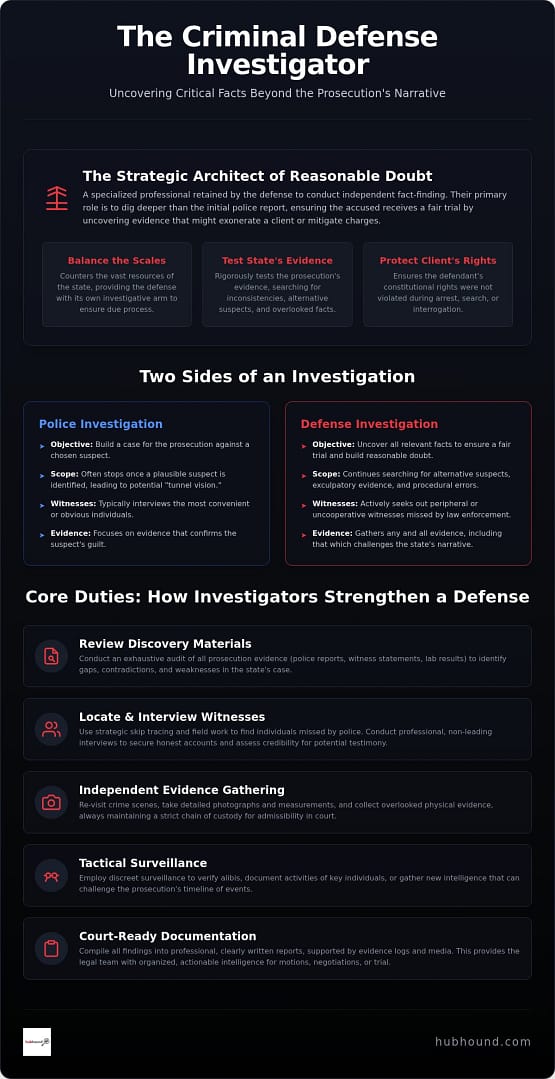
A criminal defense investigator is a specialized professional who operates as a critical extension of a legal team. Unlike law enforcement, whose primary objective is to build a case for the prosecution, this specialist focuses on gathering independent evidence to assist defense counsel. Their core objective is ensuring the defense has access to all facts, including those that the prosecution might have overlooked or deemed irrelevant. By maintaining an unbiased, professional perspective, they provide the objective analysis necessary to ensure that every piece of evidence is court-ready and legally sound.
While a general private investigator might handle a variety of civil or domestic matters, the criminal defense specialist works exclusively within the framework of criminal litigation. They are the strategic architects of reasonable doubt. They verify every detail of the state’s case while uncovering independent narratives that support the defendant’s side of the story. This role requires more than just curiosity; it demands a deep understanding of the legal landscape and the technical ability to challenge official reports. Efficient defense strategies depend on accurate data, and these professionals provide the raw intelligence needed to make informed legal decisions.
The Role in the American Justice System
The principle of being innocent until proven guilty is the bedrock of the justice system. A criminal defense investigator upholds this principle by actively seeking out the truth rather than just confirming a theory of guilt. They help balance the scales against state-funded prosecution resources. Federal data shows there are approximately 114,400 detectives and criminal investigators employed by the state, creating a massive resource imbalance for the average defendant. Private investigators bridge this gap by providing defense teams with similar investigative power. This collaborative relationship between the attorney and the investigator allows for a comprehensive strategy where no lead goes unexamined. It’s about ensuring the constitutional right to a fair trial by presenting a complete picture of the events in question, a process often utilized by a Boise DUI Attorney to challenge technical evidence.
Key Differences from Private Detectives
A high level of specialized knowledge regarding criminal law and procedure is required for this role. It’s not just about finding information; it’s about understanding due process and the admissibility of evidence. An investigator must ensure that every statement or physical item recovered can withstand the scrutiny of a criminal trial. They handle sensitive information with the highest standards of confidentiality, focusing on the specific legal nuances that a general detective might miss. General private detectives often focus on domestic surveillance or insurance fraud. In contrast, a criminal defense investigator must be adept at reviewing body cam footage, analyzing jail calls, and identifying inconsistencies in police reports. Their work is governed by strict legal standards to ensure that all findings remain viable for use in court proceedings.
Core Duties: How Investigators Strengthen a Defense Case
A professional National Investigative Training Academy trained criminal defense investigator operates with a rigorous, systematic methodology. They don’t just review the prosecution’s file; they deconstruct it. This involves meticulous crime scene photography and evidence preservation to ensure the original context of the incident isn’t lost. By capturing high-resolution imagery and physical data, investigators create an independent record that can be used to challenge official narratives or support expert testimony later in the trial. This independent fact-finding is essential for identifying gaps in the state’s logic.
Locating and Interviewing Witnesses
Police reports often miss bystander accounts or individuals who were present but uncooperative at the scene. Identifying these potential leads requires a systematic review of the area and surrounding digital footprints. Securing professional witness interviews & statements is about more than just taking notes. It’s an art that involves building rapport to extract honest, detailed accounts. Documenting witness credibility is essential. This includes identifying potential impeachment material, such as inconsistent prior statements or biases, which can be leveraged during cross-examination. These statements often provide the first real look at an alternative theory of the case.
Surveillance and Evidence Gathering
Modern defense work relies on a strategic synergy of techniques. For instance, combining surveillance techniques with real-time data analysis allows an investigator to verify or debunk prosecution claims regarding a witness’s movements. Discreet monitoring can reveal if a key state witness is associating with individuals that contradict their testimony. By using modern technology like high-definition optics and digital tracking, investigators gather high-quality, admissible evidence that provides a clearer picture of the facts. This tactical support ensures that the defense isn’t relying solely on the version of events provided by law enforcement.
Record Retrieval and Background Screening
Every prosecution witness has a history. Rigorous background screening identifies prior inconsistent conduct or underlying motivations for their testimony. Investigators retrieve medical, financial, or phone records that support the defense’s narrative, providing a data-driven foundation for reasonable doubt. This process often requires skip tracing and locate investigations to find individuals who have moved or are intentionally avoiding service. Finding these critical sources ensures the defense team has every tool available to challenge the state’s case. If you need to secure a reliable witness statement or locate a missing lead, utilizing specialized investigative services is often the deciding factor in building a successful legal strategy.
Private Investigation vs. Police Investigation: Uncovering the Full Narrative
Police investigations are often viewed as the definitive account of a crime. This is a dangerous misconception. Law enforcement officers work under immense pressure, and a nationwide workforce crisis in 2026 has left many departments struggling with recruitment and retention. This strain often leads to tunnel vision. Once a suspect is identified, investigators may subconsciously filter out information that doesn’t support a conviction. A criminal defense investigator provides the necessary counterbalance by approaching the case with the goal of comprehensive discovery rather than a predetermined outcome.
The prosecution’s goal is a conviction. The defense investigator’s goal is the truth. This requires re-interviewing every individual mentioned in the initial police report. Officers often take brief, high-pressure statements that miss critical nuances. A private specialist has the time to dig deeper, finding the inconsistencies that create reasonable doubt. They don’t just check the facts; they evaluate the context that law enforcement might have ignored. This process ensures the defense team isn’t relying on a one-sided narrative built by the state.
Identifying Gaps in the Prosecution’s Case
Finding what isn’t in the file is just as important as analyzing what is. Investigators meticulously review the discovery file to identify missing physical evidence or leads that were never pursued. They look for procedural errors or violations of rights during the arrest process that could lead to the suppression of evidence. For stagnant cases, a fresh set of eyes often uncovers technical details that were overlooked, providing a new path forward. This rigorous assessment identifies where the state’s narrative fails to meet the burden of proof.
Building the Defense’s Independent Narrative
A robust defense requires an independent narrative supported by affirmative evidence. This might include proving an alibi through digital footprints or identifying alternative suspects. If the alleged incident occurred in a professional setting, conducting specialized workplace investigations can uncover internal dynamics or corporate records that clarify the situation. This level of thoroughness gives the attorney the leverage needed for successful plea negotiations or a decisive trial presentation. A well-investigated case ensures the defense isn’t just reacting to the state’s claims but is actively driving the conversation with verified data.
Evaluating and Hiring a Professional Investigative Partner
Selecting a criminal defense investigator requires a rigorous assessment of their technical capabilities and professional standing. It’s a selective filtering process that prioritizes quality and compatibility over cost. Start by verifying proper licensing and insurance as a baseline for engagement. In most jurisdictions, professional investigators must be at least 21 years old, pass comprehensive state and FBI background checks, and secure a surety bond. These requirements ensure a level of accountability and professional conduct that is essential for handling sensitive legal matters. Don’t settle for a generalist when your strategy depends on specialized expertise.
A reliable partner must also understand the technical nuances of a corporate investigation if your case involves financial misconduct or professional environments. This specialized knowledge allows for a more targeted approach to evidence gathering. Establish clear communication and reporting structures from the outset. You need court-ready documentation that is delivered efficiently, reflecting a respect for your legal deadlines. Transparency in these operational details is a hallmark of a high-tier investigative firm.
Criteria for Selection
Prioritize firms with a proven track record in high-stakes criminal defense work. You need an ally who can handle complex tasks like skip tracing and cross-jurisdictional locates with precision. Evaluate their ability to offer a comprehensive suite of services, including process service and digital forensics. A partner that provides end to end support saves you the effort of coordinating multiple vendors. Look for evidence of their ability to uncover exculpatory data through advanced data analytics and modern surveillance technology. This technical proficiency is what separates a standard fact-finder from a strategic asset.
The Consultation Process
The initial strategy session is your opportunity to evaluate an investigator’s understanding of your specific legal challenges. A lead investigator should be able to articulate a clear plan for identifying gaps in the prosecution’s file and locating key witnesses. Discuss investigative timelines and fee structures openly to avoid future friction. While rates vary based on case complexity, a professional firm will provide a transparent framework for their services. This clarity allows you to make informed decisions without cognitive load. If you’re ready to strengthen your legal strategy with verified data, secure professional criminal defense investigations to begin the discovery process.
HubHound: Authoritative Support for Your Defense Team
HubHound serves as a specialized expert in a complex technical landscape. We provide authoritative support for defense teams through a nationwide network designed for speed and accuracy. Our commitment to rigorous validation ensures that every report meets the highest standards of quality assurance. When legal outcomes depend on verified data, you need an investigative partner that operates with precision and niche expertise. We don’t just gather information; we filter it for relevance and admissibility. This functional approach ensures you extract the necessary intelligence with minimal cognitive load, reflecting our respect for your professional time. We’re the premier choice for a criminal defense investigator when quality cannot be compromised.
Our role as an indispensable ally for defense teams is built on a foundation of reliability and transparency. We understand the nuances of the digital and physical evidence landscape. By leveraging our comprehensive suite of litigation support services, you gain access to a level of specialized authority that broader firms lack. We prioritize efficiency and clarity, moving your case seamlessly from a problem to a solution. Our investigators bring quiet confidence to the table, allowing you to focus on the legal arguments while we handle the heavy lifting of independent fact-finding.
Why Choose HubHound?
We act as a trusted curator of investigative solutions, doing the hard work of discovery so your defense is never caught off guard. Our team brings professional reliability to every case, ensuring that every lead is followed and every witness is vetted with the utmost care. We understand that evidence is only as good as its admissibility; therefore, we prioritize producing court-ready documentation that stands up to the most intense scrutiny. With over three decades of experience, we’ve refined the filtering process required to identify exculpatory facts and verify witness credibility effectively. Partnering with HubHound means choosing a firm that values niche expertise and fast-paced communication.
- Rigorous Validation: Every report undergoes a strict quality assurance process before it reaches your desk.
- Specialized Expertise: We focus specifically on criminal litigation support and corporate due diligence.
- Nationwide Reach: Our network allows for rapid deployment and cross-jurisdictional investigations.
Getting Started with HubHound
Engaging our services isn’t a complex hurdle. It’s a streamlined process designed for the modern professional who needs answers quickly. We encourage attorneys to integrate investigative support early in the case lifecycle to maximize the opportunity for discovery. This proactive approach allows for a more thorough review of police reports and a more effective search for missing witnesses. Waiting until the trial date approaches creates unnecessary risk for your client. Instead, use our directives to identify key leads and secure professional witness interviews immediately. Our skip tracing and locate investigations provide the tactical support necessary to build a robust defense from day one. To evaluate how our team can support your specific legal needs, secure a criminal defense investigator for a confidential consultation today. We’re ready to track down the highest quality solutions for your defense strategy.
Strengthening Your Case Through Independent Discovery
A successful legal strategy doesn’t rely on the state’s narrative alone. It requires a proactive approach that identifies gaps in police reports and uncovers leads that others have missed. By moving beyond the initial discovery file, you ensure that your client’s rights are protected through verified data and court-ready documentation. A professional criminal defense investigator acts as your strategic architect, identifying reasonable doubt where law enforcement may have developed tunnel vision. This independent verification is essential for balancing the scales of justice, a principle that the Law Office of Kevin Bessant & Associates prioritizes when building an aggressive defense against serious charges.
Leveraging specialized expertise in both criminal and corporate litigation support allows you to build a foundation of truth that stands up to scrutiny. HubHound provides access to licensed investigators with over 30 years of industry experience and comprehensive nationwide service coverage. Don’t leave the outcome of your case to chance when you can secure the tactical support necessary for a robust defense. It’s time to integrate high-quality investigative resources into your workflow for better case outcomes.
Secure Authoritative Investigative Support for Your Case at HubHound. Professional results start with a partner who understands the nuances of the technical and legal landscape. We’re ready to help you navigate your next investigation with confidence.
Frequently Asked Questions
What is the difference between a criminal defense investigator and a police detective?
The primary difference lies in the objective and the employer. A police detective works for the state to build a case for conviction, while a criminal defense investigator works for the defense team to uncover exculpatory evidence. One focuses on proving guilt; the other focuses on comprehensive discovery and factual accuracy for the defendant. This independent perspective helps counterbalance law enforcement’s potential tunnel vision during the initial stages of an arrest.
How much does it cost to hire a criminal defense investigator?
Investigative fees vary based on the complexity of the case and the specific services required, such as surveillance or digital forensics. Most professional firms utilize a retainer model for criminal matters, while specific tasks like process service may have flat rates. It’s best to consult directly with an investigative firm to evaluate a fee structure that aligns with your specific legal strategy and case requirements. Professional investigators provide transparent billing to ensure efficiency.
Can a defense investigator testify in court?
Yes, investigators frequently testify as expert or fact witnesses to authenticate evidence or statements they’ve gathered. Their testimony provides a professional record of witness interviews, crime scene observations, or the chain of custody for physical evidence. Having a licensed criminal defense investigator testify ensures that investigative findings are presented with the authority and credibility necessary to support your defense strategy. This documentation is a critical component of court-ready evidence.
When is the best time to hire an investigator for a criminal case?
Secure investigative support as early as possible in the case lifecycle. Early engagement allows for the preservation of fleeting evidence, such as surveillance footage or physical scene data, before it’s lost or altered. It also provides more time to conduct skip tracing for witnesses who may become uncooperative or move as the trial date approaches. Starting early gives your legal team a strategic advantage in identifying gaps in the prosecution’s file.
What kind of evidence can a private investigator legally obtain?
A licensed investigator can legally obtain information available through public records, witness interviews, and open-source intelligence. They also perform discreet surveillance in public spaces and retrieve digital footprints with proper legal authorization. All evidence must be gathered according to state and federal laws to ensure it remains admissible during trial proceedings. Professional investigators prioritize rigorous validation to ensure every piece of evidence stands up to scrutiny in a court of law.
How does skip tracing help in a criminal defense case?
Skip tracing is a technical process used to locate witnesses or individuals who are intentionally avoiding service or have relocated without notice. In criminal defense, finding a key witness who wasn’t interviewed by police can change the entire narrative of the case. This specialized search ensures that the defense team has access to every relevant voice, regardless of their current location. It’s a critical tool for overcoming the challenge of missing or uncooperative sources.
Is the information I share with a defense investigator confidential?
Information shared with an investigator working for your attorney is typically protected under the attorney-client privilege and the work-product doctrine. This ensures that the details of the defense’s investigation remain confidential and are not accessible to the prosecution. Maintaining this high standard of confidentiality is a baseline requirement for any professional investigative engagement. It allows the defense team to explore all leads without risking the disclosure of sensitive strategic information.

Article by
Joel R. Manley | President | Hubhound Investigations | OR PI-ID#: 90432 | 111 SW Fifth Avenue, Suite 3150 Portland, Oregon 97204 | 971-442-8170
Joel is licensed as a private investigator in Oregon and Tennessee. Joel started his career in 1987 serving as a Military Police Officer and Military Police Investigator.
After ending his military tour of duty, Joel became a civilian Police Officer and Deputy Sheriff. Joel took his strong background in Hostage Negotiations, Mediation and Conflict Resolution, with him to patrol some of the highest crime areas in SE Portland.
Joel was awarded Deputy of the Year for his efforts and for drastically reducing the crime rate in the area he patrolled. As a Deputy Sheriff, Joel assisted in leading a Neighborhood Livability Program that was nationally recognized for having the most innovative and progressive approach to policing.
In 2018, Joel retired as a Deputy Sheriff and founded Hubhound Investigations. Joel played an integral role in Hubhound Investigations receiving an A+ Accredited Business rating from the Better Business Bureau (BBB).
In his off time, Joel enjoys spending time with his wife, adult children and Hubhound’s Happiness Ambassador, Nya. Joel also enjoys Scuba Diving and Kayaking.
Disclaimer
DISCLAIMER: This article is provided for general informational and educational purposes only. It is not intended to constitute legal advice, professional investigative advice, or instruction to engage in any unlawful activity. Laws governing private investigations, surveillance, recording, tracking, access to information, evidence collection, privacy, trespass, licensing, and related investigative activities vary by jurisdiction and are subject to change.
Any investigative techniques, tactics, procedures, scenarios, or legal proceedings discussed in this article are presented for informational purposes and should not be interpreted as authorization or encouragement to use a particular method. Private investigators and members of the public are responsible for understanding and complying with all applicable federal, state, and local laws, licensing requirements, court rules, and professional standards.
The circumstances of every investigation and legal matter are different. Information contained in this article should not be relied upon as a substitute for advice from a qualified attorney or other appropriate licensed professional regarding a specific situation. No attorney-client, investigator-client, or other professional relationship is created by reading or using this information.